Review of The Gunslinger by Stephen King

*Introducing one of our new reviewers – Rob Z. While he waits for his first audiobooks to review for SFF Audio, we thought we’d tide you over with one of his favorite audiobook reviews.*
The Gunslinger (The Dark Tower #1) – revised and expanded ed.
By Stephen King; Read by George Guidall
Publisher: Penguin Audio, now available on Audible
Publication Date: 6 October 2003
7 hours, 24 minutes [UNABRIDGED]
Themes: / fantasy / parallel worlds /
Publisher summary:
Eerie, dreamlike, set in a world that is weirdly related to our own, The Gunslinger introduces Roland Deschain of Gilead, of In-World that was, as he pursues his enigmatic antagonist to the mountains that separate the desert from the Western Sea in the first volume of The Dark Tower series. Roland, the last gunslinger, is a solitary figure, perhaps accursed, who with a strange single-mindedness traverses an exhausted, almost timeless landscape of good and evil. The people he encounters are left behind, or worse, left dead. At a way station, however, he meets Jake, a boy from a particular time (1977) and a particular place (New York City), and soon the two are joined, khef, ka, and ka-tet. The mountains lie before them. So does the man in black and, somewhere far beyond…the Dark Tower.
The start of an epic journey. Or is it? The start I mean.
“The man in black fled across the desert, and the gunslinger followed.”
Why? To what purpose? How long has he been chasing him? Ah my friends, these are but a few of many questions.
The journey is the key, and here we throw our lot in with the Gunslinger as he speeds towards his goal. Will we ever reach it? One must continue the journey with Roland to find out. And so I have. Again.
I’ve lost track of how many times I’ve read this book. It’s probably my least favorite in the series, and yet it contains some of my favorite moments.
The glimpses into Roland’s childhood that are a large part of what makes Wizard and Glass one of my absolute favorite books are present in this book with much smaller doses. The story of Roland’s coming of age in particular is one I could listen to again and again (and so I have, say thankee-sai).
Another particular favorite of mine is Tull. It gives us a glimpse, and it just a glimpse of who the Gunslinger really is. It is here that Mr. King makes a revision in a scene I’m not sure I agree with. It’s not a “Han Shot First” re-write for me, but one I felt un-necessary that tries to offer some forgiveness for Roland’s actions.
That said. I love this book. The original book is actually a collection of 5 stories that were published in a magazine over the span of about 3 years. Mr. King revised the book in 2003.
For the most part, the revisions help to fill out the story and clear up some continuity issues that Mr. King hadn’t worked out when he first wrote them. You could maybe call it ret-con, but I really consider it more of clarification of detail that was lacking.
I’ve always wondered why so many people don’t like this book. My friend listened to it with his brother. He almost quit the series right there. His brother did. I’ve seen many people recommend skipping this book outright and coming back to it at the end. I suppose that would work, but the need for it is beyond my comprehension.
I thought maybe this re-read many years since my last around the time of the final 3 books release in the mid 2000s would shed some light on it. It did not.
Maybe it’s a sense of nostalgia. Maybe because I first read this book before many of the long sprawling epics I’ve tackled since. But their are certainly other books I enjoyed as a younger man that I no longer enjoy as an adult.
This book isn’t one of those. To me it offers you a glimpse and a promise of all that is to come. For that I must again say Thankee-sai to Mr. King.
I listened to the audible version of the revised edition of this book. The reader is George Guidall.
He was enjoyable enough, and his voice seems suited to the tale. I opted to do an audio-book re-’read’ of the series as my friend has been experiencing it for the first time and I find my memory of it lacking.
One of the things lost by doing the audio however is the artwork. I have 1-4 in trade paperback by Plume (with both the original text and updated version that this audiobook contains) and the original hard cover releases of 5-7. The Plume editions contain some, but not all of the artwork contained in the original hard cover releases.
Some may not welcome the art, as they prefer to let their own imaginations paint the pictures, but I’ve always been lacking in visual imagination so I welcome the inspiration to help my brain fill in the rest. I plan to make it a point to re-visit the art at some point as my re-read continues.
Review by Rob Zak.
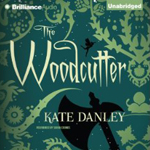
Recent Arrivals: The Woodcutter by Kate Danley


The Woodcutter
By Kate Danley; Performed by Sarah Coomes
Brilliance Audio
[UNABRIDGED] – 7 discs; 7 hours, 46 minutes
In her first foray into fiction, Kate Danley was awarded with the Garcia Prize and an Indie Book Award for The Woodcutter. The description makes it sound like it will slip right into our current fascination with fairy tales retold and retooled:
“Cinderella is dead and one of Odin’s hellhounds has gone rogue. The Woodcutter, protector of peace between the Twelve Kingdoms of Man and the Realm of Faerie, is charged with finding the beast and returning him to the Wild Hunt. Unfortunately, it seems the forces of evil have other plans. It is a race against time as the Woodcutter travels east of the sun and west of the moon, up beanstalks and down to the bowels of the earth to unravel a mystery that can only be described as Grimm.”
Posted by Jenny Colvin
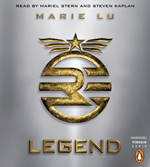
Review of Legend by Marie Lu

Legend
Written by Marie Lu; Read by Steven Kaplan & Mariel Stern
9 hours [UNABRIDGED]
Publisher: Penguin Audio
Published: November 2011
ISBN: 9781611760088
Themes: / dystopia / thriller / romance / YA /
A dystopian novel set in a future where The United States of America is a forgotten memory, Legend is part science fiction, part thriller, and part romance aimed at young adults.
The story is set sometime in the future in what is now California. The USA is apparently long-gone and instead, North America is divided into The Republic and The Colonies, which seem to be at odds. Generally it seems that The Republic is the western part of the US while The Colonies are the eastern part. From clues in the text, the reader is also lead to believe that The Colonies have more technology than does The Republic, at least in terms of weapons and possibly medicine. The reader doesn’t learn much else about The Colonies in this book, since the story is centered on two youth in The Republic. However, it is the first in a planned trilogy and it’s possible that future books will explore The Colonies more.
The Republic seems to be a militaristic state. The poor are looked down upon and the “rich” seem to be the ones running the police/militia. Through context clues, we find that nobody–not even the “rich”–are safe from government snooping. There is a plague that seems to mostly impact the poor; the rich get vaccines every year for protection. As a result of the plague, there are regular inspections and “plague checks” of those in the poor areas of town. There are also a lot of natural disasters. Hurricanes occur quite frequently, with co-commitant flooding. Earthquakes are also somewhat regular happenings. Most of this, though, forms the background for the main story.
The bulk of the story surrounds two youths, Dey and June, who are on opposite ends of the class spectrum. Relatively early, we learn that all youths have to go through “The Trials” at age 10. These trials affect ones position in society. Those who do well are allowed to go on to high school and a sort of college, to become leaders in politics and the military. Those who do average are given blue-collar jobs. Those who fail become wards of the state, destined to do menial tasks for their government. Dey failed his trials. June is the only one known to have aced them. Rather than be resigned to his fate, Dey has escaped from the government and spends his time as a bit of a loner, working to help the poor–in particular, his family–by stealing from the military/government. He’s particularly good at this and is actually the most wanted criminal in The Republic.
The story itself builds in a rather predictable fashion from there. Dey’s family is marked as one that gets the plague. Realizing this, Dey decides to steal the necessary antidote from the hospital. As he escapes, he ends up killing June’s brother, Metteaus. June, a top student in the militaristic school, is graduated early and put on the case to try to catch her brother’s killer. While trying to find the murderer, June goes undercover and ends up getting rescued from a fight by Dey. At this point, she doesn’t realize that Dey is who he is, and they strike up a sort of friendship. Eventually, June figures out Dey’s identity and aids in his capture by the police. However, having spent time with him, she has a hard time believing that Dey killed Metteaus. She ends up doing more investigation and learning many uncomfortable truths about The Republic and many of her long-held beliefs are called into question. I won’t spoil any more plot details here…
Legend is a fairly typical dystopian novel. It centers on an oppressed lower-class in society and a privileged upper class that mostly is kept in the dark about how the society works and what is really going on. As with many books like it, the protagonists (June and Dey) are resourceful and intelligent…and to some extent, rebellious. Lu doesn’t explain all of the mysteries in this book. At one point, a character calls “The United States” a legend of the past, and the reader isn’t told how society has gotten to the state its in. It seems reasonable, though, to assume that most of the society doesn’t know its own history, since they barely know the reality of the current state of affairs.
Fans of The Hunger Games will recognize key elements common to both books/series. That’s not necessarily a bad thing…while Legend is fairly predictable, it was still enjoyable enough. This is a science fiction novel aimed at the young adult crowd and isn’t particularly deep on ideas. Lu wraps themes common to the genre in a fast-paced plot. There’s nothing groundbreaking, but fans of the genre probably won’t mind. That said, I’m not sure I need to read the rest of the trilogy. It will be interesting to see where Lu takes it.
I listened to the audio version of this book. There were two narrators. The book is written from the viewpoints of Dey and June and alternates between these viewpoints. Mariel Stern read the parts from June’s point of view, Steven Kaplan read the parts for Dey’s. The reading was fine, though nothing particular stood out. Where some narrators do a bit of voice acting, trying to put more emotion into the voices and use different voices for each character, neither Stern nor Kaplan seemed to do that here; it was a more flat rather than dramatic reading. The only “excitement” in the narration came during the climax, where it seemed that Stern read more quickly, as if her reading speed was trying to keep pace with the story. The “flatness” of the reading doesn’t detract from the story, though. In fact, it can be far better than the alternative, as sometimes narration can be distracting if too much acting is done.
All in all, this wasn’t a bad book. Sure, it could have gone more deeply into the ideas instead of focusing so much on the plot…but that’s OK. Not every book needs to be deep. This one was decent and an enjoyable enough quick read. Young adults (and not-so-young adults) who enjoyed The Hunger Games will probably enjoy this one as well.
Review by terpkristin.