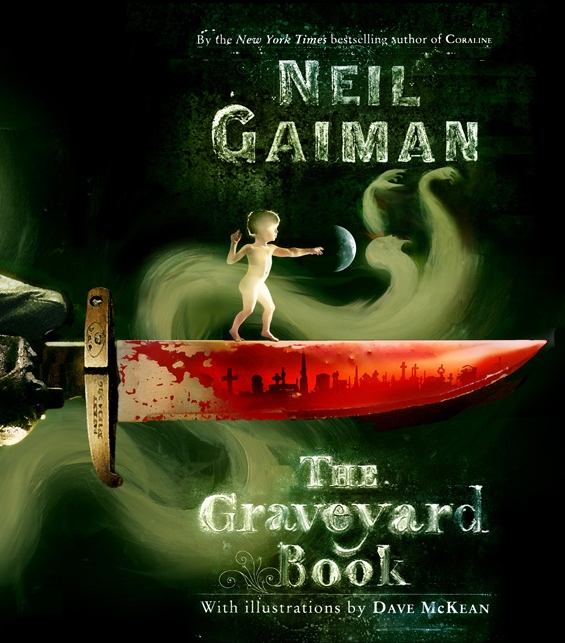
 The SFFaudio Podcast #517 – Jesse, Julie Davis, and Maissa Bessada talk about The Graveyard Book by Neil Gaiman
Talked about on today’s show:
2008, a children’s book, hardcover, a book for kids, better than most adult books, Neverwhere, Coraline, who hates Neil Gaiman?, Sandman, pictures slow it down, he didn’t feel competent, a genuine classic, character and sentences, crafting language, the wisdom of his prose, insights into basic human beings, you know its true, his evil characters, thinking about The Jungle Book, he started with chapter 4, MouseCircus.com,
“We were young, and very poor. The rooms I was renting above a shop were in a building tall and spindly and old. The kitchen and lounge were on one floor, a bedroom and my office and a bathroom on the next, and, at the top of the house, there was a big attic bedroom, and a low, long room in which an adult could barely stand up straight and in which there was a crib and a playpen. My son, Michael, who was two years old, loved his tricycle more than anything, but there was nowhere to ride it in the house, not without him tumbling down the stairs, so I would carry him and his tricycle across the narrow lane to the grounds of the local church, and he would pedal around to his heart’s content, and I would sit and read a book in the sunshine, and watch him, and look at the grey gravestones, names half-erased by time, and marvel at how comfortable a child looks in a graveyard. That was where it started. I’ll call it The Graveyard Book, I thought. Like Rudyard Kipling’s The Jungle Book.”
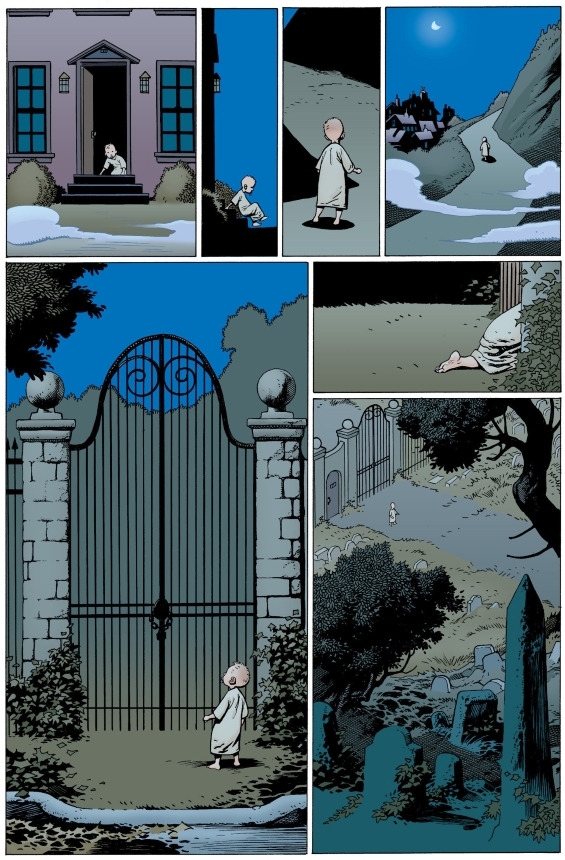
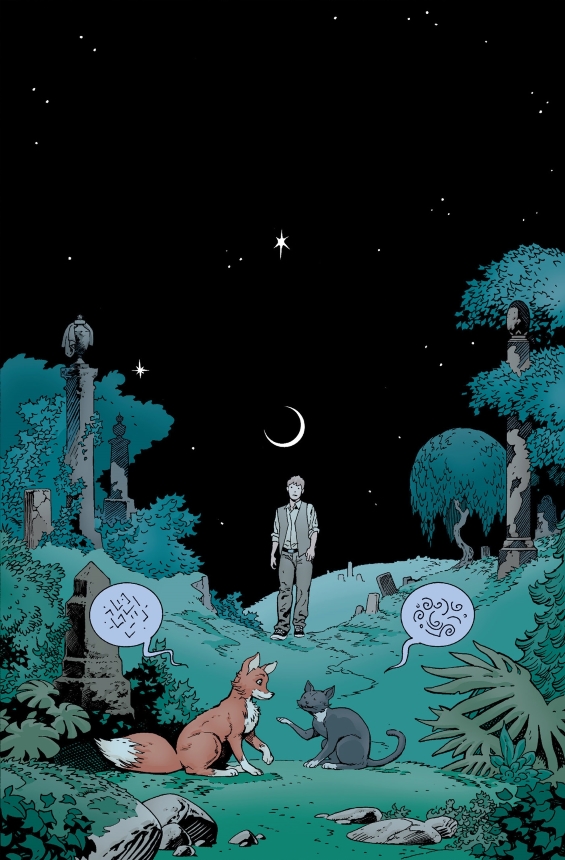
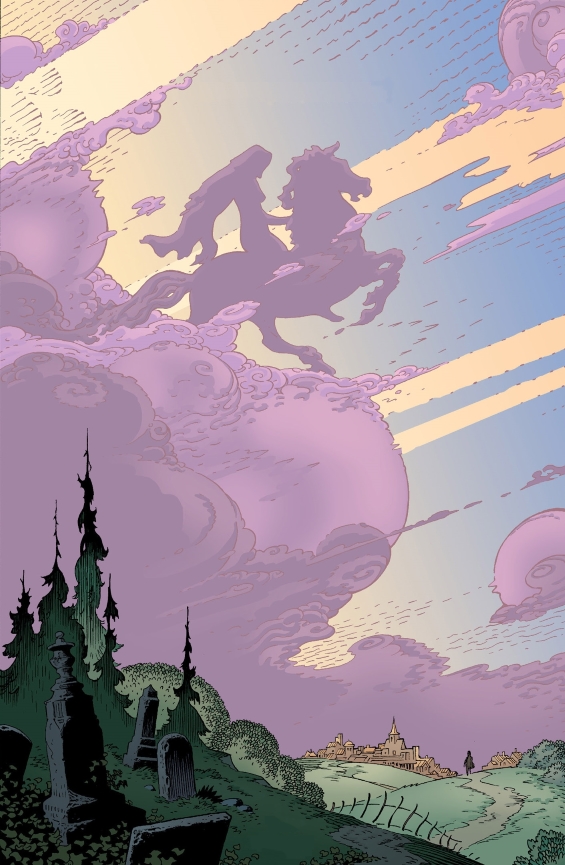
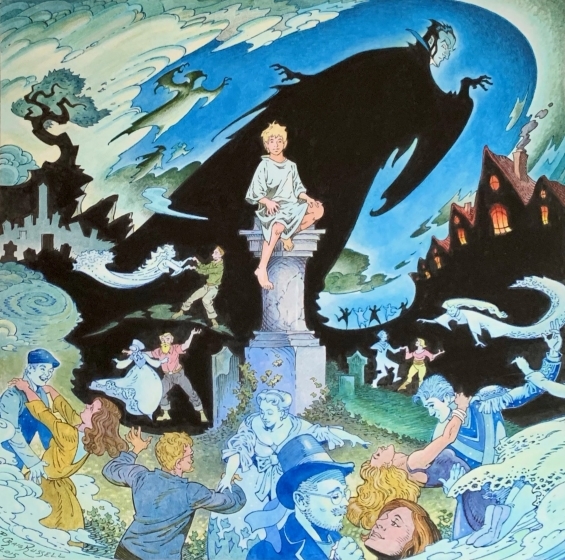
listening to it, ghoulheim, there it is!, the monkey scene with Mowgli, Silas is Bagheera and Ms. Lupescu is Baloo, the tribute to Lovecraft, The Dream-Quest of Unknown Kadath, the rubberfaced night gaunts, something Lovecraft dreamt as child, they became his friends, they tickle you, creepy and wonderful, chew off any meat left on the bones, tip-up the lead-lined coffin and all the juices, when the angles were wrong, a city built to be abandoned, just as odd, to find the equivalent, King Louis, the Emperor Of China, the 33rd President of the United States, Harry S. Truman is a ghoul, the full cast version, recorded in a Minnesota radio station, so fantastic a narrator, no better author narrator, Gaiman’s reading of Coraline, Scott Danielson, a boy story and a girl story, The New Mother by Lucy Clifford, Heather Ordover, the CraftLit podcast, very insightful, The Count Of Monte Cristo, a man and woman in a box, glass eyes and a wooden tail, the cycle repeats three times, never naughty enough, live on berries, worse than the Other Mother, children in Hell, where Coraline came from, no redemption, no mercy, fairy-tale-like, very Neverwhere-ish, has he ever written a book that isn’t about gods, regular Neil Gaiman stuff, the Endless, is there a god in this book?, who is the grey lady on the grey mare?, she’s Death, the sickle and the hood, The Old Gray Mare, she ain’t what she used to be, the Hounds of God, Romanian soup, boiled cabbage is kinda a good, eating Twinkies, Mr Lupescu by Anthony Boucher, Mr Jim Moon’s Hypnogoria (Hypnobobs) podcast, Neil Gaiman’s breadth of reading, Mr Jesse, macabre (macabray), imaginary friends, Thus I Refute Beelzy by John Collier, Scarlet has an imaginary friend, Scarlet’s story is a mini-version of this story, a kid romance, the angry teenager, play houses, meany, totally girl, so cute, very brave, going into the dark, five years old, before Julie was 3, barely remember yesterday, summer used to last several years, the perception of time, how you could get bored really easily, the world is so boring, tapped into the youth, the Sandman series, the conference of the Jacks, serial killer convention, where is Silas going?, he’s like Gandalf, standard mean horrible character, time-traveling hit-men, Connie Willis, the characters that work, there’s the deepness, Jack Frost is Shere Khan, fresh, very fresh, quite refreshing, the comic book adaptation, some of the art in here, Jill Thompson, P. Craig Russell, Galen Showman, the scale is bigger, the horizon is bigger, the ghouls, comic gross humans, monkey creepy horrible awful, the sleer, Gaiman gives you the outline and then you fill it in, the Indigo Man, the broach, the graveyard, the antique shop, super complementary, look how Silas dominates the room, there’s never a haircut scene, so intriguing, why does he hang out in this graveyard, knowledge of the prophecy?, the whole plot is way less important, why is the Danse Macabre in this?, Death is so beautiful, living forever, the living with the dead, each to each, names aren’t really important, find his name, one day everybody does, how come death’s so cool?, really smart, what’s true and what do we need to remember, the dead should have charity, Elizabeth Hempstock, Toomai of the Elephants, referential, winter flowers, we’ve crossed worlds, within generations enough, the other book that was homework, A Fine And Private Place by Peter S. Beagle, Beagle’s narration, ended up perfect, brought to life, ride that raven, they are both stories about a human living in a graveyard and they are fantasies, very gentle and slow, it could have been a little bit shorter, he made his case for all the relationships, overcoming fears, only 19 when he wrote it, mature, living a fantasy world life, a raven, taking some inspiration from Edgar Allan Poe’s The Raven, Ezekiel in the desert, a loose connection, the raven is what kept him there, psychopomp, a real personality, a ride in a back of a truck with a squirrel, set somewhere in England, so rich, find some weird house, adventures in her back yard, fully realized, how stiking is it that 10 year old kids and adults can enjoy it and not be lost, Coraline is not as amazing as this book, aimed at the children’s market, 188 pages for $10 US, images conjured by the book, no description of the lines on his face, the relationship has to Bod (she’s not going to eat him), it takes a (graveyard) village, out of time, his parents are almost the least interesting characters in the book, the poet who punished all his enemies by refusing to write his poems for the public, from my cold dead hand, kinda like Scrooge, some Lord Of The Rings stuff, the broach the knife and the cup, the Sleer is awesome, Elidor by Alan Garner, a family of jerks, William Shakespeare’s King Lear, a sword, a spear, a bowl, and an anvil, escaping into a fantasy world while you’re a kid, The Lion, The Witch And The Wardrobe, weaving in true history, he liked the roads, Celtic mythology, the ring connection, the barrow wights from The Fellowship Of The Ring, Jesse’s Roof Bear calendar, there has to be rules behind stuff to make it interesting, Roof Bear can’t leave the roof, Ghost Horse is waiting for his master to return, lifting from the Sleer?, children’s adventures, Sherlock Holmes and Doctor Watson, fun stuff for kids (and for Jesse), remembering the sort of fun you had as a kid, we don’t get to play house anymore, the pretend has a lot of value, mud pies, hanging out in childhood, beautiful, children and grandchildren, so Christmas becomes magic again, that acknowledgement, Bod’s getting too old, talking to Mother Slaughter, you’re always you and that don’t change, truth, I’m still me, that double memory, one of those profound things, LEGO robotics on Apple II computers (LEGO Logo), you really do loose something, its impossible, something you loose and yet retain the memory of it, Locke & Key: Welcome To Lovecraft by Joe Hill and illustrated by Gabriel Rodríguez, the head key, take out memories, the gender key, you forget, exploring a big old house, a menace, it works in the same way, brilliant and well worth reading, The Stepford Wives by Ira Levin, This Perfect Day by Ira Levin, 1984 by George Orwell, “Christ, Marx, Wood, and Wei”, very 1984, The Giver by Lois Lowry, a remake, the witch chapter, time in libraries, what forms your imagination, what tempts Bod is an apple, wish I’d left…, the groundskeeper’s pile of grass, she’s just a girl (who was murdered), “then I did my death curse”, when Bod falls out of his crib, a pile of plush toys, a nice doubling, do this kind thing, sends him out into danger, all the influences, nothing is forced, the mechanisms of writing, a six sentence story, all unconscious, it feels very natural, I want the magic, it takes him years and years, Tolkien: there were all these Catholic things in there, a good book, a good movie, what Neil Gaiman can do, just crafting your work, a lot of it is unconscious, an apple orchard, seeing things evolving, re-reading is not Jesse’s thing, when you run out you have to go back, re-watching, all these little things, Julie’s project, have they earned my shelf space?, deep in our cultural unconscious, 43 Bollywood movies last year, legal/police/moral situations, western culture branched-off, vengeance is looked at very differently, cultural thinking, shocked and taken-aback, northern Europe is full of apple trees, a ghost outside, Good book, what’s Ace barking at?, thought-yells, a Man Jack in the yard, a fun read.

Posted by Jesse Willis









 Reading, Short And Deep #044