Review of World War Z by Max Brooks


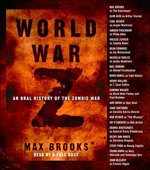
World War Z
By Max Brooks; Read by Full Cast
Publisher: Random House Audio
Published: September 12, 2006
ISBN: 0739340131
[ABRIDGED] 5 discs – 6 hours
Themes: / post-apocalypse / zombies / military / oral history /
Publisher summary:
The Zombie War came unthinkably close to eradicating humanity. Max Brooks, driven by the urgency of preserving the acid-etched first-hand experiences of the survivors from those apocalyptic years, traveled across the United States of America and throughout the world, from decimated cities that once teemed with upwards of thirty million souls to the most remote and inhospitable areas of the planet. He recorded the testimony of men, women, and sometimes children who came face-to-face with the living, or at least the undead, hell of that dreadful time. World War Z is the result. Never before have we had access to a document that so powerfully conveys the depth of fear and horror, and also the ineradicable spirit of resistance, that gripped human society through the plague years.
Ranging from the now infamous village of New Dachang in the United Federation of China, where the epidemiological trail began with the twelve-year-old Patient Zero, to the unnamed northern forests where untold numbers sought a terrible and temporary refuge in the cold, to the United States of Southern Africa, where the Redeker Plan provided hope for humanity at an unspeakable price, to the west-of-the-Rockies redoubt where the North American tide finally started to turn, this invaluable chronicle reflects the full scope and duration of the Zombie War.
I’ve broken my cardinal rule for reading books just before the movie comes out. My rule is not to read the book directly before the movie (at least 1 year before or it must be read after or just wait on the movies). The reason for this is that I want to enjoy the story through both mediums and if you read the book just before the movie, you’ve set yourself up to be a critic – analyzing everything and complaining about every detail that’s inevitably left out, but which is more often than not necessary for the medium. If you read the book at least a year before, at least with my shoddy memory, the movie becomes a happy time of fond remembrances. Oh yeah, I remember that part, so cool! Yay! Happy! In this instance, I hear the movie doesn’t quite follow the book exactly and what else can that mean than that it’s a typical zombie movie. I don’t think I’ve ruined much here.
You know, it could have been partly because of all the hype, but I didn’t love this book. I didn’t hate it either, which makes these the hardest reviews to write, but I think I have a few ideas why World War Z just didn’t work all that well for me.
The Plot
Doesn’t really exist. Yeah, there’s a loose series of events that defines the book, or the Zombie War, but it’s told through interviews with different survivors from different countries. And they’re short too, I even checked this with the book (paper-form). Each interview amounts to a page or two, maybe 5 max. Each tends to discuss a certain important event, which ends up getting referred to by characters later in the book and often mentioned by the one directly following. It’s extremely clever and lets you see how well developed this whole idea is.
It’s extremely clever
Max Brooks has literally thought of everything when it comes to a war against zombies. I thought the same in my reading of The Zombie Survival Guide, and it goes just as well here. EVERYTHING! He goes into why tanks are all but useless against hordes of zombies – because you have to take out their heads! Anything else, and they’ll still shamble and probably even become more dangerous when you trip over them on the ground. The airforce is just as useless because it’s so much money and effort for such a little amount of good. Better spent on a bunch of soldiers with tons of ammo. He even goes into better strategies for fighting this war, why the zombies are such a good enemy – because they don’t need to be bred, fed, or led.
Very clever and not even pretentious about it. Just captivating. And this isn’t the only thing I liked although we’re getting into the middle ground because I didn’t love the audio either.
The Audio
One of the things that got me excited to listen to this on audio was that it’s read by a full cast. That means they’re trying REALLY hard and that tends to be a good thing, especially if you don’t like one or two of the voices, it’s okay, it’s only temporary. With just one narrator, that can really kill a book. I mentioned that this is told through many different people in different countries and they have actors like Rob Reiner, John Turturro, and Mark Hamill. Even Max Brooks himself plays the part of the interviewer. Very cool…just up until the point of distraction. There are so many different countries represented that the accents started to distract heavily from the story. I found myself pondering why the German guy had such a heavy accent on his “R’s” and yet could perfectly pronounce “TH” every time. And this was just the one guy. One of the benefits of a single narrator is that even when they do an accent, it’s easier to understand because English is their primary language.
The audio’s great for the most part, outside of that little niggle about the accents, but one thing I absolutely HATE about it is…it’s abridged!
Abridged
I would probably never forgive myself if I listened to this abridged audio version and never actually read the entire book if I actually thought that mattered. Maybe others are better sleuths than myself, but I can’t find a reading of World War Z that’s not abridged. At the same, after having read the book, the abridged version seems to do enough justice to the entirety of the novel, what with how it is organized, that it just cuts out a few of the interviews. Normally this is heresy, but I can live with it for this one time only.
What I didn’t like
I think the thing that just makes this an okay to good book for me is that while it’s style and organization is unique and highly clever, it also takes away from my ability to care. Without just following one person or a group of people, there’s no attachment to any specific person.
The Movie
After writing the above, I actually do think the movie will make it all better. It seems like it will be following one single person and that’s what this reader needs. The movie comes out in June of this year.
In the end
Let’s just say, if we ever do get into a Zombie War, you better have a copy of World War Z and The Zombie Survival Guide on you. Someone’s already gone through the effort of thinking up EVERY situation that can occur, what’s effective, what’s not and put it down in words. No sense reinventing the wheel. While an entertaining idea and clever execution, these were the exact things that made World War Z a book only a mother could love I could never love. It’s worth a read if only to see how in-depth you have not thought about zombies.
3 out of 5 Stars (Recommended with Reservations)
Review by Bryce L.
Review of The World Jones Made by Philip K. Dick

Please welcome our newest reviewer, Marissa! You can also download our podcast readalong discussion of this book.
The World Jones Made
By Philip K Dick; Read by Christopher Lane.
Publisher: Brilliance Audio
ISBN: 978-1-4558-1456-5
[UNABRIDGED] 6 discs – 7 hours
Themes: / precognition / relativism / post-apocalpytic / carnival / government /
Publisher Summary:
Floyd Jones has always been able to see exactly one year into his future, a gift and curse that began one year before he was even born. As a fortuneteller at a postapocalyptic carnival, Jones is a powerful force, and may be able to free society from its paralyzing Relativism. If, that is, he can avoid the radioactively unstable government hit man on his tail.
So far, every Phillip K. Dick book I read makes me fall in love with him a little harder. This one didn’t disappoint.
PKD’s protagonist in The World Jones Made is a dedicated, world-weary secret-service officer for FedGov, the world government in 2002. He thinks of himself as something like “the town dog catcher,” and he’s proud of his work, even if other people (including his wife) don’t much appreciate it.
Cussick’s job is to help enforce the new Relativistic society in which just about anything is tolerated and you can believe whatever you want, but you can’t state personal beliefs as facts or impose your views on anyone else. The world has recently emerged from a huge religious war that nobody really won, and now religious dogma as well as anti-religious dogma (or any kind of fanaticism) is illegal.
Of course, there’s a dystopian twist: anyone who is caught stating their personal opinions as facts loses their civil liberties and is sent to a labor camp.
The story starts when Cussick meets a weird, slightly feverish fortune-teller named Floyd Jones at a carnival. Cussick arrests Jones for talking about the future as fact, but it soon becomes clear that Jones isn’t just spouting opinions; he’s a true precog. The FedGov police are forced to release him (just as Jones knew they would), and Jones’ subsequent cult following soon begins to upset the “stability” FedGov had forced on the population.
This is the set-up to the main plot, but I haven’t even mentioned the sub-plots that run alongside and intertwine the Jones/Cussick story, like the strange mutants who live inside a hot, steamy biodome refuge near San Francisco. There’s also the problem of the barn-sized jellyfish-aliens that have been drifting down from space to die on Earth’s surface. No one really knows what “the Drifters” are or what they want, but people find them kinda disgusting and scary (fair enough) and have a tendency to attack them in angry mobs.
FedGov, meanwhile, is trying to protect the aliens from injury, in case whatever has sent them doesn’t appreciate mob attacks by Earthlings. One of the notices up on a bulletin board in this future world goes like this: “WARNING TO THE PUBLIC: Migrating Protozoa not to be harmed. The public is hereby advised that certain Interplanetary Migratory Protozoa, referred to as “Drifters,” have, by special act of the Supreme Council of the Federal World Government, been placed in the category of Wards of the State and are not to be damaged, harmed, mutilated, destroyed, abused, tortured or in any way subjected to cruel or unusual treatment with intent to injure or kill.”
The scenery and situations in this book are pure PKD: dark and grim and bizarre. There are mutants, precogs, wives behaving mysteriously, and smoky subterranean bars where patrons order heroin from robot servants and hermaphrodites perform live sex shows on the stage.
PKD switches viewpoints between the characters of the main story-lines: the biodome mutants, Cussick, and of course the fascinating Jones, who is a long-suffering prisoner to his own future: his ability to see one year in the future means that he must experience every conversation and event twice (to his extreme irritation).
For me, Christopher Lane’s reading was just about perfect: his calm, determined narration and pacing is well suited for PKD’s writing. The characters already had distinctive personalities and voices, but Lane managed to enhance them. He also did a great job with the female voices by adjusting his tone, accents and pacing without affecting that artificial high pitch I’ve heard some other male narrators do (cringe). I especially loved how he portrayed Jones’ bored frustration at having to live every moment twice over.
I’ll definitely look out for more of Lane’s readings, and I highly recommend this audiobook as a brilliant and weird PKD experience.
Review by Marissa van Uden
Review of The Walking Dead: The Road to Woodbury by Kirkman and Bonansinga

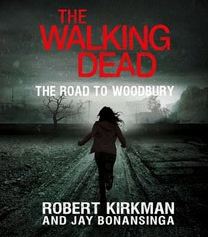
The Walking Dead: The Road to Woodbury
By Robert Kirkman and Jay Bonansinga; Read by Fred Berman
10 Hours – [UNABRIDGED]
Publisher: Macmillan Audio
Publilshed: 2012
Themes: / Horror / Post-apocalyptic / Zombies /
“He seemed like a good man.”
She looks up, focusing on the doctor. “Is that even possible any more?”
“Is what possible?”
“Being a good person?”
Fred Berman narrates this Walking Dead audiobook, written by Robert Kirkman (the creator) and Jay Bonansinga. I enjoy his narration very much. Even though there is a bunch of zombie fighting in this book, it’s character driven, and Berman adds great touches to each character.
I watch the Walking Dead TV show, and The Governor was introduced just last week. I’m told he’s a big part of the graphic novel story, and that this, the second book in a three book series, is a novelization of a storyline from those. My interest comes as a fan of the TV show – I have only limited knowledge of the graphic novels. This book does not follow the same characters that the TV show follows, but the stories take place in the same world.
My interest in the TV show and the audiobooks has not waned because it turns out that a zombie-ridden Earth is a fine place to tell a story that explores how average people cope when civilization disappears. History is riddled with terrible leaders, and this novel explores how a horrible man can end up leading people, and how those people can end up falling in line.
The novel follows several people as they travel and live and die, making their way across the post-apocalyptic landscape. Eventually, the group ends up at Woodbury, the walled community where The Governor rules. The characters are forced then to make a decision. They can follow this man that the alert ones quickly realize is mad, enjoy the safety from the zombies he provides, or they can take off again on their own, the mere thought of which would make anyone weary. The characters have many different answers. In a world where the characters are constantly threatened by the monstrous, some decide they need a monster of their own for protection, some will have no such thing, and some, despite what they’ve seen, are offended enough to try to change things.
Posted by Scott D. Danielson
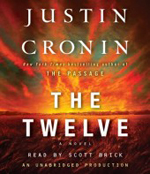
Review of The Twelve by Justin Cronin

The Twelve
By Justin Cronin; Read by Scott Brick
CD or MP3 -[UNABRIDGED]
Publisher: Random House Audio
Published: October 16, 2012
ISBN: 9780307702043/9780739366523
Themes: / Vampires / Post-apocalypse / Virus /
Publisher summary:
The end of the world was only the beginning.
In his internationally bestselling and critically acclaimed novel The Passage, Justin Cronin constructed an unforgettable world transformed by a government experiment gone horribly wrong. Now the scope widens and the intensity deepens as the epic story surges forward with . . .
THE TWELVE
In the present day, as the man-made apocalypse unfolds, three strangers navigate the chaos. Lila, a doctor and an expectant mother, is so shattered by the spread of violence and infection that she continues to plan for her child’s arrival even as society dissolves around her. Kittridge, known to the world as “Last Stand in Denver,” has been forced to flee his stronghold and is now on the road, dodging the infected, armed but alone and well aware that a tank of gas will get him only so far. April is a teenager fighting to guide her little brother safely through a landscape of death and ruin. These three will learn that they have not been fully abandoned—and that in connection lies hope, even on the darkest of nights.
One hundred years in the future, Amy and the others fight on for humankind’s salvation . . . unaware that the rules have changed. The enemy has evolved, and a dark new order has arisen with a vision of the future infinitely more horrifying than man’s extinction. If the Twelve are to fall, one of those united to vanquish them will have to pay the ultimate price.
I wasn’t going to read this book. I wasn’t! I felt like The Passage was a well-contained story and I didn’t understand where else it could go. I will let the author explain what he focuses on in The Twelve, because I find it too difficult to summarize. (This is from an older post from 2010 on io9.com.)
The next two books each go back to Year Zero at the outset, to reset the story, and to deal with something you didn’t see and didn’t know was as important as it was. It’s not a linear quest story, which I would find dull and plodding. With each book, you need to have the narrative terms reestablished with fresh elements. Also, if you didn’t see [a character] die, they’re not necessarily dead. There’s a big cast in the first book, and plenty of unresolved stuff. I will resolve it by the end. [Early vampire character] Anthony Carter? No, not abandoning him.
In [The Twelve], you go back to what happened in Denver after the outbreak took place. The story will resume in that location a few days after breakout. So you can see another angle on what occurred and certain elements will affect our band of heroes 100 years in the future. It will be called The Twelve – and it’s not who you think.
This means that the story starts with where Amy is, and follows up with an assortment of other characters. Just like in The Passage, storylines are dropped completely as others are followed. Since I was listening to the audio, it was a bit more difficult to keep track of, just because it was harder to flip back and get a refresher on names, etc.
The author provides a lot more information about what happened to various people at the very beginning, explaining how some of the communities were formed, the horrific actions of the USA government (including events like “The Field”), and other parts of the novel jump around up to 97 years from when the virus originally took hold. This kind of information is usually my favorite part of post-apocalyptic stories – the rebuilding. What kind of societies form? How do they work? Who has control? I think Justin Cronin shows a lot of creativity and variety in these situations, since it isn’t just one story, but multiple. Many of the characters, locations, and situations overlap throughout the story, and I had this sense of the author as a puppeteer, drawing strings of stories around each other. Kudos to him that they never seem to tangle in disaster.
Scott Brick is the narrator for the audiobook of The Twelve, and does a fantastic job. He doesn’t bother doing a lot of voices, but his inflection is perfect. He has this ability to get out of the way of the story that I really appreciate when I’m listening. It just comes to life and I’m not constantly thinking of HIM, but of the story.
And The Twelve requires a lot of thinking and paying attention. The multiple story lines, the jumping around in time and history, and the sprinkling of quotations that Cronin throws in kept my attention. He started with a Mark Strand poem, almost as if I needed something to clinch whether or not I’d read this book.
I won’t have that dilemma for the final book. While this story has a satisfying climax, I was left with far more questions this time around. I’m not sure I know which side everyone is on. I’m not sure I even know what sides there are, anymore. What I am sure about is that this book is hard to put down.
Posted by Jenny Colvin
The SFFaudio Podcast #180 – READALONG: The Death Of Grass by John Christopher

The SFFaudio Podcast #180 – Jesse, Tamahome, and Jenny Colvin talk about The Death Of Grass by John Christopher.
Talked about on today’s show:
post-apocalyptic, John Christopher’s real name was Samuel Youd, also known as No Blade of Grass, an anti-pot novel?, “it’s not my idea of a good time”, Stephen King’s The Stand, it’s almost like a play, there is a BBC audio drama adaptation, why not fish?, the Inuit, apocalyptic expert Jenny weighs in, John is like a feudal lord, moral lines are crossed, John’s transformation, the terrible 1970 movie version, “why hello I think I will come with you”, the cons of agriculture, Jenny’s quinoa granola, just drop a few bombs, can’t they make Soylent Green?, potatoes can let you down, real African grass virus, Paolo Bacigalupi’s Windup Girl, famines today, George R. Stewart’s Earth Abides |OUR READALONG|, David Pringle’s Science Fiction: The Best 100 Novels 1949-1984 and The Ultimate Encyclopedia Of Science Fiction, John Joseph Adams’s Wastelands, Pat Frank’s Alas, Babylon, Science Fiction: The 101 Best Novels 1985-2010, Octavia Butler’s Parable of the Sower, LeVar Burton loves it, women in the novel, Stockholm syndrome, The Walking Dead, “Dun dun dun!”, “maybe Luke can re-edit it”, Starship Troopers, Doomsday Preppers

Posted by Tamahome
The SFFaudio Podcast #180 - READALONG: The Death Of Grass by John Christopher [ 55:51 ] Play Now | Play in Popup | DownloadThe SFFaudio Podcast #073

The SFFaudio Podcast #073 – Jesse talks with Luke Burrage and Gregg Margarite about the Audible Frontiers/Brilliance Audio audiobook of Earth Abides by George R. Stewart!
Talked about on today’s show:
Earth Abides by George R. Stewart, New York City, Lucifer’s Hammer by Larry Niven and Jerry Pournelle, the best post-apocalyptic novel, a lost classic, a calm method of exposition, a student of history, Isherwood Williams, very vivid and deeply imagined, how do you define Science Fiction?, Flowers For Algernon by Daniel Keyes, philosophical nuts and bolts, the central crisis is left unexplained, the science in Earth Abides, “I understand people better after reading this book”, breeding cycles, Hard Biological Science Fiction, the disappearance of lice, overpopulation of the Earth, is it the author speaking or is it the main character?, ecology, there was no will to power, only a will to live, Baruch Spinoza, Arthur Schopenhauer, Friedrich Nietzsche, I can’t believe how long it took the guy to get to the library!, “how to render game”, “there’s lots of library love in this book”, “we’re not going to be the people that we were”, “the characters had to be ignorant out of laziness”, 1947, going to university, mediocrity is well loved, “why is dumb so cool?”, only people who are intelligent enough to ask the question…, does genius beget genius?, is intelligence particularly related to genetics?, nature/nurture, eugenics, is intelligence a particular interest rather than something in the brain?, superior interest vs. superior brainpower, Evie, finding the test, the IQ test, the observer’s position in the universe, “do you think what the government did to Alan Turing was wrong?”, the Apple logo inspired by Alan Turning’s suicide?, snopes.com, I knew I wanted to be friends with Gregg Margarite, LibriVox.org, the San Fransisco tribe, you cannot spoil this book, WWII, cargo cults, “would you ever be a member of a cargo cult?”, Montezuma and Quetzalcoatl, The Gods Must Be Crazy, religion, superstition, pinch your God, if God lived on earth people would break his windows, tribal sociological phenomena, the role of chiefs, the most interesting book about pinching I’ve ever read, “heartwarming pinching”, reading, despondence and acceptance, what does it really matter if humanity is dead?, The Star by Arthur C. Clarke, intellectual arguments vs. emotional arguments, it’s very rare to be emotionally affected (to tears) by a book, narrator Jonathan Davis, The Windup Girl by Paolo Bacigalupi, one of the best narrations that I’ve heard, Mike Resnick‘s Starship series, Star Wars, Connie Willis‘ introduction to Earth Abides, Deep Six by Jack McDevitt, “always skip over the introduction”, where does Isherwood’s name come from?, forgetting your own name, the character of Jack, I don’t read for characters, Isherwood thinks he’s an intellectual, Robinson Crusoe by Daniel Dafoe, The Swiss Family Robinson by Johann David Wyss, “I would have taken out Electromechanical Engineering“, Emm and Ezra, Charlie, George (the carpenter/plumber), “even his dog (Princess)”, a friend’s quiz, people are not just what they know or what they read, The Hitch-Hiker’s Guide To The Galaxy by Douglas Adams, “society is all the different bits and humanity is all the different bits”, adopting leaves as a currency, maybe the whole of Douglas Adams should be treated like a religious text, The Hitchhiker’s Guide To The Galaxy is a book about itself, Doctor Who, the dish of the day, other themes in Earth Abides, racism in Lucifer’s Hammer, what race is Emma?, does it matter?, the last American, people who are racist are people talk about race, race is a sociological idea, race is something – but it is not science, “I don’t live the history”, “they need to have somebody who are below them on the ladder”, Fox News, ideological reasons for watching TV, Glenn Beck is Mormon, Mormons believe that the Constitution of the United States was “divinely inspired”, his country is part of his ideology, the reason Orson Scott Card hates gays is because of his belief system, newspapers still have an Astrology section, there is no hegemony in Earth Abides, individuals interacting with one another, “people abide”, are you born of another?, matriarchy vs. patriarchy, “Is it a talisman? a totem? It’s single jack!”, “the power to destroy and drive in a nail”, a genius accident, the word “jack” means “doer”, Jack Bauer, semiotics, Jesus freaks vs. religious freaks, separating the voice of the author from the voice of the main character, The Last Man On Earth, The Last Man On Earth Blog, I Am Legend by Richard Matheson, Life After People, George R. Stewart wrote a biography of Bret Harte, Harte is far more complex than Louis L’Amour, Oakland, Mark Twain, recording for LibriVox.org, 2BOR02B by Kurt Vonnegut, we all know that Science Fiction has been carrying this burden, iambik audio, recording a 600 page book on the road, $1000 microphone, The Secret Of Kralitz by Henry Kuttner, The Ego Machine by Henry Kuttner, the Del Rey “best of” books, The Best Of Jack Williamson, Frederick Pohl, Luke rates Earth Abides 4.5 out of 5 stars, “it’s good because it’s not very good in this way”, did it achieve what it set out to accomplish, The Incredible Shrinking Man by Richard Matheson, we are thoroughly impressed, Earth Abides is 13 CDs 15 Hours, time passing, the loss of reading, is literacy in and of itself a good?, giving the book away, separating technique from practical skills, bull dodging, Make Room, Make Room by Harry Harrison, Soylent Green, get Charlton Heston out of your head but keep Edward G. Robinson, The Omega Man, potential upcoming SFFaudio Readalongs, Ubik by Philip K. Dick, The Man In The High Castle, Do Andoids Dream Of Electric Sheep?, Valis, The Transmigration Of Timothy Archer and The Divine Invasion, Leo Tolstoy, the philosophy of art, “the only true art is folk art”, art is an abbreviation of the word artifact, a nuclear bomb is art to me, labor intensive art, venus figures, craft vs. art, I don’t think art has a place in this book?, I’m pretty sure something is going on about art in this book, I see similarities between petroglyphs and Pollock, maybe I was wrong, are we post structuralist, Duchamp, Aristotle’s Poetics, Seven Samurai, Rashomon, David Lynch’s Dune, Laurel and Hardy, Gilligan and the Skipper, Akira Kurosawa, George R. Stewart basically invented the disaster novel, Ordeal By Hunger by George R. Stewart (available from Blackstone Audio).
Posted by Jesse Willis