Review of Tales of the Red Panda: The Crime Cabal


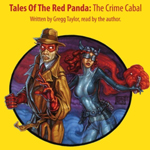
Tales of the Red Panda: The Crime Cabal
By Gregg Taylor; Read by Gregg Taylor
Publisher: Audible
Release Date: October 17, 2012
ISBN: 9780986856334
Playing time: 5 hours 53 minutes [UNABRIDGED]
Themes: pulp / heroes / depression era / gangs / zombies / bombs / hypnotism / secret identities / roof tops / grapnel guns
Depression-era Toronto is the setting for Gregg Taylor’s pulp hero The Red Panda and his sidekick The Flying Squirrel. The novel opens with the last of the big gangs in the city being brought to Justice; Police Chief O’Mally railing against the masked vigilantes at loose in his city. While the Press love the hero: defender of the weak, the poor and the downtrodden of society.
Out from the ashes of the many gangs that our hero’s have crushed rises a new gang, The Crime Cabal. This new gang knows that for them to flourish, they must deal with The Red Panda once and for all. But there is more behind the Cabal than a simple gang. When the hulking enforcers of the gang turn out to be zombies it’s clear that this is no ordinary gang.
The Tales of the Red Panda: The Crime Cabal is the first novel set within the same setting as the podcast audio dramas, also written and produced by Gregg Taylor under the Decoder Ring Theatre banner. There is continuity between the podcast and the novel, but the novel does stand on it’s own, even providing an origin story for one of the long running supporting characters. The setting and characters are all introduced with enough background and flare to be fully formed within the novel alone.
Gregg Taylor does a commendable job with the narration and the characters. Of note are the character voices especially as I’ve listened to the audio dramas for some years. Taylor captures the essence of the voices of the characters as they have been portrayed by other actors. For several years in some cases. So, even if you have listened to the podcasts you won’t be disappointed by the the portrayal of familiar characters, and if you haven’t then they come out fully formed characterizations.
My only niggle is that in the first few chapters the narration feels just a little rushed in places, but this passes.
Posted by Paul [W] Campbell
Review of The Adventures of Doc Savage

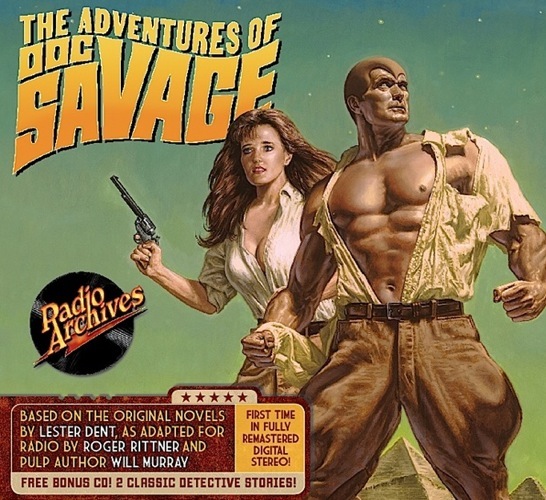
The Adventures of Doc Savage
Adapted from novels by Lester Dent
Starring Daniel Chodos as Doc Savage
8 Hours – [AUDIO DRAMA]
Publisher: RadioArchives.com
Published: 2010
Themes: / Science Fiction / Hero / Adventure / Pulp / Audio Drama / Skeletons / Chemistry /
Doc Savage is the strongest, smartest, most resourceful, best-looking guy you’ll ever meet. And he fights crime. Born in pulp magazines in the 1930′s, he’s also the subject of 181 novels, and a movie.
The Adventures of Doc Savage contains 13 half-hour episodes of audio drama that were originally broadcast on NPR in 1985. These episodes tell two complete stories that were adapted from novels written by Lester Dent. “Fear Cay” was published in September 1934 and “The Thousand Headed Man” in July 1934. The scripts were written by Will Murray and Roger Rittner.
Having never read a Doc Savage story, I was interested for historical reasons. I’ve run across these novels regularly over the years, but the pulp hero never caught my reading eye. I’m very happy, though, to have heard these audio dramas. They are very well done. They’re action packed, thoroughly entertaining, and as full of camp as you’d hope.
With the opening of “Fear Cay”, I learned that Doc Savage doesn’t work alone. He’s got a team around him that reminds me of Buckaroo Banzai’s crew. (Now, why was Jeff Goldblum wearing that ridiculous cowboy outfit again?) I now realize that Buckaroo had to have been influenced by Doc Savage. Savage also has a diverse team around him – from physical strength to electronic genius – and there’s nothing they can’t handle.
Still, Doc Savage is the best of them all. He’s not among equals. He can overpower multiple men at once, but he’s just as apt to talk himself out of a situation. And he’s got gadgets and/or chemical formulations for everything else that occurs.
In short, I had a great time listening to these dramas. They’re fun.
Find them over at RadioArchives.com.
Posted by Scott D. Danielson
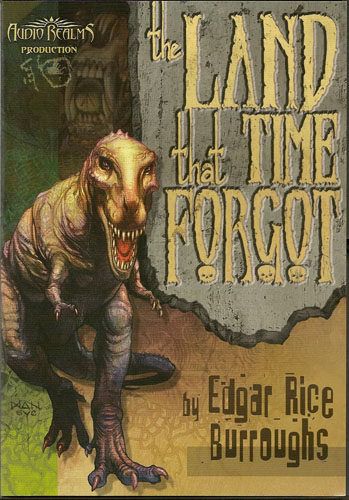
Review of The Land That Time Forgot by Edgar Rice Burroughs

The Land That Time Forgot
By Edgar Rice Burroughs; Read by Brian Holsopple
3 CDs – 3.5 hours – [UNABRIDGED]
Publisher: Audio Realms
ISBN: 9781897304334
Themes: / Science Fiction / Pulp / Ju-jutsu /
Repeat after me: Pulp is a great genre, but not all pulp is great. And some of it isn’t very good at all, I’m afraid.
I lead with this because I’ve noticed that pulp often gets a free pass from its advocates. Fans will leap to the defense of poorly plotted, boring, or otherwise not well-written stories and pulp-inspired films with a simple, “well, it’s pulp”–as if this fact somehow makes the genre above criticism.
Now, I happen to be a big fan of pulp, but I can also recognize a flawed example when I see it. Even when its written by Edgar Rice Burroughs, one of pulp’s grand masters (see many of his wonderful Tarzan and John Carter stories).
I’m sorry to say that Burroughs’ The Land that Time Forgot is not very good. It’s not as bad as, say, Magic Kingdom For Sale: Sold, and I’ve read worse, but when compared to the best pulp has to offer–i.e., almost anything written by Robert E. Howard–The Land that Time Forgot simply does not measure up.
Part of my problem with this book may be the fact that I listened to an audio recording produced by Audio Realms, delivered in uninspired fashion by narrator Brian Holsopple. Audio Realms is also responsible for producing the fantastic series The Dark Worlds of H.P. Lovecraft, read by Wayne June (who is a terrific narrator), but I found this particular entry in their catalogue rather poor.
To be fair, Holsopple doesn’t exactly have Lovecraft at the top of his game to work with. Some of the dialogue in The Land that Time Forgot is so stilted and cornball that I found myself literally cringing behind the steering wheel while driving into work. Here’s one less-than-stellar example:
“You have evolved a beautiful philosophy,” I said. “It fills such a longing in the human breast. It is full, it is satisfying, it is ennobling. What wonderous strides toward perfection the human race might have made if the first man had evolved it and it had persisted until now as the creed of humanity.”
“I don’t like irony,” she said; “it indicates a small soul.”
“What other sort of soul, then, would you expect from ‘a comic little figure hopping from the cradle to the grave’?” I inquired. “And what difference does it make, anyway, what you like and what you don’t like? You are here for but an instant, and you mustn’t take yourself too seriously.”
She looked up at me with a smile. “I imagine that I am frightened and blue,” she said, “and I know that I am very, very homesick and lonely.” There was almost a sob in her voice as she concluded. It was the first time that she had spoken thus to me. Involuntarily, I laid my hand upon hers where it rested on the rail.
I mean, this stuff makes the lines delivered in Days of Our Lives seem like John Keats in comparison.
The Land that Time Forgot tells the tale of Tyler Bowen, an American on a merchant vessel whose ship is attacked by a World War I German U-boat. Bowen survives and with the help of some British sailors manages to overpower the U-boat’s crew. Bowen is eventually betrayed by one of his own men who smashes the U-boat’s instruments in an attempt to doom the ship’s crew. When Bowen finally learns who his betrayer is, the man on his deathbed reveals his secrets like an unmasked villain from Scooby-Doo:
“I did it alone,” he said. “I did it because I hate you–I hate all your kind. I was kicked out of your shipyard at Santa Monica. I was locked out of California. I am an I. W. W. I became a German agent–not because I love them, for I hate them too–but because I wanted to injure Americans, whom I hated more. I threw the wireless apparatus overboard. I destroyed the chronometer and the sextant. I devised a scheme for varying the compass to suit my wishes. I told Wilson that I had seen the girl talking with von Schoenvorts, and I made the poor egg think he had seen her doing the same thing. I am sorry–sorry that my plans failed. I hate you.”
And he would have succeeded if it wasn’t for you meddling kids.
Lost at sea and low on food and water, Bowen and his men land on the island of Caprona, a literal island that time forgot. It’s inhabited by dinosaurs of every age as well as ice-age beasts and men in various stages of evolution. Bowen then spends the rest of the book rescuing a stranded damosel from the hands of lustful Neanderthal men and hungry dinosaurs, as well as kicking the crap out of primitive men. Oh, I didn’t mention that Bowen happens to be a physical specimen and a master of judo? Here’s my favorite passage:
Three of the warriors were sitting upon me, trying to hold me down by main strength and awkwardness, and they were having their hands full in the doing, I can tell you. I don’t like to appear conceited, but I may as well admit that I am proud of my strength and the science that I have acquired and developed in the directing of it–that and my horsemanship I always have been proud of.
And now, that day, all the long hours that I had put into careful study, practice and training brought me in two or three minutes a full return upon my investment. Californians, as a rule, are familiar with ju-jutsu, and I especially had made a study of it for several years, both at school and in the gym of the Los Angeles Athletic Club, while recently I had had, in my employ, a Jap who was a wonder at the art. It took me just about thirty seconds to break the elbow of one of my assailants, trip another and send him stumbling backward among his fellows, and throw the third completely over my head in such a way that when he fell his neck was broken.
“Californians as a rule are familiar with ju-jutsu?” “I am proud of my strength and the science that I have acquired and developed in the directing of it?” “A Jap who was a wonder at the art?” Man, if this isn’t Mystery Science Theatre 3000 material than I don’t know what is.
About the only thing that The Land the Time Forgot has going for it is that it isn’t entirely boring, if you like one mindless action scene strung together after the next. But, in summation, if you’re looking for a good representative of the pulp genre, look elsewhere.
Posted by Brian Murphy

Time Traveler reads for Scatterpod: Dark

Michael Bekemeyer of Scatterpod has started a new themed series for the show called Scatterpod: Dark. As you can imagine these tales concentrate on the darker side of human nature. Some of the shows are non-fantasy horror stories, but they often have a fantasy element.
The third and most recent installation features a Science Fiction story called Ice Planet written by Michael. The story is read by none other than myself, The Time Traveler. Although I host my own show, but with the exception of one short flash fiction, this is my first tour of duty as a narrator. When Michael sent me the story, I couldn’t refuse. It was reminiscent of the kind of stories that appeared in the pulp magazines like Planet Stories (with some added expletives).
You can download the episode here.
You can subscribe to the Scatterpod by pasting this line in your favorite podcatching device:
http://feeds.feedburner.com/scatterpod
The Dial P For Pulp podcast dials up the goodness

With a mere six podcasts completed Dial P For Pulp has already proven itself as a reliable source for great pulpy fiction. The host, David Drage, talks about pulp magazines, pulp authors, pulp books, the pulp era and games inspired by pulp. Older shows include stories by H. Rider Haggard and Robert E. Howard, but it is the most recent show, another Howard tale, that interests us the most. It’s a short story taken for the Second Annual SFFaudio Challlenge!
The Cairn on the Headland
By Robert E. Howard; Read by David Drage
1 |MP3| – [UNABRIDGED]
Podcaster: Dial P For Pulp
Podcast: March 2008
What lies beneath the stone cairn on the headland of Clontarf, where the Christian Irish defeated the pagan Vikings in pitched battle a thousand years ago? An unscrupulous extortionist plans to uncover the secret. First published in the January 1933 issue of Strange Tales of Mystery And Terror magazine.
Set your podcatcher to pulp, and subscribe to the RSS feed:
http://dpfp.libsyn.com/rss/podcasts
Posted by Jesse Willis
The Sonic Society: Pulpy, Mysterious, Funny

Season 3 of The Sonic Society, is well under way, their latest, and possibly greatest episode to date! Have a listen |MP3|.
This ep showcases Broken Sea‘s pulpy adventure series Jake Sampson: Monster Hunter. Scripting for JS: MH is well researched, and very fun. The two episodes included are from the second story arc entitled Jake Sampson And The Tears Of Ra. It is a supernatural tale primarily set in 1920s Egypt. Personally I could do without the footsteps in echoing corridors but other than that this is a highly recommended listen.
Also included in this show is the third episode of the increasingly mysterious audio drama from New Zealand. The show is called Claibourne Claybourne, it feels like a Kiwi version of Twin Peaks. It is quite slick. but I can’t seem to find a website or much information about the program on the web though. Anybody know more about Claibourne? Claybourne‘s own podcast can be found HERE, where it has already concluded with Episode 96!*
Also on tap in this show is the funniest listen ever heard on The Sonic Society, a skit from “wacko parody/absurdist/topical/musical/slapstick radio sketch comedy project” called Wasted Tape. It has nothing to do with Science Fiction, Fantasy, or even Horror but I think you’ll dig it anyway. The subject of the WT players’ jocularity: An all male cast of The Vagina Monologues.
And if you haven’t already, don’t forget to subscribe to The Sonic Society’s podcast feed:
http://sonic.libsyn.com/rss
*Thanks Roy!
Posted by Jesse Willis