
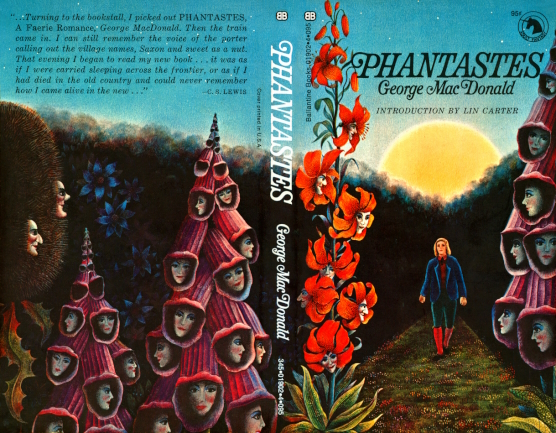
The SFFaudio Podcast #882 – Phantastes by George MacDonald (6 hours 25 minutes) read by Brad Powers for LibriVox, followed by a discussion of it. Participants in the discussion are Jesse and Scott Danielson.
Talked about on today’s show:
1858, about 34 when this thing came out, Lilith, 24 years old!, very similar, thematic differences, not fundamentally different the way they’re done, a young man coming to a home where the rest of the family is gone, an inheritance, Mr. Crow, a mirror into fairyworld, less fairy than in this one, the same thing happens, through a desk, one of earliest, and the last, express some inadaquacies, Phantastes needs more time, each chapter, how to be a good man, supersymbolic dreaming things that are happening, plunged forward, stew a little bit, like it vs. understand it, an object of contemplation, a subconscious exploration, a book you can talk about easily, fairly rambly, way more of a plot, a message that spirtualized, clearly spiritual, all about yearning, the young man is very mature, contemplating what being a good man is, about searching how to be a good man, the focus of his ramblings, the female form, numerous females in there, the porcelain one, the one he was after, almost like a statue, a Pygmalion story, spiritual enlightenment, a woman is part of it, how does a good man love?, what does a good man love?, the statuesque one, sit on it more, boy that needs a minute, get it done in time, a series of waves, Gene Wolfe’s The Book Of The New Sun, a gorgeous gem you can look at, so many classics, this trek through some land, important symbolic things are happening, books like this, what we think of a standard story plot, William Hope Hodgson’s The Night Land, 1912, a throwback style, from the 17th century, the far future, dying earth, subgenre, kinda hopeful, Hodgson is not a Christian, absent the spiritual stuff he focuses more on the girl, the female form, the joy of children, all in relation to the man, what he ought to be doing, young man’s yearnings, wants to love god, he’d be a terrible monk, prefer not to be a monk, Arthur Machen’s The Hill Of Dreams, 1908?, semi-autobiographical, Wales to London, a man of letters, extraordinary experiences in nature, with women or young ladies, girls, transcendent experiences, more dreams the The Hill Of Dreams, the effect of dreams on a waking person, every chapter is a dream, Novalis, 3 paragraphs of German, in indirect effect a nursery, a store room and a junk closet, a music fantasy, nature itself, in a true fairytale, everything alive, strangely interwoven, the time of anarchy, the primal state of nature, the world of truth, similar to it, a completed creation, stories without coherence, like music does, being modern, we recognize it as such, Ivanhoe, 1819, a huge hit, the Waverly books, by the guy who wrote Waverly, ate it up, more modern, popular, Charles Dickens, old fashioned modern, A Voyage To Arcturus, is that a science fiction novel?, fairyland on another planet, the relationships of human males to human and semi-human females, older ways of telling stories, The Devil’s Elixirs by E.T.A. Hoffmann, fairly like that of Candide, doppelgangers, your double out there, in 2 volumes, a serial, Batman Fights The Joker Part 1, we don’t like that, be self-contained, finish the movie, a journey across physical space, the cliffhangers feel like cheating, maybe it is getting at something, William Wilson by Edgar Allan Poe, madness, something all young men feel, condense it down, reading it in 1859, where fantasy comes from, there’s a kobold in it, weirdness, at school, a mirror, sees a woman in the mirror, where she is, she’s only in the mirror, if he smashes the mirror that will help her, the princess is really sick, wow!, runs back to his room and frees her, she’s gonna be grateful, a pattern of insight into reality that doesn’t come from everyday under the sun, through dream and on the periphery of dream, more going on than what we can sense, these experiences or beliefs are connective to what I should do, we’re creating myth here, mythopoetic, C.S. Lewis really loved MacDonald, more coherent, not a polemic, a lot more like Lilith than this book, a subject in mind, a judgement to how to be, the introduction from C.S. Lewis, from this it follows, 1946, the Curdie books, The Wise Woman, the Everyman edition, a great frontier, waist deep in romanticism, the bright shadow coming out of it, a strange new quality, of eternity, dipped in the myth of the Holy Grail, but a preparation for this, strange, also true, a voice from the regions we all come from, what MacDonald does best, the ordinary laws of nature are suspended, MacDonald’s world, a world of discovery, sermons, theological writings, a great frontier, a glimpse of something beyond the ordinary, real in a deeper sense, I was not alone, when the process was complete, the very essence of the experience, a gilded pill, the pill was gold all through, shocked in my teens, what I learned to love in Phantastes was goodness, the sweet air blowing from the land of righteousness, in Sappho’s phrase, he’s in love, crossed the frontier, the modern Morpheus, a fun one, about truth, Joseph Campbell, looking at myths, mankinds attempt to touch the transcendent, it exists, humanity all has this, Augustine, we restless until we rest out heads in thee, talking about God, the sub-creation, a train of thought, throw 2 things down, J.R.R. Tolkien, something that nobody else does, in all the photocopies, nobody throws poetry at you like Tolkien does, and then the elves said, the hobbits have a homey rhyme, a page of verse, in re-reading it, on my own reading it, skip this part?, that’s not story, that’s just somebody singing, I don’t want to read about you singing, every chapter starts with a bit of poetry, literally verse, Lin Carter, saccharine rhymes, from the 1970 reprint, it’s hurting the story, it does hurt the story, we’re barely hanging on to what he’s trying to say, if you get a book today, any random book, 2 lines that rhyme, in the dedication, fundamentally connected, a mode actually, quotations, inspirational, the name of the quoter, is this true?, this could be anybody, how to remember it, the meter and the rhyme, our narrator, rhyme should be forced, rhymes by sight, reinforcing the idea, not just random, each of these chapters is doing the same thing, does it again and again, a linear narrative, he becomes a squire, the goldenness of a squire to a knight, by love, the being loved, assures blessedness, super male, from a male perspective, bigender, parallels, right and proper to me, submissive to my husband, not polite to say, women shouldn’t be voting, leader of a household, the man’s role to…, different philosophies, presented with an experience, a reaction or an acceptance, a relationship thing that goes both ways, the female version of this book, neurotic, deeply thinking all the time, don’t just accept the sense experience and act like a robot, filter it through an inner guide to reality, yearning for everything being correct, dispose of the Christian overlay, the source for a lot of this, roll this back 2000 years, the Platonic, the realm of the forms, the ideal, the ideal relationship, the ideal woman, we can also think of this as connected to nature, armour, platonicized, where do you actually find these experiences thrust upon you is in nature, funny to think about, cyborgs and fairies, my new novel, Shadowrun is the game, one of these genres, Neuromancer but with elves, it doesn’t seem to make sense, throw em in the blender, elves are of the forest, cyborgs are of the cities, Gligamesh and Enkidu, characters raised by non-humans, Romulus and Remus, Haay Ibn Yaqdhan, Tarzan, cattle, raised by a cow, he is a bull, a lot of a strength there, not a lot of thought, raw beast of running free, best of friends, Murtagh meets Riggs, buddy cop movies, what we see in that late chapter, the knight can retire, the shield and the lance to the squire, become the black knight, I get to have sex with all the ladies, the son of the prophet, 17 wives, a meeting place between our experience of the spiritual, best done not in the store, in nature where there is no money, a lady hiding in the woods, this nature thing, The Tolkien Gateway, trust the oak and elm and the great beech, take care of the birch, shun the ash and the alder, her web of hair, in Chapter 3, this notion perhaps some remote influence on his creation of the Ents, old man willow, The Golden Key, never finished the preface, an interview with Harry Resnick 1967, a muddled sentence, humility, valour and courage, the queen is rather a mother, a highly selective memory, things that moved me, filled me with distaste, kind of shunned him, not an appreciator, quite a statement, the grandfather of the Inklings, hold up these two things, suddenly confronted at the pearly gates, you have to answer honestly, Phantastes or The Lord Of The Rings, why?, its better at what it’s doing, he’s not gonna be some Melville, he’s exceptional at this, he’s doing something special, there’s beauty there even its not as well woven, related to fantasy, similarities to some Poul Anderson here and there, Lilith is a much better book, more of a united theme, nuggets of contemplation, like a poem or music, it has the shape of a novel, a series of meditations with chapters, not exactly united, G.K. Chesterton, The Man Who Was Thursday, more of a city, The 39 Steps meets George MacDonald, not actually a good book either, John Buchan, the meaning of the title changes, Reading Short And Deep, the way he wrote these ones, Chesterton was employed to write a column, you need to fill this space, journalism, an editorial, what newspapers really are, they want people to buy this paper with ink on it, newspapers would have relationships with other newspapers, in Australia and London, producing column, he Chesterton, near Christmas time, a toy store, describes the toys, falls into a reveries, they’re all grubby, touched by the hands of children, The Shop Of Ghost, the spirit of generosity and Christmas, Tremendous Trifles, how to write a story, the proprietor is incredibly old, is this actually in London, Charles Dickens, Robin Hood, a comedic meditation on the spirit of Christmas, you’re still alive?, I’ve been dying for centuries, he’s Santa Claus, that spirit that gives you gifts without asking for money, give the children this experience, a barbed attack, they’re trying to kill Christmas, when the news was on, a war on Christmas, you get old, you don’t feel it the same way as when you’re young, all crass commercialism, a failure of imagination, why people would maybe reject Phantastes, pointing towards the direction of reality, we can feel the hormones, those hormones are in memory, rub up against trees in the woods, one of the trees engulfs him and embrace them, laugh, that was weird back then, this is a good book, rough, trying to be poetic, the poetry that he removed was hurting the effect of the book, trying to make money, a concern of many publishing people, trying to make a case that this is a fantasy novel, weird spirituality in the forest, no costume involved, becoming something else, point to certain passages, the goblins, the goblins we see in Tolkien the first time, the goblins are the orcs, no orcs in The Hobbit, they don’t act the same, what’s an orc to do?, a running song, tonally they’re very different, they’re not, one is written for children, the other is not written for children, as a man matures, he might write about things for different purposes, similar, more to explore, take a passage out, lots of beautiful, he was a sailor, Sargasso Seas, strange islands, strange creatures, you can just sort of tell, weird comparison, another Simak, those later Simak novels, kinda similar, episodes happening, some females, not a young man’s lust, a little more humour going, the love of the countryside and nature, then he throws in a robot, I think we should build a fire, other creatures, almost like what you would think of as goblins, not menaces exactly, the robot community, how weird is it?, The Goblin Reservation, his mature stuff, Shakespeare’s Planet on, Graveyard Planet, hints, questing innerly to find the story, lobby for it with the dictionary council, Destiny Doll, Simak reading, do more, two shorts, H.G. Wells vs. Robert E. Howard, who valleyed it better, a werewolf made by tibetan evil monks who’ve given us all human technology fighting a guy in the swamps of Mississippi, finding some ads, uprooting, The Maltese Falcon, a lot of new good stuff, not enough weeks in the year to read all the good stuff that’s coming out, The White Company by Arthur Conan Doyle, that’s impressive, pair up, The Solitary Cyclist, The Red-Headed League, The Adventure Of The Cardboard Box, human ears, sounds good, forget how good at what he was doing, how good he is, Travels With A Donkey, could be this year, could be next year, the 28th, New Years Parties, a little hiccup, missed three shows in a row, mostly from switching from Skype to Teams, little snotty, the eye thing, the vision is never gonna come back a direction that’s not super important, in hospital, it sucks to be in a hospital, dependent on other people, most of all your sick, the widget area, giant space, that’s not how you use your phone, open in new window, the hamburger, The Black Hound Of Death by Robert E. Howard vs. In The Abyss by H.G. Wells, a lady naked on a table, a diving bell, aliens at the bottom of the ocean.
Posted by Jesse Willis




 CBSRMT #0920 – The Thing At Nolan