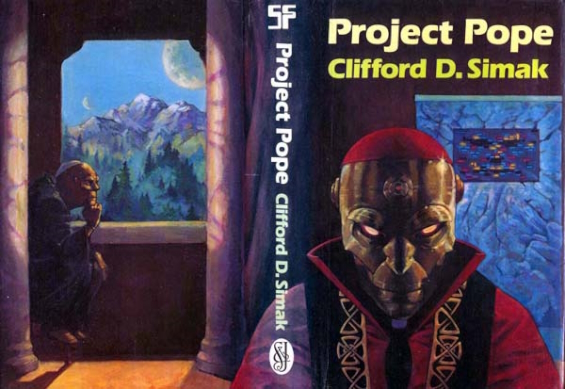
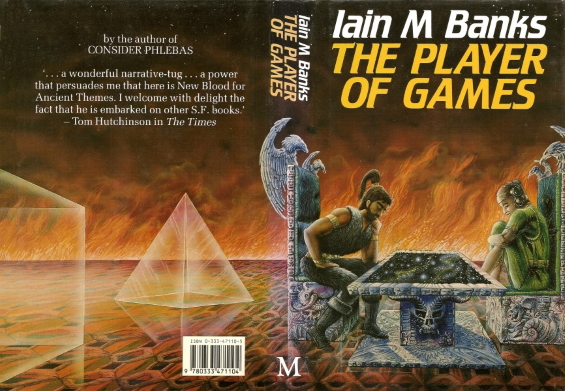
The SFFaudio Podcast #847 – Jesse and Scott Danielson talk about Project Pope by Clifford D. Simak
Talked about on today’s show:
a miraculous healing, Jesse got sick, kind of amazing, packed with ideas, some of it was like a fever dream, 5-6 days, similar to a lot of Simak, together, separately, Way Station, not like this, really late, 1981, Special Deliverance, Where The Evil Dwells, Highway Of Eternity, the kitchen sink is in this one, 2024/2025, the main idea is this ai, kind of Foundation-like, Vatican 17, pattern their project after the Catholic church, alive and well on Earth and elsewhere, monks, chopping the wood, not about Catholicism, or is it?, a pope’s infallibility, misunderstood a lot, if we can feed this ai nothing but true information…, all the data, truly infallible, transporter system, become a trilobite in the past, a packet of information, this little treasure of information, that truth, constantly collecting with the expectation the result will be an infallible “pope”, the one true religion, just Truth (and a source of that), in today’s world, almost prescient, we have our ai, the information that it has, ask chatGPT a question, pretty good at math, funny at math, you’re right, you are right in saying that, it’s ingratiating, how many months until I am 80 years old, how did you frame, 18 minus 9, about the pope, how does it handle a question that’s not some factual thing, is Pope Francis a good pope?, it’s answer was good, vary widely, 2023, how does it give an answer to that, what is good, people think this, it doesn’t really have opinions, Simak doesn’t write ai, even his robots are people, all over the place, distracted, the cardinal, pour scotch on his chin, he’s a cool guy, sure he doesn’t have to eat or sleep, non-human aliens and they’re human too, the diamond dust guy, the little sparkle who goes in your eye, watcher/sleeper, the whisperer, a lot like Ariel from The Tempest, there is no master here, wants to be friends, the unifying thing, nice and rural, nice views of mountains, walks through the forest, I don’t know what I’m doing with my life, lady with a scar on her face, no one can ever love me, I can love you, started the website [SFFaudio], robot, spaceship, artificial intelligence, robots are separate from those things, robot vacuum, clean the floor, do the dishes, grok the twitter ai, does it actually know anything, the answer is no, It Wouldn’t Work Because… by Jesse, three synonyms vain, finds a statue of his emissary, hears a beautiful voice, here’s some wine, the woman accepted the first of the king’s proposal, the missing card, king, comb, snake, they can usually guess who the woman is, its medusa, all the beautiful women are snooty, lonely, a nice parable in itself, who the woman was, the woman is medusa, given that she is medusa, she has snakes for hair, spoon-feed it to get the right answer, how the term ai has changed, chat gpt is a good search engine, and google is a bad search engine now, a really concise way, using the Catholic church as a model, an article by Ted Chiang, fiction writing, the person writing it is making 10,000 choices, a prompt, it has to fill in, take an average of the choices that other writers have made, really bland, style mimicry, interesting, that’s exactly what the ai in this is doing, emulate humanity’s way, what Vatican 17 is, if you feed it nothing but truth you’re going to get an infallible answers, what is truth?, created by humans, running into contradictory things, even if not consciously, style mimicry ourselves up a new Clifford Simak novel, in a fever, Ploppy went plop plop, other worlds, the math world, equation world, similar to a bunch of novels by Simak, Shakespeare’s Planet, the first science fiction novel Jesse ever read, science fantasy stuff, A Wrinkle In Time, fantasy, a weird book, stuck there waiting for Godot, Gutshot, The End of Nothing, looking for Heaven, a spiritual hopefulness, hopefully Heaven, that’s cool, he’s very interesting, technically it isn’t a very good science fiction novel because there’s hardly any science, where’s the science?, magical collecting, go be a trilobite for a minute, an exploration, The Cold Equations by Tom Godwin, the equations there try and save him, a very philosophical novel, Ted Chiang isn’t rambling, concise, this is a tour of the countryside over a weekend, not exactly elegiac, written by a mature man, Peter S. Beagle, bullshit!, A Fine And Private Place, Two Hearts, a novella, sitting there holding his Hugo, a poem on Reading, Short And Deep, a little joke poem, we gotta get it on, lives in a tomb, friends with ghosts, delusional homeless man in New York, a widow, a little romance, closely associated with a talking crow or raven, in this book, visit other dimensions rather than other planets, equation world, the Platonic ideal, the realm of the forms, the Realm of the Forms, Plato’s idea, we don’t learn anything we only remember, knowledge without existence, brought out into a woman’s body, in the process of being born you have a mental wipe, you forgot everything you knew in the land of the forms, I remember what a chair is, a good question for grok, how many legs does a chair have to have, a chair doesn’t take one shape, is a chaise long a chair, all the qualities of all the chairs, we know it when we see it, we know what the good is, we knew the good, when we see the good in the world we recognize it as Good, truth is the good, pretty compelling, explains a lot, a bullshit story, why people like math too much, how many meters of sand, model the world using math, at this speed and angle, we really like that, that doesn’t solve a lot of the problems we have, I have three bad choices, all three are going to be embarrassing, go to something else like principal, always don’t lie, when your people made us robots, certain faculties, appreciation of beauty, noisy dogs, Special Deliverance, his student was using a coin operated ai machine, ends up in another dimension or place, what is that about?, a cube and a puzzle, a woman who gets entranced by a single tower, she’s withered away, all symbolic, an existential novel, philosophy, quite nice, the community is fairly nice, the weird guardian alien, the old ones, indigenous species, missing entwives, a little Lovecraftian about them, sensing organs, a way to go, almost to be another Foundation, withstand the fall of the Empire, edge of the galaxy, the way the book starts off, stowaway, the first officer, a one way trip, the way to read this, it is for life, the captain was kind of a racist dude, knee deep I am in alien scum, his rat crew, The Huddling Place, Sean Standfast (YouTube), Cemetery World, huddle watch, we humans need to stick together, 7 times in this novel, Time Is The Simplest Thing aka The Fisherman, a run down rustbelt United States, Mexico, a similar program, more aggressive and more dominant, astral travelers, ideas and technologies, the equivalent of Walmart, a rise in psychic powers, a conflicted United States not in control of itself, teenage witches sky-riding their brooms, this agency called Fishhook, they hook on to some idea, spiritual growth, a search of enlightenment, the message of this book, the countryside is quite nice, some filling stew, a stew scene, how’s the stew, it’s filling, eight of his novels, search for ultimate truth, there is such a truth that exists, on the road there, here we are on the road, the norm is restored and they can continue searching, is it worthwhile or not, we can do this in a pleasant way and keep moving forward, filling stew, well made, beautiful mountains, really there, beauty is part of it, all ye need to know, if truth is beauty, an ugly truth should be nonsensical, a hard truth, a hard beauty, how he got away with this, he kept putting them out, Analog, November 1982, very positive, strongly by all means, he’s saying it’s good, an old friend, a sense of immense friendliness, constant concerns with rural settings, life, being, a certain perplexitiy in the face of reality, a pastoral writer, a folksy writer, the day to day, writes of hobbits, not men, themes are cosmic, bad manners, rurality, pastoral, cosmic, laid back flesh and blood, friendly in a neighborly way, how can we cancel this guy?, conflict in fiction, it has to exist, Simak exists, it defines on how you define conflict, a harsh word, I want some toast and mom says no, a fight over toast, man against man, man vs. nature, busy work, keep them busy, a horrible story, why kindergarten exists, its from the Prussians of course, it’s in the name, in order to make your troops obedient you have to get them young, take them away from their parents and indoctrinate them, pre-k, how did cave men manage so well without these busy work contests, scolded with marks, he’s on a kind of quest for some enlightenment while being friendly, a newspaper guy, how the news is generated, there’s not a lot of news in it, what kind he was, what they choose to shine a light on, where the bias really is, Stanislaw Lem, One Human Minute, a fake review of that book, we’d never ever had that, him and Borges, you can’t ever have the whole story, you can’t have every story told, the facts you just presented are false, laid up in a fever, when mom’s watching the news, as a farmer the weather is very important, spellcheckers are built in now, contradictory claims in the same presentation, even when it is a cogent story (no self contradictory patients), they didn’t understand what the point of the story was, Dan Carlin, how do you even know, it depends on what you watch, what the truth is, what the news is, cable news, this thing happened, Steve the expert that we found, that could be terrorists, there were terrorists and they did the thing, conjecture over what it might mean, they don’t have any wisdom, is there a source of information, one thing we can do is wait ten years, then twenty years, after 75 years, the facts that were being spun, was the Maine an inside job?, in the harbour of Cuba, the kickoff for the Spanish American war, a newspaper chain in the United States, remember the Maine!, to start a war, it doesn’t matter, if we found a conspiracy of a guy, a series of still photographs of a guy planting a bomb, not a torpedo attack, the media ginned up a war and the U.S. government wanted a war, got them a lot of possessions, now we’re an empire, feeds into this book, easier to arrive at the truth, nobody is arguing about who shot Garfield, video of Kennedy being shot, before that video came out, the Zapruder film came out in the 80s, Geraldo Rivera, what are we unsure about?, we don’t have a zoom in on the face of the sniper, it contradicts the official story, proves the government was lying in the report, standard operating procedure, its not there as a public service, reinforcing a point, liberals in the United States, Murdoch, curse him in their secular way, curse Murdoch and the evil work that he’s done, the way people hate Elon Musk, everything’s like that, who’s the owner of MSNBC, nobody knows, they got agendas, the agenda makes the spin and the focus, reading the paper lately, the end of Biden’s term, Biden’s dementia was kept a secret, it wasn’t a secret, not officially, showing the opposite, “cheap fakes”, who’s claiming what the facts are, the guy measuring the rainfall, Dan Carlin gets away with it because he sticks with old stuff, he was doing Common Sense, Hardcore History, always slow and long, 4 to 6 months, Podcast Addict, Pocket Casts, they’re fine, a fascinating book, a culmination of a career, a lot of good books, Shaun D. Standfast, City, Waystation, All Flesh Is Grass, Stephen King, Under The Dome, Out Of Their Minds, Enchanted Pilgrimage, Choice Of Gods, Terence and Maissa, The Werewolf Principle, Destiny Doll, like a Star Trek episode, like a roll playing game, there’s no plan, what is your purpose in life, a pretty interesting thing, they’re model version of ourselves, a portal fantasy, instantiated in a new character, strength 1, health 7, charisma 99 to your parents, 18 years later, confront the world, many are slain, the secret of the planet, everyone’s curious, The Goblin Reservation, Empire, Time And Again, Ring Around The Sun, The Trouble With Tycho, Why Call Them Back From Heaven, Our Children’s Children, 1976, A Heritage Of Stars, Mastadonia, The Visitors, as you well know Scott, people don’t like short fiction, they love novels, 350 page novels, tolerate an 11 hour novel, seeing things when I close my eyes, patterns, images, I’m hallucinating, there’s no audio, not hearing things, going across my eyeballs, not eating a lot, two plates of bacon and eggs, couldn’t finish the steak, all that being said, all these amazing images, the images are such that you see in some weird painters, I see it dude, claiming, little puppy’s down here, that’s his mom, next week, The Magic City by E. Nesbit, parents in Florida, spending the weekend, sun in the winter, there might be one of Empire, a Galaxy short novel, one way to go, a substantial meal, George R.R. Martin’s bookstore: Beastly Books, special editions, rare stuff, Gene Wolfe short story collection, A Storm Of Swords, what are we to make of this series will never complete, he’s almost done, 1400 pages, I will never be finished, fake news!, an update on his blog, keeps pluggin away, one more after that, Simak better, his very earliest stuff, go back to the middle, very sophisticated, it had a resignation to it, sixth novel, a fixup, Lord Dunsany, Clark Ashton Smith, short but dense, what he’s bad at, what he’s good at, loading up the atmosphere, you fool, check out Clark Ashton Smith, there’s an evil wizard and he hates people, very simple stuff, Dunsany has got depth to him, he also plays in the shallow area, Fritz Leiber, great stylist, smooth and fun, the current state of the cat, sound asleep, next to a hot printer, at least it’s a Brother, bro, Eaters Of The Dead, a big Michael Crichton kick, about a year ago, very cute, a little xmas bowtie, Santa Fe, the Iron Giant, the costume beside him, tv show or movie, very familiar, a lot of stuff his wife didn’t want in the house, just open a bookstore, keeps it stocked, Brandon Sanderson is opening a massive bookstore, a homebase to sell, the production of special editors, needs a warehouse, vertically integrated, right next to Evermore, a fantasy amusement park, not quite awesome, a fantasy village, little quests, talk to actors, RPG but live action, very enjoyable, how it ran and everything, it’s really nice, somebody bought it, I am not that foolish, I am not a park for you amusement, being sick sucks, thank you so much, get better.
Posted by Jesse Willis



 Reading, Short And Deep #272