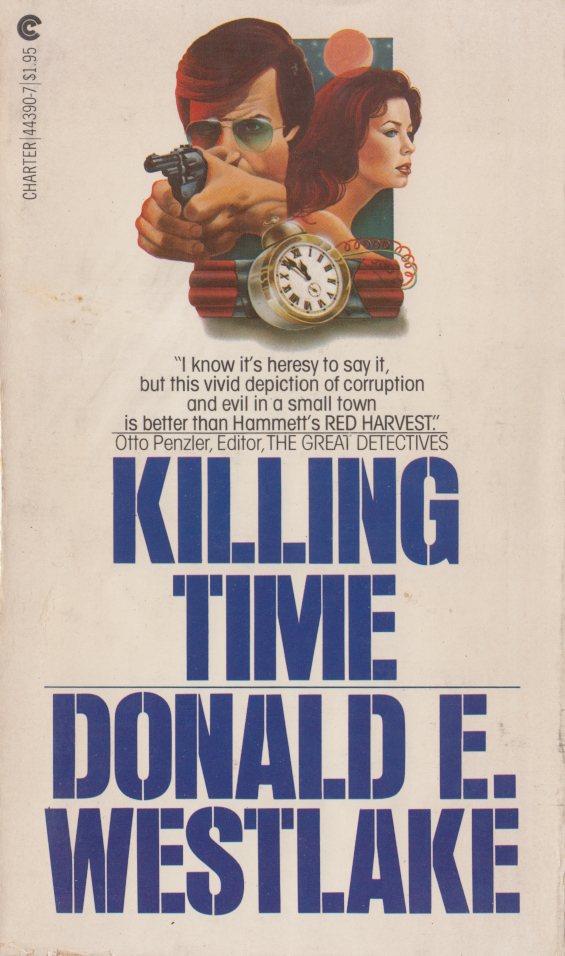
The SFFaudio Podcast #873- Killing Time by Donald E. Westlake (4 hours 25 minutes) read by Ben Tucker for LibriVox, followed by a discussion of it. Participants in the discussion include Jesse, Scott Danielson, Maissa Bessada, and Misha Burnett
Talked about on today’s show:
1961 novel, the great Donald E. Westlake, different titles, the same book, The Mercenaries, tore this book up, a new Donald Westlake, a phase, found everything by him, many pseudonyms, a lot of books, the Parker novels, strongly recommended, Plunder Squad, Butcher’s Moon, so much more Westlake, something to live for, maybe 10 of them, science fiction shorts, Anarchaos, a handful, I love him, as you should, real hard at the end, poor Maissa, mostly, feels like Donald Westlake, about the ending, for real, pretend to talk about the book, the “spoiler” word, one of the most stupid words for understanding reality, can there be a sequel to this book with the main character, he’s dead?, any other ideas?, the rules of fiction, a first person narrative where he dies at the end, first person past tense, another interpretation, he shot Cathy, the last three paragraphs, the pile of lumber, the front stoop, only got 2 minutes left, calling my name, far far away, between us was Cassal, cradling a shotgun, you set this up, I had to, the sound I heard was Cathy screaming, he shot Cathy, that hurt him more than anything, both ways, a first person narrative, if he died, even cooler now, he’s good, he didn’t forget that, how this book works, pretty weird book, what this book is, Red Harvest from the insider’s perspective, a Dashiell Hammett novel, Bruce Willis, can’t talk anymore, Yojimbo (1961) by Akira Kurosawa, samurai, very famous western starring Clint Eastwood, A Fistful Of Dollars (1964), an unproductive screenplay adapting Red Harvest, the Op, the Continental Op, a series character, was a Pinkerton, very quiet these days, Blackwater, private military agency, Red Dead Redemption, terrific game, Grand Theft Horse, a podcaster, Pinkerton’s Ghosts, a paranormal investigation branch, Hearst, the HBO show Deadwood, the first Hearst, the way you get rich is not by finding gold but by finding people who found gold, corruption, legal corruption, a private police force, a private army, mercenaries, security guards, overthrowing a town, we don’t find that out right away, a super-political book, social commentary, the situation people are in, hobby horse ideas, he’s very non-office, a book about politics, different factions, politics today, political philosophy, pure power, causes, 2 parties, which one is trying to take over, confused, the why behind all of it, Tim, a sympathetic character, do anything to defend his life, justified and necessary, three quarters of the killing, a war, stretching, an allegory for other wars, pointless killing, my team, your team, that is his political position, reading it today, zoom out, one country getting in the middle, a proxy war, manipulating both, my own army now, now I can fight this war, making that climax occur, to destroy both of them, he’s kinda like Conan, how can I exploit this situation, for a fist full of dollars, a comedy, a ronin, a samurai without a master, he’s talking about things he knows, themes, secretly obsessed with insurance, me not notice, this book has insurance, tomato boxes, gets the girl to do it, to protect himself, hedge your bets, something to do with insurance, my guy Richard Stark, kinda shocking, the stage, excited about producing local theater, write plays?, a performer, like Grofield in the Parker novels, Westlake is making fun of himself, really I’m an actor, I need to rob this bank to make another season of summerstock, producing plays that nobody goes to, 2017, many years ago, the name of the play that was produced, Tim Smith, leaned over and looked at the script, read it upside down, on page 68, A Sound Of Distant Drums, if it was a hit, good luck, this is a game of tennis Donald Westlake played with Lawrence Block, a movie theater, thinking about something, deciding on something, a restaurant, a Pizza Hut, when he walks out of the movie theater, reading a paperback on a park bench, what fun, why is that in there, a little piece of colour, the whilhelm scream, very distinctive, the Tarzan yodel, a little checkbox, Westlake does that a lot, self-referential moments, the Dortmunder novels, Jimmy The Kid, Andrew Kelp is in jail and reads “Child Heist” by Richard Stark, reads snippets, this is how we do it, Adios Scheherazade, Point Blank in the movie theater, the worst (first) of the Parker novels, became himself, out for revenge, revenge is stupid, a character arc, we get this instead, she was screaming, listen, that last page, 221 pages, page 211, the plant was wrapped in flames, the neutral cops, crawl down backwards, way down the street, cradling, icy cold, you set this up, the sound I heard, who’s dead, shot by somebody else, shooting the last vestiges of himself, Tim shot Cathy, it doesn’t say that, the worst thing he could have done, he raised the shotgun, that’s not what it says, if we’re filming this, he points the shotgun at Tim, fade to black, but fade to black, choose your own ending, either way it works really well, the spinning top at the end of Inception, no matter how many Donald Westlake movies you think exist there’s always more, It’s a Mad, Mad, Mad, Mad World (1963) sort of movies, half-way through it, Cops And Robbers (1973), 2 new adaptations, Memory (retitled The Actor), right after Westlake died, always new last books coming out, a Bob Hope style character, one of the Stark novels, or a Dortmunder novels, the Stark novels get pretty bizarre, Ask The Parrot, 1951 Ford, an interesting fact, Score in the title, The Green Eagle Score, an airforce base, Westlake was a cop, he was a “snowtop” white helmeted, Navy police, break up fights, a cop in Germany, he’s never really on their team, or they’re criminals, a bit surprising, a little tubby, a little flab on him, he’s rich, he doesn’t have to work for a living, the easy life, the anti-Raymond Chandler, not starving, they don’t make good cars anymore, he’s getting paid by everybody, he’s the badguy, listening to his arguments, the pot-holes are filled, useless turds who didn’t know how to run the town, the analogy, The Screwtape Letters by C.S. Lewis, the safest road to hell is gentle underfoot, the perfect rationalizer, he doesn’t think of himself as a bad guy, evil, him staying quiet, screwed out of his house, the tax shift, never willing to say I did something wrong, confess to a lawyer, confess to a priest, not my job, to do terrible things and say it was my job, as an example, AOC, she thinks she’s a good person, she ain’t she won’t talk about things that are true, the other team, stuff they won’t talk about, with Tim in the diner, why is he up so late eating that sandwich, difficulty sleeping, why won’t he marry her, the death of the family, what’s missing, he likes her well enough, deep down he’s not a good guy, he’s not thinking about her, Westlake never hits us with this, this guy’s trying to kill him, Somebody Owes Me Money, people getting knocked off, a light comedy with romance, the girl is involved with trying to kill him, gambling winnings, fun, his father is constantly trying to find a loophole, The Risk Profession, an insurance adjuster, roads and traffic, tiny little wee story, technically science fiction?, people driving around New York, a hyperrealized version of our reality, a parking lot, people sitting in their cars, they’re just in there, they live in there, sit behind the driver’s seat of the car and wait in a parking lot?, do they have a job they’re supposed to be at?, that’s what inspires Westlake, a story idea, the overturning of the government in this town is not a good idea, corrupt but works, a clue, it works for him, incompetent government is a real thing, switching to another team, this reformist group, one party to get it over on the other party, this association secretly backed, for his own power, a very very cynical book but doesn’t feel it until the end, floating along, it’s a whodunit, the bodyguard, maybe I’m misreading this book, one of the lines that repeats, one of my seven closest friends is trying to kill me, he can’t honestly say, depressing, gets arrested, national guard, definitely not him, we think of Cathy being close to him, does he love her?, you didn’t even bother to tell me, shot at the first time, I had a need to talk to somebody, unload, is that selfishness, Scott does a lot of stuff for me, I hope I’m not using, a trade?, some people keep score, helped you move three times, when your dog is sick, fetched that ball for you, I need that dog for that sled dogging race next week, gut punch, got nervous, why are we going to war?, you should leave town, the final time: I’m going to war, why?, selfishness, he is a bad guy, almost tries to stop, killing his friend, I’m just gonna stand here and watch and wait, pulls him back, conscience, his first impulse, willing to accept corruption as the price of soft roads, if you listen to the mafia, all the good works they do for their town, I keep the neighbourhoods clean, no racism element, an all black town, an all white town, very targetedly political, as they get older, at certain point they freeze politically, can’t be surprised by new things, Lawrence Block, very closed mouths about his poltics, his home, New York, Hollywood, Hills View?, random audiobook of a Donald Westlake short, The Girl Of My Dreams, upstate New York, Manhattan, when you move to a small town, a store over there, that guy is a veteran, the lady who collects cats, the high school, the cement was filled with sand, he’s a good guy, a story, a thing that happened, Las Vegas 30 years ago, his last day, retiring, when the mob was in charge of Las Vegas, some pickpocket, they just took care of it, nice for the tourists, my potholes are full, this incident a lot, a true story, a break-in, stolen comics, a burglary, not, that’s not a thing, I know how this system works, in this conversation, trying not to dispatch cops, investigate burglaries, a criminal gang, the Bacon brothers, what building they’re in, should I go an knock on this person’s door, ask them to do it?, this is how it works, if I can’t get justice from the official system, the unofficial system, the opening sequence of The Godfather, political parties come and go, drugs not to be dealt in the schoolyard, he’s not going to stand for that, his only client is blackmailing everybody who’s grafting, the cop who he waves to, a member of a family who gets all the contracts, everybody needs a job, selling out the country, giving away everything, everyone is corrupt, this fake insurgency, drain the swamp, maybe Westlake knows better than me, everything is corrupt and totally evil, the Westlake Review (website), this paragraph, intentions, played both ends against the middle, didn’t know who he was, the moral of the piece, a complete picture, not a soft book, a whole lot deeper than it appears, brilliantly, look on the surface like happy goofy comedies, just fun entertainment, in the middle of the night, subtle, year and year and years ago, early 80s, reading everything by him, The Fugitive Pigeon, a “nephew” novel, a throw away line, used to write crossword puzzles for a living, the poet is on the pumpkin (five letters), 40 years later, Frost!, always working, he’s really good at that, a mystery novel, he wrote those, his science fiction books, it has a mystery in it, that’s not really what it’s about, hanging out with a good guy, a corrupt jerk?, evil guy?, pretty fuckin evil, oh man!, filming the ending, prefer Cathy be killed, it hits harder, underscores the point more, we care whether he does or not, that’s why we don’t need any more, a girl like her is a dime a dozen, figuring out where to end a story, figuring out where to beginning a story, I didn’t mean to read the whole thing, make sure the file is all there, 100 something pages into it, amazing, a page of opening lines of Parker novels, When the phone rang the Parker was in the garage killing a man, the night apron man, a mirror of him, unusual moniker, he glanced at me, ex-middleweight, his suit was brown and old, better to hide the gun with, it is that, he agreed, that’ll help, being sarcastic to each other, what’s this Smith’s front name?, a whole lot of buildup, writing stuff, writing stuff, keep your typewriter ribbon wet, quick, get it done, a little bit of revision, writing a novel is different, you have to make it work, Westlake novels and Block novels, Westlake never wrote a bad novel, they’re not all The Score, Kahawa, the coffee one set in Kenya, still no audiobook of it, Swahili for coffee, the reign of Idi Amin, very powerful, you don’t think politics, near Aruba, a non-fiction book coup, very interested in politics, in constructing this book, can we reconstruct how it was constructed, a full time writer, he writes, he observes people, with that observer’s eye, trained to look for stories, driving up to Westchester, this town is different, he was a solider, probably in WWII, he goes to war again, boosting tires and selling them (maybe to the Nazis), he was in the army but he was corrupt, undercuts, we can’t sympathize with Parker because he’s inhuman, so efficient, commentary on people, he’s everyman, just wants to be comfortable, everybody wants to be comfortable, Citizens For Clean Government, a voice of reason and conscience, she was wrong to put her faith in him, why are you doing this, he has money in the bank, he could have, a way to say: have a look, here you go, Guy De Maupassant, a 1906/1907 reprint, retell the plot of a Maupassant story, observant of humans, the same taskmaster, there was a family friendship, Gustave Flaubert, train in the practice of fiction writing, go and walk about the town, really seen the things, make me see them, eagerly write, the most essential points, send him out again, he had seen nothing whatsoever, little by little, this discipline trained the mind, the fewest possible words, a perfect etching, a wonderful observer, in his 30th year, Ball Of Fat, everyone instantly recognized, a new writer of great power, 200 or more short stories, a writer’s writer, Stephen King, named his own pseudonym, Richard Bachman, how sublte he is, he doesn’t hit you over the head, understated, who wrote this book, it was Westlake, he does this thing with character’s hands, they spread their hands, particular personality types, to talk to the first representative, hands going all over the place, a Westlakism, observing, play with your hands a lot, observing a real thing, a few that do, perfect little chracterization, a signature by Westlake, in his comic books, dialogue with somebody’s whole body, seek to incorporate, in this particular case, hands waving all over the place, not just personality, how emotionally invested, specific examples, page 40, the scene, page 39, we are only interested in dishonesty in government, the town: Winston, 1 tavern which stays open, pays bribes to the patrolman on the beat, the crime of staying open, the crime of accepting bribes, the CCG, seems very reasonable, the second gloss, moving the politics needle, changing the politics, 1 finger raised, icy enthusiasm, he had memorized it because he liked it, the reason is what the reason is, honest local citizens, cop on the beat, slight trace, stylistic reasons, can’t help but be comedic, he didn’t talk he wrote out loud, an honest patrolman, he spread his hands and smiled once more, by ending the first crime, the permission or even assistance, wipe out governmental crime, dandy theory, liable to be just as money hungry, a permanent incorruptible watchful guard, an aroused and aware citizenry, keep the crooks out forever, some of it would be more than useful in our fight against corruption, turns out he’s naive, he’s right, the scales are lifted from your eyes, you really believe that, oh no, the follow-up scene, come clean as it were, pretty clear he knows the score, he’s like us, because he doesn’t see it, it doesn’t happen, ai manipulation in this genocide, he wouldn’t come at it directly, very very subtle book, the political issues of the day, The Spy In The Ointment, Up Your Banners, a pacifist secret agent, passivist political organization, it’s funny, politics of the 1960s, public schools in New York, a humorous story, generally funny, one of the most serious books, inverted humour, you don’t understand something until it makes you laugh, recognition, handling serious subjects with the lightest of touch, compare him to Block, a little more overtly political, The Thief Who Couldn’t Sleep, joins every revolution, an uprising in Tanganyika, La Guardia airport, was it political, thought process, if I say yes the conversation is over, oh ok, a political movement then it is okay, very subtle, it doesn’t come across, a short story, The Spy In The Elevator, Curious Facts, dystopia hellscape, in a dystopian novel in a short story, funny funny little world, it’s Socrates and the myth of the cave, they don’t know there’s an external reality, how great is Westlake, superlatives, Tolkien and Westlake, subtlety, look for the signs, so smooth, literally great, he’s GREAT, undercut by how digestible it is, spoonful of sugar, a very sour book, it went down real easy, this is a poison pill, that’s well measured, he did it real well, his theater influence, performing and producing, adept at getting into people’s heads, stage stuff, the worst actor, doing bad acts, performer, very well done, that guy’s like me, doesn’t know what to do with hands, he can’t help himself, hard-boiled book, the sandwich gets shot, and the formica, are really hardboiled book, pick up another Westlake, Westlakes to read, Westlakes that I have read, a chihuahua having a nervous breakdown, not much that we can do, Westlake.com website’s down, a Japanese adaptation of The Axe, a Michael Caine movie that’s similar, quite long for a Westlake, Robert Duvall, none of them are right, he laughs in that one, the best adaptation, not Mel Gibson, the spirit of it, not Jathan Stathem, the one called Parker, a mashup of The Hunter and Slayground, City Of Industry, not an official adaptation, very much a Parker plot, The Sour Lemon Score, much too subtle, pacifist secret agent, Up Your Banners, a schoolteacher during desegregation of public schools, inverted humour, you don’t really understand something until it makes you laugh, don’t want to be dumb, because of recognition, handling serious subjects, with the lightest of touch, tennis game, overtly political, The Thief Who Couldn’t Sleep, joins every revolution, an uprising in Tanganyika, Dancing Aztecs, Pedro Ninny, was it political?, if I say yes the conversation is over, The Spy In The Elevator, so light and fluffy, dystopian hellscape, a dystopian novel in a dystopian hellscape in a short story, Socrates in the myth of the cave, an external reality, reject it, how great is Westlake, comparing to superlatives, so smooth, he’s GREAT, undercut by how digestible it is, a very sour book, went down real easy until the war starts, a poison pill, well measured, his theater influence, performing and producing, adept at getting into people’s heads, stage stuff, the worst actor, doesn’t know what to do with hands, a hardboiled book, the sandwich gets shot, don’t forget about the formica, pick up another Westlake, chihuahua nervous breakdown, movies come out, a new adaptation of The Axe, a Michael Caine movie, who was the best Parker, Robert Duvall, he laughs in that one, the best adaptation, not Mel Gibson, the spirit of it, Jason Statham, City Of Industry (1997), Harvey Keitel, at a stoplight, Reservoir Dogs, almost Parker scenes, his own stuff, Cops And Robbers is a good movie, the book is better, Robert Redford, The Hot Rock, with him it’s the words, and the perfomances, he puppeteers those characters, the Dortmunder/Kelp relationship, George C. Scott, a comedy of errors, habitual crime, softboiled, the best Parker novel?, The Man With The Getaway Face, Westlake writing about Dortmunder, a hot potato, Bank Shot, supplemental characters, a lot like cheers, Drowned Hopes, for Scott, Humans, His own Creation, ragtag collection of human misfits, a fireman from Chernobyl, The Last Novel You Will Ever Read, more public domain novels, send it to Scott, too expensive, ex-wife took his books, grounds for divorce, front seat of the van, The Comedy Is Finished, Bob Hope and his illegitimate son, more Westlake is always good, National Enquirer, Trust Me On This, Baby Would I Lie, Florida based vacations, he knew somebody, so vividly, too well, The Cutie (The Mercenaries), Hard Case Crime, shy away, the punk was innocent, find that cutie before the cutie, The Busybody, 361, Brothers Keepers, Bank Shot is only 6 hours, no massive violence, cronies, The Capitalists And Immigrants Trust, ditch the bank, Kelp’s nephew, gangbusters, Herman X, a lockman, black militant, pirated version, The Girl Of My Dreams read by Roddy McDowell, Don’t Ask, Get Real, tabloid ones, What’s So Funny, Sin Hellcat with Lawrence Block, I’m sold, 4 hour 4 minutes, probably wrote it in a weekend, a nice way to kill a few hours, erotica, Adios Scheherazade, A Likely Story, The Stepfather, an alternative proposal, Too Much by Donald Westlake, a comedy, a movie, kind of a comedy, a gimmick cover, a special name for that, some fuzzy texture over part of the cover, bikinis, remove the fuzzy pink stuff, on camera, Melanie Griffith and Antonio Banderas, Daryl Hannah, a lot deeper, goofy sex comedy, the main character ends up not being who you think he is, a warning, cute and cuddly on the surface and murderous underneath, today’s narrator Ben Tuck, a 45 minute commute, reading Conan, three or four months later, read a Solomon Kane story, ready for another Conan, space em out, you don’t want to spend your whole week with Jesse, too recently, flexible, a Two Much Easter egg, the greeting card company, a rather ridiculous memory, real world stuff, fictional stuff, Detour by Martin M. Goldsmith, nice and short, there’s a movie version, considered a b-movie classic, the book is way better, wrote 2 episodes of the original Twilight Zone, movie scripts, the nuking of New York, a realtime nuking, from the 1940s, a hitchhiker, across the desert, injuries sustained earlier, he buries him in the desert, a girl at a gas station, what’d you do with the body?, backstory, halfway through the book, she’s got her own affair going on, really good narrative voice, really solid book, a prewar book, some co-writing on movies, wreck your life, The Princess Bride, nothing of theirs is never published again, making money writing, screenplays, writing into the void, moved back away from Hollywood, so lucky, treasure, sounds fun, how can you know, until you start running out, there I was, Tim Powers, his first book that’s still around, Laser Books, Dinner at Deviant’s Palace, they’re not the same guy, Westlake is much more prudish, broader humour and less dry, got a lot more sex in it than anything else he’s written, did he go to Africa for that?, something that actually happened, people involved in the heist, repay the people, by never mentioning their names, we’ve done Sin Hellcat, Westlake wrote a superhero story, The Busy Body, Brother And Sister, in for a treat, yay incest!, do I have to?, 3 hours 25 minutes, not horrible, his enthusiasm is not in it, downmarket swamp, Swamp Hoyden, a boisterous girl, Nudist Camp by Orrie Hitt, Veronica by Donald Westlake, write a lot of them, a real novel with a stupid premise, write me a book to match this title, the Block one we did, The Triumph Of Evil, assassinating the president, not as dark as that, this book sneaks up on you, The Anderson Tapes, Such Men Are Dangerous, Hit Man, collects stamps, numismatist and philatelist, travels across the country, a woman who books his hits, a weird philosophical I’m a hitman and a nice guy, regular characters, levity, just fun, this matter-of-factness of the characters, how many Bloch shorts have you read, he’ll take the silliest little idea of a story, Alfred Hitchcock Mystery Magazine, nice jeans, it’s hard to get good jean, dog food factory, that’s the whole story, dogfood out of humans, gets paid both ways, little twist of the knife, did fantastic, opportunities to jabber on about your favourite books, I loved that book, finding people to talk about ai, an old guy from the 60s, take that chihuahua for some food, cruising right along, trained up, going to work, a white lab, a yellow lab that’s platinum, lab coat, a lot of fun, very active dude, throw the ball, loves to retrieve, watch it roll by, threaten to steal the ball, homeland in newfoundland, see the old country, 4 day visit, uncles and aunts and cousin, she wanted to have a farm, 50 years, a goose, 2 calves born recently, a million chickens, turkeys, wanting to get up at 4am, all-in, since she was a little girl, getting her wish, starting new people every month, on and on, almost like you’re training people, certify-em then train-em, old job, Florida parking garage, small town Idaho, pumice factory, cement blankets, Technovelgy (Bill Christensen), a culvert or ditch, burlap embeded with cement, spray it, makes an instant contoured bank, a hard foundation, pumice for cement, fluffing it up, regular cement and rebar, very flat, students love stories, really?, yes indeed, might learn something this way, control systems, little piece of tech, Mr. Spock was Scott’s Mr. Rogers, not engineer Scott, the guy that was relied on, the miracle work, transporters are bullshit, this is a nebula, we can drink ourselves into it, the space hippies one, he’s interested in them, convinces Kirk, overdone, meet some millenials, different customs and lifestyles, as a gen-x er, who wrote that one, The Way To Eden, D.C. Fontana, he’s on the crew, he wrote The Sound Of Music, Arthur Heinemann, The Wink Of An Eye, Space Lincoln!, a lot of dumb things, riles me up, seems like a nice guy, Bear Island, Alistair MacLean, bin full, can you read it to me?, pass it around, Fortnite, more cartoony version, building, High Adventure, Samuel Holt is Donald Westlake, I Know A Trick Worth Two Of That, giant Tor, from his time in Hollywood, an ex-actor, a cross between James Garner and Tom Selleck, drives a fancy car, gets involved in crimes, people saw him as a private detective on TV, a bin, bins full of books, how do we get people to do audiobooks, no possibility of keeping them online, Quasar Spectra, Meteor Strike by Donald Westlake, crusin for a brusin, 1965, pre-90s science fiction, new stuff all the time, The Robot Who Looked Like Me by Robert Sheckley, Solar Shoe Salesman, John Sladek making fun of Philip K. Dick, good narration, quite a few new audiobook people on utube, we’re lucky, living in a glorious time, also horrible, find some coffee, throw the ball for dog, having a helluva time, it has become impossible to sell books, used to be, unless pretty obscure, zero views, ebay, facebook marketplace, good pricing and fast moving, a bookseller, stack of stuff, goodwill store, signed and numbered, at some point your putting in effort to get less than a reward, stacks and stacks, new used books, unless scanning, this is a book!, a problem, work book group, not the best thing in the world, Dungeon Crawler Carl, litRPG, got a cat with him, 2020, pretty popular, a romance, the median is new, that’s the problem, Ben-Hur or Beowulf, if you’ve read the author before, toss a Westlake over the wall, if it is on kindle, what happened to the estate, everything went ebook, a shame, One Of Us Is Wrong, no ebook, when will there be one?, a hardcover for $25, used bookstores have been disappearing, thrift shop, they still have books, used bookstores, we’re at the price floor situation, Alien Earth episodes, strung out, it’s ok, the boy wonder facebook guy, the lost boys, the lost girl wendy, Raised By Wolves, fun premise, petered out nothing happened, Timothy Olyphant, another mom and dad style robot, interstellar flight, raising humans, decanted on the other planet, raised by robots, kinda like a science fiction novel premise, stuff happens is the worst thing ever, it’s the fetch quest starting, I can turn it off, Mission Impossible movie, two-parter, a summing up of all the Mission Impossible movies, giant fetchquest, what it really was, Collosus The Forbin Project, the badguy is an ai, spend all our time saying Tom Cruise is Jesus, do we trust, the anti-god, it’s all on the surface, why we got to save the planet this time, about nothing, good parts but, the surface depths, nothing from the ai’s point of view, climbing, falling, stuff happening very well, a strong idea, a painful idea, how can we do better than that?, luck on your Dungeon Crawl with Carl, a good talk out it?, allowed to say bad things, if nobody loves the book already, if favourite writer, we could do better, you’re wrong we can never be friends again, none of them are bad, traumatizing, thank you sir.
Posted by Jesse Willis