
 The SFFaudio Podcast #519 – Jesse and Paul Weimer talk about new paperbooks, audiobooks, audio drama, and comics.
Talked about on today’s show:
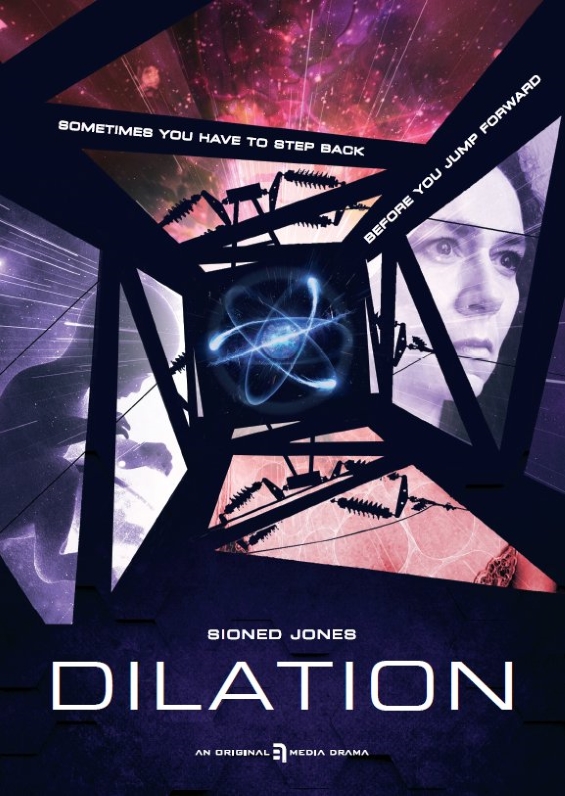
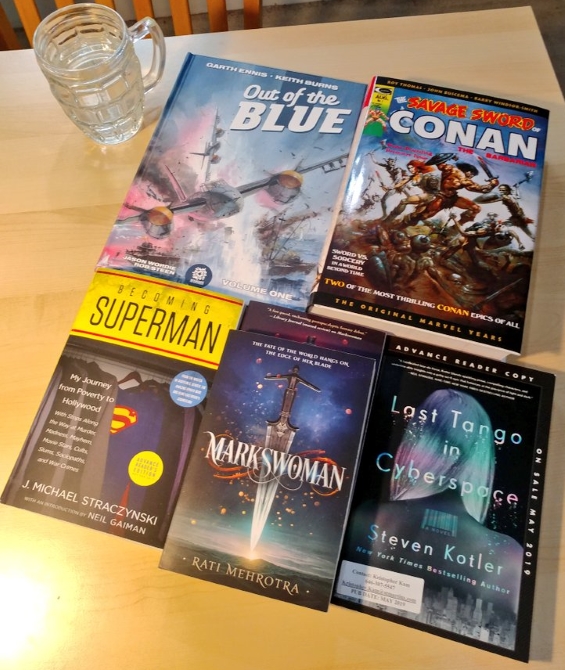
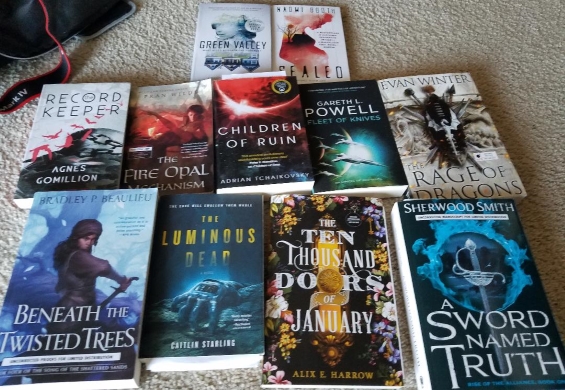
it stacks up, yo!, a book for review?, 10-15 books a week!, Mr Slow, a good result, Astounding by Alec Nevala-Lee, Becoming Superman: My Journey From Poverty To Hollywood by J. Michael Straczynski will be narrated by Peter Jurasik, no Centauri accent, a yummy sausage, why do book titles end :A Novel, making yourself more fancy, a literary pretension, The Luminous Dead: A Novel?, Thin Air by Richard K. Morgan, a rhyme or reason to their thinking, serious literature, why do we need to know that?, the middle initial, affectation, pen names, standard hat, maybe it works?, superpower, Luke Burrage’s Science Fiction Book Review Podcast review of Thin Air, mean Martian tunnels, two books in one box, a duology that came together, Markswoman and Mahimata by Rati Mehrotra, secondary world fantasy, audio of the first book, 11 hours, The Luminous Dead: A Novel by Caitlin Starling, it sounds good, caving on a foreign planet, spelunking, The Descent (2005), caves of New York, Minnesota, South Dakota, maps and caves, two cool maps, Dungeons & Dragons maps, The Nameless City by H.P. Lovecraft, Annihilation, The Martian, Adenrele Ojo, The Ten Thousand Doors Of January by Alix E. Harrow, portal fantasy, H.G. Wells’ The Door In The Wall, time travel stories as portal fantasies, Dilation by Max Hochrad, very high level, what exactly is going on, a much bigger world than we get to see, world-building to serve the story, an elf on a log, the trailer for Dilation, Do You Want To Know More?, B7 Media, Spiteful Puppet did Robin Of Sherwood audio drama, Big Finish, new Doctor Who, so many Doctors, more visually going on with sound, BBC iPlayer Radio App or BBC Sounds, The Prisoner is really good, sitting with the ideas, Patrick McGoohan, it becomes existential, exploration, the purpose and meaning of things, Mabinogi, ancient Welsh mythology, spending time 1000 years ago, the only thing comparable in North America is the H.P. Lovecraft Historical Society’s Dark Adventure Radio Theatre, The Lurking Fear audio drama is coming this summer, C.H.U.D.s, more audio drama, so much great audio drama is being made, our job, there’s too much, an intended 1984 dystopia, what exactly is going on, Dragonshadow: A Heartstone Novel by Elle K. White, The Coming Storm by Mark Alpert, feeling like a techno-thriller, political dystopic, climate change, Travelers, Tom Clancy books, turn that flag upside down, House Of Cards, Nightflyers by George R.R. Martin, the TV adaptation, the Michael Praed movie of Nightflyers (1987), Children Of Ruin by Adrian Tchaikovsky, Children Of time, how Paul manages to read paperbooks, no time for papercomics, UK authors, is there more money in audio than in paper?, only in audio releases, Audible.ca vs. Audible.com, The Pandora Room by Christopher Golden, Pandora’s box, The Phantom Empire 1935 serial, a western science fiction, Flash Gordon 1936 serial, yellowfacing, and Nicholas Cage as Fu Manchu, Machete, Hobo With A Shotgun, he’s from Mongo, Last Tango In Cyberspace: A Novel by Steven Kotler, something William Gibson wrote about a protagonist named “Case” (or Cacye), coolhunters, leaning tight, The Fire Opal Mechanism by Fran Wilde, magical jewels and people who resonate with them, a fun read, We Are Mayhem by Michael Moreci, Black Star Renegades, everybody likes Star Wars right?, robots and space battles, a 5 page glossary, a galactic rebellion, its exactly Star Wars, doing it your own way, since watching The Orville, Star Trek: Discovery‘s bad writing and not caring about science, Star Wars has a lot of baggage, killed off on a whim, Mark Hamill, answering honestly, wipe the slate clean, I shouldn’t walk out of the Star Wars experience and say “Really?”, going down the midichlorian walk, like Dune but awful, Hellhole by Brian Herbert and Kevin J. Anderson, just change the VIN, what a concept!, they don’t need Klingons, The Orville is great science fiction, I Am Behind You by John Ajvide Lindqvist, epic fantasy, The Rage Of Dragons by Evan Winter, epic fantasy, a peculiar audiobook, Jesse’s mom does not know him, A Peculiar Curiosity by Melanie Cossey, speaking of being read to…, The Phantom Tollbooth by Norton Juster, Rainn Wilson, for adults?, jumping to the island of conclusions, Paul would not say no, For The Killing Of Kings by Howard Andrew Jones, The Three Musketeers meets the Chronicles of Amber, Paul does pre-orders, deep explorations are not always needed, looking for fun, fantasy fun, an oversized hardcover from AfterShock Comics Out Of The Blue by Garth Ennis and Keith Burns, the war between, The Punisher, Nick Fury, TKO Presents, Sara by Garth Ennis and Steve Epting, Marvel Comics, Conan The Barbarian, Savage Sword Of Conan, Age Of Conan: Belit, Belit’s adventures as a young princess, why always starting as princesses?, go a-reaving, The Savage Sword Of Conan: The Original Marvel Years 1000 pages, Roy Thomas, new stuff from old stuff, Fleet Of Knives by Gareth L. Powell, Embers Of War, its better than it sounds, Ack-Ack Macaque, lots-o-fun, space opera, Powers Of Darkness: The Lost Version of Dracula by Bram Stoker and Valdimar Ásmundsson, R.C. Bray, a little bit of sexiness, a strange sidebar, The Record Keeper by Agnes Gomillion, Titan Books, he or she is doing everything, maybe its a house name, the technospace where you get house names to narrate, face-swap -> audio-swap, the Christopher Lee narrating a book from 2029, creepy cool, Chatting Science Fiction: Selected Interviews From The Hour Of The Wolf, WBAI, Ursula K. Le Guin, Kim Stanley Robinson, Samuel R. Delany, Cory Doctorow, Ray Bradbury, Nalo Hopkinson, Peter S. Beagle, China Mieville, Orson Scott Card, Lucius Shepard, Nancy Kress, Ken Liu, Charlie Jane Anders, Genevieve Valentine, Susanna Clarke, Connie Willis, a curiosity, Larry Niven books turning to audiobooks, A Gift From Earth, World Of Ptavvs, Bronson Pinchot, The Moon Maze Game a new Dream Park novel, Grover Gardner, a new cover, our show on Dream Park, Inconstant Moon, a classic, Steve Barnes, The Seascape Tattoo, The Magic Goes Away episode, All The Myriad Ways, The Secret Of Black Ship Island, Jerry Pournelle, The Burning City pissed Paul the beep off, blunt and pointed, senility setting in, Building Harlequin’s Moon, Brenda Cooper, does it spark delight?, terraforming, everyone starts regressing, Brenda Cooper does good writing with Larry Niven, set in the Ringworld universe, The Integral Trees, The Smoke Ring, physics problems, an adventure to explore what ideas Larry Niven has spun up, you definitely need to do this one and here’s why:, Bowl Of Heaven, The Very Best Of the Best: 35 Years Of The Year’s Best Science Fiction edited by Gardner Dozois, Charles Stross, Michael Swanwick, Nancy Kress, Greg Egan, Stephen Baxter, Pat Cadigan, 3 2 1, Exhalation: Stories By Ted Chiang, a new collection of Ted Chiang, Random House Audio, some copy that lives up to the hype, Ted Chiang: A Novel, Tony C. Smith’s StarShip Sofa podcast, an amazing story, Anxiety Is The Dizziness Of Freedom, standard Ted Chiang awesomeness, every three or four years he writes a story, the anti-Ken Liu, finally justified, REAL science fiction, GENUINE, “proto-technology of nano-realms”, Red Moon by Kim Stanley Robinson, Paul’s in a mood, INTERSTELLAR VOYAGES ARE IMPOSSIBLE, a hard truth, Aurora, the Chinese are going to the Moon, a really, really good writer, Jesse is so slow, In The Land Of Time: And Other Fantasy Tales by Lord Dunsany, edited by S.T. Joshi, Steven Crossley, pub tales, Dunsany is beautiful to hear, Clark Ashton Smith, funny and bittersweet tragic fun, LibriVox, one of these books, Who? by Algis Budrys, The Man In The Iron Mask, never made the A-team, the low end of the b-team, his biggest home run, 6 hours long, this ridiculous Cold War, propaganda, there was no “missile gap”, irrelevant and completely relevant again, Rogue Moon, an evil game show?, adapted into the film Moon (2009), hmmmmm.
Posted by Jesse Willis

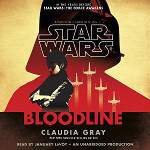 Star Wars: Bloodline (New Republic)
 Good Morning, Midnight
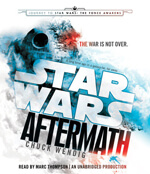 Aftermath: Star Wars (Journey to Star Wars: The Force Awakens)