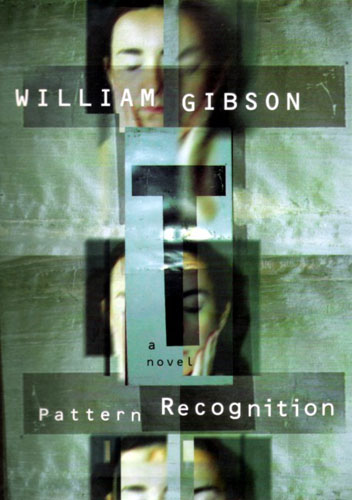
 Pattern Recognition
By William Gibson; Read by Shelley Frasier
9 CDs – 10.5 hours – [UNABRIDGED]
Publisher: Tantor Media
Published: 2004
ISBN: 140010095X
Themes: / Science Fiction / Internet / 9-11 / Crime /
“Cool Hunter.” How about that for a dream job? Companies pay you (and ply you with the latest technological goodies) to identify trends and fashions that spring up at street level so that they can commodify them and turn a buck. As far as I know, William Gibson (the man responsible for the term “cyberspace”) didn’t coin “cool hunting,” but he makes good use of the idea in “Pattern Recognition.” Cayce Pollard is Gibson’s heroine and the consummate cool hunter. Cayce can spend an afternoon walking through the teenagers clogging the streets of London when school lets out and identify at least three of tomorrow’s money-making fashion trends. She can look at two potential logos for a company and immediately know which of them will connect better with the targeted demographic. Like any other talent, though, being able to tell what works and what doesn’t has its downside. Cayce has an almost allergic reaction to most brand names; she’s got to have the labels removed from and the words filed off of the rivets on her black 501’s, her Casio G-Shock has got to be logo-free, and don’t even think about coming near her with a picture of the Michelin Man. Cayce is also deeply obsessed with a captivating film that has been mysteriously released, bit-by-bit, over the Internet, an obsession that opens the door for Gibson’s intricate plot.
Pattern Recognition was written soon after 9-11 (the events of which it references regularly), and is set in a very realistic 2002. The book probably doesn’t even technically qualify as science fiction, but Gibson keeps his ear so close to the tech-development ground that the story gives the impression of being futuristic. In fact, the book can be used as a sort of barometer to gauge your level of tech-geekiness. Are image-based search engines and vintage calculator fetishes old-hat to you? Congratulations, you’re ready to tackle Doctorow and Stross. Is the idea of a “render farm” unknown to you, and do you still double-take when you hear “google” used as a verb? Better stick to Card and Haldeman.
Having said that, this is probably the most accessible of all of Gibson’s books. His embrace of a post-cash economy era heroine and his tangential explorations of Internet forum social hierarchies and information-age Russian Mafia thugs will satisfy sci-fi vets (and provides solid evidence of Gibson’s place as a powerful influence on the new wave of cyber-post-punk writers), but the realness of Cayce’s femininity, the lack of one-dimensional characters, and, particularly, the overall attractive melancholy mood of the book make it one that you can safely recommend to your sci-fi avoidant spouse and friends.
I read the text version of Pattern Recognition soon after it came out, and was pleasantly surprised at how much enjoyment the audio book added to my experience. Shelley Frasier’s pleasantly dry narration, able handling of accents, and especially the sexy innocence she gives Cayce’s voice had me popping discs in one after another. I have a very pleasant memory of taking a break from a late-night Fawlty Towers marathon to get some Burger King, and staying in my garage five extra minutes just to finish listening to Shelley describe a British noodle bar called “Charlie Don’t Surf”.
The text version of the book includes a drawing of an object that is vital to the plot, and I was worried that the audio book might get awkward at that point, but truth be told, I didn’t even notice the absence of the drawing.
So, hats off to Gibson, Frasier, and the folks at Tantor Media for putting together an excellent reading of a great science fiction novel (that isn’t even really science fiction). As wonderful as Gibson’s more speculative work is, if Pattern Recognition is what it looks like when both of his feet touch ground, then I wouldn’t mind if he came down to earth more often.
posted by Cory Myler

 It looks like George R. R. Martin has been persuaded to join the growing ranks of Random House authors who’ll be doing “limited run” podcasts to promote their works. In eight episodes, George will “cover a range of topics from the birth of his acclaimed saga, to his experiences in Hollywood, to ‘weird stuff,’ and even reads an excerpt from his new paperback novel A Feast For Crows.” Out now is: