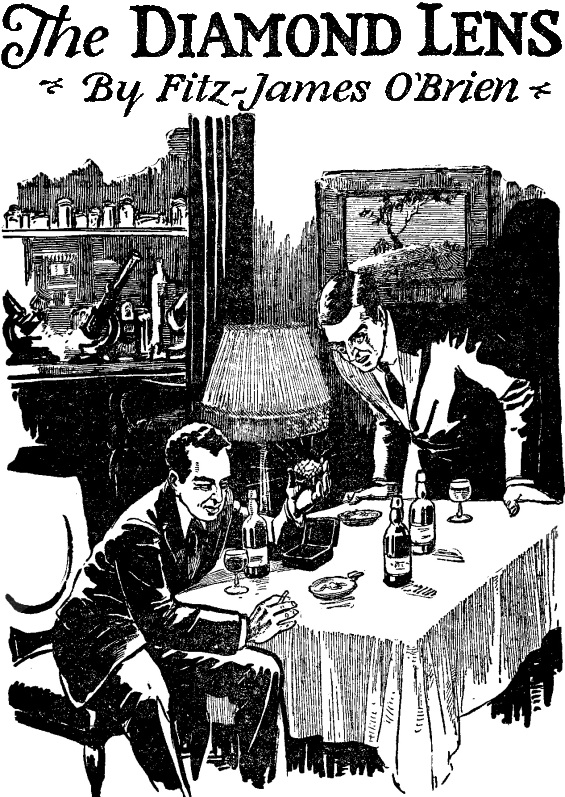
I’ve created a |PDF| from the printing in the December 1926 issue of Amazing Stories.
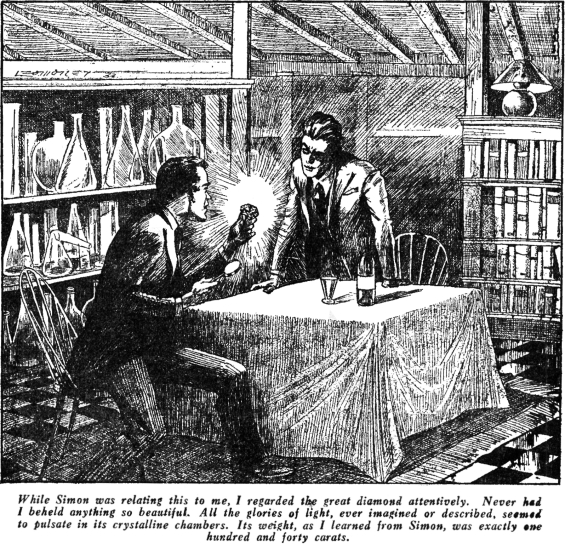
I’ve created a |PDF| from the printing in the October 1933 issue of Amazing Stories.
In his introductory essay “Expanding The Lens“, found in to the story in The Road To Science Fiction: From Gilgamesh To Wells, editor James Gunn writes:
“[The Diamond Lens] is the first known story in which another world is perceived through a microscope… [this story] opened up another world, not just for readers, but for writers as well.” Gunn goes on to praise O’Brien’s “realistic treatment of the fantastic” and says that “‘The Diamond Lens‘” may be the first modern science-fiction story.”
LibriVox narrator Corrina Schultz describes The Diamond Lens this way:
“This story has a bit of everything – obsessive scientist, psychic medium contacting the dead, clever murder cover-up, racism, creepy stalker, college student shirking his studies, the painful results of pursuing forbidden knowledge, the noble savage…”
Atop those words I myself can heap a few other attractors:
1. The Diamond Lens is bizarre in both plot and focus, with episodic like writing <-Weird for a short story. 2. It has the sensibility of a foreign culture <-The 19th century attitude toward seances is pretty fucking foreign! 3. The protagonist is a mad microscopist. <-Perhaps he was demented by the illicit lure of science? 4. The story features a brutal killing. <-With a whackjob of added racism to complicate matters! 5. It has a noir ending. <-My favourite kind. As you may have guessed I quite enjoyed The Diamond Lens.
Stories like Harl Vincent’s Microcosmic Buccaneers (1929), Theodore Sturgeon’s Microcosmic God (1941) and both Sunken Universe (1942) and Surface Tension (1952) by James Blish all stem from the microscopic pioneering of The Diamond Lens. Whereas the theme, of an alien female object of adoration in an unreachable land, also brings to mind a mighty parallel with Jack Williamson’s The Green Girl (1930). And one final note, a quick read of the Wikipedia entry for Fitz James O’Brien makes me think some of the tale is autobiographical!
 The Diamond Lens
By Fitz James O’Brien; Read by Corinna Schultz
1 |MP3| – Approx. 57 Minutes [UNABRIDGED]
Publisher: LibriVox
Published: FORTHCOMING
A scientist, having invented a powerful microscope, discovers a beautiful female living in a microscopic world inside a drop of water. First published in the January 1858 issue of The Atlantic Monthly.
 The Diamond Lens
Based on the story by Fitz-James O’Brien; Performed by a full cast
1 |MP3| – Approx. 25 Minutes [RADIO DRAMA]
Broadcaster: MBS, NBC, ABC
Broadcast: December 31, 1944
Provider: Archive.org

Posted by Jesse Willis