
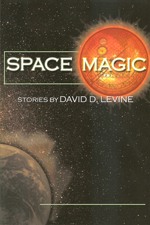
Review of Space Magic by David Levine

SFFaudio Review

Space Magic by David D. LevineSpace Magic
By David D. Levine; Read by David D. Levine
Publisher: Book View Café
Publication Date: 25 June 2013
ISBN: 978-1-61138-281-5
[UNABRIDGED] – 7 hours; 56 minutes

Themes: / short stories / interstellar salesman / comic book fantasy / space  magic /

Publisher summary:

This Endeavour Award-winning collection pulls together 15 critically acclaimed science fiction and fantasy stories that take readers from a technicolor cartoon realm to an ancient China that never was, and from an America gone wrong to the very ends of the universe. Including the Hugo Award-winning Tk’Tk’Tk, the Writers of the Future Award winner Rewind, Nucleon, The Tale of the Golden Eagle, and many other highly-praised stories, Space Magic shows David D. Levine’s talents not only as a gifted writer but as a powerful storyteller whose work explores the reaches of space as well as the depths of the human heart.

Space Magic is a collection of short stories by David D. Levine that are either Science Fiction, Fantasy, or some combination of those together. I really enjoyed this short story collection. Short stories in general sometimes feel underdeveloped or trivial, but the stories in this collection each do a great job of introducing a whole new world, what’s going on, and coming to a satisfying conclusion. If you like science fiction or fantasy of any kind, this is a great collection of stories.

Here were some of my more favorite stories:

Nucleon – This was like Mr. Magorium’s wonder imporium at a junkyard. A fun concept and likeable characters.

Zauberschrift – Really cool story about a scribe who used to apprentice with feuding wizards needs to help a village plagued by bad magic. Really cool magic ideas and insights into mob mentality.

Rewind – This story really reminded me of Equilibrium in how you have someone from an elite force of some totalitarian government join in with the rebellion with his super abilities/powers. So many possibilities in this story.

Brotherhood – A great story of the labor force in their struggles with the man that will have you wondering why it’s in this collection for most of the story…(in a good way)

Tk’Tk’Tk – This story takes the problems of a salesman selling to a different culture to the extreme. What if you were an interstellar salesman coping with the cultures of another species you could barely understand?

Charlie the Purple Giraffe Was Acting Strangely – This story is crazy. What happens to comic characters between the cells and between the comics?

The Ecology of Faerie – This story is like Faerie horror. I don’t know how Mr. Levine did it, but he made a Faerie story like Night of the Living dead and it’s awesome!

David D. Levine does his own reading for this book, and does a decent job.

Posted by Tom Schreck
Review of The Elephant Vanishes by Haruki Murakami

SFFaudio Review

The Elephant VanishesThe Elephant Vanishes: Stories
By Haruki Murakami; Translated by Alfred Birnbaum and Jay Rubin
Read by Teresa Gallagher, John Chancer, Walter Lewis, Rupert Degas, Tim Flavin, Mark Heenehan, Jeff Peterson
Publisher: Random House Audio
Publication Date: 6 August 2013
[UNABRIDGED] – 10 hours, 31 minutes
Download excerpt: |MP3|

Themes: / light fantasy / personal identity / life’s meaning / a dwarf inside of me / short stories / surrealism /

Publisher summary:

With the same deadpan mania and genius for dislocation that he brought to his internationally acclaimed novels A Wild Sheep Chase and Hard-Boiled Wonderland and the End of the World, Haruki Murakami makes this collection of stories a determined assault on the normal. A man sees his favorite elephant vanish into thin air; a newlywed couple suffers attacks of hunger that drive them to hold up a McDonald’s in the middle of the night; and a young woman discovers that she has become irresistible to a little green monster who burrows up through her backyard.

By turns haunting and hilarious, The Elephant Vanishes is further proof of Murakami’s ability to cross the border between separate realities – and to come back bearing treasure.

Some of the stories in this collection originally appeared in the following publications: The Magazine (Mobil Corp.): “The Fall of the Roman Empire, the 1881 Indian Uprising, Hitler’s Invasion of Poland, and the Realm of the Raging Winds” (in a previous translation; translated in this volume by Alfred Birnbaum), The New Yorker: “TV People” and “The Wind-up Bird and Tuesday’s Women” (translated by Alfred Birnbaum), “The Elephant Vanishes”, and “Sleep” (translated by Jay Rubin), and “Barn Burning” (in a previous translation; translated in this volume by Alfred Birnbaum) Playboy: “The Second Bakery Attack” (translated by Jay Rubin, January 1992).

In Haruki Murakami’s The Elephant Vanishes, Murakami tries to bind a collection of stories with a few common threads woven through the various narratives.  At this, Murakami failed to hold my interest.  But Murakami does manage to seduce the reader, if only from time to time, with glimpses of brilliant storytelling.  And it became the prospect of discovering these hidden gems that kept me going.

I don’t think that Murakami shines in the short story genre.  His style of writing requires time for the odd sense of surrealism to grip the reader, sometimes like a lover, other times like an anaconda.  But in these short works, Murakami’s talent for making the odd seem normal, had too much of a rushed sensation.  Instead of being seduced, I was narratively groped.

I didn’t appreciate the numerous narrators that this audio production contains.  It would have been far better to have two or perhaps three readers, but this audiobook simply has too many voices.  I ended up feeling detached for too much of the time.  I liked that this audio production doesn’t use musical interludes to mark new stories or sections of change.

Should you read this book?  Well, if you like Murakami, then yes.  But you should go into this with the understanding that some of these stories just flop with all the grace of a sweat-soaked sock on a locker-room floor.  But a few of these tales possess a magic vitality that lingers in the consciousness long after you are through.  It is for these stories that make the reading worthwhile.

Posted by Casey Hampton.