
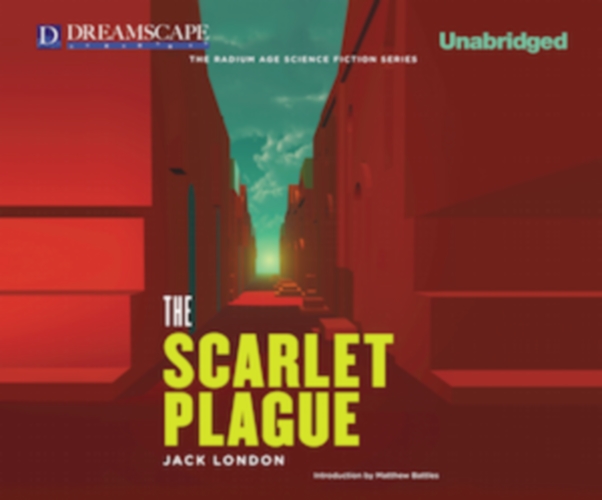
 The Scarlet Plague
By Jack London; Read by Drew Ariana
Approx. 2 Hours 13 Minutes [UNABRIDGED]
Publisher: Dreamscape Audio
Published: August 20, 2013
Themes: / Science Fiction / San Francisco / Plague / Post-Apocalypse / Disease / Philosophy / Politics / Class Conflict /
The year is 2013 and plague has struck. Not a wannabe killer like SARS or the Spanish flu, but a tsunami type devastation that swallows every living thing, check that, every person, in its path. Its nickname is the red death because at its arrival the first thing that happens to the infected person is they start sporting a red face – like a beacon for everyone else around them to – RUN. The next thing that happens is they die. Well a little more goes on in between, numb feet, numb hands, a heart so numb it stops. All within an hour, or a few hours if the person is lucky/unlucky enough to have it drag out that long. Then for fun what’s left of the numbed, red faced, ex-person, immediately starts decomposing, falling apart before the eyes of anyone still around to witness it, practically shooting decomposing germs into the air like a plant shooting its spores. There are two classes of people, the ultra rich and everyone else. As the ultra rich jump into their airships to get as far away as possible, they just carry death with them – first class. Everyone else simply falls down and dies where they are. The devastation’s full name is Scarlet Plague. Sixty years into the future when the very few last contenders of what was once the mighty human race hear tell about it, they can’t even decipher what scarlet means because language (like life) has degraded to the point of only holding on to what’s necessary. Scarlet is red. Counting only needs to go as high a ten. The squiggles on money and books are meaningless, but that’s of no consequence because neither books nor money are in use anyway. Apologies, I’m getting ahead of myself. About 160 years ahead.
The Scarlet Plague by Jack London, published in 1912 is about the plague that will strike 100 years from his time, told from a perspective 60 years hence by the last man alive who’s ever seen an airship or read a book. 2013, a hundred years into the future for Jack London, is today and yesterday, this week. Hearing this story now, is like what it was to read (or re-read) 1984 in 1984. Sort of surreal. Interestingly 1984 is a year that was mentioned in the story of the plague. Did George Orwell choose that year with a tip of his hat? Probably. I’ve heard George was a fan.
Back to Jack. What did he get right? What did he miss? Commercial airships? Instant wireless communication? Check, check. About 8 billion people planet wide? Check. The ultra rich and everyone else, hmmm, not that far off the mark, probably pretty close considering he was most likely exaggerating a little to make a point. The work didn’t actually feel like science fiction, it felt contemporary, the section that describes this part of the century anyway. Like his projection to 2073 started from here, not from a century ago. Because the today part of the story is so right, it makes the rest of the story worse.
Not worse as in it’s a bad story. It’s an excellent, superbly imagined, tangible story. Worse in regards to how Mr. London judged the human condition. 60 years from now, 160 years from when the book was written, James Howard Smith or Grandsir, is telling his three grandsons the story of the plague. A story that was in great demand 20 or 30 years before, is quickly becoming lost – now of passing interest to two of the boys, and of real interest to only one. For one thing Grandsir’s sentences are way too complicated, especially when he goes off into his memories and starts speaking as he used to do when he was professor of English literature at Stanford. Speech has become staccato and minimalist, the niceties of language having died off with everyone that had time for that sort of thing. The other problem is the things Grandsir talks about make no sense to the boys. Cities, cars travelling by air, exchanging things with money, wasting time with written markings, all of it is so outside of what the boys know it might as well be make believe. The ramblings of a deranged, lost, old mind. With an estimated world population of less than 500, life has become a question of survival. If you want to eat then you have to go out and kill yourself some dinner. Grandsir calls his grandsons savages. When he was a boy (one of his constant refrains) there were those who gathered food and those who ordered its gathering. His progeny has been reduced to food gatherers. Interestingly Grandsir’s still got them gathering food for him. Old habits die hard I guess.
So why was this professor of classical literature spared to help re-forge humanity? No reason. One in every few million just didn’t get red faced. Maybe death momentarily blinked as it passed them by or got distracted by the particularly amusing scene of the mountains of bodies piling up at its feet. A couple of feeble minded, the very richest most splendid woman in America, a violent, vile, wife beating chauffer who made himself her husband, our friend the professor – just a few random cards in the deck. Life’s like that. You build your magnificent cities, you spend your time creating art and pondering the great questions, and life responds by carelessly wiping itself out. Careless in that it doesn’t quite finish the job. But no matter, because life will make its way forward again.
And now we come to the worst part of the story. It’s not the plague and what happens in the aftermath. The author makes it clear that ultimately, in the long run, humanity will rally back. They’ll rebuild and create again. The worst part is what Mr. Jack London sees after that.
Drew Ariana who read the story in this recording did a good job. My only issue was the character voice he assumed for Grandsir. I didn’t have a problem with the voice, the problem was, so much of the story was told using this voice it became a little distracting. Otherwise, an easy, pleasant listen.
By the end of the book, awash in dystopia, I was seeing a little red. Too delightful not to share, here’s a little red (or Scarlet) for you. “All man’s toil upon the planet was just so much foam. He domesticated the serviceable animals, destroyed the hostile ones, and cleared the land of its hostile vegetation and then he passed and the primordial flood of hostile life rolled back again, sweeping his handy work away.”
Posted by Maissa Bessada
 The Wonderful Story of Henry Sugar and Six More