

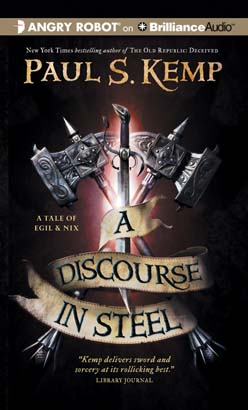
 A Discourse in Steel
By Paul S. Kemp; Read by Nick Podehl
10 hours 11 minutes [UNABRIDGED]
Publisher: Angry Robot on Brilliance Audio
Published: 2013
Themes: / sword and sorcery / magic / adventure / fantasy city
My first encounter with the sword-and-sorcery genre came when I discovered Fritz Leiber’s Fafhrd and the Gray Mouser stories, neatly packaged into audiobooks at Audible with introductions from no less a figure than Neil Gaiman. How could I refuse? While Leiber’s world-building was top-notch, though, I found fault with his lack of any real character development. Now, I know what you’re thinking: Seth, characters in a sword-and-sorcery novel aren’t supposed to be developed! While I agree in principle that the genre is supposed to thrive on antiheroes like Michael Moorcock’s Elric, there’s a vast difference between making an intentional authorial decision not to develop characters, or to develop them in an unconventional way, and simply neglecting the care and feeding of a protagonist. Of this I found Leiber guilty. So I set the genre aside in hopes of finding a specimen more suited to my predilections.
Enter Paul S. Kemp’s Nix and Egil series. The eponymous heroes (it’s almost impossible to call them antiheroes) are, respectively, a sprightly little man of craft and cunning from the slums of Dur Follin, and a hulking, hammer-wielding priest of Ebenor, the momentary God. At first glance, you would be forgiven for mistaking this pair for Leiber’s Fafhrd and Gray Mouser, or, perhaps if you squint, Terry Pratchett’s Bravd and the Weasel. But where Leiber’s adventurers are often gray as the Mouser’s name, Kemp’s likable rogues flash and sparkle like a colored prism, reflecting and refracting their personae as the wheel of the story turns. And speaking of the city of Dur Follin, its twisting alleys, Low Bazaar, taverns, and guild houses are every bit as well-realized as Leiber’s Lankhmar.
I rediscovered fantasy in my teens through reading David and Leigh Eddings’s mammoth epics. While I now recognize that much of their work was middling at best, I still admire their capacity to write charming, amusing, and at times poignant dialogue. Kemp has honed this particular skill to a keen edge. The playful, good-natured banter between the two unlikely companions will have you laughing out loud one moment and pondering the mysteries of life itself the next. Their friendship is deep and genuine in the way that so many fictitious friendships simply aren’t. Nix and Egil each have their own past, present, and (it is to be hoped) future. Their hopes, fears, and regrets are writ large in the story’s pages, and this emotional element propels A Discourse in Steel beyond the mark of mere adventure into territory that far too fantasy novels explore.
You’ll notice I’ve said nothing of the plot. This is partly because I cordially dislike plot regurgitations in reviews, but also because the plot is, in a sense, unimportant. I don’t mean to suggest the plot is bad. In fact, it’s well-paced, intricate for a novel of this length, and not without its little surprises. But one comes away from reading this book with a sense that the plot served mostly as a backdrop for exploring these two remarkable characters, like set decorations in a theater performance. Of course, if all this emotional and philosophical discussion makes your eyes glaze over, and you just want to read fun stories of swashbuckling adventure, fear not, A Discourse in Steel has them in spades, or hammers. As you can probably tell by now, I am more captivated by the character development, and sometimes felt the plot barged in on a real moment of heart, but I confess that most readers will find the novel’s plot and pacing perfectly measured.
The novel isn’t without its faults. Nix and Egil are masterfully developed, but the book’s other dramatic personae, with a couple no notable exceptions, lack that same fit and finish. The villains, in particular, come across as fairly one-dimensional, even though they get a lot of stage time. Rusilla and Merelda, the tale’s damsels in distress, fare slightly better, especially towards the end, but as the series title suggests, this is the Nix and Egil show. The novel also flags a bit once the plot maneuvers the characters out of the stress of Dur Follin, which as a city is complex enough to be a character in its own right. To paraphrase one of the characters, Nix and Egil seem to belong in Dur Follin, and watching them out of their element, like fish out of water, takes a moment’s adjustment. The book’s last fault, if you could call it that, is that it ends too soon, leaving several key questions unanswered, questions about Egil and Nix, questions about the city of Dur Follin, and questions about the wider world beyond.
The audiobook is narrated by Nick Podehl, who, to me at least, has become synonymous with epic fantasy in audio, thanks in no small part to his narration of Patrick Rothfuss’s Kingkiller Chronicles. His bag of vocal tricks just seem to be a natural fit for the genre. He is able to glide smoothly between Egil’s rumbling curses and Nix’s falchion-sharp witticisms, and during the action sequences his sense of timing is impeccable. Podehl is the narrator equivalent of what’s called in Hollywood a character actor. He lacks the star power and name recognition of a Simon Vance or a William Dufris, but if you’ve listened to many audiobooks recently, you’ve probably heard his voice. He certainly does justice to Kemp’s work.
A Discourse in Steel is the second Nix and Egil adventure, but it can be read on its own, though its predecessor, The Hammer and the Blade, is nearly as good. I’m grateful to the efforts of Paul S. Kemp and his creations Nix and Egil for showing me that the sword and sorcery genre can embody both style and substance. Maybe it’s time I revisit Leiber and the other S&S greats; maybe I’ll find they’re not as soulless as I thought.
Reviewed by Seth Wilson.
 Lockdown: Star Wars (Maul)