LibriVox: Beside Still Waters by Robert Sheckley

SFFaudio Online Audio

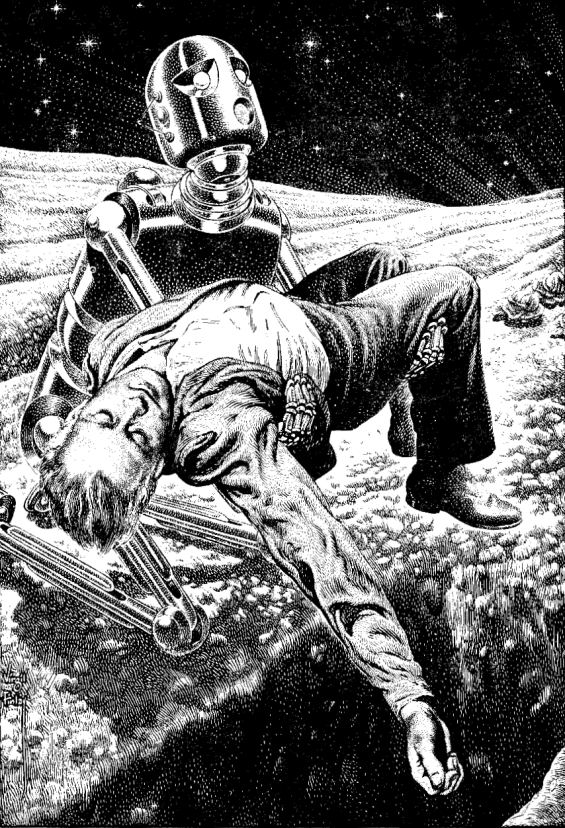
Robert Sheckley was a joker, a satirist, a poker of fun at all of the silliness in life. But there’s something more going on in this short short story from 1953. Sure there’s the existentialist angle, and of course there’s the requisite Sheckley humor, but it’s the other quality in Beside Still Waters that makes this Sheckley story a bit different. You can see it right there in the title (taken from Psalm 23 of the Hebrew Bible), and you can see it in the Virgil Finlay’s illustration for the story too:

Beside Still Waters by Robert Sheckley - Illustration by Virgil Finlay

Beside Still Waters is an elegiac tale, offering only a cup of sadness to the reader, it’s the sort of story that Clifford D. Simak might have written. And that should be recommendation enough.

LibriVoxBeside Still Waters
By Robert Sheckley; Read by Frank Malanga
1 |MP3| – Approx. 10 Minutes [UNABRIDGED]
Publisher: LibriVox.org
Published: November 28, 2010
When people talk about getting away from it all, they are usually thinking about our great open spaces out west. But to science fiction writers, that would be practically in the heart of Times Square. When a man of the future wants solitude he picks a slab of rock floating in space four light years east of Andromeda. Here is a gentle little story about a man who sought the solitude of such a location. And who did he take along for company? None other than Charles the Robot. First published in Amazing Stories Oct.-Nov. 1953.
|ETEXT|

And here’s the |PDF| I made from the original magazine publication.

Posted by Jesse Willis

The Geek’s Guide To The Galaxy #55 – Michael Chabon

SFFaudio Online Audio

Geeks Guide To The GalaxyA recent Geek’s Guide To The Galaxy podcast was an interview with Michael Chabon, mostly about his role in the John Carter script.

Now depending on the guest and the topic Geek’s Guide To The Galaxy can be anywhere from fairly interesting to absolutely fascinating.

But like far too many podcasts it’s biggest problem is not content, it’s the volume mix.

Podcasts are not only listened to with high end earphones in soundproofed rooms, they’re listened to in the rain, in the streets, and from the tiny little iPhone speaker across the room.

Geek’s Guide To The Galaxy‘s volume is just too damn low.

Despite this, here’s the |MP3|.

Posted by Jesse Willis

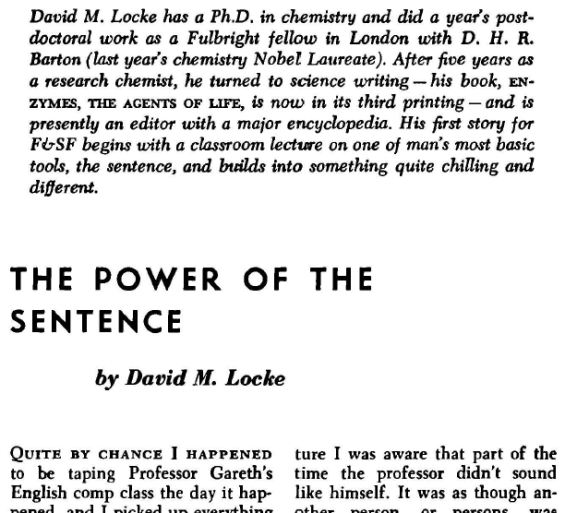
Mindwebs: The Power Of The Sentence by David M. Locke

SFFaudio Online Audio

I just got an email from a friend of the site. He had this to say:

So, in between listening to Carlin’s podcast [Dan Carlin’s Hardcore History], and the Mindwebs episode I’m including here, I remember something one of your guests said during one of your podcasts. It might have been Gregg, and I can’t remember which podcast, but he said something to the effect that human bodies are vessels to carry ideas into the future, so that bodies are irrelevant, beyond that purpose. That’s a very interesting idea to explore, the pervasiveness of ideas, how once an idea is in the open, no amount of censorship can make it go away, and hence this Mindwebs episode.

My friend had added a recording as an attachment to the email, and after scanning it for viruses, I listened to it.

The Power Of The Sentence

Contrary to my anti-virus software’s opinion the audio does contain a danger.

And now after sharing that warning sentence with you I should point out that The Power Of The Sentence was David M. Locke’s only Science Fiction work. I’m wondering now if perhaps the story was not fiction, and that maybe the story was finished by a student of his.

Here are the details…

MindwebsMindwebs – The Power of the Sentence
By David M. Locke; Read by Michael Hanson
1 |MP3| – Approx. 28 Minutes [DRAMATIZED READING]
Broadcaster: WHA Radio (Madison, WI)
Broadcast: April 21, 1978
Provider: Archive.org
An English professor lecturing about the use of sentences finds his examples are taking on a life of their own. First published in the April 1971 issue of Fantasy & Science Fiction

Incidently, more details about Mindwebs are available at the OTRPlotSpot.com.

[Thanks Mel … I think … We think.]

Posted by Jesse Willis

The Shadow And The Flash by Jack London

SFFaudio Online Audio

The Shadow And The Flash by Jack London

Famous Fantastic Mysteries, June 1948 COVER - The Shadow And The Flash by Jack London

Famous Fantastic Mysteries, June 1948 - The Shadow And The Flash by Jack London

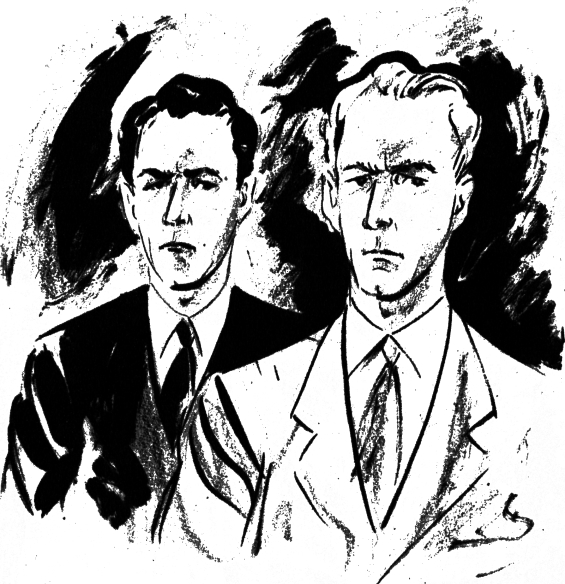
Here’s one of Gregg Margarite’s earliest narrations for LibriVox. Because it was so early it sounds like one of his more amateur recordings – mostly because Gregg reads it too fast. But one thing that didn’t really change, that needed no refinement, his skill at picking stories to record. This Jack London short story is fun Science Fiction. It’s about a pair of nearly identical, ferociously competitive, brothers. The tale was written in 1902, five years after The Invisible Man, by H.G. Wells, was published as a novel.

Indeed, the plot is rather … how shall I put this ? … familiar ? … with the The Invisible Man. But that’s okay as there’s a line aknowledging it by one of the brothers. At least it’s a hat-tip in that direction. But instead of one mad scientist as in Well’s novel, we have two in The Shadow And The Flash – in fact were they a pair of superheroes (or supervillains) that’d be each of their names (The Shadow and The Flash) as they get their powers from the way they approached the problem of invisibility – that is to say from opposite ends, as it were.

It was at about seven minutes in before the story really took off – here’s the part that grabbed me:

Lloyd warmed to the talk in his nervous, jerky fashion, and was soon interrogating the physical properties and possibilities of invisibility. A perfectly black object, he contended, would elude and defy the acutest vision.

“Color is a sensation,” he was saying. “It has no objective reality. Without light, we can see neither colors nor objects themselves. All objects are black in the dark, and in the dark it is impossible to see them. If no light strikes upon them, then no light is flung back from them to the eye, and so we have no vision-evidence of their being.”

“But we see black objects in daylight,” I objected.

“Very true,” he went on warmly. “And that is because they are not perfectly black. Were they perfectly black, absolutely black, as it were, we could not see them—ay, not in the blaze of a thousand suns could we see them! And so I say, with the right pigments, properly compounded, an absolutely black paint could be produced which would render invisible whatever it was applied to.”

“It would be a remarkable discovery,” I said non-committally, for the whole thing seemed too fantastic for aught but speculative purposes.

LibriVoxThe Shadow And The Flash
By Jack London; Read by Gregg Margarite
1 |MP3| – Approx. [UNABRIDGED]
Publisher: LibriVox.org
Published: March 12, 2009
A tale about two brothers who take different routes to achieving invisibility, as narrated by their best friend. First published in The Bookman, June 1903. Later published in The Windsor Magazine, October 1904, and in Famous Fantastic Mysteries, June 1948, Leoplan #502 (May 18, 1955).

Here’s The Windsor Magazine edition |PDF|, here’s the Famous Fantastic Mysteries edition |PDF|, and here’s a Spanish translation from Argentina’s Leoplan |PDF|.

Illustrations from The Windsor Magazine publication:
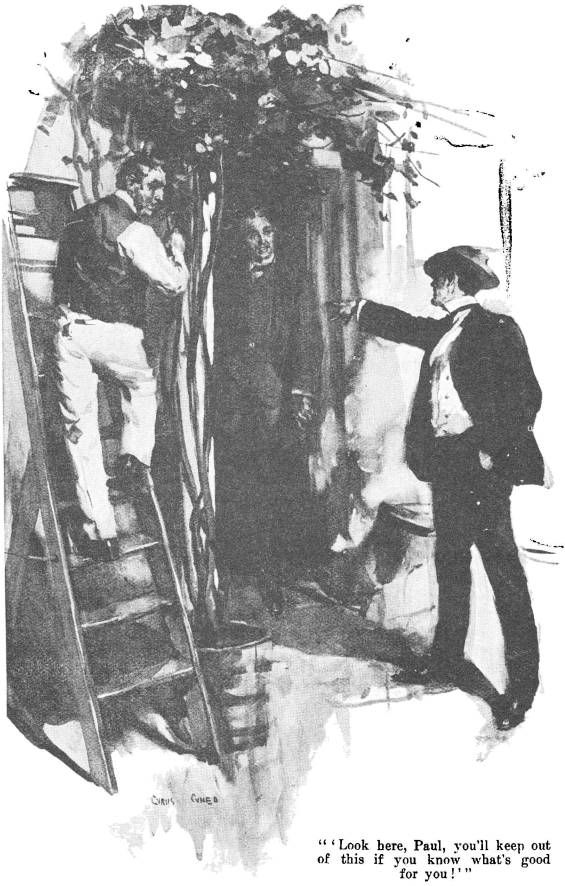
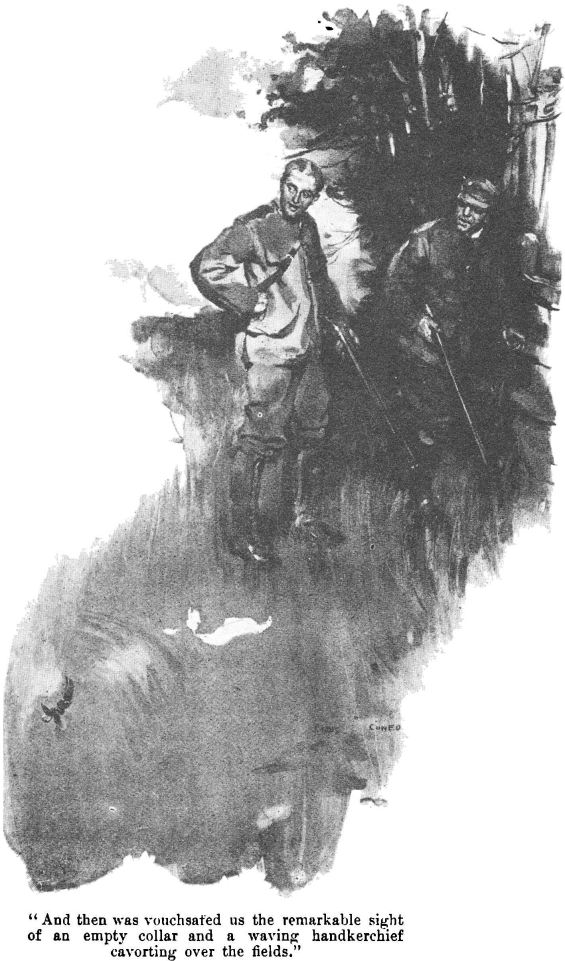
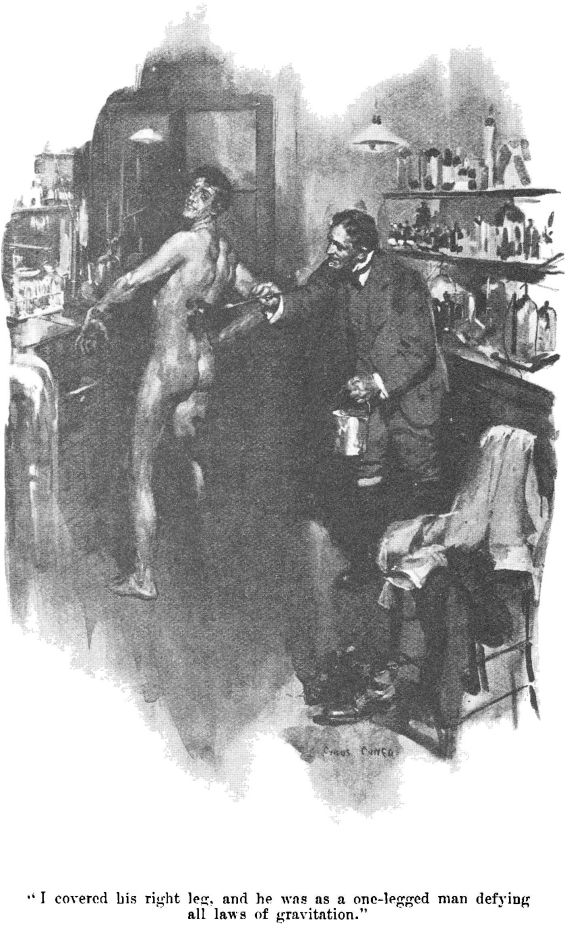
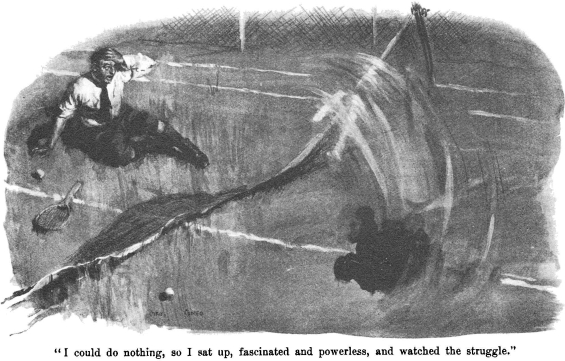
The Shadow And The Flash - illustration from The Windsor Magazine

Virgil Finlay’s illustration from Famous Fantastic Mysteries:
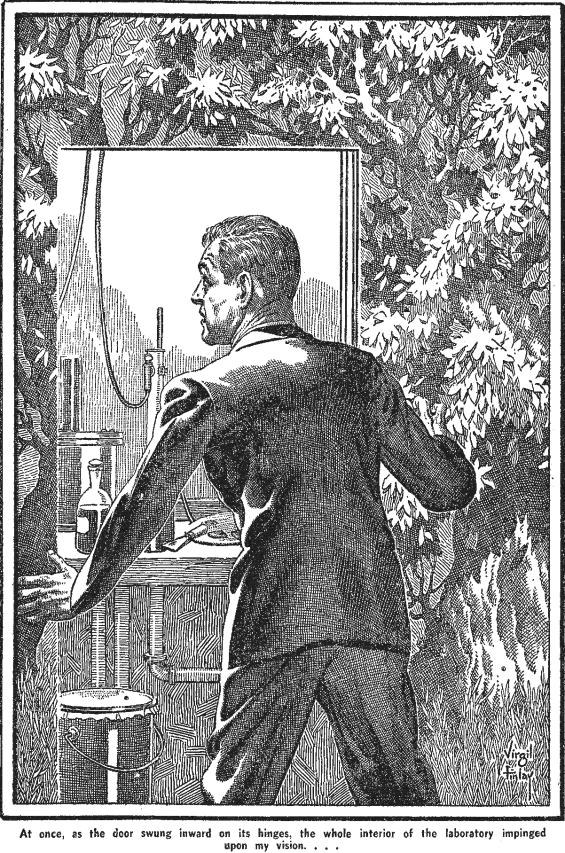
Famous Fantastic Mysteries, June 1948 - The Shadow And The Flash illustration by Virgil Finlay

Raul Valencia’s illustrations from LeoPlan 502:
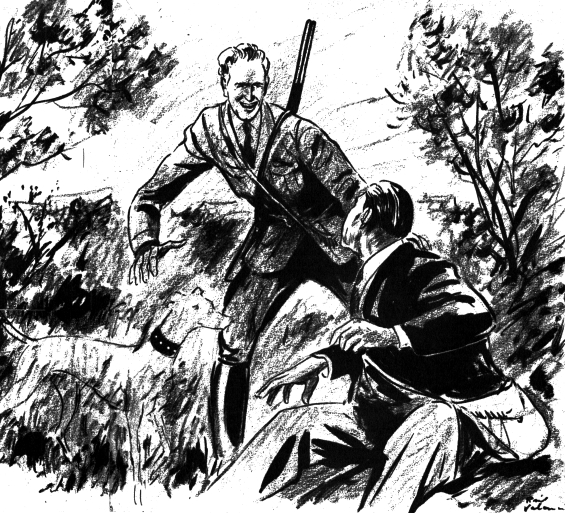
The Shadow And The Flash - illustration by Raul Valencia

Posted by Jesse Willis

StarShipSofa: The Truth Is A Cave In The Back Mountains by Neil Gaiman

SFFaudio Online Audio

StarShipSofaSFFaudio EssentialThe latest StarShipSofa podcast, episode #232, features Neil Gaiman‘s 2010 novelette The Truth Is A Cave In The Back Mountains as its “main fiction.” The narrator is Richie Smith and the story begins at about 12 minutes in.

|MP3|

Podcast feed: http://www.starshipsofa.com/feed

iTunes 1-Click |SUBSCRIBE|

There are few words that can get me as excited about a story as “Neil Gaiman” – he’s one of only a handful of living writers that’ll make me read anything he writes.

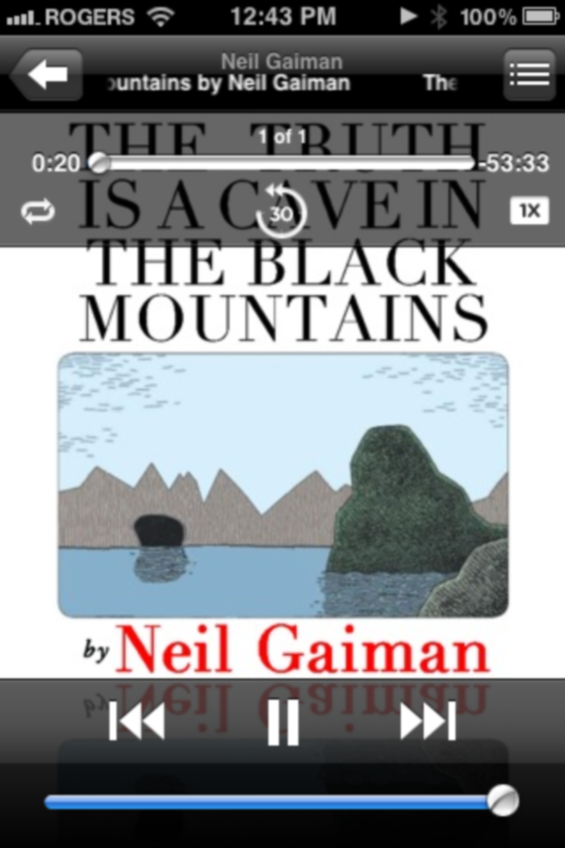
And when a story gets podcast I tend to go a little crazy, extracting the narration from any framing bits within the podcast, running that extracted audio through Levelator, and making my own art for the resulting MP3. Like this:

iPhone Screenshot of THE TRUTH IS A CAVE IN THE BLACK MOUNTAINS by Neil Gaiman

I took the original cover art by the wondrous Tom Gauld from the collection (Stories) where the novelette first appeared, photoshopped it (actually Paint.neted it), used MyFont.com’s “What The Font” feature to find the font (Didot LTStd-Roman), and put it all together.

Looking at it from the outside, it probably sounds completely bonkers to you. And perhaps it is.

But what can I do?

The medication that I’ve been taking for it (two carefully measured cups of coffee every morning) aren’t reducing the behavior in the slightest. Do you think I should up my dosage?

Update: Having now finished listening, I find The Truth Is A Cave In The Back Mountains to be yet more proof that Neil Gaiman is one of the best authors of any century. What Ted Chiang is to Science Fiction Neil Gaiman is to Fantasy.

Posted by Jesse Willis

Elegy by Charles Beaumont

SFFaudio Online Audio

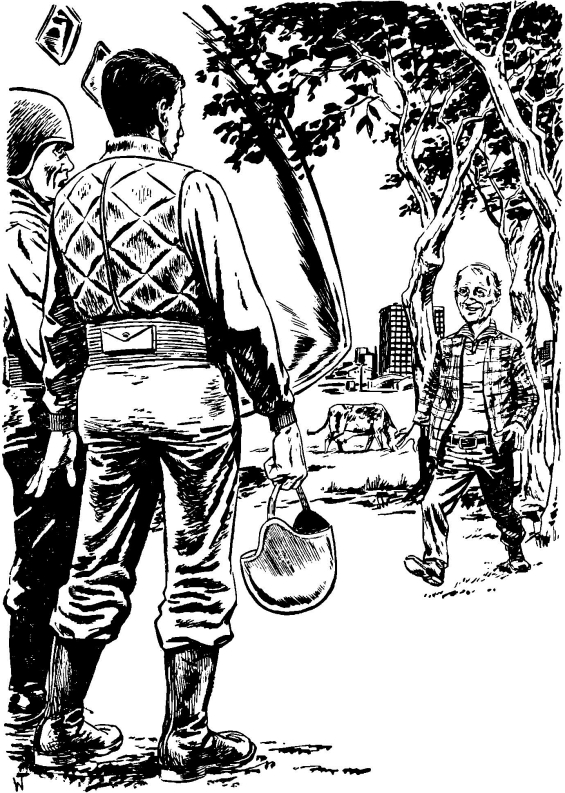
Elegy - ILLUSTRATION from  Imagination, February, 1953
Elegy by Charles Beaumont

Elegy, by Charles Beaumont, is available over on Gutenberg.org and that means it’s in the PUBLIC DOMAIN. This short story, by the legendary Charles Beaumont, was adapted as an episode of The Twilight Zone. That’s how I found it, and that’s why it was produced as an audiobook for Tom Elliot’s The Twilight Zone Podcast. But before I detail that let me first offer you this handy |PDF| version.

Here’s the audiobook:

The Twilight Zone PodcastElegy
By Charles Beaumont; Read by Jim Moon
1 |MP3| – Approx. 43 Minutes [UNABRIDGED]
Podcaster: The Twilight Zone Podcast
Podcast: June 27, 2011
|ETEXT|
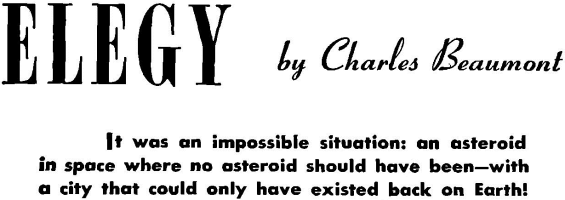
It was an impossible situation: an asteroid in space where no asteroid should have been—with a city that could only have existed back on Earth! First published in Imagination, February 1953.

Podcast feed: http://feeds.feedburner.com/TheTwilightZonePodcast

iTunes 1-Click |SUBSCRIBE|

And here’s The Twilight Zone adaptation:

And here‘s Tom Elliot’s podcast review of the TZ adaptation |MP3|.

Posted by Jesse Willis