Podcasts: Week Ending Oct 22, 2011

SFFaudio Online Audio

Mentat Jack I’m writing about what I listen to, what it makes me think about and what you might find interesting. Let me know if you think there’s something important I’m missing and if there’s a SFF related podcast you listened to during the week (no matter when it was published) that I should spotlight here.


This week’s post is quite late, but I’m continuing to enjoy reflecting back on what I listen to.

Writing Excuses 6.20: Endings brought to mind the discussion on a recent (for me, it may actually have been the first episode) SF Squeecast, in which an affectionate bashing of Christopher Priest “everyone just walks off stage” endings ensued. Lou Anders joined writing excuses again and endings were discussed largely in relation to the Hollywood formula. Lots of info in 15 minutes and they lie. They’re all super smart. |MP3|

Adventures In SciFi Publishing continues to publish twice a week. Episode 143 discussed Amazon’s new imprint, 47North. Amazon is in a spectacular position for trend spotting and they’re flush with cash to pay for the editing/marketing/etc. needed to make a successful publishing venue. AiSFP ask a good question, will B&N carry these books? They also talk with Brenda Cooper. It’s interesting to hear a futurist talk about her fantasy time travel novel. I’ve not yet read any Cooper, but she’s always a delightful guest. |MP3|

Gary K. Wolfe, Ursula K. Le Guin and Jonathan Strahan (Coode Street Podcast 71) politely roast Margaret Attwood’s book, In Other Worlds: SF and the Human Imagination. This mainstream/literary vs genre discussion rears it’s head constantly (see SF signal’s latest mind meld) and in many fan’s minds Attwood is the poster child for the “I do not write science fiction” crowd. It was pleasant to hear 3 intelligent people at the core of science fiction look at Attwoods relationship with science fiction from every possible angle. |MP3|

Pony by Erik Amundsen is a pure Clarkesworld story (podcast). It’s dark, stylized and highly original science fiction. Told from the first person, this tale of wrangling genetically engineered war ships mixes SF and western so seamlessly that Firefly seems positively mainstream in comparison. |MP3|

Pseudopod is my main audio stop for straight out horror. I’d love a suggestion for another podcast of similar quality to add into the mix. That’s not to say I didn’t enjoy this week’s tale of a young serial killer and his abusive father. Yardwork was particularly well read. Personally, the level of abuse from the father seemed a bit over the top. I bring that up because of my comment about Radio Nowhere last week. I’m quite happy that the closest experience I have to abuse involved the occasional cruel interaction with childhood “friends.” I digress. The story sort of offers the satisfaction of Dexter, but no matter how sympathetic the protagonist is, there’s no question that he’s a very, very bad boy. |MP3|

While on Pseudopod, I REALLY loved The Cord by Chris Lewis Carter. Usually, when I encounter an idea in a story I’ve recently encountered in a non-fiction science venue, I’m reading science fiction. It’s awesome to encounter this in horror and basically makes strict genre boundaries seem particularly silly. In this case an unreliable narrator is used to great affect in a deceptively simple extrapolation from true stuff that actually happens. Even if horror isn’t normally your cup of tea, don’t miss this one. |MP3|

The second AiSFP I listened to this week involved an interview with K.V. Johansen. I think Lou Anders, her publisher, did a better job making this sound like a must read book in an earlier podcast. That said, she made the world seem like one that will take nicely to a long series and I’m intrigued by some of her earlier fiction for younger readers. Shaun is experimenting a lot with the format of the show, in this case breaking up the interview with a “from the editor’s desk” segment. I’m not sure how I feel about the contrast between a discussion of epic fantasy and a question about the state of science fiction, but the more dynamic format definitely adds life to the show. |MP3|

Episode 315 of Escapepod is Clockwork Fagin by Cory Doctorow. It’s from the new anthology Steampunk! and it’s a both a wonderful example of steampunk and just a great story. It’s full of Dickensian orphans, clockwork analytical engines, and murder – told with a maker ethic that you’d expect from Doctorow. |MP3|

Posted by Steven Klotz
The Iron Door Playhouse: Two Halloween Audio Dramas: Doctor Finkelstein’s Revenge and Ghosts At The Iron Door

SFFaudio Online Audio

The Iron Door PlayhouseRecorded in Malad, Idaho (at The Iron Door Playhouse) in 2010 and 2011 here are two original plays written and directed by our very own Scott D. Danielson. These are humorous Halloween themed audio dramas, recorded live (on stage) by local actors. Both productions feature gentle joking with the Halloween creature conventions, as well as the occasional wry stab at more topical terrors (look for a pathetically pining vampire and a protesting henchperson).
Doctor Finkelstein’s Revenge
By Scott D. Danielson; Performed by a full cast
1 |MP3| – Approx. 48 Minutes [AUDIO DRAMA]
Recorded: October 31, 2010

Ghosts At The Iron Door
By Scott D. Danielson; Performed by a full cast
1 |MP3| – Approx. 42 Minutes [AUDIO DRAMA]
Recorded: October 29, 2011

Posted by Jesse Willis

Alastair Reynolds on The Coode Street Podcast

SFFaudio Online Audio

Notes From Coode StreetGary Wolfe and Jonathan Strahan spend an hour with Alastair Reynolds, talking science fiction.  The conversation is focused, no awards are mentioned, and they talk a lot of about Alastair’s inspiration, Arthur C. Clarke, as well as his upcoming novel, Blue Remembered Earth (it’s on Wikipedia already).

Rss feed:  http://jonathanstrahan.podbean.com/feed/

|MP3|

Posted by Tamahome

The Diamond Lens by Fitz James O’Brien

SFFaudio Online Audio

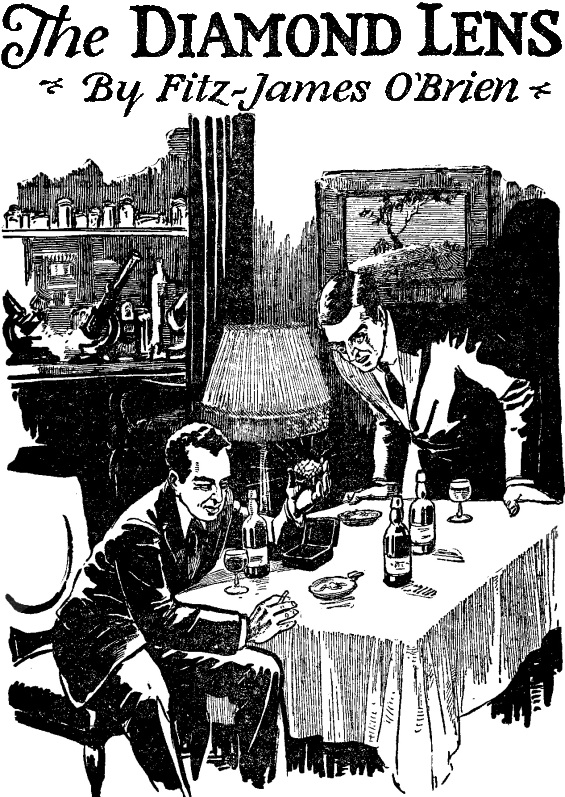
The Diamond Lens by Fitz James O'Brien - illustration uncredited - December 1926 issue of Amazing Stories

I’ve created a |PDF| from the printing in the December 1926 issue of Amazing Stories.

Introduction to the October 1933 issue of Amazing in which The Diamond Lens was published

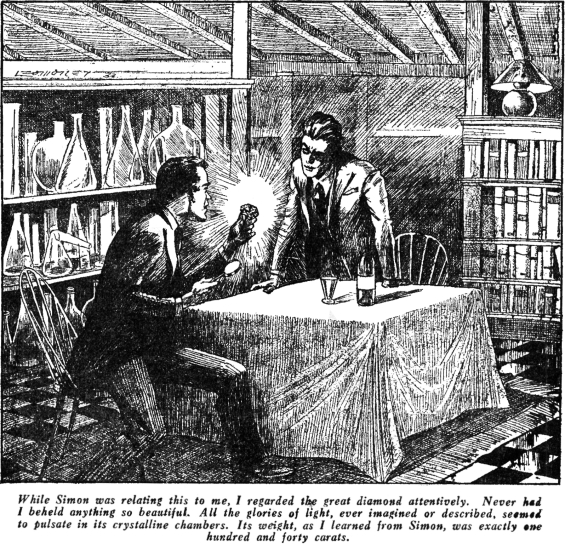
The Diamond Lens - Illustration by Morrey

I’ve created a |PDF| from the printing in the October 1933 issue of Amazing Stories.

In his introductory essay “Expanding The Lens“, found in to the story in The Road To Science Fiction: From Gilgamesh To Wells, editor James Gunn writes:

“[The Diamond Lens] is the first known story in which another world is perceived through a microscope… [this story] opened up another world, not just for readers, but for writers as well.” Gunn goes on to praise O’Brien’s “realistic treatment of the fantastic” and says that “‘The Diamond Lens‘” may be the first modern science-fiction story.”

LibriVox narrator Corrina Schultz describes The Diamond Lens this way:

“This story has a bit of everything – obsessive scientist, psychic medium contacting the dead, clever murder cover-up, racism, creepy stalker, college student shirking his studies, the painful results of pursuing forbidden knowledge, the noble savage…”

Atop those words I myself can heap a few other attractors:

1. The Diamond Lens is bizarre in both plot and focus, with episodic like writing <-Weird for a short story. 2. It has the sensibility of a foreign culture <-The 19th century attitude toward seances is pretty fucking foreign! 3. The protagonist is a mad microscopist. <-Perhaps he was demented by the illicit lure of science? 4. The story features a brutal killing. <-With a whackjob of added racism to complicate matters! 5. It has a noir ending. <-My favourite kind. As you may have guessed I quite enjoyed The Diamond Lens.

Stories like Harl Vincent’s Microcosmic Buccaneers (1929), Theodore Sturgeon’s Microcosmic God (1941) and both Sunken Universe (1942) and Surface Tension (1952) by James Blish all stem from the microscopic pioneering of The Diamond Lens. Whereas the theme, of an alien female object of adoration in an unreachable land, also brings to mind a mighty parallel with Jack Williamson’s The Green Girl (1930). And one final note, a quick read of the Wikipedia entry for Fitz James O’Brien makes me think some of the tale is autobiographical!

LibriVoxThe Diamond Lens
By Fitz James O’Brien; Read by Corinna Schultz
1 |MP3| – Approx. 57 Minutes [UNABRIDGED]
Publisher: LibriVox
Published: FORTHCOMING
A scientist, having invented a powerful microscope, discovers a beautiful female living in a microscopic world inside a drop of water. First published in the January 1858 issue of The Atlantic Monthly.

The Weird CircleThe Diamond Lens
Based on the story by Fitz-James O’Brien; Performed by a full cast
1 |MP3| – Approx. 25 Minutes [RADIO DRAMA]
Broadcaster: MBS, NBC, ABC
Broadcast: December 31, 1944
Provider: Archive.org

Arthur C. Clarke describes The Diamond Lens (from an article in Playboy)

Posted by Jesse Willis

Forgotten Classics: The Beautiful People by Charles Beaumont

SFFaudio Online Audio

“Beauty is no quality in things themselves: It exists merely in the mind which contemplates them; and each mind perceives a different beauty.”
– David Hume (Of The Standard Of Taste)

We tend to forget. Scott Westerfeld’s Uglies series seemed fresh and original when it came out a couple years ago. But that’s because we’d forgotten about Charles Beaumont and The Beautiful People. Westerfeld wrote four novels exploring territory that Charles Beaumont pioneered. It’s short story that packs a helluva punch. Imagine a world when everyone around you says that you are ugly, that you’re fat. that you’re unhealthy, that you’re self image is completely wrong, and most importantly that you’ve got to change because social position will be completely untenable.

Now imagine that world – our world – just a few years in the future. A world in which everyone wears a mask on all the days before and after October 31st.

Pure horror.

The Beautiful People has stuff to say about beauty and ugliness, the proper place of women, the value of book reading, as wells as the passing fads of sleeping and eating.

Here is a |PDF| version.

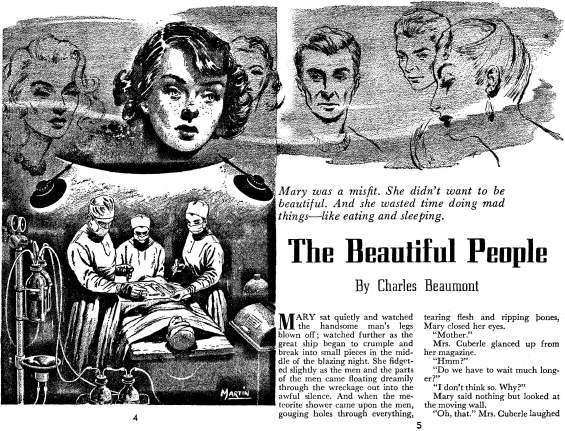
The Beautiful People illustration by Martin

Forgotten ClassicsThe Beautiful People
By Charles Beaumont; Read by Julie Davis
1 |MP3| – Approx. 47 Minutes [UNABRIDGED]
Podcaster: Forgotten Classics
Podcast: October 2011
|ETEXT|
Mary was a misfit. She didn’t want to be beautiful. And she wasted time doing mad things—like eating and sleeping. First published in the September 1952 issue of If Worlds of Science Fiction.

The Twilight Zone adapted The Beautiful People into an episode entitled Number 12 Looks Just Like You.

Posted by Jesse Willis

BBC Radio 4 Extra: The Eagle Of The Ninth RADIO DRAMA

SFFaudio Online Audio

Last weekend saw the re-broadcast of first episode (of four parts) of the 1996 BBC’s radio dramatisation of The Eagle Of The Ninth, that’s Rosemary Sutcliffe’s excellent YA novel. It was recently turned into a pretty good film (The Eagle). If you’re a fan of Henry Treece, as I am, you’ll probably also like Sutcliffe. The next three parts will air on subsequent weekends. I hope to collect them all over on RadioArchive.cc when it completes. Based on the first episode, listenable HERE, you may want to do the same. Sadly no unabridged version of the audiobook currently exists.

BBC Radio 4 ExtraThe Eagle Of The Ninth
Based on the novel by Rosemary Sutcliffe; Dramatised by Sean Damer; Performed by a full cast
4 (half-hour) Broadcasts – Approx. 2 Hours [RADIO DRAMA]
Broadcaster: BBC Radio 4 Extra
Broadcast: Sunday October 23, 2011 (and the subsequent three Sundays)
Can Marcus recover his father’s reputation and the lost Eagle from his legion in Rosemary Sutcliffe’s children’s adventure set during the Roman occupation of Britain?

Cast:
Tom Smith
Mark Coleman

Produced by Hamish Wilson

Here’s the trailer for the recent movie version:

Posted by Jesse Willis