BBC Radio 4: Something Wicked This Way Comes AUDIO DRAMA

SFFaudio Online Audio

The BBC is not noted for programming that specifically celebrates Halloween. There is, however, a new production of the Ray Bradbury classic Something Wicked This Way Comes (a full cast radio production), which is one thing that is wickedly coming this way this weekend:

BBC Radio 4The Saturday Play – Something Wicked This Way Comes
Adapted from the novel by Ray Bradbury; Dramatised by Diana Griffiths; Performed by a full cast
1 Broadcast – Approx. 1 Hour [RADIO DRAMA]
Broadcaster: BBC Radio 4
Broadcast: Saturday October 29, 2011 (14:30-15:30)
Set in 1960’s Illinois this gem of modern Gothic literature is the memorable story of two boys, James Nightshade and William Halloway, and the evil that grips their small Midwestern town with the arrival of a “dark carnival” one Autumn midnight. These two innocents, both aged 13, (Will is born one minute before Halloween, and Jim one minute after) save the souls of the town (as well as their own). This is a vivid variation on the eternal theme of the fight between Good and Evil. A thrilling, chilling, richly kaleidoscopic sound world ensues; a shimmering mirror maze that reflects your older or younger self, depending on your desires, and a magic carousel that plays Chopin’s Funeral March forwards – with each rotation you gain a year, and rotating backwards – you get younger.

Cast:
Will … Theo Gregory
Jim … Josef Lindsay
Charlie … Henry Goodman
Mr. Dark … Kenneth Cranham
Mr. Coogar/Lightening rod salesman … Gerard McDermott
Miss Foley … Barbara Barnes
Dust Witch … Buffy Davis
Robert … Taran Stanzler
Young Miss Foley … Amelia Clarkson
JED … Ethan Brooke
Composer … David Paul Jones
Sound … Paul Cargill
Produced/Directed by Pauline Harris

[Thanks Roy]

Posted by Jesse Willis
The Thousand-And-Second Tale Of Scheherazade by Edgar Allan Poe

SFFaudio Online Audio

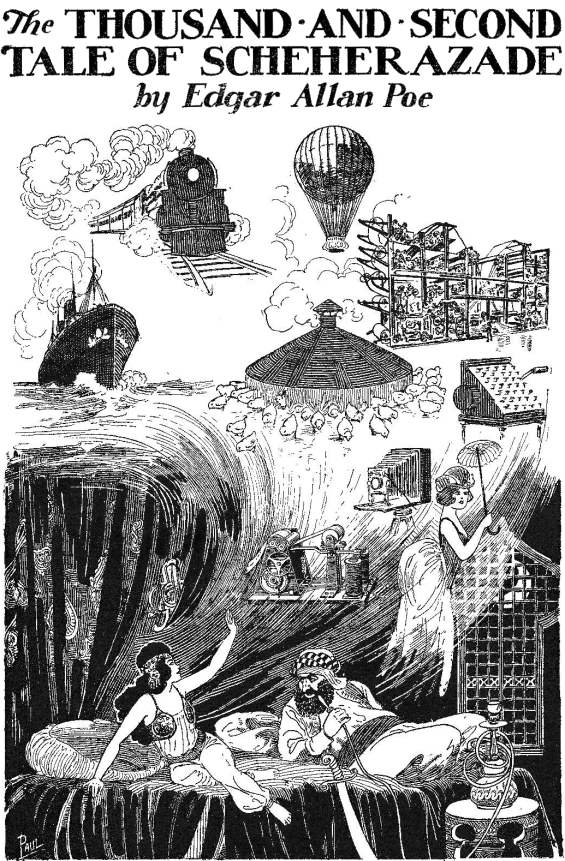
The Thousand-and-Second Tale of Scheherazade by Edgar Allan Poe - illustration by Frank R. Paul

Here’s the uncredited editorial introduction, presumably by Hugo Gernsback himself, to The Thousand-And-Second Tale Of Scheherazade as it appeared in the May 1928 issue of Amazing Stories:
“When we realize that this story was written nearly 100 years ago, we must marvel at the extraordinary fertile imagination of Poe. Poe was probably the inventor of “Scientifiction” as we know it today, and just because the story was written almost a century ago, certainly does not make it less valuable. On the contrary, it becomes more valuable as time passes. It is just as applicable to the modern man, who is mostly in the fog about what goes on around him in science today, as his predecessors were a century ago.”

Indeed, if you read it straight through, without pausing to read the footnotes, you’ll probably only get a vague sense of what’s going on in this story. And though I think I tumbled to the idea pretty early on, I still found myself in many places echoing the king’s many harrumphs. I’m not one to use the term “genius” lightly, but if anyone is worthy of the term, it is certainly Edgar Allan Poe. Even in his lesser works, like The Thousand-And-Second Tale Of Scheherazade, there is a wry brilliance that may be entirely matchless.

LibriVoxThe Thousand-And-Second Tale Of Scheherazade

By Edgar Allan Poe; Read by Gregg Margarite
1 |MP3| – Approx. 55 Minutes [UNABRIDGED]
Publisher: LibriVox
Published: October 1, 2009
First published in the February 1845 issue of Godey’s Lady’s Book.

And here’s the matching |PDF|.

Posted by Jesse Willis

The Sci-Fi Christian Podcast

SFFaudio Online Audio

Sci-Fi ChristianThe Sci-Fi Christian is a podcast (and site) about books, comics, movies and TV shows (with a heavier emphasis on the latter two). As you might surmise the hosts, Matt Anderson and Ben De Bono, are both Christians. As such they talk about the intersection between their beliefs and the media they consume. The premise, as laid out in the first episode |MP3|, is that they’ll be asking questions like ‘Was Jesus a Zombie?’ and ‘What does God think about teleportation? (Is it suicide?).’

Here’s the official description:

“We see The Sci-Fi Christian, in all its iterations, as being about the collision between faith and nerdom. We believe that good genre fiction is about more than just entertainment. We seek to engage with the themes and philosophies behind our favorite stories, wrestling with the big ideas within speculative fiction. We’re unabashedly nerdy and unabashedly Christian. Even if your faith background differs from ours, we look forward to interacting with you at The Sci-Fi Christian!

If you’re a theist you may like this. But even from an outsider’s perspective there is a lot to like in this show. The hosts don’t have identical tastes in the properties that they enjoy (which makes for a sparkier conversation). Also good is that they’re genuinely and equally enthusiastic about the subjects they discuss.

I myself am less enthused. This is not because I am not a Christian. As with every show that I’ve heard that uses the “Sci-Fi” shibboleth in its title there is a certain lightness to The Sci-Fi Christian Podcast that turns me off. Perhaps the best identifier of such a podcasts is a pervasive usage of the words “spoiler” and “spoiler alert.”

I will happily go to the grave never having to hear the phrase “spoiler alert” or listen to someone discuss whether something was (or wasn’t) “a spoiler.” To my mind the whole “spoiler” meme is one that, if it has value at all, should be only acted upon and never discussed.

Podcast feed: http://thescifichristian.com/podcast/

Posted by Jesse Willis

CBC Q: Interview with Margaret Atwood

SFFaudio Online Audio

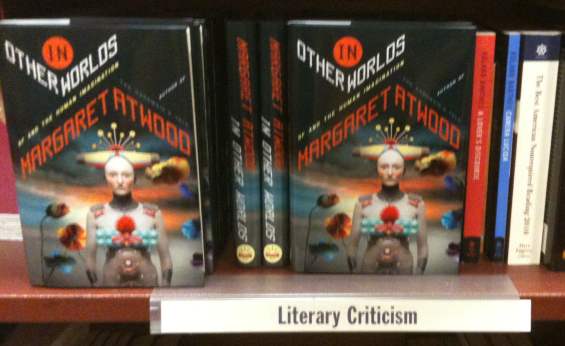
CBC Radio One - Q: The PodcastHost Jian Ghomeshi of CBC Radio One’s Q has an astounding new interview with Margaret Atwood. Atwood’s latest book, In Other Worlds: SF And The Human Imagination, can be found in the “Literary Criticism” section of your local paperbook store.

Gomeshi talked to Atwood about the realistic novel, comics, Weird Tales and the “sluttish” reputation of SF.

In Other Worlds by Margaret Atwood

One point in the interview left me confused and asking questions. Atwood claimed that “Conan the Barbarian is the literary descendant of Walt Whitman … and Henry James”.

I am floored.

What the fuck is she talking about?

Seriously, did she misspeak?

Did she mean to say that Robert E. Howard himself was their literary descendant?

Surely she didn’t mean the the character. Either way I don’t get it.

Or maybe she meant the stories themselves were somehow in the tradition of Walt Whitman and Henry James??? How could that be?

No matter how I look at it I don’t see how either Walt Whitman or Henry James ties into Howard. It just doesn’t make any kind of sense to me.

Does anybody know what the hell Atwood meant by that?

Seriously, I do not get it.

Will I have to buy her book to understand this thesis?

Have a listen |MP3|.

Podcast feed: http://www.cbc.ca/podcasting/includes/qpodcast.xml

Posted by Jesse Willis

P.S. CBC, please release Apocalypse Al. You can call it “scientific romance” or something else, just release it.

Scientific American – 60-Second Science – Moon Not Made of Cheese

SFFaudio Online Audio

Scientific American  - 60-Second ScienceEvery once in a while I have an surreal conversation. The conversation usually begins when a person says something I misunderstand. They claim something and then proceed to tell me about it. I assume that the person in question’s claim is a claim about the universe (I assume that because that’s the place I’m trying to understand). When the surreality begins is when it turns out that they are actually talking about is a part of the world – I guess that’s their perception of it.

The other day I had one when a friend of mine suggested I read a book called Fringe-ology. He described it as “a good book.”

Was he right? Is Fringe-ology a good book? The title sounded frighteningly unfruitful to me.

The question I then asked myself was: “Must I read it to form my own judgement?”

It was highly rated on Amazon.com (five stars and twenty five reviews). Did that fact make it “a good book?”

The book’s subtitle, How I Tried to Explain Away the Unexplainable-And Couldn’t, didn’t make me want to read it either. Science, as I understand it, isn’t about “explaining away” anything (unless you are speaking metaphorically, which the practice of science certainly doesn’t embrace). And the “unexplainable” is a term that shows some seriously misguided thinking about reality (based on my reading of science history). Perhaps that was just marketing though.

Upon closer examination there is something else that makes me question Fringe-ology being a “good book” – there is a bent spoon on the book’s cover.

That is not a good sign.

To try to convince me to read Fringe-ology: How I Tried to Explain Away the Unexplainable-And Couldn’t my friend said this:

“[the author Steven Volk is a] Hard-nosed news reporter who looks honestly at this stuff. And find he can’t disprove much of it.”

I suggested that no matter how hard one’s proboscis, the act of setting out to disprove something wasn’t science.

My friend then went on to talk about the reams of sworn eyewitness testimony to the existence of UFOs. And that they would be admissible as evidence in a court of law.

I then suggested that “reality is not determined by a judicial process.”

It was at about this point that I twigged to some sort of incommensurability in our communications. I was talking about the world, as discovered by the practice of science, and my friend was talking about some other way of seeing the world (that I think is demonstrably false – but perhaps enjoyable or something).

In the end I may have to accept my friend’s judgement about my character. He said I was a “closed” person. He may be right. I will not read horoscopes, I will not accept sworn eyewitness testimony for paranormal claims, and I don’t expect to be reading Fringe-ology: How I Tried to Explain Away the Unexplainable-And Couldn’t any time soon – at least not without some more compelling reasons than I’ve been given.

There’s another way to put all of the above.

My friend was talking about institutional facts and I was talking about brute facts. He thinks the inexplicable exists, whereas I suggest that a book about the inexplicable is going to be zero pages long.

Which brings me to this extraordinarily boring (but presumably useful to my friend) story from Scientific American’s 60-Second Science podcast: “Moon Not Made of Cheese” – which takes a very pragmatic approach to debunking shitty ideas.

|MP3|

Podcast feed:

http://rss.sciam.com/sciam/60secsciencepodcast

Posted by Jesse Willis

Inkstuds: Interview with Brian K. Vaughan and Pia Guerra of Y: The Last Man

SFFaudio Online Audio

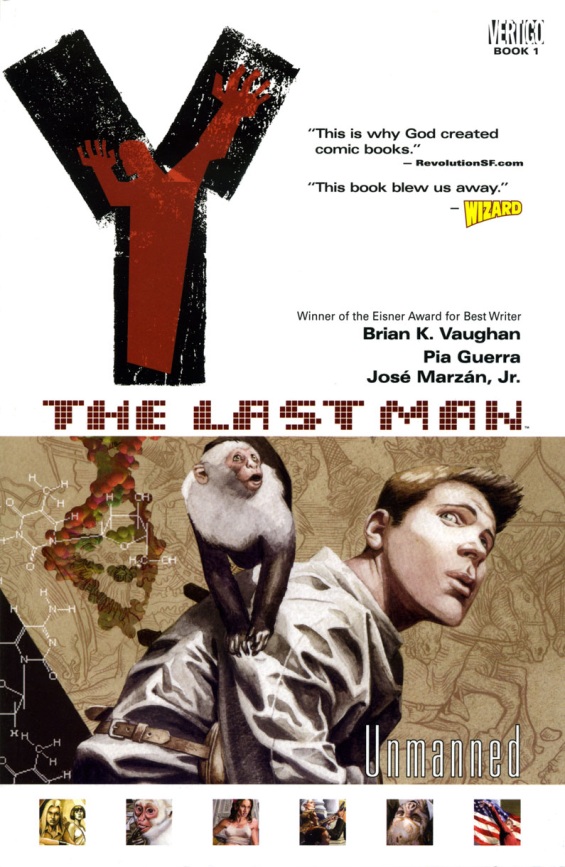
InkstudsThere’s an interesting 2008 interview with Brian K. Vaughan and Pia Guerra, the writer and artist behind Y: the Last Man, right here |MP3|. Here’s the description:

The inkstuds were joined by two stellar creators today. Brian K Vaughan and Pia Guerra have been doing Y the Last Man for the 5 years, and just released the last issue of their acclaimed series. It was a really neat chat about there collaborative work and the series.

Y: The Last Man - Collection 1

Posted by Jesse Willis