Review of The Dragon Factory by Jonathan Mayberry

SFFaudio Review

Fantasy Audiobook - The Dragon Factory by Jonathan MayberryThe Dragon Factory: A Joe Ledger Novel
By Jonathan Maberry; Read by Ray Porter
16 Hours – [UNABRIDGED]
Publisher: Blackstone Audio via Audible.com
Published: 2011
Themes: / Science Fiction / Cloning / Genetics / Mayhem /


“Detective Ledger?” he said, and held out an ID case. “NSA.”

“How do you spell that?”

Joe Ledger’s back.

In Patient Zero, (SFFaudio review here) he saved the world from a zombie apocalypse and Muslim terrorists. Almost single handed.

How will he do on the island of Dr. Moreau?

In The Dragon Factory Joe is evading government agents trying to shut down the DMS, is the only man alive to have defeated genetically engineered super warriors, and is romancing his beautiful fellow agent Grace Courtland.

And that’s just in the first few chapters.

Once again, Jonathan Maberry weaves a threat we know with a threat from fiction. A mad scientist (Cyrus) is using genetic experiments to mold the world in a way that will have horrific results for the population at large. Did I mention he’s German? And enjoys cloning as a light pastime?

Meanwhile, a pair of amoral, super intelligent, albino twins are mixing and matching genetics to create creatures of myth and monsters from your worst nightmares.

Joe’s got to find and stop all of them before the “Extinction Wave” doomsday program counts down to zero and releases havoc on the world. With a little help from Top, Bunny, Grace, and the enigmatic Mr. Church, of course.

I enjoy the way that Maberry mashes up several genres, with tongue in cheek, and produces a pulp fiction style, action-packed roller coaster ride that keeps me on the edge of my seat.

This book tells a good portion of the story from the crazed villains’ point of view, to good effect. I really love the dysfunctional family of super-villains where the children have disappointed the father by not having enough “vision” and the kids have giant “daddy” issues.

Maberry also dug just a bit deeper than I expected by contrasting the villainous family with Eighty-Two the clone who Cyrus loves most but who fails every psych test in being “acceptable” (as his henchman, Otto, puts it). I didn’t stop to think about what that meant when filtered through the horrific mindsets that Otto and Cyrus have, but the result was an interesting surprise that led to some interesting musing about free will versus evil and nature versus nurture. It isn’t that deep but I still found its inclusion refreshing in a book of this sort.

As in Patient Zero, Ray Porter’s narration was spot on, voicing Joe Ledger as if he were the man himself, with slight variations applied to other characters to make them come alive equally well. I’d rather hear these books narrated than read them myself just for the sheer enjoyment of Porter’s style and emphasis.

Make no mistake, The Dragon Factory is a straight-up thriller without a lot of twists and turns in plot. You read it for the hunt, for the action, for the adventure. You also read it for the twists of humor, the pulp fiction style, and the monsters. Especially for the monsters.

It’s a good time at high speed. What more can you ask?

Posted by Julie D.

Review of The Name of the Wind by Patrick Rothfuss

SFFaudio Review

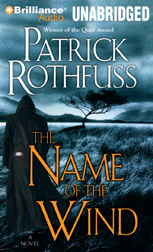
Fantasy Audiobook - The Name of the Wind by Patrick RothfussThe Name of the Wind
By Patrick Rothfuss; Read by Nick Podehl
28 hours – [UNABRIDGED]
Publisher: Brilliance Audio
Published: 2011
Themes: / Fantasy / Magic / Magicians / University /

The emperor may have clothes, but they didn’t fit me
A review by Brian Murphy

What do you want out of your fantasy? Exotic places? People different than the ones you know? High language? The clangor of battle? Wonders cold and distant and magnificent? The calling of silver trumpets? You don’t get any of this in Patrick Rothfuss’ The Name of the Wind. It feels very … pedestrian, and common. Rothfuss’ created world is very much like our own, and is altogether too much with us. Worst of all, its protagonist is annoying as hell. In my opinion.

I was fully prepared to love The Name of the Wind. I knew about the overwhelmingly positive reviews on Amazon, and the rave reviews from bloggers whose tastes and opinions frequently mirror my own. I was excited to see fantasy/SF luminaries like Robin Hobb, Ursula LeGuin, and Orson Scott Card (“He’s the great new fantasy writer we’ve been waiting for,” the latter wrote) singing its praises, and was fully prepared to do the same.

But the long and short of it is this: I didn’t love this book, and for long stretches, I didn’t even like it. Which makes me a bit sad, as I too was anticipating the arrival of a new great hope to emerge (or rescue, depending on your point of view) from the current crop of fantasy writers. As it turns out, I’m still waiting.

All that said, I recognize The Name of the Wind as a pretty solid artistic endeavor. In no way would I describe it as objectively bad, and the more I thought about it, I realized that it’s just not to my tastes. So I thought I would detail in this review why I didn’t like it, and then speculate on a few of the reasons why so many others have found it appealing. Of course, since I didn’t like The Name of the Wind very much, this review will spend much more time on the former, so be prepared.

The Name of the Wind is the first in a planned trilogy called The Kingkiller Chronicles. It details the life and times of a young man named Kvothe, a brilliant and talented magician doing his best to stay out of the limelight by posing as a simple innkeeper. When we meet Kvothe he’s in his early to mid 20s and is already a legend, though the events of his life have been exaggerated and mythologized. The Name of the Wind is essentially about a single day in which Kvothe sets the record straight for the loremaster Chronicler by giving the latter the full and true account of his youth and his subsequent rise to fame. We learn about Kvothe’s upbringing with a traveling group of minstrels and performers, to his days as a homeless street urchin, up through his first year at a University for wizards.

The Name of the Wind is epic fantasy length-wise (approximately 700 pages, and 23 discs in the audio version), but has nothing to do with J.R.R. Tolkien. It has everything to do with Harry Potter—Potter with a harder edge, yes, but Potter, unmistakably. When I read the description of the book and some of the reviews on Amazon I was expecting something closer to Ursula LeGuin’s Earthsea series—mythic, serious, a book with lessons to teach us about human nature and our place in the world. Instead I got a harmless, overlong soap opera.

I think we need a new name for this type of fantasy. This “positive” review (“Lovely and Undemanding” by Jo Walton or Tor.com) expresses one of my problems with the novel: its lightweight nature. Writes Walton, “It’s not very demanding—and I wonder if that’s precisely part of its wide appeal and success… I wonder if “undemanding” is something we actually seek in fantasy, if it’s part of the star quality that DAW instantly recognised in Rothfuss? … The Name of the Wind is a lovely read, but at the end there isn’t much to say about it.”

There is something to say about The Name of the Wind, of course, but the word that comes to mind is ordinary. I don’t mind applicability to the real world in my fantasy fiction, but what I don’t want is 1:1 equivalency. Aside from some sprinkled anachronisms (calling a week “a span,” or invoking the name of “Tehlu” instead of God) Rothfuss’ world is too much like our own. Half or more of the book is about Kvothe’s struggles with … student loans. Most of the problems Kvothe encounters are pedestrian: Young love, separation from his parents, completion of school projects on time, teachers who just don’t understand him. His college days also suffer from what I would call 90210 syndrome—despite the heavy workload we’re assured he’s suffering under, Kvothe seems to have endless time for hanging out with friends and sipping wine at the bar, or saving the town from marauding dragons. Which is much cooler than schoolwork, of course, but not entirely realistic. This is a problem, given that one of the conceits Rothfuss employs in The Name of The Wind is that he’s telling us a “real” story as opposed to a cliché fantasy. He uses the construction, “Now if this were a book, then X would have happened, but this is not a fantasy, and so here’s the real truth,” time and time again. But the problem is we never once feel like we’re in something other than a well planned, well coordinated, safe fantasy. Rothfuss does not have the maturity as a writer to pull off this conceit, in my opinion. Despite its claims to the contrary The Name of the Wind is a genre novel in every sense of the word. Again, that’s not a bad thing, and many readers have enjoyed it and will continue to do so. But let’s not pretend it’s anything more than another Belgariad.

This brings me to my first major problem with The Name of The Wind: I don’t like Kvothe. I don’t need to identify with the main character to enjoy a story, but I have to at least enjoy residing in their head space. I come up just short of actively despising the dude (Rothfuss does deserve praise for evoking that reaction in me, but I would bet it wasn’t his intent). The only way to explain Kvothe is that he is some avatar of the Gods. It’s utterly impossible for a boy his age to know what he knows. A precocious human child does not even come close to explaining his impossible adroitness and encyclopedic knowledge. Even after spending three years as a homeless street urchin, during which he did little but beg for coins and bread, Kvothe can rattle off every historical and anatomic question thrown at him by a brilliant panel of instructors to gain admission to the university. At one point he finds a dead man with a crossbow and knows how long the man has been dead, the type of crossbow he’s using, its cost, its usage, the fact that it’s illegal, etc. This is supposedly a medieval setting and yet what we have in Kvothe is a medieval McGyver, a walking Wikipedia page, applying scientific rigor and clear-headed rationality to every situation he encounters (another thing that irks me: The medieval tech level of Rothfuss’ world makes no sense. We have a college of brilliant teachers who have mastered anatomy and physics and every natural science known to man, yet are stuck reading rare books over candlelight and riding on horses).

One Amazon reviewer said that “Kvothe’s cockiness, arrogance, and impatience are constantly and quite believably landing him in trouble.” Except that they really don’t. Kvothe is not cocky and arrogant, save on a very superficial level. Impatient, yes. But his impatience lands him in minor scrapes from which he emerges undamaged or perhaps lightly scathed. He is, basically, perfect in every way, able to overcome every challenge with ease. For example, Kvothe takes the stage at a prestigious tavern to “earn his pipes,” a challenge which requires him to play before a tough, knowledgeable crowd to earn the distinction of master musician (yes, he’s an incredibly gifted lute player too. I didn’t mention that yet?). A jealous student sabotages Kvothe’s lute string so that it breaks at the height of his performance. But Kvothe is unflappable. It’s not even a real crisis, just a chance for Kvothe to again prove that he is that much better than we could have even thought. He finishes the most difficult song in the land with five strings and doesn’t miss a beat. Afterwards the audience weeps uncontrollably. There always seems to be a crowd around to applaud his every word. Hordes of faceless onlookers cheer his every act, applaud his every song, laugh at his every joke.

Kvothe’s only reported “fault” is his awkwardness with women and his inability to understand them, yet during one scene he compares his love Denna to a half dozen flowers with practiced, poetic ease, wooing her as no suitor before ever could. Denna returns the favor, spending paragraphs describing how Kvothe’s eyes change color when his emotions are aroused and how beautiful his red hair is. Kvothe flatters her back, telling her that only one other person has ever noticed that his eyes change color… this is bad romance novel stuff.

As for its originality? Sorry, I’m not seeing that either. The magic system seems very much cribbed from Ursula LeGuin, the conceit that knowing the true name of something grants you power over it.

So after all that grousing what is there to recommend about The Name of the Wind? At the sentence level Rothfuss is a pretty good writer. I think he’s better than Terry Brooks, and better than Stephen Donaldson. The Name of the Wind is compulsively readable, which is no mean feat. Stephen King has been labeled by a number of critics as pedestrian or lightweight, yet most of these guys can cite chapter and verse of his books and have apparently read all of them straight through. That’s because he’s so darned readable. So is Rothfuss. The story is easy to follow and carries you along to the end.

Second: Rothfuss gives you a lot of cool stuff to gawk at. Teachers engaged in a decades long war over the proper way to shelve books. A room where papers are cast to the wind and land on tiles labeled with “yes,” “no” and “maybe,” answering your questions unerringly like a medieval magic eight ball. And so on. Again, very Harry Potter-esque with its fine imaginative touches. Rothfuss also embeds lots of “Easter Eggs” and bits that prove significant later on, or lead the reader to speculate about their importance in the story. There’s lots of chatter by fans about why the evil Chandrian are so secretive, what the Underthing (mysterious passages and rooms beneath the school) are all about, and so on.

Yet a third reason: The Name of the Wind is a nice change of pace from the “GrimDark” fantasies of Joe Abercrombie, George R.R. Martin, and Richard Morgan, where everyone is a bastard and ends up raped, or dead, or both. We can cheer for Kvothe, and enjoy his scrapes, and perhaps remember what it was like to love our first girl with an unrequited love, or when we could barely scrape together six bucks on a Thursday night for a pizza.

In summary, The Name of the Wind is the product of a good writer with a lot of potential but did not deliver what I was looking for. Your mileage will vary, of course.

Posted by Brian Murphy

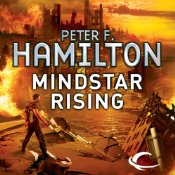
Review Of Mindstar Rising (Greg Mandel, #1) By Peter F. Hamilton

SFFaudio Review

Mindstar Rising (Greg Mandel, #1)
By Peter F. Hamilton; Read by Toby Longworth
Audible Download – 14 Hours 52 Minutes [UNABRIDGED]
Publisher: Audible Frontiers
Published: December 1st 2011
Themes: / Science Fiction / Mystery / Global Warming / Psychic Abilities

It’s the 21st century, and global warming is here to stay, so forget the way your country used to look. And get used to the free market, too – the companies possess all the best hardware, and they’re calling the shots now. In a world like this, a man open to any offers can make out just fine.

A man like Greg Mandel for instance, who’s psi-boosted, wired into the latest sensory equipment, carrying state-of-the-art weaponry – and late of the English Army’s Mindstar Battalion. As the cartels battle for control of a revolutionary new power source, and corporate greed outstrips national security, tension is mounting to boiling point – and Greg Mandel is about to face the ultimate test.

This is an older Peter F. Hamilton novel, first published in 1993.  It’s relatively short compared to his later books.  Just this year it got reprinted in America with Quantum Murder as one book.  (I guess thick books sell more?)  It has also just gotten the audio treatment from Audible Frontiers.  Peter F. Hamilton is kind of a potboiler sf writer, and yet he’s really smart.  He seems to put a lot of research into his scenes, including some science.  Sometimes I feel like he’s giving too many details compared to someone like Joe Haldeman, and I get a little restless.   Maybe it’s my fault and I’m getting confused, which is easier to do in an audiobook.  But then something shocking or intense happens, and it keeps me going.  Plus his character development is above average for a genre writer.  And he doesn’t shy away from sex or violence as much as other writers.  I feel like he writes for adults.  If you thought the Night’s Dawn or Void trilogies had too many fantasy elements, you might prefer this series.  It is more straight science fiction.  That’s assuming you don’t consider psychic abilities to be fantasy.  At least they’re framed here in a scientific way.  You may encounter some libertarian political messages as well.  The setting is a post global warming world where a Leftist government has left England in shambles.  It will become important to the plot.

I happen to know that Hamilton is a plotter and outlines in advance.  I experienced the ‘Connie Willis effect’ while reading — I wasn’t sure why a certain character or location was introduced, but then it all tied together in the end.  The last three or four hours here really cooked.  He can describe beam weapons and explosions well.  (Compare the end of his The Neutronium Alchemist with the end of Samuel R. Delany’s Nova.)  Although I caution you there’s a somewhat grisly escape.  And I don’t like the word ‘tropes’, but some of the ‘cool stuff’ you’ll see in this novel are mind uploading, cybernetic brain enhancement, and genetically enhanced animals.

No messing.

Posted by Tamahome


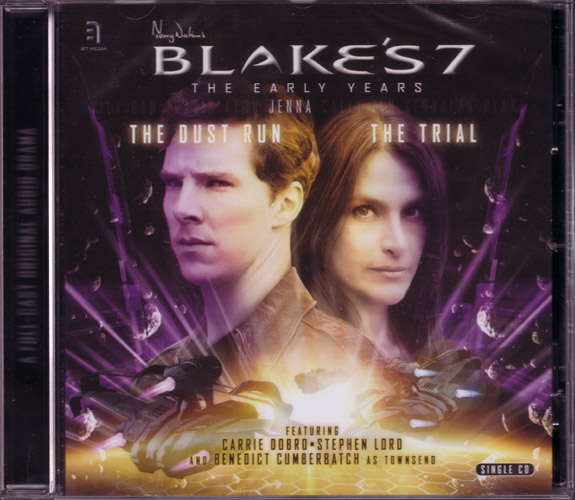
Review of Blake’s 7 The Early Years – Jenna: The Trial / The Dust Run (Vol. 1.5)

SFFaudio Review

Blake's 7 The Early Years - Jenna: The Trial / The Dust Run (Vol. 1.5)SFFaudio EssentialBlake’s 7 The Early Years – Jenna: The Trial / The Dust Run (Vol. 1.5)
By Simon Guerrier; Performed by a full cast
1 CD – Approx. 70 Minutes [AUDIO DRAMA]
Publisher: B7 Productions
Published: November 30, 2009
ISBN: 9781906577087
Themes: / Science Fiction / Galactic Empire / Dystopia /

The Dust Run – Jenna Stannis has grown up as a spacer, where the normal rules don’t apply. No school, no police, no public imperatives – that’s still all to come. But the situation on Earth is changing and the effects are slowly being felt throughout the Vega system. It’s going to mean trouble for a brash boy called Townsend – who Jenna doesn’t fancy at all. Soon Jenna and Townsend are competing in the Dust Run – racing shuttles through an asteroid field without using computers, making the complex calculations in their heads. It’s dangerous, fool-hardy and really good fun. But they’re playing for the highest of stakes…

The Trial – The election is going to change everything. A man called Roj Blake promises the voters new hope, an end to years of corruption. There are those who can’t let him be heard. But Jenna Stannis is determined to get his message out to the colonies. It’s been years since the Dust Run, and Jenna’s a changed woman. She’s left the Vega system far behind, using her exceptional piloting skills to carve out a life as a smuggler. Blake’s message could earn her a fortune – or cost her, her life.

This is the final two stories in the first Blake’s 7 The Early Years series. First up is The Dust Run. It starts with a framing story in which we see the cruelty of the Earth Federation up close. Under torture Jenna, a young woman, reveals everything about her truant past. Then, in the story proper, we meet her as a charming teen. She comes from an underemployed spacer family, has just a few friends but none of them are particularly trustworthy. For fun Jenna likes piloting shuttles at high speed through a region of space filled with a heavy concentration of particulates. It’s precisely her lightheartedness that sets Jenna up for a fall.

The Trial also uses the framing device but skips ahead in time to the events which lead to Jenna’s incarceration. The problem is that her interrogator also claims to be acting as her advocate! If Jenna is to have any chance of avoiding imprisonment on Cygnus Alpha she’ll have to shade the truth. This episode reminded me of the other great Orwellian episodes of serial SF (like Star Trek: The Next Generation‘s “Chain of Command” – in which Picard is tortured and Babylon 5‘s “Intersections In Real Time” – in which Sheridan is tortured). The darkness of Jenna Stannis’ Federation universe is equally Orwellian, but, as I’ve mentioned in other reviews of this series it has more than a touch of Brave New World in it too. This new Blake’s 7 series, like it’s TV predecessor, is an intelligent Science Fiction series that masquerades as consumable pop-culture “sci-fi”.

Carrie Dobro, who played a charismatic alien thief in the Babylon 5: A Call To Arms TV-movie and on the prematurely canceled Babylon 5 spinoff Crusade, stars as Jenna Stannis. Dobro has a star-level magnetism in both these productions. She’s sure of herself, a devious and clever power seeker, never fully in control, always seeking it, but at heart a sympathetic survivor. Simon Guerrier and Carrie Dobro have created a worthy back-story for Jenna Stannis. Highly recommended!

Posted by Jesse Willis

Review of Blake’s 7: The Early Years: Zen: Escape Velocity

SFFaudio Review

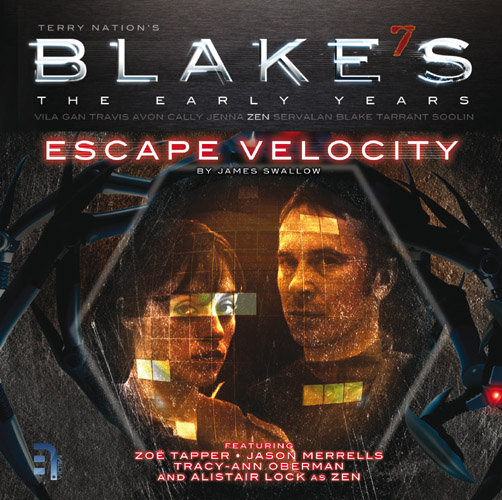
B7 PRODUCTIONS - Blake's 7: The Early Years: Zen: Escape VelocitySFFaudio EssentialBlake’s 7: The Early Years: Zen: Escape Velocity (Volume 2.1)
By James Swallow; Directed by Andrew Mark Sewell; Performed by a full cast
1 CD – Approx. 1 Hour [AUDIO DRAMA]
Publisher: B7 Productions
Published: April 26, 2010
ISBN: 978190657709
Themes: / Science Fiction / Artificial Intelligence / Cloning / War / Aliens /

Based on Terry Nation’s seminal 70s science fiction TV series, The Early Years is a prequel series of audio stories that explores the origins of key Blake’s 7 characters prior to them meeting rebel leader Roj Blake. This latest entry to the ever-expanding series takes a new twist, concentrating on a character that doesn’t breathe or have any parents, the synthetic intelligence known only as Zen. When Roj Blake first stepped on board the mysterious, derelict alien spaceship Liberator, his every movement was monitored by the ship’s controlling intelligence, Zen Luckily, Blake and his rebel crew managed to gain the ‘confidence’ of this creation from an alien world and so he was able to use the Liberator in their quest for justice against the Federation. But the origins of Zen have remained a mystery, until now. What terrible catastrophe left the Liberator drifting and shattered? What drove the ship’s intelligence to murder its original crew? What dark secrets lie at the heart of this alien machine? And are Blake and his crew really safe on board the Liberator?

Often, you’ll want to know somebody’s back-story, and then later, when you actually get it – in a prequel story – you’ll find that it is far, far, far less interesting than whatever was going on in your imagination. For me, the years between 1980 and 1999 were ones filled with near-reverence for a fascinating character, the ultimate baddie: Darth Vader. But no amount of apologetics can possibly remove the sickly saccharine story of a nine-year-old Darth Vader filled with “a high concentration” of midichlorians. Yuck. And yet “prequel” is not always a dirty word. I don’t feel that way about The Young Indiana Jones Chronicles, and likewise the Blake’s 7 prequel stories (1.1 |READ OUR REVIEW|, v.1.2 & 1.3 |READ OUR REVIEW|, 1.4 |READ OUR REVIEW|). By far the most mysterious character in the original TV series was Zen, the artificial intelligence. Zen was pretty closed-circuit about its past, not revealing much over the two years it appeared in the series (1978 – 1980). In life Zen “projected a dour, non-committal personality” and would “reply to certain questions with the phrase ‘That information is not available.'” This left left open the possibility that Zen was hiding secrets or “secretly executing its own agenda.” In this magnificent audio drama we are given a genuinely interesting explanation as to why Zen was so very melancholic, why the ship was found crew-less, seemingly abandoned and drifting near Cygnus Alpha.

Zen: Escape Velocity clearly reveals the frightening truth about all of Zen’s character quirks and its cryptic answers from the TV series. But it also shows more. Back in 2008 I reviewed the Blake’s 7 – Audio Adventures boxed set |READ OUR REVIEW| – the first three episodes of the new B7 audio drama series. One detail found within that review was that Zen was, unlike the original series, suicidal at the time of its discovery. Listening to Zen: Escape Velocity you will discovery exactly why that was so.

Six actors, Zoë Tapper, Jason Merrells, Tracy-Ann Oberman, Alastair Lock, Sam Woodward and Pamela Banks play different members of the original crew of the Liberator (back when it was still called “Deep Space Vehicle 2” and when Zen was called “SHIP-MIND”). The story, told by a careful cross-cutting backwards and forwards in time, shows the original crew welcoming their new PILOT, Zoë Tapper, aboard DSV2. Strangely, she is having memory problems and needs shepherding by the ship’s doctor. As the crew takes its positions and readies themselves for battle, we learn about their fascinating society. This is wonderful social Science Fiction like nothing exactly I’ve read or seen or heard before!

Zen (SHIP-MIND) only used the first-person, singular personal pronoun (“I”) once on the television series – it is used multiple times in this production. Zoë Tapper (who appeared in another Terry Nation re-imagined series) and Jason Merrells (playing the doctor), are the central sympathetic heroes of Zen: Escape Velocity. Alastair Lock, who also acts as a post-producer, musician and sound effects man for the CD, portrays SHIP-MIND (Zen). Sounds are rich, deep and best experienced in a quiet room. The stereo effect and a good set-of headphones,as I used, will bring an immense visual experience that belies the fifty-six minute running time. A five minute “Bonus Music Track” (original to this episode) rounds out the disc.

Posted by Jesse Willis

Review of Patient Zero by Jonathan Maberry

SFFaudio Review

Horror Audiobook - Patient Zero by Jonathan MaberryPatient Zero: A Joe Ledger Novel, Book 1
By Jonathan Maberry; Read by Ray Porter
12 CDs – Approx. 14.2 Hours [UNABRIDGED]
Publisher: Blackstone Audio
Published: October 2010
Themes: / Horror / Zombies / Terrorists / Covert Intelligence /

Jonathan Maberry caught my attention immediately with Patient Zero’s dedication:

This book is dedicated to the often unsung and overlooked heroes who work in covert operations and the intelligence communities.

And then he caught it again with the quote with which the book begins.

A hero is no braver than an ordinary man, but he is braver five minutes longer. — Ralph Waldo Emerson

I know a particular person who is one of those unsung heroes and so my natural inclination is to look approvingly upon the author’s sentiments.

However, I wasn’t here for a covert intelligence story or a spy story but for zombies. Also, because I’d heard the Writing Excuses podcasters praising the Joe Ledger series.

Then I heard the first two sentences of the book itself.

When you have to kill the same terrorist twice in one week, then there’s either something wrong with your skills or something wrong with your world.

And there’s nothing wrong with my skills.

Aha. The hat trick … which also informed me that I actually was here for a covert intelligence story, for a spy story, and, this should go without saying by now, for zombies.

Here’s a quick story synopsis.

Joe Ledger is a hardened Baltimore cop with serious skills in physical combat. After a surprise raid on suspected drug traffickers, he is strong-armed into joining the DMS, a rapid response task-force that handles problems too big for Homeland Security. The latest problem is a terrorist’s bio-weapon which, for all practical purposes, turns the infected into zombies. While Joe and his team try to track and stop the threat, we also see the bad guys: a tangled knot of corporate interests and Muslim fanatics gearing up for the ultimate assault on American soil.

In a way this is a meta thriller. It is obvious that there are the standard types which are being used. The Warrior. The Super Villain. The Mad Scientist. The Best Friend who is also The Conscience. Characters will even call people by these labels. This is reinforced by such tidbits as when a scientist excitedly asks Joe if he’s read Doctor Spectrum comics where Joseph Ledger is a character. However, Maberry keeps it from being cliched. Perhaps it is the zombies but I felt it was also due to Joe Ledger’s character and the blistering pace of the book. Short, fast chapters keep the action moving and the reader on the edge of their seat.

As with many thrillers, the story is relatively formulaic. The good guys are very good. The bad guys are very bad. Joe bleeds red, white, and blue and there is no way he is going to let terrorists harm Americans. There is a bit of humor, a touch of romance, and a ton of suspense. And zombies. Lots and lots of zombies coming in wave after wave.

It’s a formula that works. We need heroes and villains in our stories. Sometimes it is easy to see who they are. Patient Zero works because Maberry reminds us of how much entertainment there is to be had in the telling of such a tale.

My one problem with the book was that there were a couple of extended zombie attack sequences where Joe and the team just had to keep fighting and fighting … and fighting. We’d have gotten the same effect by cutting out just a bit of the fighting, particularly in the crab plant. They didn’t really have to be down to the point of ripping legs off of tables for weapons in order for me to understand just how desperate the situation was. However, this is a small quibble.

Much of the delight in this audiobook comes from Ray Porter’s narration. He reads Joe Ledger’s lines as if he were Ledger himself, reacting perfectly with a naturalness that made me feel as if I were hearing Joe’s actual thoughts. I particularly enjoyed the moments when he would hesitate or pause to emphasize points because that carried me into Joe’s emotions much more than if I had been reading.

The only problem with the narration was that Porter was a little too thorough. There is one character whose identity we don’t know until the end of the book but who we hear speaking with his employer. As I listened, I continually wondered if Porter had randomly chosen the accent with which this character spoke. I found myself listening to other characters in the book, wondering if we’d met this character yet and if he had that accent. It didn’t give it away much before the book itself did but it turns out that the narrator was being true to the character and that is something that I don’t think would have come across in the actual book. This isn’t a big deal, but it was an interesting problem.

Overall, you have to like this sort of thriller to enjoy this book. But if that’s the sort of thing you like, as I obviously do, then you’re going to really enjoy meeting Joe Ledger. And wave after wave of zombies.

Posted by Julie D.