Aural Noir Review of Gentlemen Of The Road by Michael Chabon

Aural Noir: Review

RANDOM HOUSE AUDIO - Gentleman Of The Road by Michael ChabonGentlemen Of The Road: A Tale Of Adventure
By Michael Chabon; Read by Andre Braugher
Audible Download – Approx. 4 Hours 13 Minutes [UNABRIDGED]
Publisher: Random House Audio
Published: October 2007
Provider: Audible.com
Themes: / Adventure / Crime / Jewishness / War / Politics / Mercenaries / Con-men / Khazaria /

Gentlemen Of The Road was first published as a serial in The New York Times Magazine. Despite it’s sword and sorcery feel, it is not actually a Fantasy novel, but is instead a “swashbuckling adventure” set in an obscure, but real, historical setting. Its heroes, Amram and Zelikman, are an odd, but vaguely familiar, pair. Familiar in their companionable rivalry and clearly inspired by Fritz Leiber’s famed pair of characters: Fafhrd and Grey Mouser. But, instead of one being a short, urban thief and the other a hulking Northern barbarian, the two are instead the titular gentlemen of the road, wandering Jews, or as Chabon himself states in the audiobook’s afterword “Jews With Swords.” And that’s what was really important in this story; though each of these two Jews looks entirely unalike from the other, they are tied together by far flung tradition, common heritage and similar tales of woe. The larger of the pair is Amram, a swarthy Abyssinian with a penchant for shatranj and quite literally an axe to grind. The slighter and paler of the pair is Zelikman, a fair haired Frank, who far from being a member of the thieves guild is actually a doctor (he wields an “over-sized bloodletting lance as a rapier”). Together they are a neat pair of dark age sell-swords/con-men, working the taverns and inns of southern Eurasia. It is, all in all, one of the neatest set-ups for a book I’ve ever heard. And you couldn’t find a funner fictional premise for illustrating the Jewish diaspora in an adventure novel.

One evening (circa AD 950), a chance encounter at a roadside inn in the kingdom of Aran leads to a body-guard job. The job involves a journey to the neighboring khaganate of Khazaria. Along the way they meet many a fellow road traveler and have some less than polite encounters. Eventually, Amram and Zelikman (A & Z) find themselves fully entangled in a rebellion and plot aimed at restoring a displaced Khazar prince to the throne.

Narrator Andre Braugher is a television actor that I’ve admired since his portrayal of the unwaveringly professional detective Frank Pembelton on Homicide: Life on The Street. Braugher has a powerful voice that he uses to deliver Chabon’s ornately constructed descriptive scenes and dialogue. You can tell, with every sentence of Braugher’s delivery, that Chabon loves language. I thoroughly enjoyed the book after I got into it. But it wasn’t easy, I really had to shift gears. This is embellished storytelling, it feels both old-fashioned and unrepentantly ostentatious. It has very little of the usual fantasy stylings, it dumps any ordinary flat or prosaic description in favour of the deliberately lavish. Once I did get into it, I loved it. There’s a lot of detail to enjoy here. Chabon’s hulking Abyssinan, for instance, has a battle-axe. He gained it after combat with the Varangian Guard in Byzantium. A runic inscription on it roughly translates into “defiler of your mother.” Another writer would have done it another way – another writer wouldn’t have done it at all. This is what makes Chabon, his books and this novella in particular so special.

Sadly, the audiobook lacks the map and the 15 terrific black and white illustrations (by Gary Gianni ) found in the paperbook. Here is a peek at both:
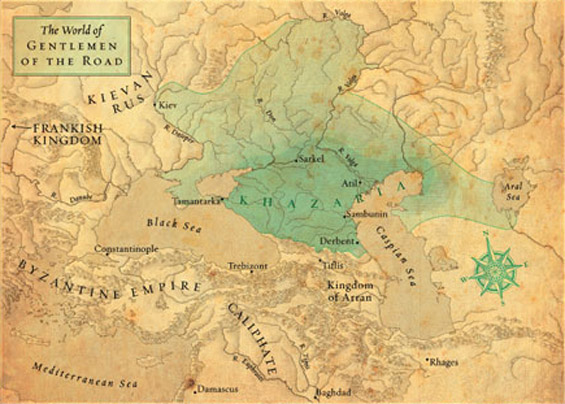
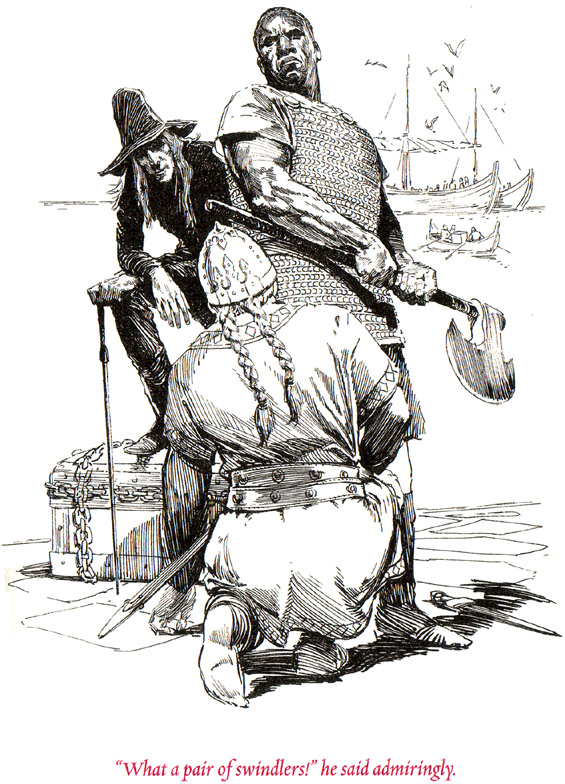
Gentlemen Of The Road - MAP

Gentlemen Of The Road - PAGE 161

Posted by Jesse Willis

Review of Little Fuzzy by H. Beam Piper

SFFaudio Review

Little Fuzzy
By H. Beam Piper; read by Jim Roberts
Audible Download – 6 hours 45 mins [UNABRIDGED]
Publisher: Jincin Recordings
Published: 2010
Themes: / science fiction / philosophy / extraterrestrial / sentience

Little Fuzzy is a poor man’s, a thinking man’s, Avatar. It tells the story of a capitalistic corporation exploring a far-off planet with a classical name, Zarathustra. While harvesting the planet’s unobtanium brightly-colored sunstones, prospector Jack Holloway discovers a stange new species, and makes it his life’s work to defend the new creatures. Missing are Avatar‘s flashes, bangs, and rich world-building, but the novel more than compensates with intriguing storytelling that both challenges the mind and touches the heart.

Events in Little Fuzzy take place on the planet Zarathustra. The Chartered Zarathustra Corporation owns the world in all but name, and harvests its resources for trade on the intergalactic market. The world itself is poorly realized. Apart from anti-gravitational devices, hovering cars, and super-advanced CCTV lie detectors, very little in the novel suggests a science fiction setting. Guns, paper, and cigarettes predominate. The novel hints at a rich and storied history of the galaxy with its mentions of the Atomic Era, but these allusions never find ample explanation. The novel does take place in Piper’s Terro-Human Future Universe, however, so readers eager to learn more can probably do so in other novels and short stories.

The major exception to the book’s lack of world-building is the wild flora and fauna on Zarathustra around which Little Fuzzy ultimately hinges. Prospector Jack Holloway finds one of the titular foot-high golden-furred creatures, and soon realizes that the fuzzy fuzzy Holloway Zarathustra (yes, that becomes its official classification) exhibits behavior that may point to sapient consciousness. One of the fuzzies soon meets its demise at the hands of a Zarathustra Corporation agent, and Jack Holloway kills another agent in the ensuing scuffle. The rest of the novel explores the question of consciousness through the narrative framework of a criminal trial. Like the works of Isaac Asimov, Little Fuzzy abounds with cerebral dialogue that, at times, reads like a philosophical proof, but never drones on long enough to become monotonous.

The real show-stopper is Jack Holloway’s emotional connection to his newly-discovered species. At various points he fulfills the roles of teacher, champion, and father to the beleaguered little fuzzies. Thiis emotional power pulls the reader by the heartstring’s through the book’s one or two bare spots to a satisfying conclusion.

Little Fuzzy is also a brilliantly-written novel. Some of the fathers of science fiction appear to take themselves far too seriously, but this certainly can’t be said of H. Beam Piper. While the novel hardly qualifies as a comedy or satire, colorful splashes of humor indicate that, though the book addresses intriguing intellectual issues, at the end of the day Piper is having fun as a writer and a storyteller.

Jim Roberts’s performance of Little Fuzzy for Jincin Recordings won’t win any awards, but his tone fits the mood and content of the novel. His reading is strong enough that even the book’s few tedious passages won’t put the listener to sleep.

Originally published in 1962, just two years before H. Beam Piper’s suicide, Little Fuzzy was written at the zenith of his writing career, and it shows. As a proof-of-concept novel about the nature of consciousness, the book could have easily crossed the line between fiction novel and science lesson, as do some of the other science fiction novels of Piper’s era. Sprightly writing and emotion that almost, but not quite, verges on sentimentality make Little Fuzzy a stand-out novel of its time, and indeed for all ages.

As a footnote, John Scalzi recently announced that he’s written a reboot of the series with the blessing of the Piper estate, dubbed Fuzzy Nation, and that he’s currently shopping it around to publishers. The franchise is certainly in capable hands.

Also be sure to take a look at Jesse’s review of the Audio Realms edition of Little Fuzzy

Posted by Seth Wilson

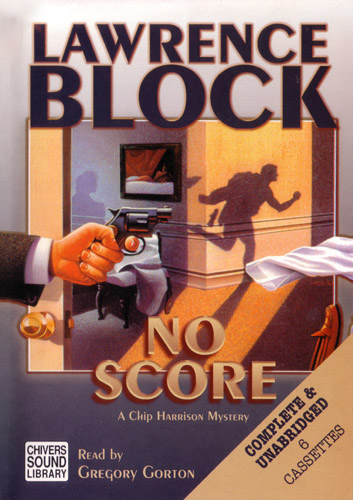
Aural Noir review of No Score by Lawrence Block

Aural Noir: Review

CHIVERS - No Score by Lawrence BlockSFFaudio EssentialNo Score (book #1 in the Chip Harrison series)
By Lawrence Block; Read by Gregory Gorton
6 Cassettes – Approx. 5 Hours 30 Minutes [UNABRIDGED]
Publisher: Chivers Audio
Published: 1999
ISBN: 0792722620
Themes: / Crime / Sex / Quest / Pornography / Chicago /

It is a mystery why a street-smart young man like Chip Harrison has to resort to elaborate plans to attract a young woman like Francine. But someone turns Chip’s dream into a nightmare of danger. Chip has to act fast and furiously in a sizzling and suspenseful adventure that only Edgar Award-winning Lawrence Block could have written. Chip Harrison rightfully takes his place beside Block’s best known characters.

Seventeen year old Chip Harrison is a virgin. Francine, the narcissistic sexpot sitting on his bed, is two years older than Chip. All that stands between Chip and Francine is a tight yellow sweater and a green plaid skirt. Chip’s been preparing for this situation for a while now. He’s read all the right books, practiced all his moves on other girls, and now it’s all actually going to happen! And then, just as the deed is about to be done, a man with a gun walks in and shoots poor Chip! That’s chapter one. In chapter two Chip fills in some details about what happened before that – he’s an orphan, the son of a pair of con-parents. With no funds in the bank and not enough game on the basketball court. Poor Chip was kicked out of his prep school just a couple of months shy of graduation! Now, with little more than the clothes on his back, Chip Harrison has to meet and lay the girl of his dreams – the question is, will he get to do it? Or will he die trying?

Yep, that’s it! The whole novel is basically one kid’s quest to make it with a beautiful girl, almost any beautiful girl will do. As such, No Score probably the slimmest connection to mystery and crime of any book I’ve ever reviewed for SFFaudio. Later novels in the Chip Harrison series actually are genuine mysteries (they are all parody/homages to Rex Stout’s Nero Wolfe mysteries in fact). Though later books in the series are more properly mystery novels, like No Score they all share Chip’s enthusiasm and all the juvenile charm he brings to the telling. Lawrence Block is probably my favourite writer of first person perspective fiction. His sentences are chock full of wry humor and quick wit. When you pair his terrific writing with a capable narrator the results are explosively good. This is just such a novel and just such a pairing. While there’s not more than one or two actual jokes in No Score the laughs are all out loud and come every few minutes. I sure wish narrator Gregory Gorton was still recording audiobooks. He is a terrific performer with a wide range. In No Score he performs as Chip, a chipper and horny young man, Gregor, a fortyish immigrant from an unnamed Balkan country, and several sexy women in a terrific falsetto.

Posted by Jesse Willis

Review of The Eyes of the Dragon by Stephen King

SFFaudio Review

Fantasy Audiobook - The Eyes of the Dragon by Stephen KingThe Eyes of the Dragon
By Stephen King; Read by Bronson Pinchot
11 Hours – [UNABRIDGED]
Publisher: Penguin Audio
Published: 2010
Themes: / Fantasy / Good and evil / Magic / Monarchy / Wizards /

After writing his magnum opus IT, Stephen King briefly stepped away from the genre that defined his career. The result was The Eyes of the Dragon (1987), a fantasy novel. King said that he wrote The Eyes of the Dragon for his daughter Naomi (for whom the book is dedicated, along with King’s friend Ben Straub) who reportedly never liked her father’s terrifying tales.

While that may be true, I also think that King may have thought he had said all that he had to say about horror and was looking to explore other genres. He may also have simply exhausted himself with the tome-like IT and needed to try his hand at something short and simple. Compared with most King novels, The Eyes of the Dragon is a chapbook (it’s nine compact discs in the Penguin Audio version, 380 pages in paperback including illustrations).

In brief, The Eyes of the Dragon is a story about the inheritance of the kingship of the fictional realm of Delain. Roland, the old king, fathers two sons late in life, Peter and Thomas. Peter, the eldest, is slated to inherit the throne. Peter possesses all the qualities you would want in a monarch—he’s smart, just, honest, and brave. Thomas on the other hand is a near clone of his father—an average thinker, prone to vacillations, reluctant to make important decisions. Roland’s adviser is Flagg, a shadowy wizard who has served the kings of Delain for centuries, perhaps longer. Flagg is actually a demonic figure who wants to see Delain in ruins and the world thrown into a dark age of bloody anarchy. He devises a plot to poison Roland, framing the murder so that the blame falls on Peter. When the dust settles, Thomas, only 12 years old, unfit to rule and terrified with his new responsibility, is put on the throne. Flagg knows that Thomas will be a puppet in his hands and the instrument through which he can finally see his centuries-long evil plans come to fruition. Peter is sentenced to life in a prison in the tower of the Needle, a small cell high above the city.

King has professed a love for the writings of J.R.R. Tolkien (The Stand is a semi-homage to The Lord of the Rings, and The Dark Tower series draws its inspiration from that book as well). The Eyes of the Dragon shares a lot in common with The Hobbit. Roland’s ancient heirloom is the arrow Foe-Hammer, one of the names given to Gandalf’s sword Glamdring. It’s also an allusion to the black arrow Bard uses to bring down the dragon Smaug. King tells the tale using an omniscient narrator who speaks with a pleasant, conversational voice, and seems to be relaying the tale years later and from some other time and place. This authorial voice is another hallmark of The Hobbit, written initially for Tolkien’s children and meant to be read aloud.

In general I liked The Eyes of the Dragon very much. As with all of King’s stories it’s wonderfully told with a compelling narrative. It feels like a fairy tale with an edge, in which the events will likely work out for the good in the end but with blood spilled and hearts broken along the way.

Peter is a great character and is easy to root for. Despite his unjust sentence and the fact that he knows he will likely never leave the Needle alive, he refuses to succumb to despair. Peter is a born leader with a carriage of command. Guards who initially spit in his soup or try to bully him, believing that as a convicted murderer he will be humbled and easy prey, are cowed by his regal bearing. His captors begin to question whether he indeed murdered his father. Peter has truth on his side and maintains his innocence with a quiet certitude that inspires awe. After his first week in the Needle he makes up his mind to live, and to not relinquish his kingship. Though he’s been convicted and stripped of his regalia and title he is in all respects still the uncrowned King of Delain.

If you’re a fan of King’s world and works you’ll recognize the name of Flagg, who is also the main villain of The Stand and The Dark Tower. While menacing in The Eyes of the Dragon, I found Flagg not as terrifying as he is portrayed in The Stand. Perhaps it’s because he’s less mysterious here and more of a prototypical evil dark wizard. He only reaches the truly insane level of depravity and malice I came to associate with Flagg of The Stand at the very end of the novel.

The Eyes of the Dragon is a moral tale and uses the fantasy trope of pitting opposing sides of good and evil against each other (Peter is almost stainlessly pure, while Flagg is an unredeemable monster who wants to see Delain thrown into a 1,000-year reign of anarchy and blood-soaked chaos). In between are characters with shades of gray, and just like The Lord of the Rings the outcome is decided by a few average folk who have to make difficult choices that run at odds with their own best interests.

But The Eyes of the Dragon is not without a few flaws. In my opinion King is far more comfortable and convincing when he’s writing about our world and in particular his Maine birthplace. Fictional small towns like Derry and Castle Rock feel real because King knows their environs and peoples. In contrast, the kingdom of Delain is unremarkable and without character (it’s a typical monarchy with kings and a servant class, whose technology is roughly high medieval). Any truly fantastic elements are at a minimum: Flagg is the only person who has access to magic and his spells are more alchemy than spellcraft. The only monster we see is a single smallish dragon in a flashback sequence whose head is mounted on the wall of Roland’s sitting room (from this trophy we get the title of the novel).

There are some holes in the plot, too. For someone who is incredibly ancient, powerful, and brilliantly evil, how does Flagg let Peter live for more than five years, letting him patiently spin his escape plot from the top of the Needle? Flagg recognizes Peter almost from birth as a formidable threat: Why wouldn’t he poison him, or pay the guards to murder him, or simply do it himself? When Flagg finally does catch on to Peter’s escape plan and comes racing up the stairs of the Needle swinging his monstrous double-bladed axe like a medieval version of Jack Torrance, I wondered why he had chosen to wait so long.

The second plot hole is Peter’s method of escape. I won’t spoil it here, but it seemed unrealistic that one of the omnipresent guards (who frequently pop their heads into the window on Peter’s cell door) wouldn’t have caught him in the act at some point during his five-plus years of imprisonment.

Still, a few problems aside, The Eyes of the Dragon is, like most of King’s material, a great read and highly recommended. Bronson Pinchot does a wonderful job as narrator and in particular delivers a wonderfully-voiced Flagg, delivering his lines with a whispering malice.

Posted by Brian Murphy

Review of A Galaxy Trilogy Volume 2 – A Collection of Tales from the Early Days of Science Fiction

SFFaudio Review

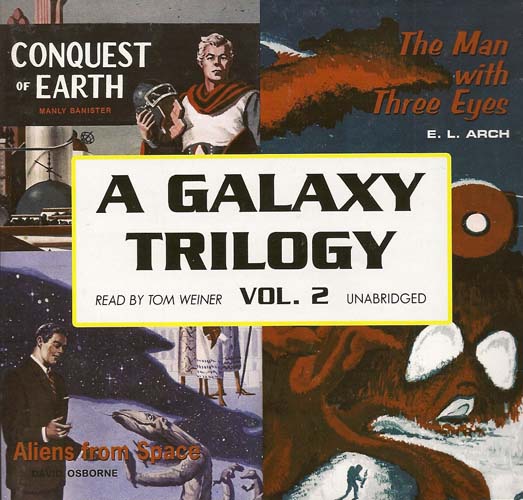
A Galaxy Trilogy, Vol. 2A Galaxy Trilogy, Vol. 2 – A Collection of Tales from the Early Days of Science Fiction
By David Osborne, E.L. Arch, and Manly Banister; Read by Tom Weiner
11 CDs – Approx. 13 hours [UNABRIDGED]
Publisher: Blackstone Audio
Published: 2009
ISBN: 9781433291081
Themes: / Science Fiction / Aliens / First Contact / Politics / Cold War / Russia / Washington, D.C. / Colorado / Amnesia / Prophecy / Sociology / Iowa / Teleportation /

Back in the 1950s at the dawn of science fiction, writers were turning out wildly imaginative stories for the pulp magazines. Robert Silverberg, writing as David Osborne, estimates he wrote over a million words in one year. Here are three more exciting stories from those heady days from the pioneers of science fiction.

Discs 1 – 3: Aliens From Space by David Osborne (Robert Silverberg)

First published in 1958, under a pseudonym, this Robert Silverberg short novel is set in a fascinatingly futuristic 1989. It is in a period of relative peace on Earth since the recent collapse of communism in Eastern Europe. With this new détente in the offing only an outside influence could disrupt the path to global harmony. And that is exactly what happens when an alien spacecraft lands in an Iowa cornfield. It seems that these aliens have been watching Earth for millennia, and now we are on the cusp of ‘regular interplanetary travel’ these alien beings wish Earth to accept their hand/tentacle in friendship. This aid would be especially needed too as it seems there is another alien species out there in the galaxy – one which would likely destroy the Earth, and all humans, given half a chance. A team of diplomats and scientists from around the world is quickly assembled to negotiate a treaty and alliance. Among them is Professor Brewster, a prominent scientist of psychosociology. He thinks the aliens are hiding something. But could it just be their very alienness? He points out the advanced technology they offer comes with its own problem; receiving technology from an technologically advanced civilization doesn’t advance the recipient’s own culture – it merely makes the culture dependent upon the giver’s civilization. But is that a small cost compared with annihilation?

A friend of mine pointed out that Greg Bear’s 1987 novel The Forge Of God has a similar premise. There are many terrific ideas in the gloriously short novel. Aliens From Space is a kind of cold war apologue, a prisoner’s dilemma situation. Wrong action invites destruction or at the very least, great loss. In a way the Brewster character reminded me of Jared Diamond (of Guns, Germs And Steel fame). Diamond and Brewster, by asking interesting questions, find interesting answers.

Discs 4 – 7: The Man With Three Eyes by E.L. Arch (Rachel Cosgrove Payes)

The Man With Three Eyes is not a terrific Science Fiction novel. But, it is a fair meta-Science Fictional story. It works well as a quasi-period piece/alien invasion story/Agatha Christie-style mystery. It’s set in 1967 New York, more specifically in Greenwich Village. It’s protagonist, I won’t call him a hero, is an Irishman, Dan Gorman. He works as a Science Fiction magazine illustrator and lives in Mrs. Mumble’s boardinghouse. That’s the central location for the plot, as it’s a virtual United Nations of ethnically diverse characters. There’s an Afghan, a German, a Mohawk, a Welshman, an Eskimo (not an Inuit), an Ethiopian, and a refugee from Hong Kong. They all seem to get along pretty well until Dan accidentally places himself in the middle of an alien espionage ring operating out of a dead drop joke shop. There, he picks up a “third eye” and takes it to a party to impress a girl. It doesn’t work like he expects (but then I can’t imagine it’d work at all), and instead acts like the titular object in H.G. Wells’ short story The Crystal Egg (giving the user a vision of aliens on another planet). Dan then leaves the party and looses the eye in his own apartment. The next two thirds of the novel feature everyone hunting for it.

Sound confusing? It is, at least a bit. I found myself wondering how fast E.L. Arch had written The Man With Three Eyes Or if he had written it on a bet. But, like I said, I think it kind of works anyway. It’s not really a good Science Fiction story, but it ain’t a bad story and can probably tell you a lot about how Science Fiction stories were written in the mid 1960s New York. It felt quite a bit like what I imagine time travel to Greenwich Village in the 1960s would feel like.

Discs 8 – 11: Conquest Of Earth by Manly Banister

The aliens came to earth more than two ice ages ago. Now, under millenia of domination by these invaders, one Man amongst a small cadre of six Men with mental powers, elite combat training and a deep education in all things human, can manoeuver to throw off the chains that have sapped Earth of most of its precious resource, water.

Like the Bene Gesserit from Frank Herbert’s Dune, Manly Banister has created a far future quasi-planetary romance with and especially compelling depiction of what it would mean to be trained to detect and interpret every nuance of human physiology. In fact this whole short novel is like a pocket version of Dune – what with all the quasi-religious/scientific ideas, the overlords, the secret societies and the deserty planet-ness. Conquest of Earth may have more ideas per hour as any other audiobook I’ve listened to in the last decade. When Kor Danay (aka the Scarlet Sage) graduates from his training he begins a quick journey across Earth that leads to scenes of assassination, disguise, mind reading and later an unusual trip off-world with a quickly romanced wife named, get this, Soma! One reviewer called the plot “aimless” and “desultory” and I can see that. The whole story feels disjointed in a way that cannot really be understated. Kor has many abilities the set him apart from other people, and even his fellow “Men.” First up, he has the ability to speed up the molecules of his body so as to, from his perspective, stop time! This trope, by the way, was probably first proposed in the The New Accelerator by H.G. Wells, and later by Star Trek in an episode called “Wink Of An Eye.” One lengthy later sequence features another quasi-Star Trek fore-echo too, namely in “The Paradise Syndrome.“ Did I mention that Kor also has a ”Divisible Mind” which may be the key to defeating the enemy Trisz? He does!

In terms of the style of writing, well, there is a nice soliloquized-style explanation of why the Trisz should not be thought of as actually evil despite being insidious energy beings or a being who rule (or rules) the Earth with an iron fist. There is a lot of other zany stuff going on in this novel: teleportation, trickery, a prophetic computer, and a dose of amnesia (for good measure). I will admit Conquest Of Earth comes off as if it was plotted by a mish-mash of meth’d up aliens in order to win a stream of consciousness contest, but somehow it really didn’t seem to bother me. And, I wouldn’t be surprised to hear it had won.

David Osborne is an acknowledged pseudonym of Robert Silverberg. E.L. Arch was a pseudonym of Rachel Cosgrove Payes (being an anagram of her first name: “Rachel”). But it is entirely unclear to me who Manly Banister is or was. There is some discussion of the improbably named Manly Banister HERE, but no Wikipedia article currently exists on this person. Even the narrator name, Tom Weiner, is an alias.

Narrator Tom Weiner’s voice lends depth and presence to the three novels – he adds an appropriate alien lisp to some of the alien speakers, plays around with accents and delivers it all a gravitas and seriousness that doesnt mock this fun material. Listening to A Galaxy Trilogy Volume 2 felt very rewarding!

A minor issue with this collection includes the distinct lack of markings on the discs. 11 CDs are in the set, with three short novels, but none of them is marked with which novels are on which discs. On the other hand, all three novels begin at the beginning of a CD.

Posted by Jesse Willis

Review of Hater by David Moody

SFFaudio Review

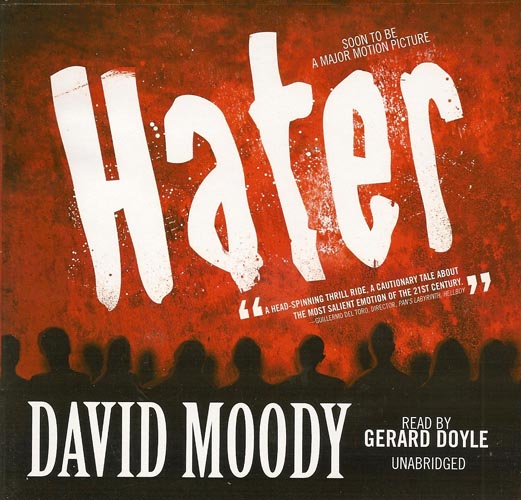
Science Fiction Audiobook - Hater by David MoodyHater
By David Moody; Read by Gerard Doyle
6 CDs – Approx. 7 Hours [UNABRIDGED]
Publisher: Blackstone Audio
Published: 2009
ISBN: 9781433292866
Themes: / Horror / England / Apocalypse /
A modern take on the classic “apocalyptic” novel, Hater tells the story of Danny McCoyne, an everyman forced to contend with a world gone mad, as society is rocked by a sudden increase in violent assaults. Christened “Haters” by the media, the attackers strike without warning and seemingly without reason. Within seconds, normally rational, self-controlled people become frenzied, vicious killers. As the carnage mounts, one thing soon is clear: everyone, irrespective of race, gender, age, or class, has the potential to become either a Hater or a victim. At any moment, even friends and family can turn on one another with violent intent. In the face of this mindless terror, all McCoyne can do is secure his family, seek shelter, and watch as the world falls apart. But when he bolts the front door, the question remains: Is he shutting the danger out or locking it in?

I think point of view is very important to telling a story. In most of Hater author David Moody seems to be actively working to subvert POV. Scenes that should be described from a third person perspective, like extended action by a non-participant, shouldn’t be told from a first person present tense – at least they shouldn’t if you’re already playing with other POVs.

This problem with Hater might not be so obvious had any of the characters been anything other than depressingly repellent. Danny McCoyne is supposed to be an everyman. Apparently David Moody thinks an everyman has a crappy job, a hateful boss, a shrewish wife, and a sackful of unruly, selfish kids. One review called this section of the book an evocation of “the quiet desperation of an ordinary life.” Another wrote: “[Danny’s] inner monologue consists mainly of complaining about his personal and financial situation.” Myself, I think that Moody has deliberately created, in Danny McCoyne, a character so satisfied in his blame game in-authenticity, so full of what the existentialists call “bad faith,” that you are supposed to be hoping to have him shocked into action, into taking control of his life and living in the world. The problem with this theory is that if its true Hater shouldn’t really be a novel. It’s not a good idea to have your audience sitting through four hours of blech to get to the revelation, however revelatory. And yet, about 5/6th of the way through this novel the thing that I’d been waiting for, hoping for, almost demanding really, finally happened. And, it happened pretty much as I expected it would. Perhaps if Danny McCoyne been a touch brighter he would have seen it coming too. I don’t read a lot of zombie fiction, or zombie-like ficition, but the idea Moody presents is a good one – it just shouldn’t have been done this way. Perhaps another problem here is that Hater seems to want to exist in a world in which books like I Am Legend had never been written. There’s a mainstream pitch to this novel that I can’t imagine has actually increased sales any.

Here are some more of the silly mistakes in Hater: Apparently there is no internet in David Moody’s England. Danny McCoyne’s family basically lives in front of the television, and most conversations and arguments that they have are about what they see on the TV. That’s just retarded. I know there are some people out there who just refuse to participate in the internet, but I can’t imagine that when the television stops even pretending to deliver relevant news that a family, desperate for some facts about what’s happening in the outside world, wouldn’t turn on their computer. Also dumb is that the exact location of events are never revealed, we get plenty of evidence that the story is set in a mid-sized English city. Danny lives in a “flat,” the police carry “truncheons” and the buses are double-deckers – the Prime Minster is mentioned. It’s England. We got it. But then with the cadence and dialogue also smacks of English suburbia why isn’t the place just out and named then? Well, maybe it was, and then it was edited out in some kind of half-hearted attempt to appeal to American audience. Yes, my friends Hater is a novel with strategic word changes. There are both “football fans” and “soccer fans” in Hater. I hate this kind of sad sack editing. It’s in the intellectually diminutive tradition of Harry Potter And The Philosopher’s Zone (aka Harry Potter And The Sorcerer’s Stone). It doesn’t make me a Hater-fan it just makes me a hater.

I quite enjoyed the Darker Projects audio drama adaptation of Moody’s novel Autumn. Autumn was later adapted into a truly terrible film. Apparently Hater has been optioned as well. I think the film will be better than the movie, by at least 4 hours. I’m not sure about narrator Gerard Doyle, his delivery is very English, very approriate, I guess, but this material doesn’t exactly make me associate good with the sound of his voice. The cover, made for Blackstone Audio, is a vast improvement over the truly uninspiring paperbook edition.

Incidentally, there’s a podcast preview (with a different narrator) available through iTunes |HERE|.

Posted by Jesse Willis