Review of Transition by Iain M. Banks

SFFaudio Review

Science Fiction Audiobook - Transition by Iain M. BanksTransition
By Iain M. Banks; Read by Peter Kenny
13.5 Hours – [UNABRIDGED]
Publisher: Hachette Audio
Published: 2009
Themes: / Science Fiction / Alternate Realities / Consciousness / Culture /

It was my understanding that Iain Banks published his non-science fiction under this name and his science fiction as Iain M. Banks. I haven’t read any of his other books, despite having Consider Phlebas on my book shelf for the last twenty one years. After reading Transition that book has suddenly jumped a lot closer to actually getting read. Sadly it isn’t available in audio or it would be a done deal.

Transition tells the disjointed, non-linear story of Tumudjin Oh. Oh is one of the many agents for The Concern, an organisation that spans the multi-verse, also known in some realities as l’Expédience. His job involves traveling to different realities and performing a wide range of tasks. From leaving a leaflet so that someone will see it and change their life, or stopping someone from entering a building moments before is collapses and even outright assassination. Banks employs the Many-Worlds variant of alternate realities and the implications of what realities they do, and more importantly do not
encounter, are central to the core conflict. Travel between realities is not by means of a portal or vehicle, but by the use of a drug, septus. This allows individuals to send their personalities to different realities, where they take over the body of someone already there. Usually, the invaded body is of a similar age and body type, but that isn’t set in stone. Once in the host body, they have access to the skills, knowledge and languages of their host. Travel is not a there and back, but a never-ending series of forward jumps that periodically may return to previously visited realities, but not necessarily into the same host as before.

Oh is very much the pawn between the rival Madame d’Ortolan and Mrs Mulverhill. d’Ortolan is the unofficial head of l’Expédience, and is grooming Oh. Much as the rebel Mrs Mulverhill does. He has a small case of OCD that follows him from body to body, sometimes stronger than others. We follow Oh in the present as he is sent on a mission by Madam d’Ortolan and also flashbacks telling how he has come to this point. Mrs Mulverhill, always wearing a veil in whatever reality and
body she has, attempts to seduce Oh both physically and politically.

There are other view points that we cycled throughout the book. Some are told in the first-person, others in third. Patient 8262 is a Transitioner who has hidden himself in a clinic in a reality where he hopes to escape his mysterious pursuers. Madame d’Ortolan has plans concerning the governing Council of the Concern, which Mrs Mulverhill objects to. Oh, who’s points-of-view sections are titled The Transitionary, meets d’Ortolan and received his orders. There are also
points of views from other characters, including Adrian Cubbish, a drug dealer turned financier, who we comes from our own reality.

Banks’ explore a range of topics, particularly in their first person narrations, from Christian Terrorists, torture, limited liability companies and drugs. Adrian goes into detail about his love affair with Cocaine, comparing it to the variety of alternatives.

The several points of view, particularly the multiple first person narrators confused me at first. I had to replay the first chapter or so once I figured out what was happening. Listen out for those POV changes, they could have been made clearer with a slightly longer pause perhaps.

The narrator, Peter Kenny, is outstanding. You can hear the thought behind the intonation of every phrase. A very detailed and thought out narration. The high point for me was Bisquitine’s insane ramblings. Jumping accent and voice sentence by sentence to bring her madness to life. Yet he uses the technique to make a certain sense of the stream
of apparently random phrases. I’ll be looking out for more from this narrator, even out with the SF genre.

As I mentioned at the start, I’ve not read any of Bank’s work before. If Transition has taught me nothing, it’s that I’ve been sorely remiss in this. Transition is a very dense, detailed story. The scenes come to life in only a few words, Banks’ prose is a delight to read. I’m certain that I’ll appreciate it even more on a second, and probably a
third listen. I’m sure I’ll understand more of the depth of the plot and the character’s machinations. Banks doesn’t dwell on what makes each reality distinct. Experienced transitioners can sense the make up of a reality, and their almost check-list breakdown as they assimilate into their new host body covers it. The realities themselves aren’t the centre stage, the only exception is Calbefraques, the base reality of l’Expédience. Instead the story focuses on the character’s.

After my single listen, I’m not sure about some aspects of the story, such as why so much time was spent with some characters. Adrian in particular, but also Patient 8262. Not that these sections weren’t entertaining, but I struggle to see what their character’s were contributing. Patient 8262 at least provided exposition on Transitioning and the setting as a whole, and so served as an overall narrator of sorts.

An engrossing listen that appeals to my love of complexity and traveling amongst alternate realities. Highly recommended.

Posted by Paul [W] Campbell
Review of Simon Bloom: The Octopus Effect by Michael Reisman

SFFaudio Review

Fantasy Audiobook - Simon Bloom The Octopus Effect by Michael ReismanSimon Bloom: The Octopus Effect
By Michael Reisman; Read by Nicholas Hormann
9.5 Hours – [UNABRIDGED]
Publisher: Listening Library
Published: 2009
ISBN: 9780739382387
Themes: / Science Fiction / YA / Science / biology /

|LISTEN TO AN EXCERPT|

As another chronicle begins Simon Bloom and his friends are thrust back into mortal peril. This time the gang heads to the Order of Biology’s headquarters. When the gang gets there they find an unexpected surprise – it’s underwater! Simon and his friends must prepare themselves for battle against the evil Sirabetta (unsure on spelling) who somehow has regained her memory. Simon and his friends face enemies from other orders and the Order of Biology’s domain itself!

One of the things I liked most about this story was the author’s use of humor for the oddest things. When something gross or funny is described in the book it is described by using words like “air ripping”, or “vacuum cleaner bag smell”. I think that it is brilliant.

The reader, Nicholas Hormann, makes the experience of listening to this book all the more interesting. The way he reads just makes me laugh, you have to listen to the book to know what I mean. He is excellent with accents. When he reads characters in the story like Flangello (again not sure about spelling) he speaks with a very good Italian accent. Nicholas is not the most emotional reader, but this fact does not detract from the story one bit.

I encourage everyone to listen to this audio book, providing that one has read the first book (Simon Bloom: The Gravity Keeper), otherwise one might not understand the book in its full context. I absolutely loved this audiobook and I am sure any person that enjoys science will feel the same way.

Posted by DanielsonKid

Review of The Lies Of Locke Lamora by Scott Lynch

SFFaudio Review

Science Fiction Audiobook - The Lies of Locke Lamora by Scott LynchThe Lies of Locke Lamora
By Scott Lynch; Read by Michael Page
18 CDs – Approx. 23 Hours [UNABRIDGED]
Publisher: Tantor Audiobooks
Published: 2009
ISBN: 1400110513
Themes: / Fantasy / Crime / Magic /

An orphan’s life is harsh—and often short—in the island city of Camorr, built on the ruins of a mysterious alien race. But born with a quick wit and a gift for thieving, Locke Lamora has dodged both death and slavery, only to fall into the hands of an eyeless priest known as Chains—a man who is neither blind nor a priest. A con artist of extraordinary talent, Chains passes his skills on to his carefully selected “family” of orphans—a group known as the Gentlemen Bastards.

Here’s the one sentence summary I’ve been using to describe The Lies Of Loche Lamora:

Like Oliver Twist in Lankhmar.

In a way this is the anti-Harry Potter book. It’s about a school for thieves and not magicians. It doesn’t have heroes and villains as much as it has profligate crooks and despicable liars. Our protagonist is the titular Locke Lamora, a young wastrel in the city of Camorr. He’d starve or be sold into worse slavery had he not been born with a certain larceny in his heart. Camorr, the city itself, too is a terrific character in this book, being a vividly described assemblage of various fantasy cities Lankhmar, Arenjun, and real life historical ports like late medieval Venice. Under careful tutelage, Locke and his companions grow into formidable talents, practicing their art in a series of ever more elaborate con-games.

When I was a kid playing Dungeons and Dragons I almost always played the “thief” class. Magic users always seemed lame to me, clerics were like magic users but with religion (which seemed to me like a third wheel for actual role playing) and fighters were boring. Sure you’re tough – and that’s good for fighting, but that’s it. I always thought there was a little too much fighting in D&D. My favourite part of role playing was the part in the tavern, before the quest proper really got started. I was inspired by Baggins burglar clan – but thought they had it too damn easy with the magic ring of theirs. Later in life I’d see movies like: The Sting, The Grifters, and Harry In Your Pocket. I’d read books like: The Green Eagle Score and The Girl With The Long Green Heart. Those stories all had setups I really dug. I liked characters who lived by their wits. Characters who, without being either the best shot, or the fastest draw, without having the biggest muscles or fastest legs could make the getaway with at least half a sack of gold in hand. And that’s why I like The Lies Of Loch Lamora so much.

The Lies Of Locke Lamora is rich with detail. I have a hard time conceiving just how much time Scott Lynch put into the world building. The magic system is based, smartly, around the “language” or “name” model of magic. Words have power. Knowing the “true name” of something or someone gives you power over it. Indeed, even in real life language is almost like magic. I can say to you something like: “The blue horse with the rainbow flavoured fedora is clambering slowly up the valley’s cool red roof” and some sort of weird imagery is suddenly **poofed** into your mind. I can buy into this kind of magic. It’s the same kind of magic that J.K. Rowling puts into her villain names: Just think about it, Voldemort and Malfoy, (“underground death dweller” and “bad foil”). It’s too bad Rowling didn’t have the teachers at Hogwarts teaching this magic language magic system instead of the hodge-podge it has – I might have cared more. So back to the book at hand, magic plays a fairly central role in the plot of The Lies Of Locke Lamora, it’s rare, and doesn’t enter into the novel until quite late. Other furnishings in Lynch’s Fantasy landscape include substitution. Instead of glasses we get “optiks” and instead of chemical we get “alchemical.”

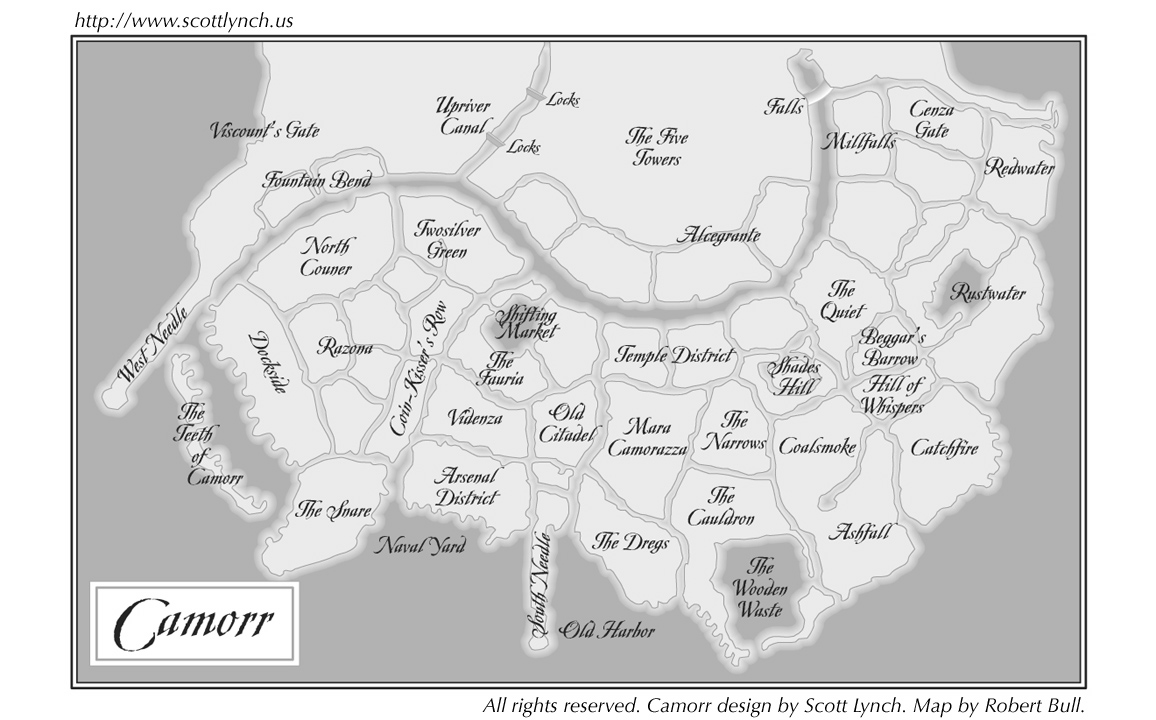
Thinking back, narrator Michael Page did employ a fairly wide range of voices. And there are quite a few characters for him to bring to life. Several of these age over time. Some narrators take over the text, Page is not one of them – he delivers the lines as appropriate, so that for the most part I didn’t notice his performance. If there are any laments I have about this excellent audiobook they are very few. One would be it’s length, it is a tad long. This is a sin that virtually every Fantasy novel is guilty of these days. It held my attention, but there were certainly a few scenes that could have been easily summarized without losing one whit of the novel’s otherwise careful pacing. Another lament, the Bantam Spectra paperbook edition of this book includes an excellent map of the city of Camorr. Modern audiobooks never include maps as a supplement. So neither does this Tantor edition. This is a mistake. Any novel assumes a certain familiarity with geography but Fantasy novels, especially of this kind, are burdened with creating a new world from scratch. An audience that is unfamiliar with its geography is less likely to be able to follow the action spatially. Several times during my was listening I wished I had a map of the city of Camorr at hand.

If you do get this audiobook I suggest that you print out a copy of THIS MAP over on ScottLynch.us.

Posted by Jesse Willis

Review of Shards by Bruce Baugh

SFFaudio Review

Horror Audiobook - Shards by Bruce BaughShards
By Bruce Baugh; Read by Wayne June
1 MP3-CD – 9.5 hours – [UNABRIDGED]
Publisher: Audio Realms
ISBN: 9781565048652
Themes: / Horror / Vampires / Lasombra /

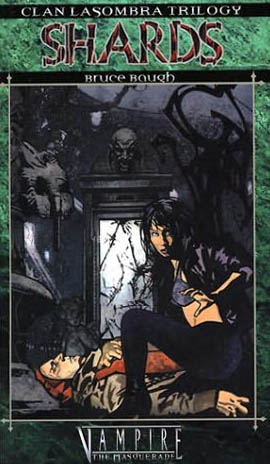
I don’t mind a good vampire story if it’s really an action movie that just happens to be about vampires (and as long as the protagonist isn’t a self-absorbed adolescent girl that can’t get over how “perfect” Edward is, but I digress). Otherwise, neh, I’m not so interested. Audio Realms tricked me into listening to Shards by Bruce Baugh (from Clan Lasombra Trilogy: Shards, Shadows, Sacrifices) by making the woman on the cover look like Kate Beckinsale.

Duped! It was the real deal. Vicious, evil vampires and no good guys. I loved it! I don’t usually like books where there is no one to cheer for. Don’t get me wrong, I like a hero with flaws, I just don’t like it when everyone including the protagonist is evil. But Bruce Baugh does a remarkable job with his characters. With each individual, motivations and predispositions were entirely understandable.

The protagonist, Lucita, is disillusioned about all things vampire. After 10 centuries a vampiress begins to ask herself, “Why? Why should I let the (undead) man hold me down? What’s the point of anything, really?” It’s kind of like Office Space for vampires. So of course she kills her “tyranical sire” and is ready to end herself too. The story starts at that point.

The Clan Lasombra is unhappy about Lucita’s behavior and (apparently ignoring the fact that she’s as hot as Kate Beckinsale) they send out a posse of ne’re-do-wells to hunt her down. The book is a fantastically creative vampire-hunts-vampire pursuit. Bruce Baugh created a plausible world where vampires could exist among us. I don’t know what I can say about the end without spoiling it, but it wasn’t predictable.

What stands out in this production is the narration. Since the antagonist was a female Audio Realms might have used a woman narrator, but Wayne June was just perfect for the story. I have a short list of narrators I just love to listen to, and none exceed Mr. June’s talent. His range of credible voices is astonishing. It has a deep, vibrant timbre that feels like smooth burgundy velvet. It made me think of an old muscle car when you start the engine and it idles deeper and stronger than most other cars. It was absolutely perfect for the characters in the story. Every time a new character was introduced and June would use a new voice I would think, “My goodness, how many unique voices can this guy do?!” They were all uniquely distinct and believable. It would be one thing if he had twenty generically evil vampires to do variations on. But he had to pull off the characters that Baugh had created, including an English vampire that I’m sure was the Fifth Beatle, ones with Spanish and Russian accents, nerdy college kid vampires, and and so forth. June sold me on every single character.

I’m not saying I believe in vampires, but I am saying that if Wayne June actually was a vampire it would explain a lot! A word of caution: the vampire’s language suggests that they’ve drank the blood of one too many drunk sailors, if you know what I mean.

Shard’s was a delightful, dark surprise. I’ve listened to it twice already and recommend it, even if (like me) you’re not normally a fan of dark vampire stories.

Posted by Michael Hinds

Review of Conan the Cimmerian by Robert E. Howard

SFFaudio Review

Fantasy Audiobook - The Coming of Conan the Cimmerian by Robert E. HowardSFFaudio EssentialThe Coming of Conan the Cimmerian
By Robert E. Howard; Read by Todd McLaren
18.5 Hours – [UNABRIDGED]
Publisher: Tantor Media
Published: 2009
Themes: / Fantasy / Conan / Sword and Sorcery /

What do readers want out of fantasy fiction? Epic quests to banish evil from the world? Coming of age stories of young wizards and warriors growing up and into their great, latent powers? Many do: I enjoy these types of stories myself, from time to time.

But when my heart yearns for pulse-pounding, savage adventure, curvaceous women and thrilling sword fights, forgotten, vine-grown cities, and ancient, monstrous evil guarding hoarded gems and gold, I turn to Robert E. Howard, creator of Conan the Cimmerian.

Now, thanks to Tantor Media, we have the luxury of listening to pure, unaltered Howard as well. The Coming of Conan the Cimmerian is the first of three planned releases by Tantor collecting all of the original Conan tales. This 15 CD set (18.5 hours) includes the first 13 Conan stories, in the order Howard wrote them. Narrator Todd McLaren delivers the stories with passion and precision.

The Coming of Conan the Cimmerian was originally published in 2005 by Ballantine Books/Del Rey, followed shortly by The Bloody Crown of Conan and The Conquering Sword of Conan. Taken together, these three books for the first time included all of Howard’s original, unedited Conan stories. For those who may not know, Howard’s tales first appeared in Weird Tales magazine in the 1930s, and were later published in edited form, along with pastiches of variable quality, by Lancer/Ace books in the 1960s and 70s.

The stories in The Coming of Conan the Cimmerian include:
• The Phoenix on the Sword
• The Frost-Giant’s Daughter
• The God in the Bowl
• The Tower of the Elephant
• The Scarlet Citadel
• Queen of the Black Coast
• Black Colossus
• Iron Shadows in the Moon
• Xuthal of the Dusk
• The Pool of the Black One
• Rogues in the House
• The Vale of Lost Women
• The Devil in Iron

Rather than provide a simple plot summary of the short stories listed above, I thought I’d use this platform to talk about Howard’s place in fantasy fiction and the broader field of literature. Many fantasy readers turn their nose up at Howard. They think his stories are all surface, pure story with no depth. Or they mistakenly conflate Howard’s Conan with the dumb brute of the films Conan the Barbarian or Conan the Destroyer. These folks are of course wrong.

It is true that many of Howard’s tales were written for quick publication in the pulp magazines of the era. As a result, some are rather formulaic. But Howard at his worst captivates with his seemingly effortless ability to produce breathless action. He had a talent for depicting whirling combat and wonderful images in a few words, and for poetic turns of phrase.

At his best, Howard wrote with surprising depth worthy of closer analysis, even study. His most ubiquitous, well-known theme was civilization vs. barbarism. Howard believed that as nations became civilized they grew correspondingly decadent and corrupt. Men who fight savagely and shed their blood to carve out shining kingdoms grow soft in times of peace and plenty until greed and sloth set in. Old kingdoms weaken through internal strife until they collapse from within or are invaded from without. In Howard’s works and in the mind of the author himself, the howling “barbarians at the gates” were always waiting to pounce when kingdoms grew weak, and Conan himself was one of the horde. Honest rule by might and the axe was preferable to the soft lies and deception of civilized men, whose faces were masks concealing their falsity.

To quote Conan from “Beyond the Black River,” “Barbarism is the natural state of mankind. Civilization is unnatural. It is a whim of circumstance. And barbarism must always ultimately triumph.”

Other critics have noted existentialist strains running through Howard’s stories, as well as a hard-boiled realism that leant even his most fantastic, otherworldly tales a feeling of grounded, earthly reality. Howard also infused his stories with the myth of the American frontier. Born in Texas in 1906, Howard listened with rapt and wistful attention to old men who had witnessed first-hand the closing of the frontier, settling virgin wilderness and fighting Indians in savage wars for territory.

In my opinion Howard’s best Conan tales don’t appear in The Coming of Conan the Cimmerian: “Beyond the Black River” and “Red Nails” represent Howard at his peak, and are scheduled to appear on Tantor’s later discs. But “The Tower of the Elephant” is worth the purchase price alone, and “Queen of the Black Coast,” “The Scarlet Citadel,” “The Phoenix on the Sword,” “The Frost-Giant’s Daughter” and “Rogues in the House” are all terrific as well. “The Vale of Lost Women” is the only true dud here (it went unpublished in Howard’s lifetime, and was probably better off left in a footlocker), while “The Pool of the Black One” didn’t do a lot for me, either.

In addition to Howard’s stories, Tantor also includes a wonderful introduction by Patrice Louinet, which does a far better job than I describing Howard’s themes. “If the true work of art is something that at once attracts and disturbs, then the Conan stories are something special, an epic painted in bright colors, featuring heroic deeds and larger-than-life characters in fabled lands, but with something darker lying beneath,” Louinet writes.

The one problem with the set? Tantor inexplicably failed to include track listings. You have to skip around to find the stories, and while it didn’t bother me too much for this review (I listened straight through), you’re out of luck if you ever want to just pop in a disc and listen to “The God in the Bowl,” for example. Ah well. I know Tantor has corrected this oversight and plans to include track listings on its future releases.

Still, this omission aside, Tantor Media should be commended for releasing the audio versions of the books that every true Howard fan should have in his or her collection.

Posted by Brian Murphy

Review of Killing Castro by Lawrence Block

Aural Noir: Review

Killing Castro is book number 051 in the Hard Case Crime library.

BBC Audiobooks America - Killing Castro by Lawrence BlockHard Case CrimeKilling Castro
By Lawrence Block; Read by Henry Leyva
4 CDs – Approx. 4 Hours 45 Minutes [UNABRIDGED]
Publisher: BBC Audiobooks America
Published: January 2009
ISBN: 9780792759751
Themes: / Thriller / Cuba / Hitman / Mercenaries / History / Assassination / Crime /

There were five of them, each prepared to kill, each with his own reasons for accepting what might well be a suicide mission. The pay? $20,000 apiece. The mission? Find a way into Cuba and kill Castro.

Until the announcement on the Hard Case Crime website in 2008 most Block aficionados, like me, had no idea that novel that is Killing Castro existed. Us Blockheads knew that LB had written a ton of novels early in his career. Heck we’d even identified quite a few of them. But unless you’d owned a copy of Fidel Castro Assassinated: A Dramatic Tale of a Daring and Successful Plot to Kill Cuba’s Dictator, and had compared this obscure 1961 Monarch paperback with Block’s writing you’d never have known he’d written it. This is because it was originally attributed to an otherwise unknown author “Lee Duncan.” Had it been written by “Paul Kavanagh” (a known Block pseudonym), I’d have already found and read a copy years ago. Indeed, to my ears this certainly feels like a lost fourth Paul Kavanagh novel. Two of Paul Kavanagh’s three other novels are about shady operatives doing black-ops for cash too. If you want the original paperback, by the way, ABEbooks.com currently lists a copy at $150.00. That’s down from the $600 asking price just a few months back. Hard Case Crime offers the gorgeous covered paperback version for just $7. Me, I’ll stick with the BBC Audiobooks America version.

One of the things I liked most about this audiobook, other than the brisk characterization and snappy plotting, was all the historical context Block put into the novel. This isn’t merely a thriller, or a crime story. Running just under 5 hours (204 pages in paperbook) there’s about half an hour of historical exposition between all the action. In those sections Block deftly details Fidel Castro’s personal biography, the history Batista’s rule of Cuba, Fidel’s leadership of the revolution and a thoughtful analysis of the revolution’s aftermath. As far as I can tell the history is entirely accurate. It sticks to the facts and makes a case both for and against Castro’s revolution without any special pleading. To my mind “Lee Duncan” could have probably got a job at the Cuba desk of the CIA, just based on the analysis within this novel. They really could have used him too as the book originally came out the same year as the CIA-backed Bay Of Pigs invasion. But I guess the covert world’s loss is our literary gain.

This is the first time I’ve heard Henry Leyva as a narrator. He performs the American mercenaries with enough distinction to tell all five of them apart, and gives good voice to two Cuban rebels, one male, one female. As Leyva is fluent in both English and Spanish he brings a ton of authenticity to the Cuban accented anti-castristas. He really is a narrator to watch. I first heard him as an actor performing in an episode of J. Michael Straczynski’s excellent audio drama anthology series City Of Dreams. He’s also narrated the audiobook version of Cuba Libre by Elmore Leonard, so I’m gonna have to get my hands on that audiobook too.

Posted by Jesse Willis