Review of Club Dead by Charlaine Harris

SFFaudio Review

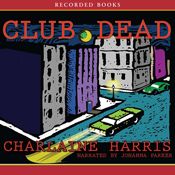
Club Dead by Charlaine HarrisClub Dead
By Charlaine Harris; Read by Johanna Parker
Audible Download – 8 hours [UNABRIDGED]
Publisher: Recorded Books
Published: 2008
Themes: / urban fantasy / paranormal romance / vampires / werewolves / True Blood

The second season of HBO’s True Blood, based on Charlaine Harris’s Sookie Stackhouse novels. The show’s first season very loosely followed the first novel in the series, Dead Until Dark, while the second season made significant departures from the second novel, Living Dead in Dallas. Hoping to garner some clues about the show’s third season, I decided this would be a good time to read the third installment in the series. While the flavorful writing and vivid characterization are still top-notch, Club Dead lacks the charm and magic that made the series opener so memorable.

As the novel opens, telepath human Sookie Stackhouse is finding her vampire boyfriend Bill Compton a bit distant. He’s exhibiting the characteristics of an internet addict, spending hours on his computer and hiding his activities from her. Without warning Bill announces he’s going away on business, and leaves a set of computer disks in Sookie’s protection. As if this isn’t disconcerting enough, Bill’s vampire boss Eric Northman from Shreveport soon calls on Sookie to tell her that Bill has vanished somewhere in the town of Jackson, Mississippi, and charges the werewolf Alcide Herveaux with helping Sookie find her squeeze. The city of Jackson, and its supernatural-friendly night dive Club Dead, serve as the setting for most of the novel’s action.

Sookie Stackhouse is a fantastic character, and it’s always a treat to spend more time with the strong-willed yet insecure waitress from Bon Temps, Louisiana. The vampire Eric Northman, a shadowy figure of great power in the first two novels, also finds more development here. He becomes more three-dimensional, but at the cost of losing some of his mystique. Newcomer Alcide Herveaux, who introduces Sookie to Jackson’s werewolf community, fits comfortably among the series regulars. Sookie’s love interest, Bill Compton, is absent for much of the novel, but he does resurface near the book’s conclusion. Relationships among these principal personalities shift significantly during the course of the book. I’m not sure I approve of the shifts in affiliation and allegiance, but they certainly made for some moments of powerfully emotional storytelling.

Charlaine Harris’s writing is superb, especially her ear for dialogue and her liberal use of local color. Having spent many years in East Texas, which in many ways lies in the same cultural sphere as the book’s setting, I can attest to the verisimilitude Harris achieves in her prose, accentuated by the first-person storytelling from Sookie’s perspective.

The problem with Club Dead, as with its predecessor, is that it removes too much of the human element from the story. Urban fantasy is at its best when it juxtaposes the supernatural and magical against the backdrop of the commonplace and mundane. The first novel, Dead Until Dark, achieved this brilliantly, introducing vampires into the sleepy village of Bon Temps. This powerful quality of urban fantasy is lost in Club Dead among all the machinations within and between the werewolf and vampire communities, fascinating though they may be. Indeed, the eponymous Club Dead itself exemplifies this. Whereas Fangtasia, or even Merlott’s, in the preceding novels were melting pots of the races, Club Dead is an almost-exclusively supernatural hangout, sprinkled only here and there with the presence of humans.

The audiobook version is narrated brilliantly by Johanna Parker, who perfectly captures Sookie Stackhouse’s spunky fire and angsty gloom. The southern colloquialisms roll off Parker’s tongue like sweet lemonade on a hot Texas summer day. Her portrayal of the dark, menacing power of the vampires, werewolves, shapeshifters, and other supernatural beings is no less impressive. Often the force of her narration made me jump or sent tingles down my spine, which is just what you want from a good audiobook.

Even with its lackluster plot, Club Dead is a worthy addition to the Southern Vampire Mysteries, and anyone who has enjoyed the first two novels will certainly want to continue the adventure. Fans of the TV show True Blood should also pick up these novels and experience firsthand the witty, brilliant, sometimes-twisted mind of Charlaine Harris.

Posted by Seth Wilson
Review of Hyperion by Dan Simmons

SFFaudio Review

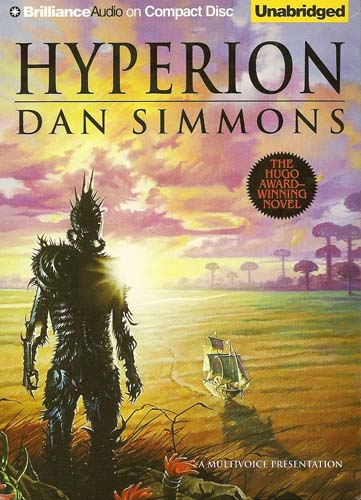
Hyperion by Dan SimmonsSFFaudio EssentialHyperion
By Dan Simmons; Read by Various
19 CDs – 21 hours – [UNABRIDGED]
Publisher: Brilliance Audio
Published: 2009
ISBN: 9781423381402
Themes: / Science Fiction / Artificial Intelligence / Aliens / Religion / Starships / Simulations / Transportation /

Seven people, all headed to the planet Hyperion to visit the Shrike, find themselves on the same ship. Regular pilgrimages are made to the Shrike, but these seven have been granted a visit to the Shrike together. To find out why this is, they all agree to tell each other their personal stories of what brought them. The result is a Canterbury Tales in space. A priest, a soldier, a poet, a scholar, a detective, and a consul each tell their story; all separate, all intensely personal, all very different, yet all involving the Shrike in some way.

The book is set in the distant future, and the ideas are plenty. There’s farcasting, where doorways are created to other worlds. One character has a house where every room is on a different world. Costs a fortune, but it can be done. There are artificial intelligences, starships, and sims. Against this backdrop is the Shrike, an alien creature that lives in the Time Tombs, and the seven on a pilgrimage who land in a city on the planet Hyperion, then make their way to see the Shrike over land. “Pilgrimage” is definitely the right word here, because the whole book has a mythic-religious quality. Each person is dealing with very difficult stuff, and what each person hopes to gain from the Shrike when they finally get to see it is nothing short of intervention of a higher power.

Audible Frontiers did a wonderful job with this audiobook. It used to be available only through Audible, but now Brilliance Audio is offering a hardcopy version on CD, which is how I listened. Each story is told by a different character, and each one uses a different narrator. The narrators were all excellent, so this is a perfect presentation of this book.

All seven of the stories are fascinating, well-written stories. There isn’t a weak one on the bunch. This is a top-shelf science fiction novel, up there with the greatest books of the genre.

Highly recommended, without question an SFFaudio Essential! The single caveat is that you must plan to read the next book in the Hyperion Cantos, (called The Fall of Hyperion), because the story doesn’t end with the end of this book. The Fall of Hyperion is also available from Audible (digital) and Brilliance Audio (CD), as are the two books that complete the series, Endymion and The Rise of Endymion. This is the only one I’ve read, but I expect I’ll be reading them all.

Posted by Scott D. Danielson

Aural Noir Review of Paranoia by Joseph Finder

Aural Noir: Review

Macmillan Audio - Paranoia by Joseph FinderParanoia
By Joseph Finder; Read by Scott Brick
Audible Download – 13 Hours 8 Minutes [UNABRIDGED]
Publisher: Macmillan Audio
Published: July 2009
Provider: Audible.com
Themes: / Thriller / Espionage / Business / Crime / Corporate Culture /

Adam Cassidy is 26 and a low-level employee at a high-tech corporation who hates his job. When he manipulates the system to do something nice for a friend, he finds himself charged with a crime. Corporate Security gives him a choice: prison – or become a spy in the headquarters of their chief competitor, Trion Systems. They train him and feed him inside information. Now at Trion, he’s a star, skyrocketing to the top. He finds he has talents he never knew he possessed. He’s rich, drives a Porsche, lives in a fabulous apartment, and works directly for the CEO. He’s dating the girl of his dreams. His life is perfect. All he has to do to keep it that way is betray everyone he cares about and everything he believes in. But when he tries to break off from his controllers, he finds himself in way over his head, where nothing is what it seems and no one can really be trusted. And then the REAL nightmare begins…

I quite enjoyed this audiobook. That surprised me quite a bit. I was fairly skeptical going in. Books about business are often too much like self-help books. At worst they can be all full of untestable advice, formulaic reformulations of Sun Tzu’s The Art Of War, dogmatic variations on Machiavelli’s The Prince or even, horror of horrors, creating their own Baconian-style methodology (writing lists of commonalities). But, I told myself, this is a business thriller and not a business book, so I gave it a try. Now,after reading this thriller I think I’d be up for reading a good book on real world corporate espionage. It might be more interesting than any other kind of non-fiction business book I’ve read. A few other things struck me about Paranoia. First, Joseph Finder can write. This isn’t Oprah fiction, this literature that fits in somewhere in between John Grisham and Nelson DeMille. Second, there are a few twists and turns along the fairly predictable path. Some of these came rather unexpectedly. Those being generally in a good way. Third, Adam Cassidy, our flawed hero, is a fairly likable protagonist. This is helped by having the story told first person (and narrated the ever lovable Scott Brick). As to the novel’s formula, there were a couple of rough patches. At several points throughout the novel Finder seems to make a special effort to distance Cassidy from the techie world he works in. This felt a bit odd for the story, but it seems like a ploy to make a thriller set in the iPhone world more mainstream than it really is. At certain points Finder has Cassidy far less familiar with his tech business than he should be. In my experience techies usually don’t think of their toys as mere tools. I’ve never worked for Palm or Apple or Research In Motion (they make the BlackBerry), but I’m betting that the folks who work there are a lot more techie than Adam Cassidy. Another issue, the family and friends felt constructed into the plot – put there to provide a break from the main thrust of the story. Despite this I found myself not too upset with the author’s manipulation. Scott Brick again probably helped here. I’m not convinced he’s the best narrator for a lot of novels I hear him reading, but for those told first person, I must admit he’s got to be one of the best. Lastly, as with the character being blatantly aimed at the mass market, rather than more realistic for his position, there is comparable problem with the novel’s title. Sure there is a bit of paranoia in Paranoia – but that title has more to do with crappy generic book titling culture than the book itself. Corporate suits get there way on this all the time, and we consumers aren’t calling them on it. I would much rather read We Can Remember It For You Wholesale than Total Recall. The first tells me something about the story.

I picked up Paranoia during Audible.com’s free giveaway of the audiobook a few weeks back. After getting my first taste for free I think I’d be willing to pony up an Audible credit for the next Joseph Finder novel to come out. One Audible reviewer gave the novel a low star review because it has “more F-Bomb’s in it than any other book that I’ve read.” Thinking back, I can’t say I remember that many. The odd “Fuck!” now and then was present, but given the circumstances Cassidy is dealing with from chapter to chapter leaving them out would have been far more noticeable than having them there. Real drama tends to have swearing. I don’t usually like to talk about adaptations of audiobooks into other mediums. My ususal thinking is that fiction is best in the audiobook form, but I realized about two thirds of the way through that Paranoia might be improved further. There is a chapterized serial cliff-hanger feel to it that is similar to that of some of the best of modern television programs (the likes of Dexter, Breaking Bad and Weeds). Thematically, of course, this theoretical television adaptation would be far more similar to the short lived Fox TV series Profit. If there is going to be an adaptation of this novel, I suggest it be to cable TV, if only to keep the all the swearing.

Posted by Jesse Willis

Review of Dune, Messiah by Frank Herbert

SFFaudio Review

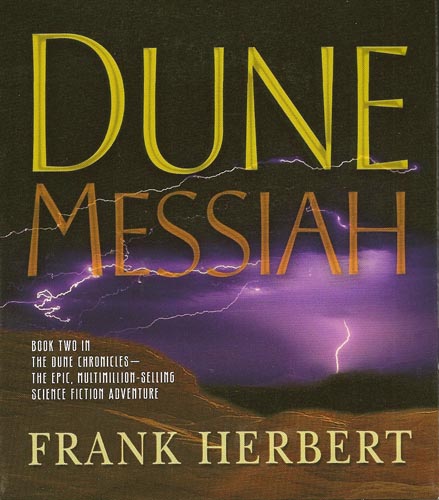
Dune Messiah by Frank HerbertDune, Messiah
By Frank Herbert, Read by Scott Brick, Katherine Kellgren, Euan Morton, and Simon Vance
9 hours – [UNABRIDGED]
Publisher: Macmillan Audio
Published: 2007
Themes: / Science Fiction / ESP / Religion / War / Charismatic Leader /

Its 12 years after the triumph of Paul Atriedes on Arrakis, as presented in Dune. But “happily ever after” wasn’t the kind of book that Frank Herbert was interested in writing. Nor was a “Dune Part II” in which Paul would be presented with another challenge, maybe greater than the first, which he would conquer – with much rejoicing. (Yayyyyy!) Instead, Frank Herbert gave us something (here it comes) completely different.

Dune, Messiah opens with a discussion between members of the Spacing Guild, the Bene Gesserit, the Bene Tleiaxu, and the Princess Irulan about how to bring about the fall of the Emperor Paul, making it immediately apparent that things are not going well for Paul. The known universe has not fared well under his rule. The religious fervor around Paul has increased over time, with people, acting in Paul’s name, performing atrocities on various planets. The Fremen way of life has been completely devastated by the changes brought about by Paul’s government. Paul’s ability to see the future has become something of a burden. He’s often acting in ways to fulfill his role rather than of his own volition. He acts to fulfill fate rather than to fight against it.

It’s not hardly the stuff of heroic literature, like Dune was. Instead, it’s decidedly anti-heroic, which is precisely what Frank Herbert was aiming for. He was writing a book in which his hero makes mistakes in order to illustrate the danger presented by a charismatic leader. From Dreamer of Dune, a biography of Frank Herbert written by his son, Brian:

Among the dangerous leaders of human history, my father sometimes mentioned General George S. Patton, because of his charismatic qualities — but more often his example was President John F. Kennedy. Around Kennedy a myth of kingship formed, and of Camelot. His followers did not question him, and would have gone with him virtually anywhere.

To Frank Herbert, this kind of thing was extremely dangerous. This is an especially interesting counter-viewpoint here in 2009, where the United States has another very charismatic leader. One can’t help but to wonder what Herbert would have to say today.

So Dune can be considered to be the rise of Paul Atreides, and Dune, Messiah could be considered the fall. There’s no question that Dune, Messiah is not the masterpiece that Dune is, but it’s still very interesting. Besides the continued exploration of science fiction ideas like the ghola (Duncan Idaho returns as a ghola in this book – a reanimated man that is Duncan Idaho, but is he really?), the overall exploration of an anti-hero is something that is rare enough in science fiction to make it an refreshing read. Children of Dune, the next book, was definitely on Herbert’s mind as he wrote this one, so it’s difficult to present any kind of final judgment until I read that one. Perhaps the fact that I’m interested enough to continue is judgment enough.

Macmillan Audio’s presentation of the book was excellent. There are multiple narrators, each reading sections of the book. All the narrators are top-notch, so I was very pleased with it.

I found some of the history of Dune, Messiah‘s publication to be interesting as well. John W. Campbell couldn’t wait to serialize Dune in Analog magazine, and did so. But when Dune, Messiah came around, he was disappointed enough in the direction of the story that he wouldn’t buy it for his magazine, despite the popularity of Dune. Galaxy Magazine ended up serializing it.

In Road to Dune, Brian Herbert and Kevin J. Anderson quote a letter from John W. Campbell about Dune, Messiah:

The reactions of science-fictioneers, however, over the last few decades have persistently and quite explicitly been that they want heroes – not anti-heroes. They want stories of strong men who exert themselves, inspire others, and make a monkeys uncle out of malign fates!

Perhaps that’s so, but I enjoyed the book very much, partly because it was different.

Posted by Scott D. Danielson

Review of The Steel Remains by Richard K. Morgan

SFFaudio Review

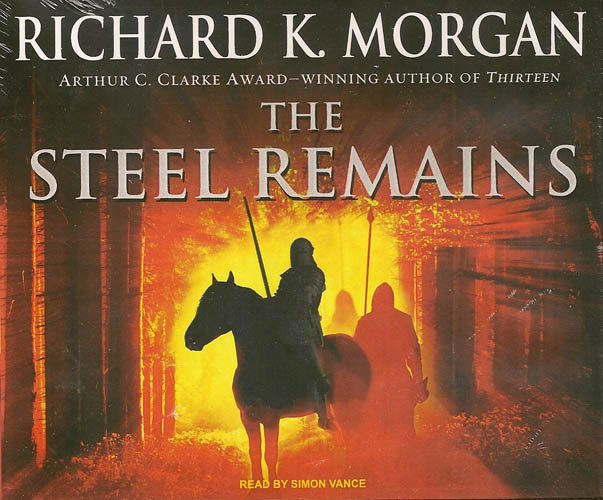
Science Fiction Audiobook - The Steel Remains by Richard K. MorganThe Steel Remains
By Richard K. Morgan; Read by Simon Vance
[UNABRIDGED]
Publisher: Tantor Media
Published: 2009
ISBN: 9781400139637
Themes: / Fantasy / Noir / Hard Boiled / Magic / War / Homosexuality /

“Men were like blades, they would all break sooner or later, you included. But you looked around at the men you led, and in their eyes you saw what kind of steel you had to hand, how it had been forged and tempered, what blows, if any, it would take.”

—Richard Morgan, The Steel Remains

With his new book The Steel Remains, Richard Morgan sets out to (as main character Ringil Eskiath might say) “prick the bloated arse” of J.R.R. Tolkien and post-Tolkien fantasy. Elsewhere on the web Morgan has expressed his deep dissatisfaction with traditional high fantasy, which often pits stainless forces of good against hordes of irredeemable evil in bloodless, antiseptic sword play. He’s accused Tolkien of the same shortcomings (a flawed analysis with which I vehemently disagree). Against this backdrop, Morgan set out to write The Steel Remains as a deliberately gray, grimy, alternative viewpoint. His book succeeds in sliding cold steel into the lie of childlike fantasy, with which my favorite genre of fiction is admittedly littered.

But when the screaming of gutted men and the skirling of steel dies down, and the full extent of the destruction is laid bare for us to see, The Steel Remains does not have much to offer. The old cliché that it’s easier to tear down and destroy than to build anew applies here. In its falling over itself desire to slice and dice fantasy’s traditional conservatism, The Steel Remains indulges in plenty of its own predictable clichés: Every priest is a religious fanatic and a sex fiend, every leader a morally and ethically corrupt, egotistic blowhard, for example. The book lacks a moral compass; Morgan the author’s world view must be a bleak one, indeed.

The action of The Steel Remains focuses on the converging storylines of three uneven characters—one very well done (Ringil, a sarcastic, war-weary, homosexual master swordsman), one middling (Egar, a brawling, boisterous, randy barbarian from the steppes), and one rather forgettable (Archeth, a black, female half-breed of human and Kiriath, deadly with throwing knives and hooked on drugs). All three are veterans of a recent war against an invading race of “scaly folk,” in which humanity staved off utter destruction at a very high price. Ringil, a war hero but now combat- and world-weary, has retreated from his mercenary lifestyle and is living a slothful, under-the-radar existence, until he’s summoned by an urgent message from his mother: Ringil’s cousin, Sherin, has been sold into slavery to repay a debt, and Ringil’s mother wants her back. Ringil reluctantly agrees.

Soon Ringil finds out that the slavery web in which Sherin has been caught is very dark, wide, and sinister. At its centre are a race of alien beings called the dwenda—tall, attractive, human-like, magic-using creatures that are a combination of Michael Moorcock’s Melniboneans with their cruel and alien immorality, and Poul Anderson’s Nordic-inspired, haughty, and warlike elves (Morgan lists Anderson and Moorcock as two of his sources of inspiration; the third is, unsurprisingly, Karl Edward Wagner). The dwenda are planning to incite a second war on earth and then destroy the victor, taking back their ancestral lands (the dwenda dwelled on earth many years ago). The dwenda require the sacrifice of barren human females to fuel the dark powers that are the source of their sorcery.

There’s much to like in The Steel Remains. Morgan’s prose is sharp and highly readable, and he shows a fine eye for detail and realism in his culture and city-building. Trelayne—a nasty, sprawling, brawling city in which whoring, slavery, and public executions are practiced openly—feels real. Egar’s Majak culture is based on pre-colonized North American Indians, and is well-done with its shamans and superstitions, trade in vast herds of buffalo, and armor and weapons suited to a nomadic lifestyle on the plains.

In addition, if you like your battles bloody and realistic, Morgan is your man. His fight scenes are well-done and you get a great sense of Ringil’s skill with his deadly broadsword of Kiriath steel, and Egar’s brutal butcher’s work with his two-bladed Majak lance. Disembowelings, beheadings, and other ghastly wounds are rife.

Much of the book passed under my eyes as well-oiled but heartless machinery producing graphic combat carnage and highly explicit sex (I’ll pause here to state that the blood and semen-soaked pages of The Steel Remains would make George R.R. Martin blanch, and Eric Van Lustbader—author of The Ninja—green with envy). I found the characters rather unlikeable and unengaging, and the plot fair at best. Very little actually clicked with me until the concluding act, in which Ringil, Egar, and Archeth reunite to fight a desperate last stand against the duenda. This was one of the few moving scenes in the book in which I actually felt some measure of concern and identification with our heroes. Ringil’s rousing speech is of the stuff with which great heroic fantasy is made. I wish there was more like this.

In summary, we know that life is can be dirty and horrible. War is hell, yes, and men are weak and piggish. But Morgan drives the same points home, again and again, over 400 dark, cynical, iconoclastic pages of The Steel Remains, which by the end is too one-note and sacrifices story at the expense of the author’s agenda.

Narrator Simon Vance does a terrific job as narrator, changing his voice to suit the temperaments and personalities of the various characters in Morgan’s novel. Clarity and precision are among Vance’s strengths as a reader and he does not disappoint here. When I began listening to The Steel Remains, and before I had seen the narration credits, I recognized Vance’s distinctive voice from his wonderful depiction of Count Dracula and the rest of the characters from Bram Stoker’s Dracula (Blackstone Audiobooks). For unknown reasons Vance performed Dracula under the pseudonym, Robert Whitfield.

[For more of Brian’s thoughts on The Steel Remains check out The SFFaudio Podcast #034]

Posted by Brian Murphy

Review of By Heresies Distressed by David Weber

SFFaudio Review

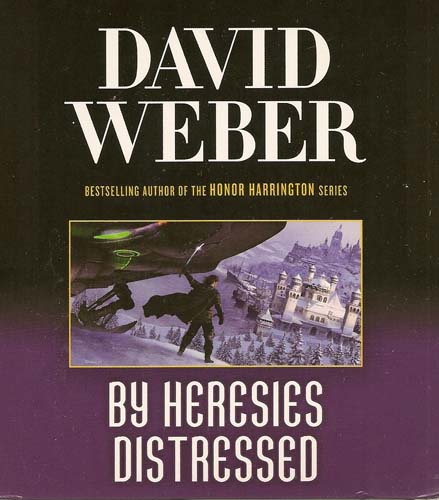
Science Fiction Audiobooks - By Heresies Distressed by David WeberBy Heresies Distressed
By David Weber; Read by Jason Culp
Approx. 25 Hours [UNABRIDGED]
Publisher: Macmillan Audio
Published: 2009
ISBN: 9781427206794 (CD)
Themes: / Science Fiction / Empires / Religion / War /

The Empire of Charis has been founded out of the marriage between King Cayleb of Charis and Queen Sharleyan of Chisholm, and further expanded by the annexation of Charis’ enemy Emerald. Now Cayleb and Merlin go on the offensive. Sharleyan stays behind to construct the new government out of the former Kingdoms, while Cayleb leads their Navy and tens of thousands of Charisian Marines against the League of Corisande and Prince Hektor. Hektor was the willing puppet of the Church of God Awaiting when he led an armada from several of Safehold’s nations against Charis. That armada was defeated with the aid of the technologies introduced by Merlin, but not before Cayleb’s father, King Haarahld, was killed.

Retribution is also dealt against the Kingdom of Delferahk, greatly offending the Church in the process when the priests responsible for the massacre are called to account. Merlin’s SNARCs, autonomous flying, invisible spy cameras, continue to provide a massive tactical advantage and help to solidify Cayleb’s reputation as a master tactician especially as the battle moves onto land. Some of the advances hinted at in the previous books are seen in action and their effects, amounting to almost two centuries of advancement in our history, are somewhat predictable. Unfortunately, the SNARCs can’t be everywhere, and Merlin and his A.I., Owl, can’t review everything that they record. The Church loyalists manage to slip past Merlin’s security, and target Empress Sharleyan in an attempt to break the new Empire.

Being the third book in the series, Weber brings the anticipated final conflict with Mother Church several steps closer. There is less focus on the new technologies being introduced in this book than in those that proceed it. The tactics and politics assume much more the focus. The land battles are clearly drawn, and the narrator, Jason Culp, keeps the back and forth between the combatants clear.

There are a noticeable number of lengthy monologues, in some cases in the middle of what was a normal conversation. They could have been more concise, however Jason delivers them well. He brings all of the many characters to life with ease, from the lowest soldier in the middle of a battle to the nobility and the priesthood.

Merlin is a magical character to the inhabitants of Safehold, but of Arthur C. Clarke’s variety: sufficiently advanced technology. Although that technology plays an important part in the events, it doesn’t really intrude. Merlin’s visions are provided by his SNARCs and the explanation of, what amounts to a mobile phone, in one scene is as intrusive as it gets. Weber’s Safehold series should appeal to fans of alternate history as well as fantasy and Science Fiction.

Posted by Paul [W] Campbell