Review of Blood of Ambrose by James Enge

SFFaudio Review

Blood of Ambrose by James EngeBlood of Ambrose
By James Enge; Read by Jay Snyder
Audible Download – 14 hours 29 mins [UNABRIDGED]
Publisher: Audible Frontiers
Published: 2009
Themes: / Fantasy / High Fantasy / Arthurian Legend / Sword and Sorcery / Necromancy / Regency / Immortality /

In his introduction to the Audible Frontiers recording of Blood of Ambrose, James Enge places his debut novel in the “swords and sorcery” fantasy sub-genre. While the work certainly fulfills the expectations established by that label–it’s replete with feats of arms, dark conjurings, and roguish characters–it also owes debts to the Arthurian tradition and to humorous fantasy in the vein of David Eddings and Joe Abercrombie. The resulting mélange of tropes and styles sometimes clashes, but in the end it leaves the reader with a varied and satisfying reading experience.

The blurb from Pyr, who publishes the hardcopy edition, reads as follows:

Centuries after the death of Uthar the Great, the throne of the Ontilian Empire lies vacant. The late emperor’s brother-in-law and murderer, Lord Urdhven, appoints himself Protector to his nephew, young King Lathmar VII and sets out to kill anyone who stands between himself and mastery of the empire, including (if he can manage it) the king himself and his ancient but still formidable ancestress, Ambrosia Viviana.

When Ambrosia is accused of witchcraft and put to trial by combat, she is forced to play her trump card and call on her brother, Morlock Ambrosius—stateless person, master of all magical makers, deadly swordsman, and hopeless drunk.

As ministers of the king, they carry on the battle, magical and mundane, against the Protector and his shadowy patron. But all their struggles will be wasted unless the young king finds the strength to rule in his own right and his own name.

With names like Uthar and Viviana, even the most casual scholar of Arthuriana will recognize several connections to that illustrious tradition. Even the book’s title, Blood of Ambrose, is an allusion to Arthur, since in some medieval texts King Arthur is sometimes conflated with the late Roman British official Ambrosius Aurelianus. Though the novel is set in a seemingly fictional realm, tantalizing connections to our own world fleetingly appear, including overt references to the Latin tongue and to Britain itself. The relationship between the Ontilian Empire and our own past, however, is never fully explored. While Enge asserts that Blood of Ambrose serves up a completely self-contained story, he certainly leaves room for future world-building.

King Lathmar VII, as the above blurb suggests, is ostensibly the novel’s protagonist. Seen in this light, Blood of Ambrose is a coming-of-age story, and in this capacity it succeeds beautifully. In the book’s early hours, Lathmar is tossed around “like a sack of beans,” as he says, but by book’s end he’s making his own decisions and asserting his rightful authority. His relationship with the other characters are fraught with ambivalence and ambiguity.

The novel’s shining star, though, is the almost-immortal Morlock, who epitomizes the paradoxical swords-and-sorcery antihero. On the one hand, he’s valiant, protective, and very kind to Lathmar. Yet at times he is prone to violent outbursts or spells of depression. In a unique twist, we’re also told that he’s had a drinking problem in the past, and his refusal to let spirits pass his lips recurs as a frequent talking point among the other characters.

Unfortunately, the novel’s plot isn’t on par with its vibrant characters. Blood of Ambrose certainly tells some thrilling, engaging, and poignant stories, but they work better as standalone adventures rather than building a unified edifice. Characters like Lathmar, Morlock, and the arch-villain poisoner Steng serve as unifying threads,  but the plot simply lacked the momentous drive to keep me interested in what would happen next. Luckily, the character development was strong enough to provide me with that forward impetus.

Jay Snyder’s reading of Blood of Ambrose is mostly run-of-the-mill, with one significant exception. His resonant, laconic, intentionally dead-pan portrayal as Morlock transcends mere performance. This is how a flesh-and-blood Morlock really would speak. Seldom in my experience listening to audiobooks has a character been so indelibly linked to the narrator who gives him voice. Snyder’s depiction of Lathmar also deserves note; the transition from tremulous stuttering to firm command mirrors the development of the young king. His rendition of the tempermental Ambrosia is less flattering, and her outbursts can grate on the listener’s ears like claws. Of course, that may well be intentional.

Though it tells a rather lackluster story, Blood of Ambrose introduces a fascinating settting populated by a host of multi-faceted characters. It’s my hope that James Enge will continue to work and play with this colorful palette.

Posted by Seth Wilson
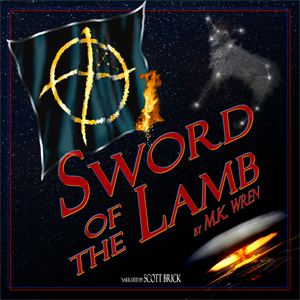
Review of Sword of the Lamb by M.K. Wren

SFFaudio Review

Sword of the Lamb by M.K. WrenSword of the Lamb
By M.K. Wren; Read by Scott Brick
MP3 Download – 21 hours, 27 minutes – [UNABRIDGED]
Publisher: Scott Brick Presents
Published: 2008
Themes: / Science Fiction / Epic / Secret Societies / History / Political Intrigue /

I was thrilled to hear that SFFaudio scored a copy of Sword of the Lamb from Brick by Brick, narrator Scott Brick’s audiobook production company. Hearing Scott wax eloquent on the audio entry for his blog, I was hooked and begged to review it. Among other things he says:

“I loved it right from the beginning – I loved its format, I loved its pathos, I loved its political intrigue, and more than anything else, I loved its characters. The relationship between the two central characters, Alexand DeKoven Woolf and his brother Richard, is one of the greatest I’ve ever read. It is amazingly well-executed, rich in detail and nuance, and unashamedly sentimental. …

As you might have guessed, I tore through the next two volumes just as quickly as the first, and found myself profoundly moved. THE PHOENIX LEGACY is a huge, sprawling epic of political intrigue in the 33rd Century, in which mankind has witnessed amazing technological advancements, yet its society has devolved into a new kind of feudalism. It’s a tale of class struggles across solar systems, it’s THE WINDS OF WAR set in outer space, it’s A TALE OF TWO CITIES meets DUNE, it’s… it’s its own unique creation, a gem that most people, even most science fiction fans, don’t know about.

I’ve asked myself why this is, why this gem exists in bookstores everywhere but has largely gone ignored, but it defies explanation. Maybe it’s because of those damn covers; they really were bad. …”

Or … maybe, it’s because the books, or at least the first book, is not as brilliant as A Tale of Two Cities or Dune. I never read The Winds of War but I have read Gone With the Wind many times. Sword of the Lamb is not as brilliant as Gone With the Wind either. Oh how I hate to be the only person that Scott Brick ever introduced to these books who did not fall in love with them, but there you go. I wanted to love The Sword of the Lamb, I really did. However, every time I felt myself falling for it, the author tripped me up.

First, a brief synopsis of The Sword of the Lamb. Set in the 33rd century, mankind has long since populated many planets. Their government, called The Concord, looks as if it is about to take that inevitable downward slide into a dark age, which would be the third in known history. This is a feudal system governed by the Lords of trading houses and supported by two servant castes, who are actually not much more than slaves. We see the story through two brothers of the DeKoven Woolf House, Alexand and Rich. Alexand is the eldest son and being groomed for the power and responsibility he will eventually inherit. Rich, fragile because of a childhood illness, takes the path of scholar and sociologist. Both boys have been greatly influenced by their tutor who was a passionate supporter of the downtrodden lowest “bond” class. The combination of logic and insistence that “bonds” are people who deserve more than they receive sends both young men down paths they could not possibly foresee, including involvement with the underground movement, The Society of the Phoenix.

This is a book where the relationships shine. The brothers are very different but have an unbreakable understanding and bond. Alexand and his love, Adrien, likewise have a meeting of minds and hearts that leaves them inseparable. Make no mistake about it, these are indeed epic characters and we want to see them succeed and achieve their heart’s desire no matter what the cost. Wren has a gift for dialogue and even seemingly unimportant situations are compelling and interesting when there are characters involved. She uses this to great advantage in painting characters in the book.

Likewise, her plot is interesting. It is true that one can foresee the major story lines before they come along. (Let’s face it, Alexand and Adrien had it much too easy in their match. It practically screamed “star-crossed lovers coming next scene!”). However, that is forgivable if the story is told well. Much of the time, Wren pops in surprising little twists and turns in the broader plot that make the story much more interesting and keep us thinking.

With all that going for it, what could go wrong?

Info-dumps.

Nothing can kill a story like too much exposition and this book has it in spades. Wren can’t resist from the very beginning when the tutor is going to bid the boys goodbye and decides to give them one last quiz. (Hey, what easier way to just throw a thousand years’ worth of history at the reader?) She can’t resist making us listen to old computer tapes of university lectures from leading sociologists about a woman’s diary during one of the terrible societal breakdowns long ago or recordings of insightful university lectures. She can’t resist even when we are being introduced to that long awaited encounter with the actual Society of the Phoenix. We’re excited! We’re seeing a secret society! But first, let’s have someone sit around and think at very great length about how they are organized and who hates who. Gee, who doesn’t love a sharp rap over the knuckles and a history lesson before beginning an adventure?

In short, the author doesn’t trust her characters to be able to carry the story without giving us a lot of background that doesn’t matter at all. Things are getting going, we are in a white-heat to see what will happen next, and she grinds it all to a halt with yet another long, boring description. By the time she’s done, we barely care about the story any more. At least, that’s how it hit me. Luckily, her genius with characters was such that I would reluctantly be pulled back into the story. Only to have her once again stick out her foot and trip me on the way to the finish line. Overall, I tend to blame the book’s editor. This is something they are supposed to catch. And didn’t.

To be fair this may be something that stands out in audio form much more than on the printed page. I would have been skipping, or at best skimming, those long expositions in a regular book. Scott Brick is an enormously talented narrator and he pours his heart and soul into the book as we would expect since he loves it so. I’m not sure he is capable of doing a bad job of narrating anything. But even he couldn’t lessen the abyss of those sections. In the end, I finally would just skip ahead as best I could to get to the spots where the story would pick up and move forward. It was always worth it. The story was good. The characters, of course, were great. The narration was fantastic. But those info-dumps … they were killers.

Perhaps I’m nitpicking. Maybe most people don’t loathe info-dumping the way that I do. Fair enough. However, let’s consider those other epics to which this book was compared. A Tale of Two Cities. Gone With the Wind (my own addition, I know). Dune. It didn’t matter if we knew much or, indeed, anything, about the French Revolution, the American Civil War, or Arakis and the Empire. The authors all managed to get in the information we needed, and even a little more, without having our eyes glaze over. In fact, we barely noticed that we were being fed background information at all. That is the difference between a truly classic epic novel and a pretty good book that’s kinda long.

Sadly, Sword of the Lamb is the latter.

Posted by Julie D.

Review of Daemon by Daniel Suarez

SFFaudio Review

Daemon by Daniel SuarezDaemon
By Daniel Suarez; Read by  Jeff Gurner
Audible Download – approx. 16 hours [UNABRIDGED]
Publisher: Penguin Audiobooks
Published: 2009
Themes: / Science Fiction / Cyberpunk / Techno-Thriller / Virtual Reality / Online Gaming / Politics /

Daemon‘s success as a self-published novel that crossed over to attain mainstream success is a testament to its cultural relevance, especially among the technorati. Suarez, who moonlights (sunlights?) as a systems analyst, promoted the novel to the movers and shakers in the technology community, Its positive reception even among this tech-savvy elite suggests that Daemon has its finger on the pulse of technological developments and their implications for politics and culture.

Daemon opens with the death of game developer Matthew Sobol, acclaimed developer of multiplayer games such as first-person shooter Over the Rhine and RPG The Gate, which bears a strong resemblance to World Of Warcraft. Some successful entrepreneurs leave money to their kids when they die, others give it all away to charity. Not Sobol. His legacy is the book’s eponymous daemon, a background process which through distributed computing has spread itself across the net and continues to carry out the developer’s will through a series of intricate commands. The capabilities of this daemon, and Sobol’s talent as a developer of artificial intelligence, become apparent when the police raid Sobol’s mansion in Thousand Oaks, California, and find themselves outclassed by a network of elaborate automated booby-traps, including an almost-sentient Humvee.

The novel pans cinematically between several characters who, in one way or another, become embroiled in the daemon’s plot, which ultimately proves to be global in scale. Dramatis personae include police detectives, government agents, a gamer, a laid-off fashion reporter, a white-hat hacker, ad a convict. It’s not clear from the outset whether these characters will become heroes or villains as the story progresses, and even when battle lines are more firmly drawn most of them still defy simple caricature, exhibiting complex motives and emotions.

The real show-stopper, of course, is the daemon itself, who possesses a high degree of intelligence and resourcefulness despite residing in lines of code. The novel’s conceit still demands the willing suspension of disbelief, but the concept and the technical specifics are so finely conceived and executed that the reader is left with a small but nagging suspicion that somewhere, sometime in a future that may be all too near, Daemon could become a reality. Suarez achieves this feat by investigating the wider political, economic, and social implications of a self-aware autonomous computer system.

The living Matthew Sobol embedded many elements of his daemon into his multiplayer games, and several characters venture into these online worlds in search of clues. These scenes are among the strongest in the book, and they carry favorable resonances with both the Metaverse in Neal Stephenson’s Snow Crash and the simulator in Orson Scott Card’s Ender’s Game. Like the virtual reality elements in these novels, the online gaming sequences in Daemon succeed because they maintain a strong causal relationship to events in the “real” world.

The action battle sequences in Daemon are high-octane, and like all good action sequences they manage to incorporate the book’s themes rather than standing as mere set pieces. For the most part, the protagonists are fighting against computer-controlled contraptions. Nevertheless, I felt that these ultimately visceral and superficial scenes occupy too much space in the novel, and detract from the book’s otherwise deep and intellectually stimulating themes. Paramount Pictures has optioned the movie rights for Daemon, and I shudder to think that the cultural significance of this novel may be boiled away, leaving only two hours of car chases.

The pacing of Daemon also leaves something to be desired. Suarez has revealed that a sequel is in the works, and the book’s cliffhanger ending promises an exciting continuation to the story. Lots of loose ends also remain dangling free, mostly in the arc of character development. The novel’s ending was certainly climactic, but it somehow failed to provide satisfactory closure. As I’ve said in other reviews, even books in a multi-volume series need to retain a high level of internal cohesion.

Jef Gurner’s narration for Daemon is spot-on. His performance is varied enough that each character’s unique identity extends into the aural sphere. Through some tricks of distortion, Penguin Audio has turned the dialogue of the daemon itself into a performance worthy of classic cinematic computerized villains.

Fans of cyberpunk in particular should consider Daemon essential reading, but any science fiction fan looking for an intriguing and visionary techno-thriller should add this audiobook to their summer reading list. The novel’s fascinating themes make it worth slogging through some scenes of gratuitous violence and tugging in vein on a few loose plot threads. Daemon is an impressive debut novel by Daniel Suarez, hopefully presaging an illustrious writing career.

Posted by Seth Wilson

Review of Academ’s Fury by Jim Butcher

SFFaudio Review

Academ's Fury by Jim ButcherAcadem’s Fury
By Jim Butcher; Read by Kate Reading
17 CDs – 21 Hours [UNABRIDGED]
Publisher: Penguin Audio
Published: 2008
ISBN:  0143143772
Themes: / Fantasy / High Fantasy / Elementals / Battle / Primitive Culture / Rome /

Having been a fan of Jim Butcher’s urban fantasy Dresden Files series for some time, as well as a consummate reader of traditional fantasy, I recently decided to delve into the author’s Codex Alera series. I found the series opener, Furies of Calderon, to be a solid entry for Butcher into the epic fantasy genre, but my recent review also pointed to some room for improvement. After devouring its sequel, Academ’s Fury, I’m happy to report that Butcher has found his voice and set the tone for the series.

A brief refresher: the Codex Alera series takes place in the land of, you guessed it, Alera, whose inhabitants possess the ability to control elemental powers called furies. The lone exception is the series’s prime protagonist, Tavi, who has come of age without developing any apparent skill in furycrafting.

Academ’s Fury skips ahead two years from the conclusion of the previous book, and finds Tavi studying at the Academy of Alera Imperia, the land’s capitol city. The novel thus adopts many tropes of the “school novel”: bullies, arrogant teachers, and mischievous rule-breaking. Tavi also gains a window into the realm’s politics by serving as page to First Lord Gaius Sextus. Further raising the stakes, an isolated adventure in Furies of Calderon turns out to have disastrous implications both for the valley of Calderon and for the imperial city itself. The result is a novel that weaves these plot treads together into a rich, satisfying tapestry.

Like its predecessor, Academ’s Fury follows the viewpoints of several characters, although Tavi is clearly the linchpin. The Cursor Amara, siblings Bernard and Isana, and the treacherous Fidelias all reprise their roles, and all these develop in significant and sometimes surprising ways. The Marat wolf tribe, which played a pivotal part in Furies of Calderon, also returns under the capable leadership of Chieftain Doroga. The chieftain’s spirited daughter Kitai also figures heavily in the story. Several new characters join these veterans in the tale’s events. The only notable standout from among them, for me, is Antillar Maximus, Tavi’s fiercely loyal friend at the Academy.

More importantly, Academ’s Fury expands the scope of the world of Codex Alera by introducing two new races: the wolf-like canim and the insectile Vord. Both races possess serious martial prowess and present a serious threat to Alera. Unlike the Canim, however, the cold, calculating Vord cannot be reasoned with. By means of worm-like parasitic scouts, the Vord take possession of humans, preserving their physical stature and mental abilities but blotting out their souls. This dynamic makes for a few horrific scenes of which Stephen King might be proud, and the Vord warriors and queens ooze vileness and evil both literally and metaphorically. The battle scenes in Academ’s Fury resemble those of R. A. Salvatore or early Terry Brooks in their invention and frenetic pace.

Jim Butcher utilizes the novel’s setting in the Academy at Alera Imperia to disseminate information about the world without resorting to mere “info-dump” modalities. Through Tavi’s readings, dialogues, and examinations, the book takes a deeper look into the history of Alera, including its tenuous connections to the Rome of our world. We also get a brief glimpse under the hood at the mechanics of furycrafting.

The novel’s greater breadth of scope and its focus on Romanesque political intrigues address the major complaints I had with the first book, but Academ’s Fury still isn’t perfect. For one thing, the pacing flags somewhat near the end. A bigger defect, to my mind, has to do with the character development. Most of the characters do develop in interesting and believable ways, but a few of them come off as flat. Sadly, this is true in some ways of Tavi, who always seems to get the better of his rage, his fear, or his other negative traits. He’s a fascinating character, but his lack of internal conflict and teenage angst diminishes his believability. Similarly Doroga, the Marat chieftain, fits too perfectly the archetype of the “noble savage”. He’s a lovable character, but he exists in a hundred other variations in a hundred other fantasy books.

Kate Reading’s performance once again brings the Codex Alera series to life. Each character receives full articulation, so that even without dialogue tags it’s clear who’s doing the talking. The Latin scholar in me occasionally winces at her non-classical pronunciation of certain words (she renders princeps “prin-SEPS” instead of “prin-KEPS”), most listeners probably won’t take issue with  such minor details.

Minor qualms aside, Academ’s Fury improves on the first novel of the Codex Alera and continues to promise great things for the series.

Posted by Seth Wilson

Review of Slaughterhouse-Five by Kurt Vonnegut

SFFaudio Review

Slaughterhouse Five by Kurt VonnegutSFFaudio EssentialSlaughterhouse-Five
By Kurt Vonnegut; Read by Ethan Hawke
5 CDs – 6 hours – [UNABRIDGED]
Publisher: Blackstone Audio
Published: 2009
ISBN: 9781433269691
Themes: / Science Fiction (or maybe not) / World War II / Time Travel / War / Aliens / Mind /

And Lot’s wife, of course, was told not to look back where all those people and their homes had been. But she did look back, and I love her for that, because it was so human.

So she was turned to a pillar of salt. So it goes.

—Kurt Vonnegut, Slaughterhouse Five

During World War II, author Kurt Vonnegut was taken prisoner by the Germans and held captive in the city of Dresden, which was later reduced to flaming rubble during a harrowing fire-bombing by American forces. According to Vonnegut, the city was a gorgeous center of art, architecture, and fine civilian life; its value as a military target was negligible. “What I’ve said about the firebombing of Dresden is that not one person got out of a concentration camp a microsecond earlier, not one German deserted his defensive position a microsecond earlier,” Vonnegut said.

Somewhere between 25,000 and 120,000 civilians (the upper figure is an early estimate, which has since been revised downward to 25,000-40,000) were killed in the inferno of incendiary and high explosive bombs. As such, Dresden remains a controversial, dark chapter of America’s involvement in the war.

Slaughterhouse-Five is Vonnegut’s look back on this dreadful event. It’s not a traditional biography, but a modified account of his own experiences as seen through the eyes of Billy Pilgrim, a tall, awkward, disconnected dreamer who is drafted into the army and thrust into combat. Pilgrim is a pathetic soul with the appearance of a “filthy flamingo,” involved in tragic events beyond his control.

Captured during the Battle of the Bulge, Pilgrim and 100 other soldiers are shipped to Dresden to serve as prison-labor. At night they sleep in a storage-cave beneath a slaughterhouse amidst the butchered carcasses of animals, and it’s this arrangement that allows them to survive the attack. After the firebombing, they emerge the next morning to find the once-beautiful Dresden so utterly destroyed that it resembles the surface of the moon.

A part of me feels guilty for reviewing Kurt Vonnegut’s Slaughterhouse-Five on a science fiction/fantasy Web site. The connections of this classic anti-war novel to the science fiction genre are tenuous, but it attains this designation (in some circles) due to the presence of the Tralfamadorians, a race of aliens that capture Pilgrim and bring him back to their planet for examination. During his months on Tralfamadore, Pilgrim is placed in a sort of zoo, his body and mind laid bare to the curious aliens.

The Tralfamadorians may be simply the imagination of an unwell, traumatized mind. Pilgrim is emotionally unbalanced, suffers a head injury after the war, and reads voraciously of the novels of science fiction writer Kilgore Trout, one of whose novels concerns an alien abduction that sounds suspiciously like Pilgrim’s own experiences on Trafalmadore. But the Tralfamadorians—real or not—allow Vonnegut to explore the concept of time and our place in it, which is the larger theme of the novel. The Tralfamadorians can see in four dimensions and have no concept of time; life just is, and human existence is a series of events and happenings with no beginnings and ends. Events simply occur; wars are fought, we are powerless to stop them and it’s ridiculous to think we can. Free will is a farce.

Pilgrim’s time among the Tralfamadorians allows him to experience his life in this fourth dimension, moving his mind back and forth to the past and future, seemingly at will. He is able to see his own death, and relive events from his childhood, his marriage, and his career as an optometrist. But Pilgrim’s wandering, time-traveling mind returns again and again to the terrible events of Dresden, an experience so powerful that his mind is unable to make sense of it. It just is, and all he can do with the rest of life is to try and look upon the good times in his life, the moments of joy, and not linger too long over the blackened, shrunken bodies, or a fellow American and friend executed for salvaging a teapot from the ruins.

Actor Ethan Hawke (of Dead Poets Society and Hamlet fame) serves as the narrator and does a nice job reading with an understated, dispassionate voice that perfectly fits the tone of the novel. This Blackstone Audio production also includes an unexpected and enlightening 10-minute interview with Vonnegut on the final disc. Here Vonnegut reveals that Pilgrim’s character was based on a real person, Edward Crone, an American who died in Dresden. “He just didn’t understand the war at all, what was going on, and of course there was nothing to understand—he was right,” Vonnegut says.

Posted by Brian Murphy

Review of Blood Noir by Laurell K. Hamilton

SFFaudio Review

Blood Noir by Laurell K. HamiltonBlood Noir
By Laurell K. Hamilton; Read by Cynthia Holloway
11 CDs –
13 hours [UNABRIDGED]
Publisher: Brilliance Audio
ISBN:  1-59737-895-6
Published: 2008
Themes: / paranormal romance / vampires / shapeshifters / mystery / sex / BDSM / urban fantasy

Blood Noir is the sixteenth installment in Laurell K. Hamilton’s Anita Blake: Vampire Hunter series. Thats an impressive track record for any writer–and somehow Hamilton has found time to work on several other series as well. This particular Anita Blake novel is heavy on the romance and emotional development of its characters. It’s fairly light on the “paranormal” or “supernatural” element until it nears its conclusion. While a fun emotional and sexual romp, Blood Noir lacks the intellectual teeth to be called “fantasy” in any meaningful sense of the word.

The book opens with a bang of the Jenna Jameson variety, as Anita Blake comforts her grieving werewolf friend Jason in the most intimate way possible, while her more regular lover Nathaniel looks on and later joins in. Libido calmed, for the moment at least, the story then commences in earnest, and Blood Noir actually presents an intriguing premise. Jason’s estranged father is dying of cancer, and Jason wants to patch up the relationship while he still can. Jason’s father, despite much evidence to the contrary, labors under the delusion that Jason is gay. To dispel this misperception, Jason brings Anita to his home in North Carolina to present as his girlfriend, a front that is only half a lie. The plot thickens further when Jason is mistaken by hometown residents for the son of the state governor.

You might be wondering how the supernatural fits into all this. So was I. While the story is well-told and the characters are emotionally complex, the fantastic elements of Anita Blake’s world don’t really manifest themselves for the first two-thirds of the novel. Sure, we’re told that Jason is a werewolf and that Nathaniel her lover is a were-leopard, and we witness several telephone conversations between Anita and her protector Jean-Claude, one of the vampire masters of St. Louis. But Hamilton is breaking the writer’s axiom of “show, don’t tell.” The early parts of the novel play out like any romance-cum-mystery, with only the barest of supernatural trappings.

Once “the metaphysical shit”, as Blake utters several times, does finally hit the fan, the action ramps up and Blood Noir becomes a thriller on par with other urban fantasy, replete with shapeshifting, vampire charms, and a bit of old-fashioned gun play. The payoff is worth waiting for. The novel draws its title from Marmee Noir, an ancient vampire who, despite slumbering somewhere in Europe, manages to wreak havoc in the lives of characters halfway around the world. The book advances the larger Vampire Hunter story arc, and promises an intriguing direction for future books in the series.

There’s no getting around it, Blood Noir is about sex. Anita Blake is possessed by the ardeur, an urge that requires her to “feed” periodically through sexual acts. Yes, Anita’s come a long way since her celibate days of the first few novels. She openly maintains several serious sexual partners, and she engages in sadomasochism and other “non-standard” sexual practices. The emphasis on eroticism feels mostly in line with the plot, and seldom ranges into the realm of over-indulgence. What saves Blood Noir from devolving into a wholly superficial sexual dog pile is Anita’s self-awareness. Anita is mostly comfortable with her open lifestyle, but she occasionally expresses misgivings about its potential negative impact on herself and others. Her external sensual and erotic lust is also complimented by a fine-tuned emotional sensitivity.

Brilliance Audio has made a modest effort to put some production shine on its audio version of Blood Noir, with some minimal distortion effects when characters speak on the phone or overhear a television news report. Cynthia Holloway’s narration tackles the novel’s sexuality head-on; she doesn’t flinch at even the most graphic scenes. Holloway especially succeeds in capturing Anita Blake’s wide expressive range, from her angry outbursts to her few moments of vulnerability.

Long-time readers of the Anita Blake: Vampire Hunter series will doubtless wish to follow the heroine’s latest adventures, and fans of paranormal romance who have somehow missed Hamilton’s work will probably want to jump into the series as well. Other readers of fantasy, even of urban fantasy, should approach Blood Noir with caution. The book provides a solid plot and well-rounded characters, but Hamilton’s hit-and-miss writing fails to conjure up the magic that fantasy, even dark fantasy, should.

DISCLAIMER: Any sexual puns or double-entendres contained in this review were purely inadvertent.

Posted by Seth Wilson