
Review of Good Morning, Midnight

SFFaudio Review

Good Morning, MidnightGood Morning, Midnight
By Lily Brooks-Dalton; Narrated by John H. Mayer and Hillary Huber
Publisher: Random House Audio
Publication Date: 9 August 2016
[UNABRIDGED] – 8 hours, 39 minutes

Themes: / post-apocalypse / apocalypse / arctic / astronaut / science / literary /

Publisher summary:

Augustine, a brilliant, aging astronomer, is consumed by the stars. For years he has lived in remote outposts, studying the sky for evidence of how the universe began. At his latest posting, in a research center in the Arctic, news of a catastrophic event arrives. The scientists are forced to evacuate, but Augustine stubbornly refuses to abandon his work. Shortly after the others have gone, Augustine discovers a mysterious child, Iris, and realizes that the airwaves have gone silent. They are alone.

At the same time, Mission Specialist Sullivan is aboard the Aether on its return flight from Jupiter. The astronauts are the first human beings to delve this deep into space, and Sully has made peace with the sacrifices required of her: a daughter left behind, a marriage ended. So far the journey has been a success. But when Mission Control falls inexplicably silent, Sully and her crewmates are forced to wonder if they will ever get home.

As Augustine and Sully each face an uncertain future against forbidding yet beautiful landscapes, their stories gradually intertwine in a profound and unexpected conclusion. In crystalline prose, Good Morning, Midnight poses the most important questions: What endures at the end of the world? How do we make sense of our lives? Lily Brooks-Dalton’s captivating debut is a meditation on the power of love and the bravery of the human heart.

Review:
Isolation, loneliness, facing down death. This book contains two interwoven narrative threads. One belongs to an aging astronomer named Augustine. The other thread belongs to an astronaut named Sullivan. Something bad appears to have happened, and Augustine chooses to remain at a remote Arctic base as everyone evacuates. Sullivan is on her way back to Earth from Jupiter when Mission Control goes dark.

The premise is appealing. I have a fondness for cold and hard distant landscapes. The arctic and space is ripe and powerful for story. Lily Brooks-Dalton writes a strong opening and a heck of an ending. It is a successful ending as it turns me inward. I am still thinking about… well, no spoilers.

I felt Sullivan’s narrative thread was stronger and better written. As character, she is more round and engaging than Augustine, at least for me. Most of my complaints are founded in my own study of writing and story, and may not be fair or interesting to the general reader. As characters go, Augustine was a disappointment, but Sullivan and her crewmates more than compensated. As noted, I felt the beginning and ending was especially well crafted, but the middle seemed to lag, and the writing here didn’t feel as refined. This leads me to my biggest bug, and this is pacing. I felt that too much of this story was back on its heels, and while this certainly can be metaphor to mirror an inward introspective sense of self and life and universe, at times this slowness pulled me from story. I also would have appreciated a deeper excavation of setting.

Audiobook:
This has two narrators, one for each story thread. John H. Mayer handles Augustine’s portion, and Hillary Huber takes care of Sullivan’s. I usually dislike more than one narrator, as I feel it runs the risk of getting in the way of what is being read, but this was handled quite nice, and I have no real complaints about the decision to use two readers. Both Mayer and Huber were pleasing and I found each voice suited the character. My only issue came with Huber’s accents. There is a South African, Russian, and an American Midwest accent that are rendered a tad dramatic. I think we can agree that this is a small thing, but it still kind of bugged me, and pulled me out of the moment.

This is a solid 3.5 out of 5, and I think if I weren’t so hyperaware of craft and story as story for story’s sake, I’d probably nail a 4 out of 5 on this book. In short, this is a fine book, and if you are at all interested by what this seems to be about, I think you’ll genuinely like it, a lot.

Posted by Casey Hampton.


Reading, Short And Deep #028 – The Storyteller by Saki

Podcast

Reading, Short And DeepReading, Short And Deep #028

Eric S. Rabkin and Jesse Willis discuss The Storyteller by Saki (aka H.H. Munro)

Here’s a link to a PDF of the story.

The Storyteller was first published in Beasts And Super-Beasts, 1914.

Posted by Scott D. Danielson

The SFFaudio Podcast #382 – READALONG: Scaramouche by Rafael Sabatini

Podcast

The SFFaudio PodcastThe SFFaudio Podcast #382 – Jesse, Paul, Julie Davis, and Maissa talk about Scaramouche by Rafael Sabatini.

Talked about on today’s show:
1921, Captain Blood, The Sea Hawk, The Count Of Monte Cristo by Alexandre Dumas, the morality of this character, on his high horse, betraying the Revolution, completely detached, everybody in this novel is morally gray, maddeningly indistinct, not a hero, historical explanation, that is why the book is named “Scaramouche”, he is the goad, acting as Scaramouche, Aline holds up the virtue, the epitaph on Sabatini’s gravestone, a Prisoner Of Zenda situation, based on somebody real, “A Romance Of The French Revolution”, incendiary speeches, the “Paladin of the Third”, critiquing the excesses of the French Revolution, pro-Jacobean, the character has knowledge of the future, excusing a lot of the morality, we don’t know what he’s thinking until he opens his mouth, good writing, “the tiger is the great lord of the jungle…”, hunting the tiger, solidifying what the revolution meant, dual (duel) motivation, playing the actor, foreshadowing, acting, taking on the role of actor (orator and paladin), a Heinleinian hyper-competent character, the author forces the other Scaramouche off-stage, the comedy and drama, a great sequence, becoming the mask, the inner portion of his life is reflected out on to the stage, he is himself as his purest expression, he is best as Scaramouche, he’s happiest and most content as himself as Scaramouche, you did WHAT with WHO?, we are all the sport of destiny, why look at adaptations, the 1952 movie, dad vs. brother, liberty, equality fraternity, the Robe, Omnus Omnibus, the Buskin, the Sword, enraging the audience, the privileged estates, it becomes very meta, William Shakespeare, a horrible sequel (Scaramouche: The Kingmaker), the puppetry, the author is puppetting the characters, traditional swashbuckler, The Princess Pride without the comedy, other ways of telling the story, a revenge tale, A Tale Of Two Cities, Nicholas Nickleby, reading old books, writers who were ravenous readers first, Donald Westlake (Richard Stark), the Parker series, roll and repeat adventures, Scaramouche is just living, accessory criminals, Alan Grofield is an actor/criminal who gets his own spin-off series, The Score by Richard Stark, The Damsel, The Dame, The Blackbird, Benet, there is the other way…, Sabatini’s weakness is his third act, in the center of Islam, Simon Vance’s narration of Scaramouche, Gord Mackenzie’s narration (for LibriVox), expletive deleted, name of name!, in keeping with the 19th century literary tradition, a lost tale of the French Revolution, Lord Valentine’s Castle by Robert Silverberg, wandering Scaramouche-style, juggling, waking-up with amnesia, quasi-global government, The Old Curiosity Shop, commedia dell’arte, pantomime, improv, Who’s Line Is It Anyway?, pantaloon, harlequin, the little skirmisher, Shakespeare’s types, a learned-fool, a brooding older man, the maiden -> the nurse -> the matron, you’re playing pantaloon, more meta, reading books to become a fencing master, the opening is rather boring, but soon after we’re in a sword-fight, the man-on-the-run genre, as a lawyer, taking sides, raising and destroying a company, the trainee becomes the master, friendship, friendships that betray him, caring enough, carrying on a legacy, sucking up to power, at heart a good guy despite the threats, in bed or on board, the 1952 adaptation’s ending is better than the novel’s, a young Corsican officer, played for comedy, the seven-minute fight in the theater, I will meet you behind the cathedral, killing members of the titled classes, weird morality, shooting a good guy and forgiving the man you’re after revenge for, Mel Ferrer, “he had a string of wives and I understand why”, The Taming Of The Shrew, Stewart Granger, he’s not handsome, aha!, an unhandsome Errol Flynn, Tyrone Power, star-quality, The Prisoner Of Zenda, deep into French Revolution politics, the Revolutions Podcast, aristocrats vs. the Third Estate, deep into the weeds, we’re on a powder keg politically (brexit), biting off your own to spite your face, the 2016 U.S. presidential election, the titled (and entitled) classes, the estates: Nobility 1st, Church 2nd, 3rd People, 24% of the population of with 90% of the power, justice for the rich vs. justice for the poor, production efficiency since the French Revolution, the food industry, 1% of the 1%, everybody is fed, far away to the left, the sucking up to power is still around, class betrayal, bastard children, I was betrayed!, everybody is secretly noble, never mind all that revenge, that’s the reality we live in, the book is very realistic, people are people are people, there’s something noble about liberty, equality, fraternity, the resistors to change were pulling dirty tricks, sabotage and betrayal, “noble” and “honorable”, a calculated attack, a professional boxer challenging me to a fist-fight in the street, why dueling is banned, UFC, we should use our words (lawyers), Jesse went off, same sex relationships in 1796, can we not get passed this?, they freed every slave, a very honorable action, high morality, Alexandre Dumas’ father, The Black Count: Glory, Revolution, Betrayal, and the Real Count of Monte Cristo by Tom Reiss, Napoleon is a sketchy character, the Haitian Revolution, the Church’s stranglehold on France is gone, Quebec, the Quiet Revolution, Napoleon literally sold Louisiana out, Captain Blood, slavery in Barbados, many many pirates, given our success with Scaramouche … could a LibriVox narrator record Captain Blood and The Sea Hawk?

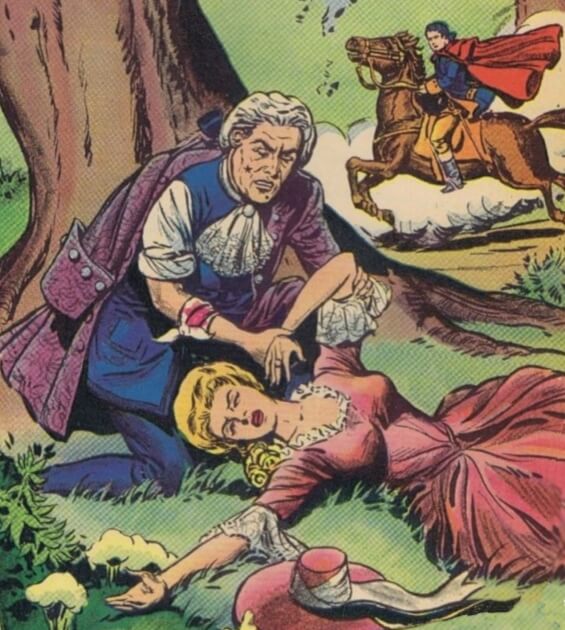
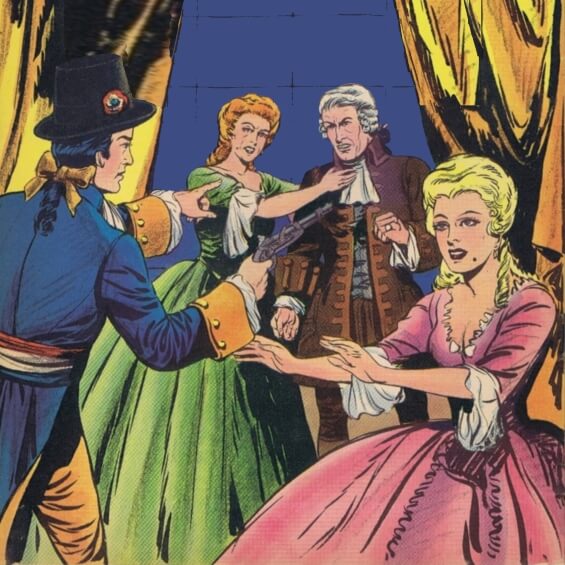
Scaramouche by Rafael Sabatini - Famous Authors Illustrated

Posted by Jesse Willis

Reading, Short And Deep #027 – Gertie The Dinosaur

Podcast

Reading, Short And DeepReading, Short And Deep #027

Eric S. Rabkin and Jesse Willis discuss Gertie The Dinosaur

Gertie The Dinosaur is an 1914 animated short film by Winsor McCay.

Here’s an MP4 download of the movie.

Posted by Scott D. Danielson

The SFFaudio Podcast #381 – AUDIOBOOK: Scaramouche by Rafael Sabatini

Podcast

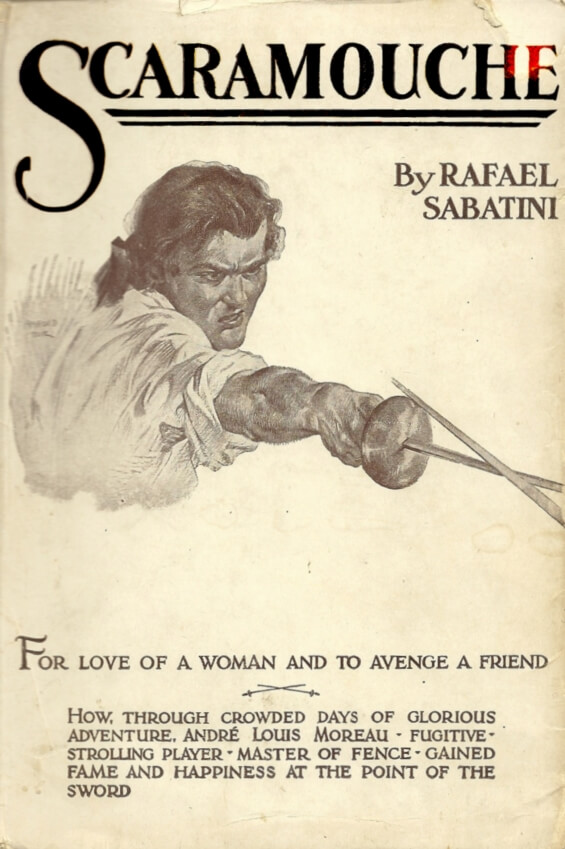
Scaramouche by Rafael Sabatini

The SFFaudio PodcastThe SFFaudio Podcast #381 – Scaramouche by Rafael Sabatini, read by Gordon Mackenzie.

This UNABRIDGED AUDIOBOOK (16 hours 50 minutes) comes to us courtesy of LibriVox.

Scaramouche was first published in 1921.

The next SFFaudio Podcast will feature our discussion of it!

Scaramouche by Rafael Sabatini

Posted by Jesse Willis

Reading, Short And Deep #026 – A Century Hence by W.M. Paxton

Podcast

Reading, Short And DeepReading, Short And Deep #026

Eric S. Rabkin and Jesse Willis discuss A Century Hence by W.M. Paxton

A Century Hence was first published in A Century Hence and Other Poems, 1880.

Here’s a link to a PDF of the poem.

Posted by Scott D. Danielson