Reading, Short And Deep #002 – Rapunzel by The Brothers Grimm

Podcast

Reading, Short And DeepReading, Short And Deep #002

Eric S. Rabkin and Jesse Willis discuss Rapunzel by The Brothers Grimm

Rapunzel was first published in 1812 as part of Children’s And Household Tales.

Here’s a link to the PDF of the story (the Lucy Crane translation).

Posted by Scott D. Danielson

The SFFaudio Podcast #356 – READALONG: The Demolished Man by Alfred Bester

Podcast

The SFFaudio PodcastThe SFFaudio Podcast #356 – Jesse, Paul, and Marissa talk about The Demolished by Alfred Bester.

Talked about on today’s show:
1952, 1953, 1951, the serialization, a futuristic old book, purple and green with the big eye, The Stars My Destination, weird corporations, quasi-computer intelligences, Marissa didn’t love it, dated elements, 1950s women, really funny, the deleted prologue (is very confusing), damn amazing, so much in so many pages, it doesn’t baby you, many ideas per page, keeping track, not great as an audiobook, page play that can’t be seen in the audiobook, the narration is great, playful with typography, SMS style talk, the Amazon reviews, @ symbols in the ebook, Jerry Chuch, he’s an Esper 2, a textual clue to his nature, (lap)², the audiobook store, an illiterate society, paperbooks are extinct, a post-literate society, when you start listening to audiobooks…, shame for not reading textual books, reading aloud as entertainment, future societies, better as a paperbook on your first read, font size changes, the reader does a lot of the work, an amazing narration, dissension has begun, image of a laughing horse, more than one text version, the original serialization in Galaxy, the finished draft is the paperbook, changes between the text, Monarch vs. Sacrament, “enhanced books”, the esper world, the best adaptation of of The Demolished Man is Babylon 5, terrible and yet essential, the Alfred Bester episodes of Babylon 5, The Lord Of The Rings in space, it’s Dune, the Psi-Corp, “demolition”, the character of Alfred Bester, a dark Powell, deliciously played by Walter Koenig, evil, powerful, charismatic, on Spaceland, The Hunger Games, an unreal world, Sinclair, rogue telepaths, what does it mean if psi-powers were real, the breeding program, marriage, mundanes and telepaths, the coming war, his girlfriend is in the freezer, D’Courtney was a latent telepath, Ben Reich’s half sister, throat cancer, a psychic-scream, Powell and Reich (also in The Stars My Destination), Ben Reich = good money, Powell = power, Dishonest Abe (Lincoln Powell), Jerry Church (corrupted by the money), when telepaths make love, soooo Freudian, New York, sooo dated, demolishing the daughter, a sexy-father figure (super creepy), room for progression, who is Ben Reich’s heir?, who is D’courtney’s heir?, Powell now has all the power and all the money, he’s the bad guy (if you squint), the reconstruction happens in Star Trek episode (to Uhura), Nomad, we misread the code too, an inverted detective story, how-done-it, how-to-catch-’em, a locked room mystery, adapting it to TV, a Philip K. Dick-style mindfuck, a hugh solipsist section, artificial personalities, false memories, no stars in the sky, Star Trek: The Next Generation: Remember Me, going back to the womb, back to the beginning, explosion, concussion, the man with no face, suddenly blood is on him, very Lady Macbeth, a premonition of his future, he’s afraid of himself, The Prisoner‘s final episode, panettone, just 175 pages, the Hugo award, creepy stuff, the gilded corpse, ReDemolished, an essay by Bester on how novels are written, the book is dedicated to H.L. Gold (editor of Galaxy magazine), Astounding, Amazing, John W. Campbell, Jr., Scientology, ESP stuff, DARPA, remote viewing, one of Jesse’s profs, premonitions, Slan by A.E. van Vogt, power fantasy, “fans are slans”, the Minority Report thingy, no sense of the poor, in the Babylon 5 universe…, resentment of PSI, super-powerful, Babylon 5 is pretty amazing, The Best Of All Possible Worlds by Karen Lord, Julian May, tension, a caste system, psionic aliens, class struggles, Chooka Frood (the corrupt brothel-keeper), a role playing game character, ceramicly beautiful, a dream, a blind albino who plays gimpsters, “accident”, Duffy Wyg&,

Eight, sir; seven, sir;
Six, sir; five, sir;
Four, sir; three, sir;
Two, sir; one!
Tenser, said the Tensor.
Tension, apprehension,
And dissension have begun.

Doctor Who, The Master, Jo’s rhyme, Mary Had A Little Lamb…, jingles, Bester wrote radio dramas, strange observations, everybody is in the business, if you are at a psychic party…, a throwaway line about the old deaf mutes…, blackmail, no man is an island, “make your enemies on purpose”, he’s an awful man, William Edgars from Babylon 5, Donald Trump, how he earned his money, that embrace, their hugging, we are not ignorant but we aren’t fully party to Ben’s plans, eating candy, there was no bullet, an apache duster, the cover of Galaxy, “humans are weird”, compact death, if we are paying very close attention we should be noticing all the details that aren’t there, the missing bullet hole, the closer you read it the better it pays you, a million more themes, we go to Venus we go to Mars, written today it would be a 600 page doorstop that wouldn’t do half the stuff, “I liked dishonest Abe”, “absolutely scary”, “let’s foreground that”, “I might marry you I’m not really sure about that”, “punch me around”, Coming Attraction by Fritz Leiber, a parody of Mickey Spillane, The Man Who Japed, “he shot her in the groin”, there whole world is completely strange, New York, the future computer, typewriter hands and punch cards, glimpses into…, rushing towards demolition, Old Man Mose, “kittenish”, they’ve turned over parts of their society to…, horrible but compelling, damaged or mean or weird, the game of Sardine, Smee by A.M. Burrage, party games, who ends up alone?, everyone is together and naked, a bunch of adults playing naked hide-and-seek, parallels to the fake solipsistic world, “here’s how I did it”, the delusionary world, he finally had to face the man with no face, I couldn’t tell him the truth…, we were buying it the whole time!, skepticism, admissible evidence and objective proof, Powell looking at Ben, the mysterious parcel, it’s a present for you Ben, clumsy hands, we’re all of just nursemaids in this crazy world, Powell friend, “listen normals”, we see the truth that you cannot see, mind to mind and heart to heart, Powell was the villain the whole time, William Edgars virus, “solve the telepath problem once and for all”, something that Reich never does, a moment of self-awareness, he’s a monster but at least he feels bad about it, Garibaldi’s manipulation, revealing all on the train, Harlan Ellison, Powell is secretly evil, we’re distracted by Reich, Inception (2010), the horror lies, tragic despair, D’Courtney’s secret wish (he wanted to die), his son gave him what he wanted, on some level Ben Reich is a telepath, everything Powell says is a lie, the more you read it the better it is going to get, you need to go into analysis, unspool it, re-reading, one of the best audiobooks, Joe Dunlop, Isis Audiobooks, from 1989, still for sale as tapes, it totally worked with the story, a good sign of a good narration.

Signet Books - The Demolished Man by Alfred Bester

Posted by Jesse Willis

Reading, Short And Deep #001 – Zero Hour by Ray Bradbury

Podcast

Reading, Short And DeepReading, Short And Deep #001

Eric S. Rabkin and Jesse Willis discuss Zero Hour by Ray Bradbury

Zero Hour was first published in Planet Stories, Fall 1947 (June-August).

Here’s a link to the PDF of the story.

Posted by Scott D. Danielson

The SFFaudio Podcast #355 – READALONG: The Dream-Quest Of Unknown Kadath by H.P. Lovecraft

Podcast

The SFFaudio PodcastThe SFFaudio Podcast #355 – Jesse, Mr Jim Moon, and Paul Weimer talk about The Dream-Quest Of Unknown Kadath by H.P. Lovecraft

Talked about on today’s show:
novel or novella, would Lovecraft have published it had he lived longer?, left in a drawer, a first draft, smoothing out, an amazing talent, a fascinating fun world, The Wizard Of Oz, a tour of Lovecraft’s material, not the place to start with Lovecraft, no existential bleakness, surprisingly gentle, even Nyarlathotep is kind of nice, more adventurous, extended into nonsense, marshaling armies, Conan’s messing about is strictly small potatoes, a gregarious jolly man, a sense of fun, poems about Frank Belknap Long’s cat, more lucidity than you expect, the ghouls, the Fungi From Yuggoth cycle, three travelers who’d previously visited the dreamland, one must be the unnamed narrator of The Crawling Chaos, King Kuranes, the narrator of Hypnos, the smoking cosmic gun, The Other Gods, the priest, The Strange High House In The Mist, a night-gaunt, the mythos was largely invented by fans, the nexus point, The Statement Of Randolph Carter, is the graveyard in the Dreamlands?, other ways to get to the Dreamlands, ghoul tunnels, the ghouls are quite friendly, Warren is dead!, the enchanted wood, the Vaults Of Zin, the realm of the Gugs, The Divine Comedy, The Cats Of Ulthar, lots of cats from Ulthar, almost an anime style plot, hilarious, whimsical, swarming cats, unlocking, context, Dunsananian, Polaris, the Land Of Lomar, ahead of Robert E. Howard and Clark Ashton Smith, C.S. Lewis, J.R.R. Tolkien, Paul’s own RPG Dreamlands, slavers, fighting the Moon Men, surprisingly visual, Celephaïs and The White ship, much mining, the Moon wine, lava gatherers, chalcedony mining, Mr. Merchant, Nyarlathotep is the wizard (and the wicked witch), Sauron, Azathoth does the gnawing, Carter’s passivity, Carter’s activity, Indiana Jones in Raiders Of The Lost Ark, an explorer’s adventure, the hound is Belloq, Bryan Alexander, not a horror book, more comedy than horror, the Nigh-Gaunts sound scary but their major power is tickling, Lovecraft has a wicked dry sense of humour, playing with a caricature of himself, based on his own nightmares, squirming feelings, “there’s more of gravy than of the grave about you”, Marley’s ghost, a bit of undigested beef, A Christmas Carol by Charles Dickens, the HPLHS’ A Solstice Carol, adapting three Lovecraft stories by way of Dickens, The Festival, Pickman’s Model, The Outsider, it all connects up, Richard Upton Pickman, The Shadow Over Innsmouth, this grand tapestry, Jim’s ball of wax, The Thing On The Doorstep, a shoggoth in those pits, Night-Gaunts (the poem), not seeing the whimsical side of it, a gamer style fashion, in Deities & Demigods, that was all bullshit, Michael Moorcock’s Elric, flying on the night-winds with the ghouls, an internal Lovecraftian world, maps, the map from the Call Of Cthulhu‘s Dreamland Supplements, Sandy Petersen, Jason Thompson’s Dreamlands map, The Green Meadow, the Vaults Of Yin, the Gardens of Zin, how do they get to the Moon on this map?, straight on until morning…, dream logic supplies an endless supply of water, how much is personal and how much is external?, Carter’s Sunset City (Kadath), the gods of earth have abandoned it for Kadath, cosmic horrors, the Games of Divinity, Fungi From Yuggoth, Homecoming (Sonnet V), our experience of reading Lovecraft, Recognition, the book is the key,

IV. Recognition

The day had come again, when as a child
I saw—just once—that hollow of old oaks,
Grey with a ground-mist that enfolds and chokes
The slinking shapes which madness has defiled.
It was the same—an herbage rank and wild
Clings round an altar whose carved sign invokes
That Nameless One to whom a thousand smokes
Rose, aeons gone, from unclean towers up-piled.

I saw the body spread on that dank stone,
And knew those things which feasted were not men;
I knew this strange, grey world was not my own,
But Yuggoth, past the starry voids—and then
The body shrieked at me with a dead cry,
And all too late I knew that it was I!

, the next poem

V. Homecoming

The daemon said that he would take me home
To the pale, shadowy land I half recalled
As a high place of stair and terrace, walled
With marble balustrades that sky-winds comb,
While miles below a maze of dome on dome
And tower on tower beside a sea lies sprawled.
Once more, he told me, I would stand enthralled
On those old heights, and hear the far-off foam.

All this he promised, and through sunset’s gate
He swept me, past the lapping lakes of flame,
And red-gold thrones of gods without a name
Who shriek in fear at some impending fate.
Then a black gulf with sea-sounds in the night:
“Here was your home,” he mocked, “when you had sight!”

then we get The Lamp, Zaman’s Hill, The Port, The Courtyard, XX. Night-Gaunts, XXI. Nyarlathotep, XXII. Azathoth, XXV. St. Toad’s, seeking after visions, XVI. The Window, I.N.G. Culbard’s adaptation of The Dream-Quest Of Unknown Kadath, this is a poem as well, word choices for assonance and alliterative sound, very aural, a pleasure to listen to, meant to be read aloud, Carter looks a lot like Lovecraft (in I.N.G. Culbard’s adaptation, Jason Thompson’s adaptation of The Dream-Quest Of Unknown Kadath, from Dunsany and Poe, it all goes back to Poe with his Dream-land poem, Ulalume, The Narrative Of Arthur Gordon Pym Of Nantucket by Edgar Allan Poe,

Dream-Land
by Edgar Allan Poe
By a route obscure and lonely,
Haunted by ill angels only,
Where an Eidolon, named NIGHT,
On a black throne reigns upright,
I have reached these lands but newly
From an ultimate dim Thule—
From a wild weird clime that lieth, sublime,
Out of SPACE—Out of TIME.

Bottomless vales and boundless floods,
And chasms, and caves, and Titan woods,
With forms that no man can discover
For the tears that drip all over;
Mountains toppling evermore
Into seas without a shore;
Seas that restlessly aspire,
Surging, unto skies of fire;
Lakes that endlessly outspread
Their lone waters—lone and dead,—
Their still waters—still and chilly
With the snows of the lolling lily.

By the lakes that thus outspread
Their lone waters, lone and dead,—
Their sad waters, sad and chilly
With the snows of the lolling lily,—
By the mountains—near the river
Murmuring lowly, murmuring ever,—
By the grey woods,—by the swamp
Where the toad and the newt encamp,—
By the dismal tarns and pools
Where dwell the Ghouls,—
By each spot the most unholy—
In each nook most melancholy,—
There the traveller meets, aghast,
Sheeted Memories of the Past—
Shrouded forms that start and sigh
As they pass the wanderer by—
White-robed forms of friends long given,
In agony, to the Earth—and Heaven.

For the heart whose woes are legion
’T is a peaceful, soothing region—
For the spirit that walks in shadow
’T is—oh, ’t is an Eldorado!
But the traveller, travelling through it,
May not—dare not openly view it;
Never its mysteries are exposed
To the weak human eye unclosed;
So wills its King, who hath forbid
The uplifting of the fring’d lid;
And thus the sad Soul that here passes
Beholds it but through darkened glasses.

By a route obscure and lonely,
Haunted by ill angels only,
Where an Eidolon, named NIGHT,
On a black throne reigns upright,
I have wandered home but newly
From this ultimate dim Thule.

the double negative, seeing the mysteries of the dreamlands with the eyes unclosed, protean quality, an evolution of that Dream-Land, the seed that took root in Lovecraft’s mind, pools with lolling lilies, Eldorado, a prodigious dreamer, Tweeting dreams, “I’m prodigious dreamer.”, keeping a dream diary, deeper and more vivid, a dream New York City, Jesse recounts dream of swimming through the streets, a sea-monster, rafts, tables, wonderful wonderful comic books, it is very difficult to read books in dreams, #nightmare, forgetting that he is dreaming, close to waking, dreams while dreaming, Dennis Quaid, Dreamscape (1984), if we can just get the internet of dreams working, awesome and amazing, Waking Life (2001), dreams as prison, Curanes story is in the middle, Curanes has trained a bunch of locals to act English, totally Wizard Of Oz, the magic of three, The Crawling Chaos by H.P Lovecraft and Winifred Virginia Jackson, some sort of plague, opium, he’s inside his own head and walks into the Dreamlands, all cities of amber and chalcedony, deserted cities, amazing imagery, inside baseball, once you’re deep into the trenches…, The Graveyard Book by Neil Gaiman has the same kind of ghouls, the way ghouls get their names (the first person they eat), maybe Pickman got eaten by a ghoul (retcon), meeps or glibbers, planning the assault on Kadath.

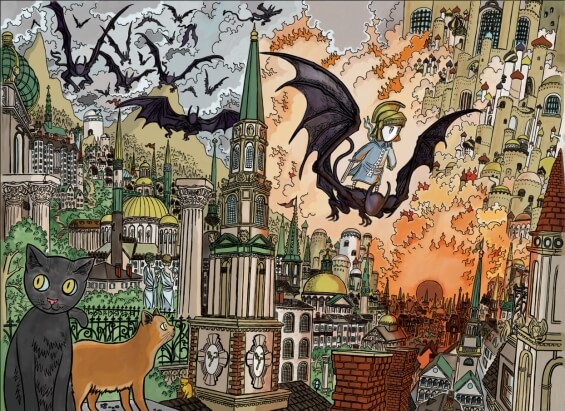
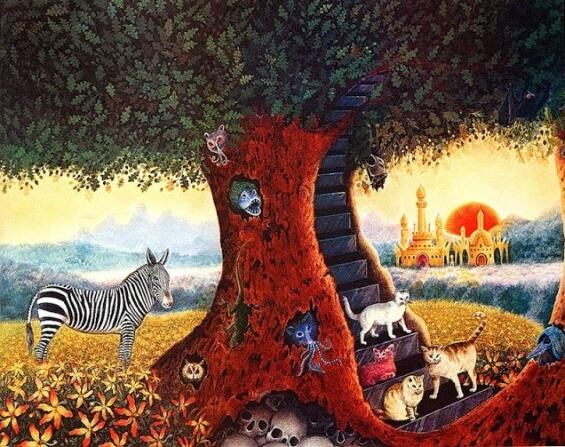
The Dream Quest Of Unknown Kadath by H.P. Lovecraft - illustration by Jason Thompson

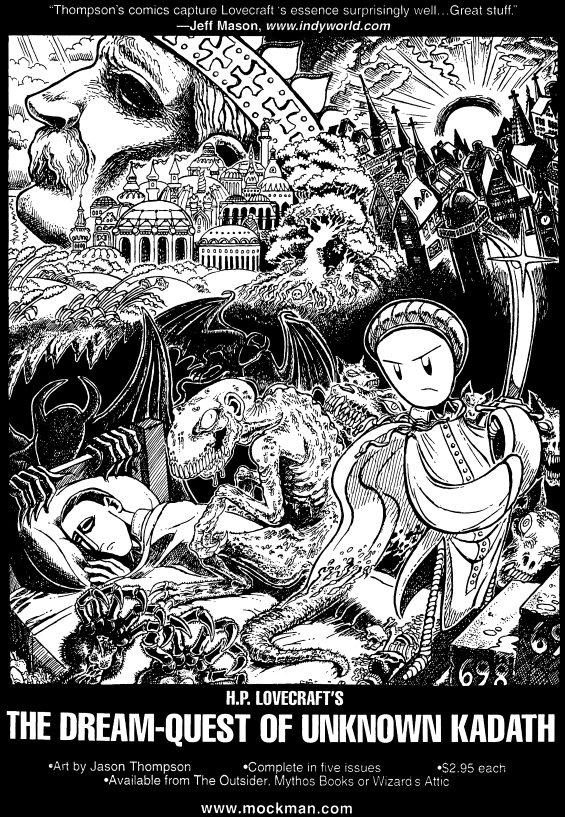
ad for H.P. Lovecraft's The Dream-Quest Of Unknown Kadath by Jason Thompson - from The Unspeakable Oath issue 16/17

Posted by Jesse Willis

The SFFaudio Podcast #354 – AUDIOBOOK: The Dream-Quest Of Unknown Kadath by H.P. Lovecraft

Podcast

The SFFaudio PodcastThe SFFaudio Podcast #354 – The Dream-Quest Of Unknown Kadath by H.P. Lovecraft, read by Martin Reyto.

This is an UNABRIDGED AUDIOBOOK of the novella (5 hour 20 minutes) comes to us courtesy of Legamus.eu.

The Dream-Quest Of Unknown Kadath was first published in 1943.

The next SFFaudio Podcast will feature our discussion of it!

Ballantine Books - The Dream-Quest Of Unknown Kadath by H.P. Lovecraft

The Dream-Quest Of Unknown Kadath by H.P. Lovecraft - illustration by Leong Wan Kok

The Dream-Quest Of Unknown Kadath by H.P. Lovecraft - illustration by Frank D. McSherry, Jr.

Posted by Jesse Willis

Review of Solar Express by L.E. Modesitt Jr.

SFFaudio Review

Solar ExpressSolar Express
By L.E. Modesitt, Jr. (review is of the print)
Publisher: Tor Books
Publication Date: November 2015

Themes: / space opera / military sci-fi / alien artifacts / science fiction /

Publisher summary:

You can’t militarize space. This one rule has led to decades of peaceful development of space programs worldwide. However, increasing resource scarcity and a changing climate on Earth’s surface is causing some interested parties to militarize, namely India, the North American Union, and the Sinese Federation.

The discovery of a strange artifact by Dr. Alayna Wong precipitates a crisis. What appears to be a hitherto undiscovered comet is soon revealed to be an alien structure on a cometary trajectory toward the sun. Now there is a race between countries to see who can study and control the artifact dubbed the “Solar Express” before it perhaps destroys itself.

Leading the way for the North American Union is Alayna’s friend, Captain Christopher Tavoian, one of the first shuttle pilots to be trained for combat in space. But, as the alien craft gets closer to its destination, it begins to alter the surface of the sun in strange new ways, ways that could lead Alayna to revolutionary discoveries-provided Chris can prevent war from breaking out as he navigates among the escalating tensions between nations.

This is an unusual book to review, since it feels unstuck in time. On the one hand, it reads like a mid-20th-century science fiction adventure, with heroic pilot and astronomer successfully solving space problems. On the other hand, it earnestly points a century ahead, to a world built from concerns very prominent in 2015.

Solar Express is about an object hurtling across the solar system during the year 2114. Two main characters engage with it, and with each other. The astronomer, Alayna Wong-Grant, works in a lunar observatory by herself, and discovers what seems like a comet. The pilot, Chris Tavoian, is tasked with exploring it. Much of the novel’s dramatic power comes from the interaction of these three, who nearly never touch each other.

The setting looms large. The world of 2114 is dominated by an East Asian polity, the Sinese republic (I think), in competition with a rising India and a sidelined North American entity (the US plus Canada, maybe including Mexico). The 21st century saw climate change occur, along with several bad wars, so there’s a touch of post-catastrophe in the staging. 2114 also sees Sinese-Indian competition rise to the brink of war, which should have added more dramatic punch to the novel than it actually did.

I began these notes by mentioning older sf, because my reading was haunted by many ghosts. Arthur C. Clarke’s great Rendezvous with Rama hovered over every page, as a humans try in vain to make sense of a cryptic alien artifact headed towards the sun. The super-competent pilot felt like a time traveler from the 1940s or 50s, as he successfully lands a plumb assignment, conducts geopolitical analysis, pilots expertly, investigates an alien machine, deals with foreign forces, deals with them again, and survives physical extremity.

That competence actually dragged down the middle third of Solar Express for me. It seemed like Tavoian’s explorations occurred at a snail’s pace, with a lot of repetition (performing similar tasks, writing to people in order to describe what we’ve just seen) and very slow progress.

The world-building wasn’t as successful as it could have been, as I noted above. For one we get too many historical observations from main characters discussing the present. People have a fondness for early 21st century history, which doesn’t make a lot of sense in that world – i.e., there’s no sense that people are history obsessives personally (as in many Poul Anderson stories) or culturally (check Harrison’s Centauri Device for an example) (57, 67, 130, 156, 232). Example: “Or [a person] believes that God in on their side. Like the Taliban in Pakistan seventy years ago.” (130) That’s an awkward reach to the reader. Imagine if a novel taking place in the present had characters in daily life – not historians – constantly referencing the War of 1812. Some of the non-narrative documents do a better job, including a kind of news + scandal sheet and selected articles.

Speaking of history, the world’s rush to war was a powerful context for the alien express, again reminding me of Arthur C. Clarke (2010 this time), but it played out oddly. The great powers confrontation is set up nicely about a 100 pages in, then ratchets up too slowly, with too much repetition (India threatens to use killer missiles, the North American president advises calm). We don’t get much insight into the crisis and its logic, perhaps because of our two-character focus.

The romance was gently handled, as each character has a lot on their plate. Besides their major work, each faces a family crisis at a distance. Astronomer and pilot have a geeky correspondence habit of exchanging political quotes with each other, the tenor of which reveal a grumpy, rather conservative outlook, which just lightly interacts with the rest of the plot.

And yet I enjoyed myself. I love stories of space adventure, and was fascinated by how this one played out. I wanted to see the alien artifact, to learn how the Sinese were responding, and what the heck was going on with the sun. Again, like a mid-20th-century sf novel, I was engaged.

As a work of hard science fiction, Solar Express is unapologetic. Like The Martian this novel zeroes in on science and technology challenges, from air filtration to spectroscopy to cleaning up lunar dust to the details of orbital mechanics. Check the jaw-dropping opening paragraph, which is a kind of dare or gauntlet hurled at the reader, starting off with a nearly 300-word first line about the physical and administrative (!) details of the moon base. Or read how the title first appears:

But by the time this object nears Mercury, it will be traveling at somewhere in the range of sixty lays per second, accelerating to as high as 250 by the time it reaches perihelion… a real solar express. (142)

Modessit does well pedagogically on this front, giving us detailed information, incremental developments, discussions, and solutions, while not stooping so low as to introduce many concepts.

So…. recommended as a fun read for people interested in hard sf and/or with a love of mid-20th-century space adventure stories. Not recommended for people who don’t read science fiction.

Posted by Bryan A.