
Review of Archangel by Marguerite Reed

SFFaudio Review

Archangel by Marguerite ReedArchangel (Book One of the Chronicles of Ubastis)
By Marguerite Reed; Narrated by Dina Pearlman
Audible Studios via Resurrection House
Release date: 17 June 2015
[UNABRIDGED] – 11 hours, 5 minutes

Themes: / military sci-fi / grief / humanity /

Publisher summary:

The Earth is dying, and our hopes are pinned on Ubastis, an untamed paradise at the edge of colonized space. But such an influx of people threatens the planet’s unstudied ecosystem – a tenuous research colony must complete its analysis, lest humanity abandon one planet only to die on another.

The Ubasti colonists barely get by on their own. To acquire the tools they need, they are relegated to selling whatever they can to outside investors. For xenobiologist Vashti Loren, this means bringing Offworlders on safari to hunt the specimens she and her fellow biologists so desperately need to study.

Haunted by the violent death of her husband, the heroic and celebrated Lasse Undset, Vashti must balance the needs of Ubastis against the swelling crush of settlers. Vashti struggles in her role as one of the few colonists licensed to carry deadly weapons, just as she struggles with her history of using them. And when she discovers a genetically engineered soldier smuggled onto the surface, Vashti must face the nightmare of her husband’s murder all over again. Standing at the threshold of humanity’s greatest hope, she alone understands the darkness of guarding paradise.

I spent a lot of my time while listening to this book confused, which made it all the more surprising when I realized at the end that I’d liked the book, and am fairly intrigued about what will come next. A book spanning multiple topics/thoughts, it was interesting to see how the various topics mostly worked together.

I think this book served in some ways as world-building/scene-setting for future books, which may explain why I was confused at times. This may be seen as a negative, but since I liked the world, it was okay, once I realized that I hadn’t missed anything with the plot (though at times, I was convinced that I had). I also liked the main character, a researcher on the planet of Ubastis but also one of the one people on the planet with a literal license to kill…anything. So while it seemed that the plot may have moved slowly, or that I was sure I was missing things, in the end it worked out okay for me. But others, especially those who listen, might have similar confusion.

It’s hard to describe what the book is “about” since Archangel covers so many topics. The book is set sometime in the future after the Earth has been effectively destroyed/overused by humans. Humans seem to have escaped to space, though it’s not clear that they had to go far to find other places to live. The book mentions a station at L5, which I presume is the L5 Lagrange point that people who’ve studied physics/astrophysics and sci-fi lovers alike will probably recognize. L5 has long been thought of as a place where space colonization might be feasible, so it seems as if it fits and that it’s not some L5 in relation to the world in the book, separate from our own system. Many humans seem to live in space, while a small handful live on Ubastis. Ubastis is a planet that has seen small waves of colonists; the first two waves of colonists were trained primarily as a military would be trained, though the job was to scout areas of the planet and start setup for more colonists in the future, to establish it as its own world. The other aspect of the colonists’ life is to study the planet and understand the resources it has and the balance between the natural ecosystem and those resources–the colonists do not wish to make Ubastis into another Earth, and so immigration to the planet is heavily controlled, only up for discussion once every 10 years. Archangel takes place just prior to one of these votes, and there is a heavy contingent of “off-worlders” lobbying for the strict limits to be lifted, to open immigration to the planet. In the book, human engineering is also not only possibly but heavily used, and most people have some level of genetic modification; most to dull aggression and many for vanity reasons.

The main character, Dr/Commander Lauren Vashti, is a “natural,” a non-genetically modified human. She was one of the people in the second group of colonists to come to the planet. Her husband was one of the leaders of that second group, and the pair are seen in many ways as a literal mother and father (and in the case of her husband, even a saint) of the planet and its resources. Vashti’s husband was killed by a highly-engineered “assault human,” a BEAST, one who was specifically genetically modified to be a soldier of sorts. This brings me to the first of the interleaved topics that the book touches on–motherhood and, to some extent, single motherhood. Vashti spends much of the book seemingly at odds with her dual role on the world. She has a literal daughter, a toddler, but often sees that being a literal mother is incompatible with being a leader, a voice for the planet as a whole. Because of her natural gifts as well as the reverence given to her, Vashti is also a literal mother to many Ubastians (and off-worlders?), as her eggs were frozen and used to create other offspring. There were striking scenes in the book where Vashti’s grief/memories of her husband are interrupted by her daughter, perfectly capturing the issues with motherhood. Later in the book, as she realizes that she is in some way a mother to the planet, similar memories are jarringly interrupted by the politics of the planet, things she must stand up for.

Obviously, another topic in the book is that of genetic engineering and the…sense…in doing so. I won’t go into details, but Vashti being a “natural” woman actually has a fairly important aspect in the plot. In particular, it seems that BEASTs can only really be “controlled” by natural humans, those without genetic modifications. This speaks volumes to the topic of genetic modification in general, but the topic is also touched upon by human nature. Because Vashti is a “natural,” she has a “normal” level of aggression/willingness to kill. It seems that many people have that particular knob turned down. Vashti is looked down upon by outsiders because she is in fact willing to kill to study the fauna native to Ubastis and willing to kill in self defense. It seems that most others find killing repugnant in general, something to be psychologically educated-away/re-educated away. The people of Ubastis (and also the off-worlders, I believe) are vegetarian. In fact, many are Muslim, though it was never really clear to me why it was important that so many were Muslim (the rest seemed to be Christian of some sort).

Another topic commonly dealt with in science fiction is that of resource use/protection of a planet/avoiding a runaway situation like we have on Earth/that eventually dooms Earth in many books…this book is no different. In her role as scientist and “mother” on Ubastis, Vashti preaches for conservation and minimization of the human footprint on the planet. The Earth is looked to as a sign of the worst that can happen.

In all, Archangel is a book about revolution. There are many types of revolution in the story, both personal revolution for Vashti, but other aspects of revolution, too. Once I came to terms with being “confused” every now and then, it was actually a fun read. The narrator, Dina Pearlman, is one whose name is familiar but I can’t find any other books that I’ve listened to that she’s narrated. Her narration had an odd cadence that was particularly difficult to follow at first. I found speeding up the audio playback helped that significantly, though her pacing may also have contributed to my confusion at times. Once I got “used” to it (at the faster playback speed), I got more into the book, but it did take awhile.

This book might not be for everybody–and certainly might not be for everybody in audio form–but as for me, I’m looking forward to seeing what happens next on Ubastis.

Posted by terpkristin.
Review of Fool’s Quest by Robin Hobb

SFFaudio Review

Fool's Quest by Robin HobbFool’s Quest (Fitz and the Fool #2)
By Robin Hobb; read by Elliot Hill
Publisher: Random House Audio
Publication Date: 11 August 2015
[UNABRIDGED] – 33 hours, 13 minutes

Themes: / epic fantasy / magic /

Publisher summary:

The harrowing adventures of FitzChivalry Farseer and his enigmatic friend the Fool continue in Robin Hobb’s triumphant follow-up to Fool’s Assassin. But Fool’s Quest is more than just a sequel. With the artistry and imagination her fans have come to expect, Hobb builds masterfully on all that has gone before, revealing devastating secrets and shocking conspiracies that cast a dark shadow over the history of Fitz and his world—a shadow that now stretches to darken all future hope.

Long ago, Fitz and the Fool changed the world, bringing back the magic of dragons and securing both the Farseer succession and the stability of the kingdom. Or so they thought. But now the Fool is near death, maimed by mysterious pale-skinned figures whose plans for world domination hinge upon the powers the Fool may share with Fitz’s own daughter. 

Distracted by the Fool’s perilous health, and swept up against his will in the intrigues of the royal court, Fitz lets down his guard . . . and in a horrible instant, his world is undone and his beloved daughter stolen away by those who would use her as they had once sought to use the Fool—as a weapon.

But FitzChivalry Farseer is not without weapons of his own. An ancient magic still lives in his veins. And though he may have let his skills as royal assassin diminish over the years, such things, once learned, are not so easily forgotten.

Now enemies and friends alike are about to learn that nothing is more dangerous than a man who has nothing left to lose.

Executive Summary: I loved this book. It’s everything I had hoped Fool’s Assassin would have been. There are a things I didn’t like, that will understandably be much more off putting for some than they were for me.

Audio book: Elliot Hill once again does an excellent job. He does a variety of voices and inflections that make doing this book in audio a good option.

Full Review
I absolutely loved Fool’s Fate. I’d have been perfectly content if the series ended there. Last year’s Fool’s Assassin was enjoyable, but not as much as I’d have liked. It left me apprehensive for this book. I shouldn’t have been. That isn’t to say bad things don’t happen to our beloved Fitz. Any fan of the Ederling books won’t be surprised by that. Ms. Hobb sure loves to torment Fitz, though probably not as much as he torments himself.

This book grabbed me from the start, and never let me go. I hated every time I had to stop listening. In fact once my hardcover copy arrived, I augmented my audio time by reading the print as well.

For reasons I can’t fathom, many people seem to skip the excellent Liveship Traders series and more have skipped the quite enjoyable Rainwild Chronicles. While I wouldn’t call it a prerequisites for this book, I would highly recommend reading those books first. There are so many great rewards in the book for people who have. If you haven’t, I doubt you’ll be lost, but you won’t get the same enjoyment in my opinion.

It’s pretty much impossible for me to get into why I loved this book more than the last one without massive spoilers, however I suspect most longtime fans will share my excitement.

That said, despite getting one of my rare 5 star ratings (this is only the second book by Ms. Hobb I’ve given that to), there are some complaints. Or maybe not complaints so much as things I wish weren’t in this book. I found them very upsetting. I’d have preferred some kind of alternative reason used to drive the plot forward. I suspect some people may be more upset than I was, and others may be more indifferent.

Overall though, those were very minor things to me in an absolutely fantastic book. I will warn that if you hate cliffhangers, you may wish to avoid reading this book until we’re much closer to the release of the next book. It is a pretty big one. With it being the second book of a trilogy, and how the first book ended, I can’t say I’m very surprised.

Much like the last one, I am both nervous and excited to read the next one and see what Ms. Hobb has in store.

Review by Rob Zak.

Review of Angles of Attack by Marko Kloos

SFFaudio Review

Angles of AttackAngles of Attack   (Frontlines #3)
By Marko Kloos; read by Luke Daniels
Publisher: Brilliance Audio
Publication Date: 21 April 2015
[UNABRIDGED] – 10 hours

Themes: / military sci-fi / weird aliens / combat power armor / humanity uniting /

Publisher summary:

The alien forces known as the Lankies are gathering on the solar system’s edge, consolidating their conquest of Mars and setting their sights on Earth. The far-off colony of New Svalbard, cut off from the rest of the galaxy by the Lanky blockade, teeters on the verge of starvation and collapse. The forces of the two Earth alliances have won minor skirmishes but are in danger of losing the war. For battle-weary staff sergeant Andrew Grayson and the ragged forces of the North American Commonwealth, the fight for survival is entering a catastrophic new phase.

Forging an uneasy alliance with their Sino-Russian enemies, the NAC launches a hybrid task force on a long shot: a stealth mission to breach the Lanky blockade and reestablish supply lines with Earth. Plunging into combat against a merciless alien species that outguns, outmaneuvers, and outfights them at every turn, Andrew and his fellow troopers could end up cornered on their home turf, with no way out and no hope for reinforcement. And this time, the struggle for humanity’s future can only end in either victory or annihilation.

The more I read Marko Kloos, the more I am impressed. This is military SF done right. The writing is solid, the story is solid, and the longer his Frontline series continues, the better it gets.

Angles of Attack is the third book in the Frontline series, and it is by far the best written and executed story. Kloos delivers truly strange aliens known as the Lankies that force a divided humanity to unite. The year is 2116, and it appears that Earth is about to fall.

When you begin navigating the military SF genre, you quickly, all too quickly, encounter massive info-dumps politely known as exposition, really super extra bad melodramatic writing, and fossilized tropes that just won’t die. And while Marko Kloos does employ some well-known tropes, he does so in such a way that it feels fresh, and the reader doesn’t mind the slight manipulation because the story is engaging.

Here’s the down and dirty of this book. The first four-fifths is stunning. The final one-fifth is comparable to something sticky stuck to the bottom of your shoe. You wish it wasn’t there, but you’re not sure how best to remove it, so you keep walking and hope that eventually it will simply go away. This is to say, even with the not so great last act of this book, it is a damn good story that is well written and worth your while to read.

Audiobook:
Get the audiobook. Luke Daniels hammers this reading out of the park. Seriously, find the audiobook and listen.

For those of you who aren’t entrenched military SF readers, the Frontline series by Marko Kloos is one of the best series to become familiar with the subgenre. I highly recommend this series, and this book.

Rating:
This is a 3.5 out of 5 that I am rounding up to 4 out of 5 because I feel generous.

Posted by Casey Hampton.

Review of CONAN RED SONJA by Gail Simone, Jim Zub, Dan Panosian, Randy Green, Rick Ketcham, and Dave Stewart

SFFaudio Review

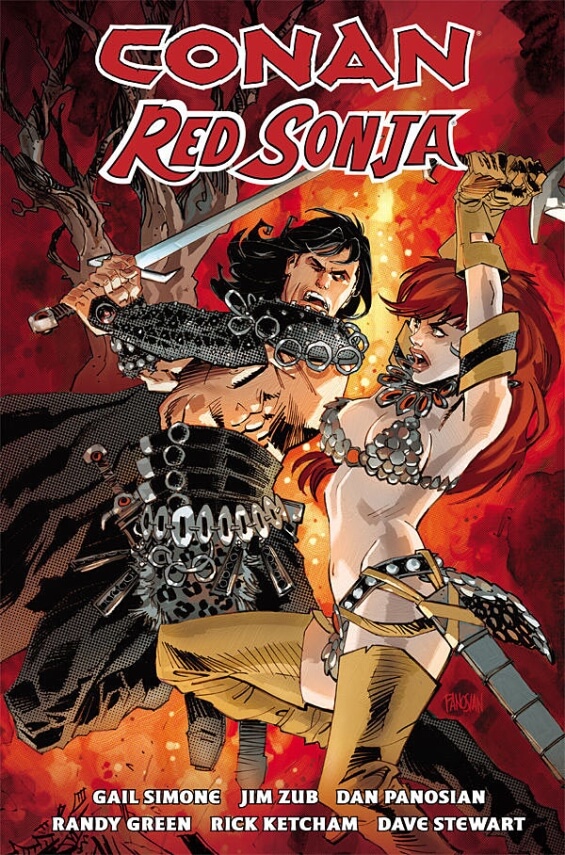
Dark Horse Comics - Conan Red Sonja (Hardcover)

Conan Red Sonja
By Gail Simone, Jim Zub, Dan Panosian, Randy Green, Rick Ketcham, and Dave Stewart
Publisher: Dark Horse Comics
Published: July 2015
ISBN: 9781616556518

Conan Red Sonja is a hardcover collecting issues 1-4 of a limited series of floppies put out by Dark Horse Comics.

I was prompted to review this comic, a trade hardcover actually, after re-reading the review snippets on the back of the book. SciFiPulse, Kabooooom, Geeked Out Nation, and Doomrocket all praised Conan Red Sonja (I think I may have heard of one of these websites before).

And, after reading it myself, I’m thinking it might be time for another opinion on Conan Red Sonja.

I didn’t hate it. But I am very disappointed with it.

I think Conan Red Sonja would make an fine book for a preteen who has not read many comics, or maybe someone a little older who needs a bit of distraction while waiting at an airport, or any someone who needed to get an idea who and what Conan and Red Sonja were but didn’t really want to know any the specifics (for some reason). Conan Red Sonja would make a suitable book for one of these persons.

There are some things Conan Red Sonja has going for it. It isn’t completely disjointed, despite having large time jumps between issues. It contains some good artwork. Some good colouring. It is printed on great paper. It is bound very well.

I also think I like what writers Gail Simone and Jim Zub were aiming at. And to be fair they don’t completely miss the mark. This book has a some nice set pieces. Individual panels here and there can be quite pretty. The splash pages are well composed. The whole package is there. Unfortunately its just lacking in all the little polished details that would have made Conan Red Sonja something really good.

In essence what’s wrong with Conan Red Sonja is that it is just not smart enough.

Now I bet most people who haven’t read a lot of Conan comics wouldn’t expect you’d go to Conan or Red Sonja comics for smartness, but I do.

It used to be that Conan’s stories were based on short stories by Robert E. Howard (and a few other authors). That tended to smarten things up quite a bit. And Conan comics, unlike the superhero comics, had real deaths, people would die and – get this – not just come back a few issues down the road. That was smart too. Trust me, I know whereof I speak on this whole issue. I’ve been reading comics since the mid 1980s. I grew up collecting and reading Savage Sword, Conan The Barbarian, King Kull, Red Sonja and pretty much every other Robert E. Howard character they’d do a comic about. So I know Conan and Red Sonja pretty damn well – and it can be very smart stuff.

This comic isn’t very smart.

I’ll point to five very specific problems:

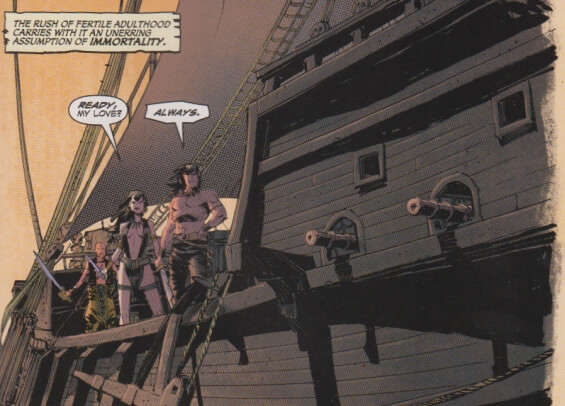
Conan Red Sonja page 29 "Always"

1. NO GUNS. Despite the drawing above, there are no cannons in the Hyborian age. Maybe this wasn’t actually in the script, maybe this is just a slip-up by an enthusiastic artist who, thinking “this is a pirate ship” and “pirate ships have cannons” drew some cannons. They don’t have cannons, not in the Hyborian Age.

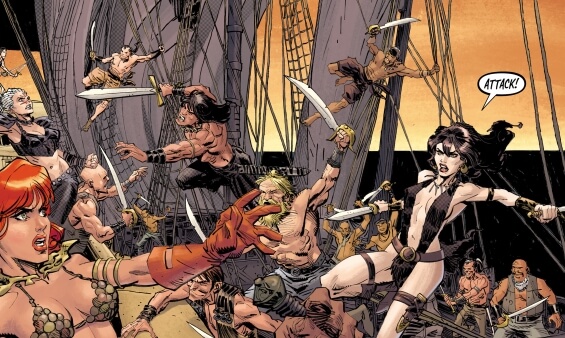
Conan Red Sonja pages 30-31 "Attack"

2. INVERSE RACISM. The pirate ship on the right. Do you see what’s missing? You can’t make racism go away by avoiding situations that might look controversial. Bêlit’s crew is supposed to black, made up exclusively of “ebony-skinned warriors.” Bêlit’s crew, in Conan Red Sonja don’t look ebony to me. Yes, Howard was racist, but Bêlit isn’t racist. She is selfish. Wanton. Cruel. But not racist. Having Bêlit not have a black crew is a stupid way to avoid looking like being racist. It’s like having the Kents of Smallville be Chinese for the purposes of racial diversity, but keeping Clark Kent white – he’s a fucking alien! – So, suffice it to say, I don’t get the point of the change here – it just makes me think yeahhh, they’re afraid to deal with the fact that the creator of this character was racist, so lets pretend everyone is white in the Hyborian Age. Howard specifically sets up this image in Queen Of The Black Coast. Bêlit is an “ivory” skinned warrior woman leading a crew of “ebony” skinned pirates. Deal with it.

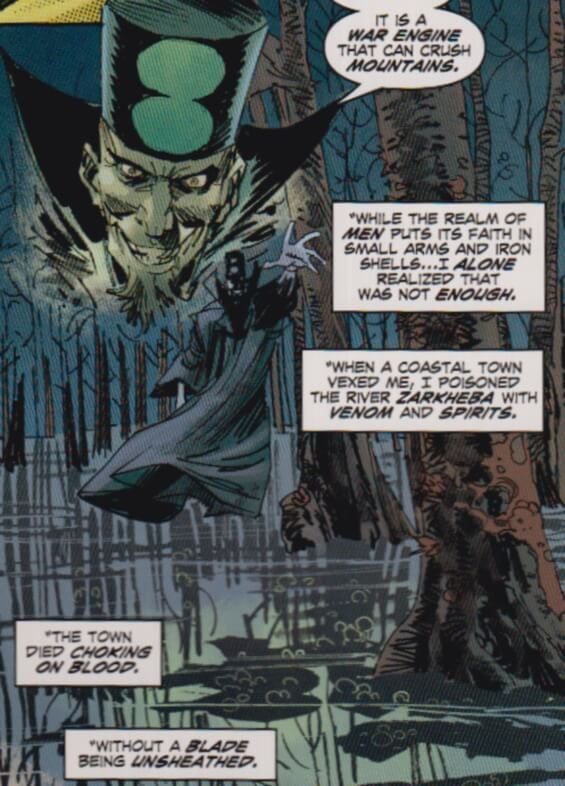
Conan Red Sonja page 45 "Unsheathed"

3. NO FUCKING WAY! No, Thoth Amon is not responsible for the poisoning of the Zarkheba River, nor, as we are probably supposed to infer, the subsequent death of Bêlit. Bêlit is responsible for her own death. Despite what writers Gail Simone and Jim Zub have Thoth Amon saying above, there’s no reason at all to have him say it – other than it is something for him to say.

First of all, Thoth Amon isn’t the be-all and end-all of evil in the Hyborian Age – he isn’t the evil behind every evil. He isn’t anything close to being the Professor Moriarty of Hyborian Age (and neither was Moriarty, actually). That’s just lazy, lazy writing.

Thoth Amon shows up in exactly one Robert E. Howard story, The Phoenix On The Sword, and the two characters never actually meet. Or as the Wikipedia page for Thoth Amon puts it “[Thoth Amon] is often used as Conan’s arch enemy in derivative works.” Well, here’s another derivative work to add to the list, Conan Red Sonja.

Moreover, Thoth Amon’s explanation for why he supposedly poisoned the Zarkheba River doesn’t hold water. There were no ruins of a coastal town at the mouth of the river! There was a ruined city upriver, that’s the setting for the climax of Queen Of The Black Coast, but that city was ancient, and had very different reasons for going bad. Again, shitty lazy writing.

Maybe there are excuses for this sort of thing, maybe the folks at Conan Properties International and Red Sonja, LLC, are so worried about protecting the characters they invented claim to own that they are micromanaging the writing team – telling them what can and cannot be written. I don’t know.

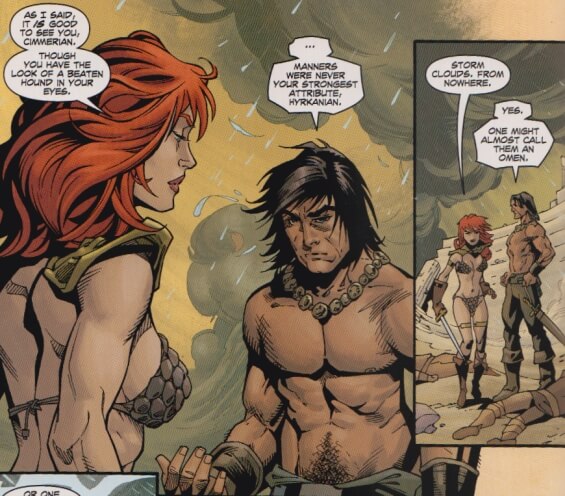
Conan Red Sonja - page 56 "A Beaten Hound"

4. ART. When not occasionally looking drugged, sometimes, just from panel to panel, Conan will look like a different dude. He will rapidly grow and then lose abdominal hair. Weird right? Too weird. I could buy a version of Conan with abdominal hair, or a version with chest hair, or a version with hair everywhere, or a Conan with a completely hairless torso (the traditional look). What I can’t buy is the growing and mowing I’m being asked to do between panels. Pick a fucking hair pattern.

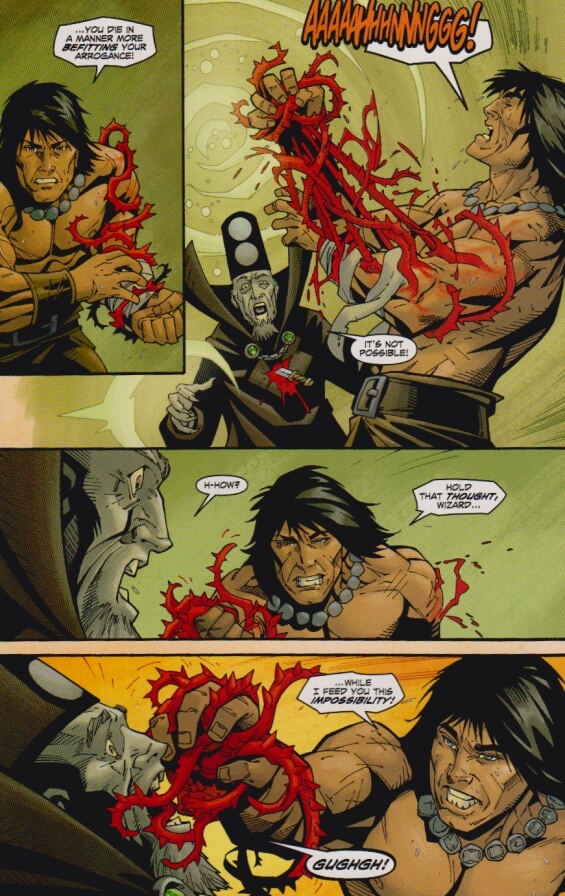
Conan Red Sonja - page 81 "I Feed You This Impossibility"

5. LOGIC. While The overall plot McGuffin isn’t bad – I like the idea of a red seed (from space) – one that sprouts a red-thorned vine that infects and chokes all the life out of everything in a land – it’s not a new idea of course, its from H.G. Well’s The War Of The Worlds – I like it! Yet I don’t think this book uses it very well. For example, we’re told it kills absolutely everything it gets close to, and so when Conan, after getting infected somehow (the book doesn’t show us how) – after getting infected Conan has the red thorny vines growing out of the muscle on his left forearm. His cure for this infection is fire (which is cool) but when the red thorny vine grows back Conan just pulls it out by the root – and that cures it?!? WTF!? What about all the other people and animals and plants that were killed by this invasive red alien plant? You’re expecting me to accept that this burn it then pull it technique will work for Conan but didn’t work for anyone else?

And that again is the problem with Conan Red Sonja, this book doesn’t expect anything of me. It certainly doesn’t respect the rules and patterns of the Hyborian Age and so it can’t and doesn’t respect itself.

I’ve seen this happen with a lot with corporate controlled franchises. They turn a character with whom an author told stories into fan service machines – telling us more about the character and forgetting what made the original writing so compelling.

Don’t give us more backstory, don’t give us prequels, do something awesome.

Posted by Jesse Willis

Review of Waiting for Bigfoot by Jim Butcher

SFFaudio Review

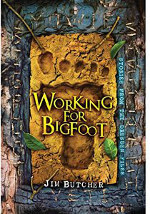
Waiting for BigfootWorking for Bigfoot: Stories from the Dresden Files
By Jim Butcher; Read by James Marsters
Publisher: Penguin Audio
Publication Date: 21 July 2015
[UNABRIDGED] – 3 hrs, 45 mins

Themes: / short stories / urban fantasy /

Publisher summary:

Chicago wizard-for-hire Harry Dresden is used to mysterious clients with long hair and legs up to here. But when it turns out the long hair covers every square inch of his latest client’s body, and the legs contribute to a nine-foot height, even the redoubtable detective realizes he’s treading new ground. Strength of a River in His Shoulders is one of the legendary forest people, a Bigfoot, and he has a problem that only Harry can solve. His son Irwin is a scion, the child of a supernatural creature and a human. He’s a good kid, but the extraordinary strength of his magical aura has a way of attracting trouble.  In the three novellas that make up ”Working For Bigfoot,” collected together for the first time here, readers encounter Dresden at different points in his storied career, and in Irwin’s life. As a middle-schooler, in ”B is For Bigfoot,” Irwin attracts the unwelcome attention of a pair of bullying brothers who are more than they seem, and when Harry steps in, it turns out they have a mystical guardian of their own. At a fancy private high school in ”I Was a Teenage Bigfoot,” Harry is called in when Irwin grows ill for the first time, and it’s not just a case of mono. Finally, Irwin is all grown up and has a grown-up’s typical problems as a freshman in college in ”Bigfoot on Campus,” or would have if typical included vampires.

I’m really glad this has been collected together in one book. Each story was originally released in a different anthology last year and they all go with each other.  The premise is that a Bigfoot named Strength of a River in His Shoulders has a half human son named Irwin living around Chicago, and can’t check on him, what with being a Bigfoot and all, so he periodically hires Harry to look after him.

These are all fun stories that take place at different points in Harry’s life as Irwin grows up. B is for Bigfoot takes place between Fool Moon and Grave Peril, I Was a Teenage Bigfoot takes place circa Dead Beat, and Bigfoot on Campus takes place between Turn Coat and Changes.  They aren’t really anything special though. I’m not a huge fan of short stories in general, and I found these stories weaker than several of the ones in Side Jobs: Stories From the Dresden Files. They are still worth a read if you’re a die hard Dresden fan like I am.

The stories all pull in different beings from the fairly rich Dresdenverse to offer a variety of issues for Harry to solve. Things tie together rather nicely between the three stories, and in some ways could be one longer story with large time gaps between certain events. James Marsters makes it awfully hard for me ever want to read a Dresden book in print again. Listening to them is just so excellent. Likely I’ll mix and match on my initial reads and then do the audio for any rereads. Smart move to release this one in audio.

Overall, in my opinion this is a collection only for the die-hard Harry Dresden fans.

Review by Rob Zak.

The SFFaudio Podcast #331 – READALONG: The Lord Of The Rings (Book 4 of 6) by J.R.R. Tolkien

Podcast

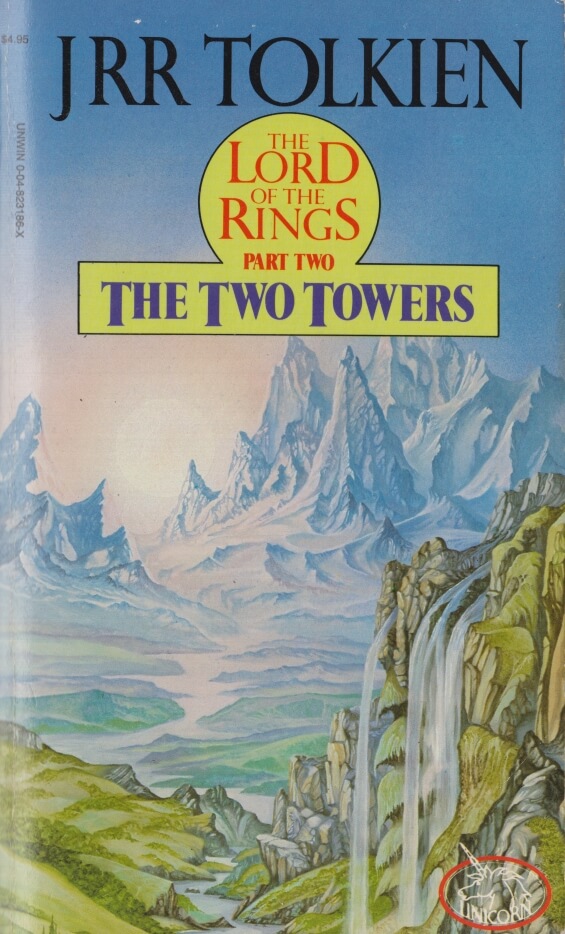
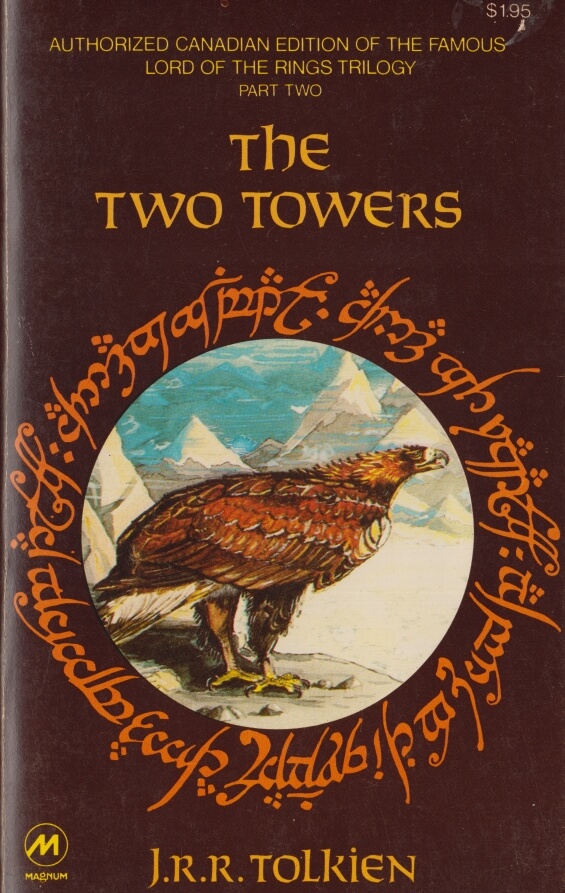
TheSFFaudioPodcast600The SFFaudio Podcast #331 – Jesse, Julie Davis, Seth, and Maissa talk about The Lord of the Rings Book IV (“The Journey To Mordor”) by J.R.R. Tolkien (aka the second half of The Two Towers).

Talked about on today’s show:
Book 4, from The Taming Of Smeagol to the end of The Two Towers, or “Don’t get tangled-up with a spider”, or “Frodo slogging through the marshes forever”, or “nothing but a bunch of people walking”, Jesse’s least favorite, so gloomy, poems, flora, fauna, stew, Julie thinks it’s necessary, encounters, the overall gloom, the purification of Frodo, also Sam, carry-on and finish-off, Sam as the hero, Sam telling the story, Sam is the lowest of the low, the evolution of Sam, Sam is jealous of Gollum, Jesse loves the meta-stuff, “Mr Frodo, sir”, Smeagol must save them both, once upon a time, “Tell me more about Sam, dad.”, the huge elf warrior, Gollum’s story, we’re never the villain, what inspired Richard K. Morgan’s The Steel Remains, seeing it from the orcs’ point of view, how well structured, looking forward and looking back, nuanced and multi-layered, Tolkien’s reputation, a very black and white moral sensibility…, the other point of view, the creation of orcs, Melkor, one of the seven gods of Middle Earth, the blight of Mordor, the flowers on the crown, dark and light, Frodo and Gollum, old and beautiful vs. old and pitiable, they could have been each other, the argument between Gollum and himself, the editing, why is Gollum bad, stinker and slinker, Sam’s apology to Smeagol, Smeagol is passive aggressive, the timing as the greatest tragedy of the whole book, Cory Olsen, the lost opportunity, twisting the promise, what the ring has promised him, Gollum the great could eat fish three times a day!, his modest dreams, like a dog off a leash, he’s like a dog in every way, guilty dogs, dogs turning on their masters, fish are sweet to Gollum, everything that we like he hates, calling Gandalf’s words to mind, the big picture, the eye is looking for you, Smeagol’s contribution, even the worst evil, chance if chance you call it, diverting evil to good, the deal with Faramir, another structural thing, three travelers in a land, Riders Of Rohan, who be you, it is totally a mirror, Aragorn and crew, revealing vs. being discovered, the righteous, blindfolded again, a foreshadowing of Éowyn, well the Rohirrim are great but…, bear that in mind, Faramir’s mind reading power, who are the Númenóreans?, Jesse thinks it is wisdom, not so much about race, it’s because he’s full of lore, the mind reading thing, Galadriel’s telepathy, “No”, “come hither”, ESP?, character vs. race, country first (Borimir) vs. wisdom first (Faramir),

I do not love the bright sword for its sharpness, nor the arrow for its swiftness, nor the warrior for his glory. I love only that which they defend.

this is the guy, the BBC radio drama, you ran all the way to me!?, Tolkien is teasing us, an echo of Galadriel, grey eyes glinting, not if I found it on the highway, “It’s not a romance novel, Julie.”, “Wow, what a guy!”, David Wenham, Aragorn is a ranger of the North and Faramir is a ranger of the South, Sam’s oliphant, what false promises did Sauron make to these guys?, dressed like Robin Hood and the merry men of Sherwood, one of the most religious things in The Lord Of The Rings, a meeting in the secret lair, Sam’s overspeaking reflecting Frodo’s overspeaking back in the Prancing Pony, heart over head, another geographical reflection, behind a waterfall, Helm’s Deep, seeing Rohan, seeing the storm, the dark skies, Minas Tirith and Minas Morgul, the chapter titles, The Passage Of The Marshes, The Black Gate Is Closed, Of Herbs And Stewed Rabbit, ruin the conies, the homely things, pots and pans, the phial of Galadriel, the Checkov’s shotguns, the belt that Borimir was given, the magic items, used once, Hobbits learn to cook before they speak, the rope!, Shelob stings Frodo like when Frodo is stung by the morgul blade back at Weathertop, running blindly on the bridge, Cirith Ungol, Shelob is Ungoliant’s daughter, the children of Shelob inhabit Mirkwood, South African spiders, how many time has the ring been worn?, Bilbo at the party, Frodo at the Prancing Pony, Frodo at Weathertop, Frodo at Amon Hen, Frodo at Borimir’s confrontation, Sam at Shelob’s lair, the ring’s effect on Sam, different people are effected differently by the ring, Frodo’s power with the ring would be to command, the ring is like a computer, if you think google is the internet…, the ring gives invisibility as a basic power, it gives Sam the power of sharp hearing and translation, Frodo can see more, Sam’s superpower is listening (he was an eavesdropper), as they approach Mordor the ring gets heavier and more powerful, leap from a precipice into a fire, it also blinds Frodo, the ring’s perception, “the master’s back”, because it is linked to Sauron, like a dog?, back to the magic items, if you play Dungeons and Dragons, a bow of plus to killing orcs, even Borimir’s gift, Sam’s dirt, Frodo’s phial, Sting from Frodo to Sam, leaving the Mithril armor, and then there’s the rope, the tying of the rope, is it a magic rope?, Galadriel’s rope?, that’s not her gift, words have power, another manifestation, “We got rope” [says some random elf], cloaks, rope, and bread, who is following?, is Gollum really allergic to the rope, if somebody tied me up, he can’t eat the lembas, he hates light, the ropes, and the nice things, climbing down Dracula-style, he knows his knots, the mystery from the previous, what happened to the entwives?, back in the Green Dragon Inn, “oh those tales”, the Ents tell where the Entwives went, the Brown Lands are brown, Jesse found a thread somewhere on the internet, Teleporno, a lot of digital ink was spilled, the last paragraph of page 258, just after watching the storm, “the skirt of the storm”, primed for finding the entwives, looking at Fanghorn,

At last they were brought to a halt. The ridge took a sharper bend northward and was gashed by a deeper ravine. On the further side it reared up again, many fathoms at a single leap: a great grey cliff loomed before them, cut sheer down as if by a knife stroke. They could go no further forwards, and must turn now either west or east. But west would lead them only into more labour and delay, back towards the heart of the hills; east would take them to the outer precipice.

“There’s nothing for it but to scramble down this gully, Sam,” said Frodo. “Let’s see what it leads to!”

“A nasty drop, I’ll bet,” said Sam.

The cleft was longer and deeper than it seemed. Some way down they found a few gnarled and stunted trees, the first they had seen for days: twisted birch for the most part, with here and there a fir-tree. Many were dead and gaunt, bitten to the core by the eastern winds. Once in milder days there must have been a fair thicket in the ravine, but now, after some fifty yards, the trees came to an end, though old broken stumps straggled on almost to the cliff’s brink. The bottom of the gully, which lay along the edge of a rock-fault, was rough with broken stone and slanted steeply down. When they came at last to the end of it, Frodo stooped and leaned out.

ties it too a stump, got this rope from the elves, oh I don’t want it elf rope behind, the rope is not magic, not really high fantasy, the birch stump untied the rope!, the last of the entwives, Frodo and Sam aren’t looking out for the entwives, “10 points for creativity”, a structural argument, they untie their bonds and sit down on a stump, answering any and every question, Julie goes with Tolkien’s answer, Jesse argues for the book over the author, here’s proof that the entwives are there, every time Galadriel’s name gets mentioned, the last thing he says is Galadriel and he strokes the rope, there is no truth of the matter, we cannot go to Middle Earth except by reading this book, Jesse keeps marshaling the argument, “you will find friends”, “Elrond is right”, two hobbits sit down on a stump and are taken by a tree, on the edge of a forest, symmetrically it works, an undefeatable argument unless, if were trying to solve mysteries…, the fragrant area, it used to be, this place had its history too before it was the Brown Lands, there are things we don’t know and things Tolkien didn’t know about it, world-build the hell out of it, structurally: the time, a three day foot journey to the west and a three day foot journey to the east, near simultaneous action, the end of page 70, even the wind is mapped out, Emun Myul, “almost felt you liked the place?”, a magic talking tree, the final nail in the coffin, the birch, the word book comes from the word birch, bravo bravo, the mystery is left there, when we were talking about the word stuff, Tom Bombadil,

‘It’s a trap!’ said Sam, and he laid his hand upon the hilt of his sword; and as he did so, he thought of the darkness of the barrow whence it came. ‘I wish old Tom was near us now!’ he thought. Then as he stood, darkness about him and a blackness of despair and anger in his heart, it seemed to him that he saw… a light in his mind, almost unbearably bright at first…. Far off… he saw the Lady Galadriel… in Lórien, and gifts were in her hands. And you, Ring-bearer, he heard her say, remote but clear, for you I have prepared this.

and that happens again, Sam brings light by thought, the big theme, with this phial, brandishing this light, intolerable light, unbearable light, the infection of light, Frodo asleep becoming a phial of light, Sam seeing it in Frodo, Frodo fading?, Frodo purified?, light going through him, the pincushion effect!, Frodo the white, the trend of weariness, the fate of all the elves, Mythgard Academy, that’s a choice, The Choices Of Master Samwise, you noodle!, everything that happens in the last book, foolish choices (wise choices), signing a contract you haven’t read, who would have the ring now?, somebody cut this open, the orcs had orders, in the floaty ghosty of the eye, the black hand only has four fingers, does Sauron have a body?, rolling Frodo into a ditch, all my choices have proved ill, what good lay in choice?, the very last map in The Two Towers, the wetwang and the entwash, Rohan, the new book The Fellowship: The Literary Lives of the Inklings: J.R.R. Tolkien, C. S. Lewis, Owen Barfield, Charles Williams by Philip and Carol Zaleski, telling the story of The Inklings, Lewis’ atheism and conversion, intertextuality, reading each other’s minds, Eagle And Child pub, Hugo Dyson, an alternate theory on the entwives, the vocal mannerisms of treebeard are those of C.S. Lewis, the question is not: “where are the entwives” but rather “where are our husbands?”, Dorothy L. Sayers, a male exclusive club, christian apologetics, a shoo–in.

UNICORN - The Two Towers by J.R.R. Tolkien
MAGNUM - The Two Towers by J.R.R. Tolkien
UNICORN - The Two Towers by J.R.R. Tolkien

Posted by Jesse Willis