Review of The Providence of Fire by Brian Staveley

SFFaudio Review
The Providence of Fire by Brian StaveleyThe Providence of Fire (Chronicle of the Unhewn Throne #2)
By Brian Staveley; Narrated by Simon Vance
Publisher: Brilliance Audio
Publication Date: 13 January 2015
[UNABRIDGED] – 23 hours, 37 minutes

Themes: / fantasy / brothers / monks / assassins / barbarian hordes /

Publisher summary:

Brian Staveley’s The Providence of Fire, the second novel in the Chronicle of the Unhewn Throne, a gripping new epic fantasy series in the tradition of Brandon Sanderson and George R. R. Martin The conspiracy to destroy the ruling family of the Annurian Empire is far from over. Having learned the identity of her father’s assassin, Adare flees the Dawn Palace in search of allies to challenge the coup against her family. Few trust her, but when she is believed to be touched by Intarra, patron goddess of the empire, the people rally to help her retake the capital city. As armies prepare to clash, the threat of invasion from barbarian hordes compels the rival forces to unite against their common enemy. Unknown to Adare, her brother Valyn, renegade member of the empire’s most elite fighting force, has allied with the invading nomads. The terrible choices each of them has made may make war between them inevitable. Between Valyn and Adare is their brother Kaden, rightful heir to the Unhewn Throne, who has infiltrated the Annurian capital with the help of two strange companions. The knowledge they possess of the secret history that shapes these events could save Annur or destroy it.

I gave this book the same rating as The Emperor’s Blades, and I think in many ways it’s better. But I also had higher expectations coming in. I had none for the first book, and found myself pleasantly surprised. So I was looking forward to this.

This book started off slow. With how the last one ended, I guess I was sort of expecting the book to hit the ground running. The last book is largely the “magic school” trope, although there isn’t a whole lot of magic. But there is rigorous training and rivalries and the like. And some of the characters can do magic.

Maybe my love of that trope, or the fact that they were “in training” made me less aware of just how STUPID The Emperor’s kids are. There was no hiding that here. I’m not a big fan of the super smart, super capable protagonist who can’t seem to do any wrong, but I hate the “I’m going to pull a plan out of my ass and somehow things will work out mostly right in the end” protagonist even worse. It would d be bad enough if only one of them did, but all three of them did, and continued to do it. They didn’t learn from their mistakes. They didn’t really seem to grow as characters. They just kept being idiots. And selfish. It got pretty frustrating.

So why did I give this 4 stars? Well two reasons mainly. One the story is interesting. The world building Mr. Staveley does in this book is especially intriguing. The pieces he put in place in this novel look to make for a really interesting third (and final?) book in this series.

Secondly he has some great supporting characters. Some are returning from the first novel, and some are new. In particular I really enjoyed the POV chapters from a former supporting character who was given a chance to shine. They were easily my favorite chapters in the book. I only wish they had started sooner. Maybe even in the last book, but it wouldn’t have made too much sense, so I understand the reasoning.

Overall this book is better, but with higher expectations, I found myself a bit disappointed at the same time. But I’m looking forward to the next book. I think for a middle book there is a lot to like. Hopefully the Emperor’s kids will get a clue by then.

As a narrator, Simon Vance is excellent as always. He was one of the main reasons I decided to try out The Emperor’s Blades. His performance is such that this series remains a must audio for me, even if it means waiting a bit longer to get my hands on the next book.

Review by Rob Zak.
Review of The Companions by R.A. Salvatore

SFFaudio Review

The CompanionsThe Companions (Forgotten Realms: The Sundering, Book 1)
By R.A. Salvatore; Narrated by Victor Bevine
Publisher: Brilliance Audio
[UNABRIDGED] – 15 hours

Themes: / fantasy / magic / Forgotten Realms / wizard /

Publisher summary:

On the dusty plains of Netheril, a young Bedine girl spins a web of forbidden magic, obliterating a pair of assassins with a single lightning strike. On the banks of the Sea of Fallen Stars, a tiny thief walks willingly into battle with a ruthless killer, a wide grin upon his face. In the tunnels of Citadel Felbarr, a dwarfling is ambushed and strikes back with an attack well beyond his apparent strength and years. These three seemingly unrelated commoners, growing up across the far reaches of the Forgotten Realms®, hold the fate of Faerûn’s most famous dark elf, Drizzt Do’Urden, in their hands. But that fate is far from certain. For in the shadows a cunning cabal of wizards is watching, intent on hunting Chosen—mortals blessed by the gods. These wizards know something mere commoners do not: Long-forgotten gods have begun to stir. Long-lost lands have begun to tremble. The world around them is about to change. And these wizards will do whatever it takes to turn the coming chaos to their advantage. In this first book of the six-book Sundering series, New York Times bestselling author R.A. Salvatore launches a major world-shaping event that will revive old favorites, introduce new complications, and move his signature hero Drizzt into a restored era of the Forgotten Realms.

Oh, Salvatore. Never change.

Drizzt Do’Urden is back in The Companions, although in a very limited fashion. The bulk of the story focuses on Cattie-brie, Bruenor, and Regis as they are (I am not making this up) sent back to live again, from birth onwards, in order to help Drizzt far after their original deaths.

Yep. They have adult consciousness in baby bodies. They’re aware of the sensation of being birthed. They have completely adult, mature minds trapped in little toddler dwarf/human/halfling bodies. They have to struggle through relearning how to walk, eat, be toilet trained…let me back up.

Mielikki, a goddess of nature, allows the Companions to chose whether to be reborn in order to help Drizzt in a time of great need. Wulfgar appears to chose not to, electing to go to his heavenly reward instead, but the others are all reborn and go through childhood. They constantly work to hide their identities while being somewhat torn in their loyalties. The story culminates with their reunion with a wounded Drizzt and his magical panther, Guenhwyvar. Even Wulfgar shows up at the end, and it’s nicely set up for the next book in the series.

Did I mention the vampire drow? Or the dolphins? This book has it all.

Except for the beginning and end, Drizzt is not part of the action. He has escaped capture and is considered lost, so instead each chapter begins with a letter of his, a seeming memoir, on a theme that is then touched upon in Cattie-brie, Bruenor, and Regis’s new lives.

I’m not sure I’d necessarily recommend this book, as it was very odd. I did enjoy it, even as I laughed at some of the parts, and would definitely listen to the next one.

The narrator did a really good job, even managing to pull off a falsetto for the female characters voices without it turning off-putting. There was a short bit of music in between each disc, and they repeated the first few sentences from the last disc in the first track of the next disc.

Posted by Sarah R.

Review of The Gods Themselves by Isaac Asimov

SFFaudio Review

Gods ThemselvesThe Gods Themselves
By Isaac Asimov; Narrated by Scott Brick
Publisher: Random House Audio
Release Date: January 2014
[UNABRIDGED] –  11 hrs, 26 mins

Themes: / science fiction / aliens / annihilation / survival /

Publisher summary:

Only a few know the terrifying truth – an outcast Earth scientist, a rebellious alien inhabitant of a dying planet, a lunar-born human intuitionist who senses the imminent annihilation of the Sun… They know the truth – but who will listen? They have foreseen the cost of abundant energy – but who will believe? These few beings, human and alien, hold the key to the Earth’s survival.

Though a science fiction novel, The Gods Themselves is also primarily about magic.

Throughout the courses I took for my my undergraduate degree in Economics, we talked a lot about the driving forces behind the choices people make. One of the greatest is magic. We all want to find that magical thing that makes us not have to work as hard; magic makes life easier.

This quest for magic has helped us innovate on a grand scale and use the resources around us for our own benefit. Whether it’s been good in the long run, I’ll not get into just this second.

In The Gods Themselves, a magic is found which makes life easier and it’s the Electron Pump. Somehow, some beings have reached across the universe, time, or something, to impress themselves upon our world and made possible an endless energy source, which benefits all of humanity.

The only problem is whether it is really for our benefit and what happens when the worst is found out? Would humanity easily give up such a gift?

It’s interesting to read this book, published in 1972, in light of today’s problems with humanity’s stewardship of the world. I’m sure, actually, that Mr. Asimov thought his day was bad.

This book is told in three separate parts, each of which was published independently in Galaxy Magazine and Worlds of If. They focus on three quite different groups of people and their interaction with the Electron Pump.

The first focuses on the physicists who discover and deal with the Electron Pump. The second focuses on those others and it’s absolutely otherworldly, so much so, that it was quite difficult to read at first until you understood what was going on a bit more. It reminded me a little of Orson Scott Card’s Mithermages series.

The final part focuses on a human colony on the moon. One of the parts I can talk about without spoiling things is the description of gravity on the moon. Those who’ve lived there all their lives are essentially trapped there because their bones couldn’t survive Earth’s gravity and those who travel there have to take frequent, excruciating, trips home to Earth to keep their bodies in shape. After listening to a Star Wars book, it’s interesting to note how little they care about the different gravities of worlds. Must be some hyper-technology that accounts for it right?

Because Asimov is himself a scientist, the physics are competently explained, at least to a lay person like myself, and the dire consequences of humanity’s actions are understood … through science. Amazing!

And a note on the audiobook reader, Scott Brick. Brick has been around the block, I don’t know how many times I’ve come across his recordings. You can always trust him to bring the gravitas to any recording and you’ll find nothing less here.

This cleverly named book won both the Nebula Award in 1972 and the Hugo in 1973. And as the origin of the name of the book says, quoted from Friedriech Schiller, “Against stupidity the gods themselves contend in vain.” (for the German speakers: “Mit der Dummheit kämpfen Götter selbst vergebens.”)

As apt today as it was … when it was written.

4 out of 5 Stars (highly recommended)

Posted by Bryce L.

The SFFaudio Podcast #306 – AUDIOBOOK/READALONG: The Fall Of The House Of Usher by Edgar Allan Poe

Podcast

Edgar Allan Poe's The Fall Of The House Of Usher
The SFFaudio PodcastThe SFFaudio Podcast #306 – The Fall Of The House Of Usher by Edgar Allan Poe; read by Mike Vendetti. This is an unabridged reading of the story (49 minutes) followed by a discussion of it. Participants in the discussion include Jesse, Julie Davis, Bryan Alexander, and Mike Vendetti

Talked about on today’s show:
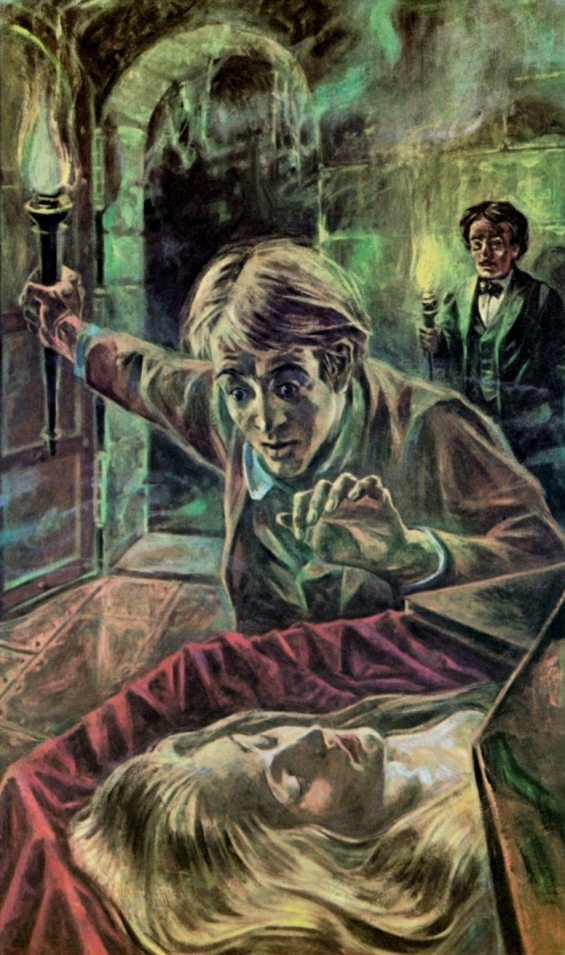
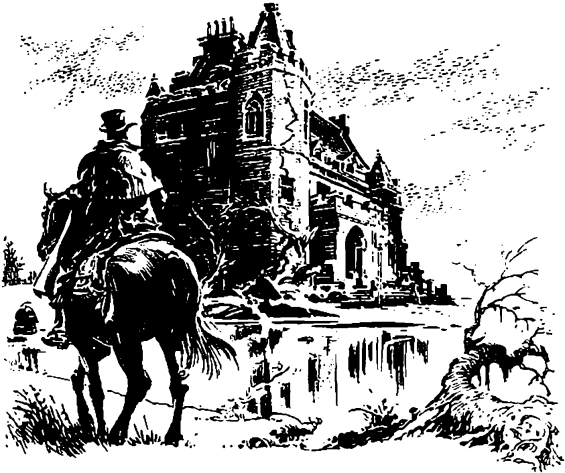
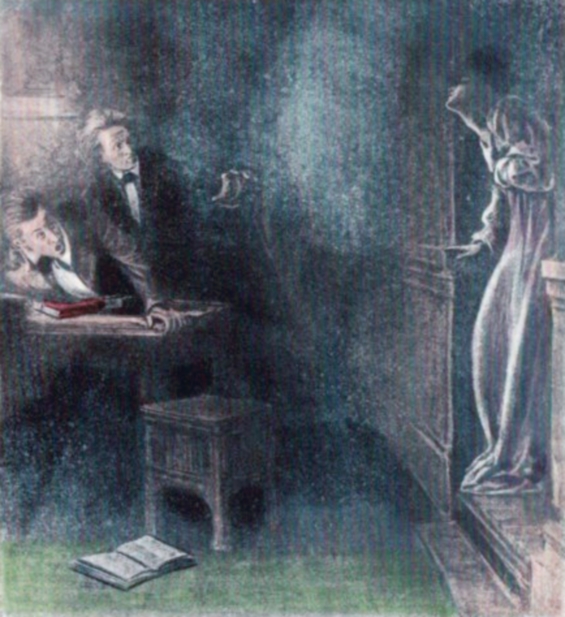
LibriVox.org, Audible.com, a Reader’s Digest version, a ponderous vocabulary, prolixity, Poe the hoaxer, the part of him that invented the mystery short story, a corpse flower, this is what Lovecraft does, “he’s done his research!”, words made by mad men, mapping the elephant’s outline, the movies, the comics, the Wikipedia entry, The Haunted Palace by H.P. Lovecraft, the Roger Corman movie, the poem is the outline for the story, the history of the house of usher, dead trees with white trunks, New Jersey, the lutes well tuned law, porphyrogene – “born to the purple”, synecdoche, a photo negative, upside down and inverted, golden banners, the fungi, The Tell Tale Heart, The Bells, a republic society in love with aristocracy and royalty, The Masque Of The Red Death is a dystopia, Hop Frog, “its beautiful … but horrible things happen”, John Buchan, broken off pieces of themselves, Thomas A. Shippey, the Vatican astronomer, no titles allowed anymore, Queen Elizabeth II, Br. Guy Consolmagno, absentee royalty, a super-mix, “evil things in robes of sorrow”, entombed, equating architecture and person, you can’t separate Roderick from his sister, “I heard it man”, why did he dare not speak?, buried alive, twins and twinning, the 1989 adaptation of The Fall Of The House Of Usher, why they can’t just tell the story in adaptations, this is hospice care, was Roderick tormented by his twin sister?, I see a skull, the house is a skull, the trees are ribs or arm bones, a ghost, dying of old age, reason, rationality, Guy de Maupassant’s Who Knows, the furniture represents the faculties, the end of The Life Of Pi, the miasma, an unhealthy atmosphere, in awe of Poe, Everything That Rises Must Converge by Flannery O’Connor, the Usher stump, the stump of the tree of Jesse, a tottering mind, everything’s lined with copper, a Frankenstein motif, a long family line of incest, “it had put forth no enduring branch”, “so lain”, viewing it as a story about incest, set in the location of Hammer Horror, Middle Lovecraft, seeing Lovecraft through Poe, a cyclopean vocabulary, H.P. Lovecraft’s Favorite Weird Tales edited by Douglas A. Anderson, crazy complicated sentences, Walden by Henry David Thoreau, CraftLit, the prologue to The Scarlet Letter, reading Poe aloud, Supernatural Horror In Literature, oral cadence, the very summits of artistry, fictional miniaturists, Ligeia, another dead woman story, so Lovecraft, he loves his architecture, “sharing a single soul”, the crack, “the eye of a scrutinizing observer”, laughing out loud, the unnamed narrator is of the same class as Roderick, context for the story, science stories, buried alive stories, The Pit And The Pendulum, sense experience, again New Jersey, Italy, The Scarlet Letter by Nathaniel Hawthorne, weird fiction out to wazoo, why do they do that?, demented messed up stories, Young Goodman Brown, Rappaccini’s Daughter, supernatural elements, sense experience, an utter depression of soul, the after dream of the reveler upon opium, the dropping of the veil, the veil of dreams, the after-dream is after the dream?, the veil is beautiful, a shout-out to Thomas de Quincey, crawling fungi, red-litten windows, “laugh but smile no more”, coffin worms, creeping into the crypt to often, The Conqueror Worm, a foreshadowing, reasons for laughter vs. reasons for smiling, the hideous throng, Usher II by Ray Bradbury, premature burial, Buried (2010), The Death of Olivier Bécaille by Emile Zola, Weird Tales, Poe is a hilarious writer, punning and japing, Mad Trist by Sir Launcelot Canning, Dead Families 101, How To Repair Your Doomed House, The Man Who Collected Poe by Robert Bloch, wacky moments, The Cask Of Amontillado, deGrave wine, The Tomb by H.P. Lovecraft, Jervas Dudley as one of the Usher descendants, a lot more Poey, there are not a lot of sisters in Lovecraft, The Moon Pool by A. Merritt, The Moon Bog by H.P. Lovecraft, Edgar Rice Burroughs, comparing Poe to Lovecraft, The Narrative Of Arthur Gordon Pym Of Nantucket, The Dreams In The Witch House, the novella (short story) vs. the novel, it starts off as a horror tale, What The Moon Brings, Ireland, a little bit ushery,

The Fall Of The House Of Usher by Edgar Allan Poe
The Fall Of The House Of Usher - illustration by Russell Hoban (1963)
Pocket Classics - The Fall Of The House Of Usher
House Of Usher (1960)
The Fall Of The House Of Usher illustrated by S. de Ivanowski
Mark Summers illustration for The Fall Of The House Of Usher by Edgar Allan Poe
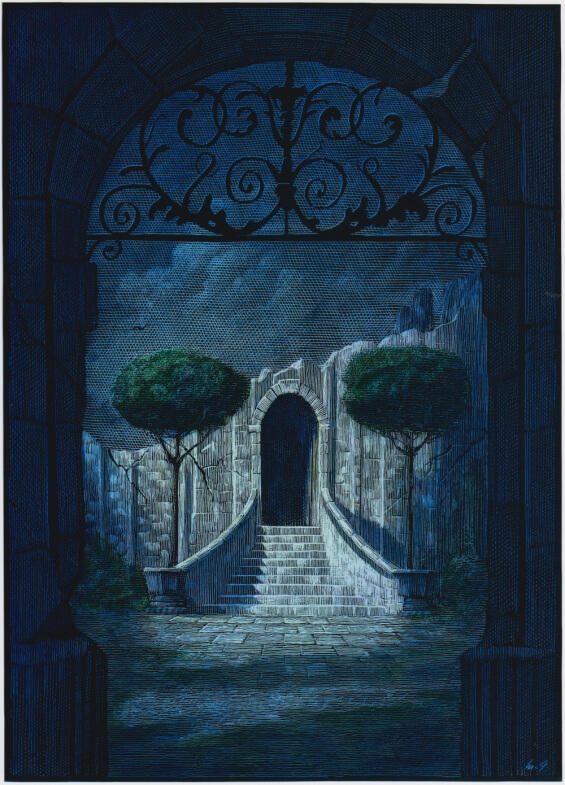
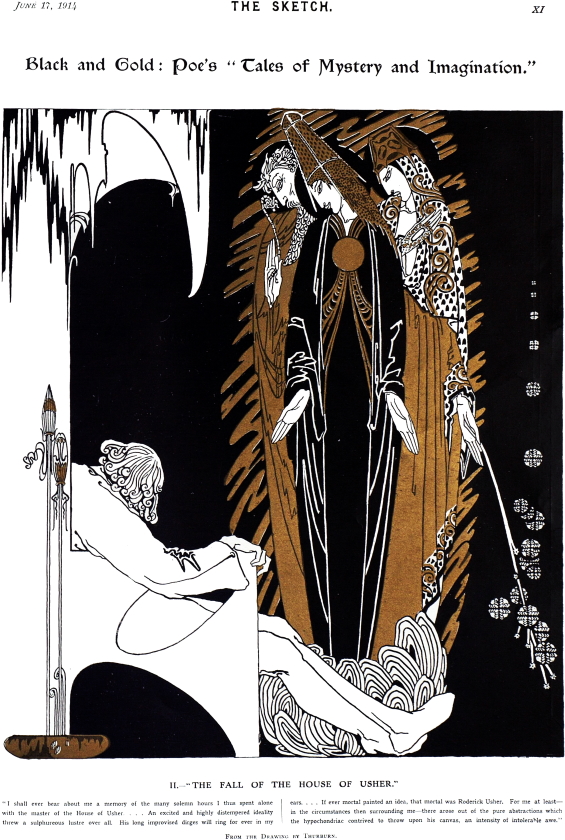
The Fall Of The House Of Usher illustration by Thurburn

Posted by Jesse Willis

Review of Heraclix and Pomp by Forrest Aguirre

SFFaudio Review

Heraclix and PompHeraclix and Pomp: A Novel of the Fabricated and the Fey
By Forrest Aguirre; Narrated by Brandon Massey
Publisher: Audible Studios (via Resurrection House)
[UNABRIDGED] – 11 hours and 7 minutes

Themes: / fantasy / golem / magician / magic / faery /

Publisher summary:

Heraclix was dead and Pomp was immortal. That was before Heraclix’s reanimation (along with the sewn-together pieces and parts of many other dead people) and Pomp’s near murder at the hands of an evil necromancer. As they travel from Vienna to Prague to Istanbul and back again (with a side-trip to Hell), they struggle to understand who and what they are: Heraclix seeks to know the life he had before his death and rebirth, and Pomp wrestles with the language and meaning of mortality. As they journey across a land rife with revolution and unrest, they discover that the evil necromancer they thought dead might not be so dead after all. In fact, he might be making a pact to ensure his own immortality….

There are some books that are just magical, that are written in such a way that you can’t help but be drawn into a new world even if it’s set against our own. Neil Gaiman writes this way and so does Susanna Clark in Johnathan Strange and Mr. Norrell.

Forrest Aguirre, World Fantasy Award winner for his editorial work in the Leviathan 3 anthology, has created such a tale. The story of Heraclix and Pomp is magical before the magic even begins, or possibly just at the same time.

Because this is the story about a golem, who has been fabricated by a magician, and Pomp, a faery.

They go on a journey to find out what exactly Heraclix is made of … in more ways than one. Being a golem, he’s been formed from different parts of various bodies and some behave abnormally to say the least.

I knew I would enjoy this tale right away, however, my main problem actually has nothing to do with the writing or the story itself, it’s the audio narration.

I almost put the book down because the narration was just plain hard to listen to. Brandon Massey’s narration was dull and monotone, almost robotic even, with words over-pronounced so that each letter is sounded out. I don’t like listening to audiobooks on faster speeds, because I like to appreciate the acting and the reading itself, but 1.75 speed actually made this much better to listen to. At least there was a reason for the robot-sounding voice.

As much as I wanted to love every moment of the book, I was so off-put by the narration that it made it really hard to enjoy the story. I didn’t look forward to my car rides and sadly I don’t have the time to go back and read, which I’m sure I will enjoy much more.

Despite these facts, I could still see the glimmer of lyrical beauty in the narrative. It’s a great story and wonderfully written and my reduced rating is mainly a factor of the audio presentation.

3.5 out of 5 Stars (recommended, but not on audio)

Posted by Bryce L.

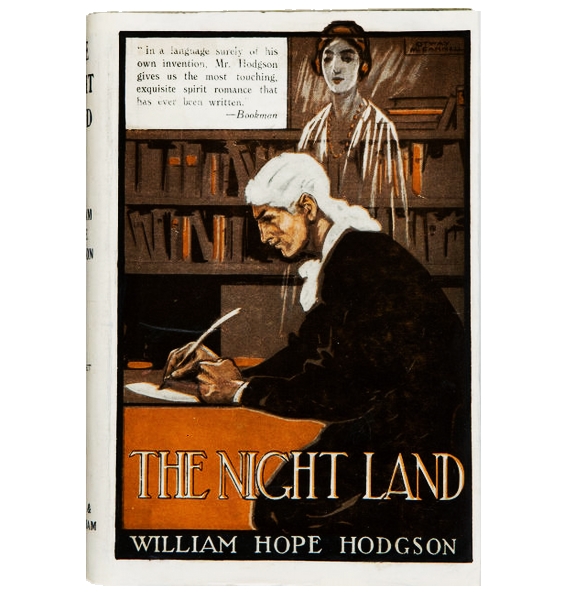
The SFFaudio Podcast #305 – AUDIOBOOK: The Night Land by William Hope Hodgson

Podcast

The SFFaudio PodcastLibriVoxThe SFFaudio Podcast #305 – The Night Land by William Hope Hodgson, read by Mark Nelson.

This UNABRIDGED AUDIOBOOK (18 hours 40 minutes) comes to us courtesy of LibriVox.

The Night Land was first published in 1912.

For our discussion of The Night Land check out episode #288

The Night Land by William Hope Hodgson

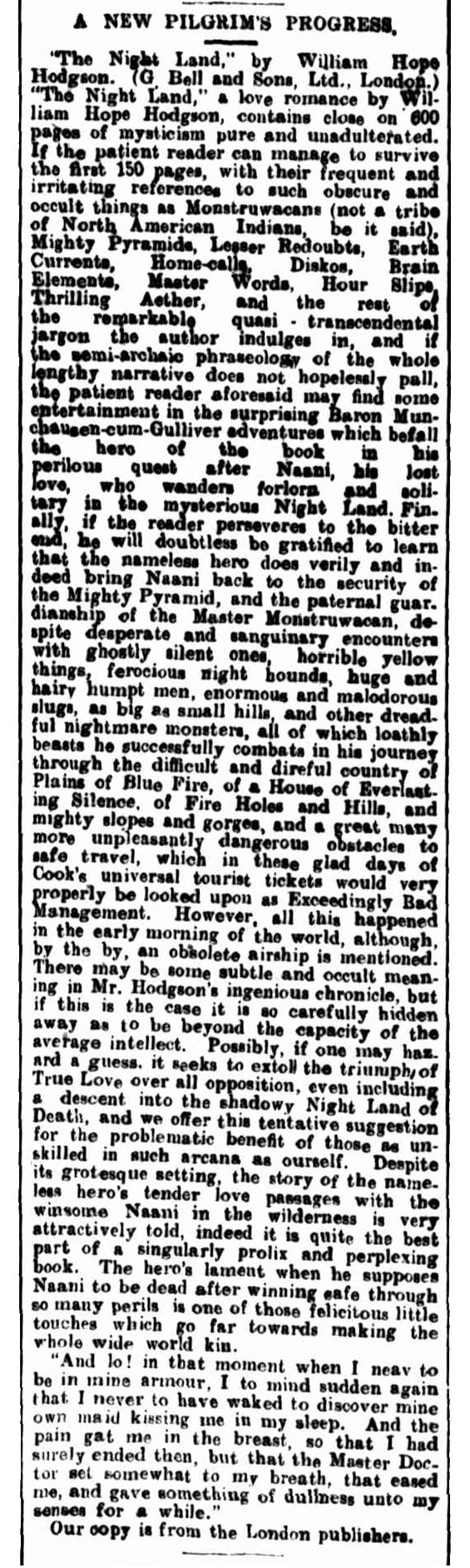
Review of The Night Land by William Hope Hodgson from the Western Mail (Perth), June 1, 1912

Posted by Jesse Willis