Review of Indexing by Seanan McGuire

SFFaudio Review

Cover art for Indexing by Seanan McGuireIndexing
By Seanan McGuire; Read by Mary Robinette Kowal
Publisher: Brilliance Audio
Publication Date: 4 March 2014
[UNABRIDGED] – 13 hours
Themes: / metafiction / urban fantasy / fairy tales

I’m usually opposed to quoting the synopsis in my reviews–it’s just fluffing my word count! But I’m not even going to try to explain the premise of Indexing myself, so this time I’ll let the synopsis do all the heavy lifting.

“Never underestimate the power of a good story.”

Good advice…especially when a story can kill you.For most people, the story of their lives is just that: the accumulation of time, encounters, and actions into a cohesive whole. But for an unfortunate few, that day-to-day existence is affected—perhaps infected is a better word—by memetic incursion: where fairy tale narratives become reality, often with disastrous results.

That’s where the ATI Management Bureau steps in, an organization tasked with protecting the world from fairy tales, even while most of their agents are struggling to keep their own fantastic archetypes from taking over their lives. When you’re dealing with storybook narratives in the real world, it doesn’t matter if you’re Snow White, Sleeping Beauty, or the Wicked Queen: no one gets a happily ever after.

Indexing is New York Times bestselling author Seanan McGuire’s new urban fantasy where everything you thought you knew about fairy tales gets turned on its head.

As the author of both the October Day series and, under the pseudonym Mira Grant, the Newsflesh trilogy, Seanan McGuire is no stranger to writing urban fantasy. But, as you may have deduced from the blurb, Indexing is not your run-of-the-mill hot vampire-on-werewolf ménage-a-trois urban fantasy. Instead, it’s populated with fairy tales. Here be Pied Pipers, Frog Princes, and Mother Gooses (Geese?) in spades. In the moribund desertscape of urban fantasy, Indexing is a cool refreshing garden grown wild with novelties. McGuire’s writing is dynamic enough to play fair with both the here-and-now realities of an urban setting and the timeless terrible beauty of fairy tales. Like quicksilver, the tone can glide from spunky 21st-century dialogue riddled with F-bombs to an ethereal transcendence full of snow and moonlight.

The presence of stories come to life in the world of Indexing places it squarely in the realm of metafiction. In fact, the book takes its title from the very real Aarne-Thompson Index, a comprehensive listing of folktale types compiled in the early twentieth century. In the land of metafiction, Indexing has some pretty affluent neighbors, such as Italo Calvino’s If On A Winter’s Night A Traveler and Jorge Luis Borges’s The Library of Babel. Unfortunately in this regard the book fails to measure up, like that rundown house you drive by on your street and mutter about how you wish the neighbors would cut their grass. The premise itself is intriguing in exactly the way that speculative fiction is supposed to be, but the underlying worldview is overly pessimistic. In this story, Narrative itself is a character, or at least a vital force, trying to impose itself onto our order of reality. According to the world of Indexing, this is almost always a very bad thing, something that needs to be stopped. The novel’s closing chapters bring to light some extenuating circumstances that lend this structure a modicum of feasibility, but the reader still comes away with the sense that our world is better off without fairy tales made manifest stalking our streets.

As I write this, it occurs to me that this bothers me so much because it’s at odds with why I read speculative fiction in the first place. I firmly believe that these stories really do make our world better, in a very tangible way. I’m not saying we should unleash every fictional character on the streets of New York–there would probably be utter chaos. But there would be hope too. There would be Aragorn, for example, and Optimus Prime, and–you get the idea. The influx of story into our own world, “mimetic incursions” as they’re called in Indexing, needn’t always be the harbingers of misery and ruin. In fact, I think I took personal offense at the book’s denigration of stories. And then, of course, there’s the added irony that we’re actually reading, or listening to, a story. Just what sorts of mimetic incursions will Indexing spawn, I wonder. Ahh, the joys of peeling the layers of metafiction, kind of like an onion, but pointier and more slippery.

To be clear, my criticism of the novel’s metafiction is purely ideological. Leaving those aside, McGuire tells a damn good story. The pacing ratchets up the suspense like a mystery novel, and the writing, as I said, is sturdy as a house made of bricks. (See what I did there? Three Litle Pigs reference? Okay, never mind, on with the review.) And even if the book’s metafiction elements are problematic, its exploration of storytelling does succeed on a psychological levee. Narrative psychology and therapy have become buzz words in the last twenty years, and on both individual and cultural levels  we do think of our lives, both individually and collectively, as stories. In that sense, the main characters of Indexing become archetypes for ways in which people deal with their stories, their past, their trauma, whichever psychobabble catch phrase you like. Some fight it, others embrace it, while still others have more of a story than they think they do. Like most good speculative fiction, Indexing succeeds because of its powerful characterization.

Mary Robinette Kowal, a weaver of fantastic tales in her own right, shines as Indexing‘s narrator. Her performance of Henrietta Marchen, a recovering Snow White through whose eyes we see most of the book’s events, is at once confident and vulnerable in perfect measure. And I don’t think I’ve ever heard a female narrator quite reach the baritone depths that Kowal does when she voices the burly Andy Robinson. The only blemish in the performance is her portrayal of Sloan Winters, whose incurably foul mouth is already grating enough without eery sentence curling up at the end like a skunk’s tale. Perhaps Kowal is simply trying to instill in us, the listeners, the same distaste that Sloan’s teammates feel towards this Wicked Sister. But that’s the only cloud in the sky. The glamour of Kowal’s voice captures the capricious fairy-tale heart of Indexing.

In spite of my significant ideological qualms with the book, I thoroughly enjoyed McGuire’s foray into the world of fairy tales. There’s no indication that a sequel is in the works, which is a shame. I’d gladly spend more time with this world’s colorful characters and fairy tales, morose and morbid though they may be. And I would dearly love to learn that Narrative isn’t so bad after all.

Posted by Seth Wilson

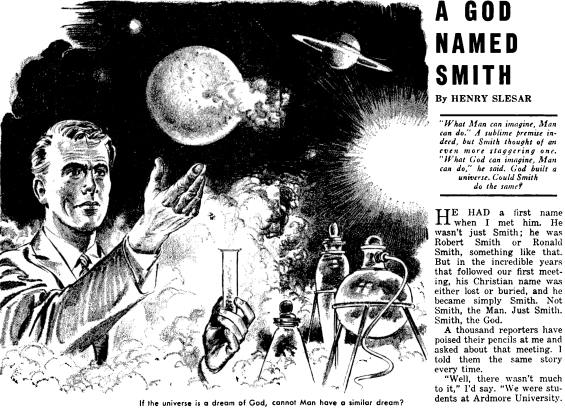
CBSRMT: A God Named Smith by Henry Slesar [RADIO DRAMA]

SFFaudio Online Audio

A God Named Smith by Henry Slesar

Henry Slesar was one of the most prolific scripters for the late-1970s early-1980s CBS Radio Mystery Theater. But before his career in radio drama Slesar was an author of Science Fiction. Like Alfred Bester, who also wrote for CBSRMT, Slesar was in the habit of recycling his earlier stories for the hour long anthology series (even though the show calimed to have such episodes written “especially for the Mystery Theater”). One such episode is A God Named Smith. It was first published in Amazing Stories, July 1957. And precisely 20 years later it was an episode of one of the last old time radio dramas.

CBS Radio Mystery TheaterCBSRMT #0658 – A God Named Smith
1 |MP3| – Approx. 44 Minutes [RADIO DRAMA]
Broadcaster: CBS
Broadcast: June 2, 1977
Source: CBSRMT.com
A young child prodigy creates an entire planet of his own, intending it to be a better world than earth. He finds volunteers to populate it, and establishes himself as a god.

Cast:
Russell Horton
Evie Juster
Robert Kaliban
Norman Rose

And here’s a |PDF| of the original story.

Posted by Jesse Willis

Review of 1634: The Baltic War by Eric Flint and David Weber

SFFaudio Review

Cover art for 16341634: The Baltic War
By Eric Flint and David Weber; Read by George Guidall
Publisher: Recorded Books
Publication Date: 17 September 2013
[UNABRIDGED] – 26 hours 20 minutes
Themes: / alternate history / time travel / military

1634: The Baltic War, although a weighty volume in its own right, is but one stitch in the giant tapestry that is Eric Flint’s sweeping Ring of Fire series. The series imagines the tumultuous Thirty Years War in seventeenth-century Europe disrupted by the arrival of a small West Virginia town sent back in time from the year 2000 by a freak cosmic accident. As masterfully told in the series opener 1632, the injection of modern technology and ideas into this bleak post-Reformation world has immediate and far-reaching consequences. The synopsis for 1634: The Baltic War illustrates just how much things have changed.

The Baltic War which began in the novel 1633 is still raging, and the time-lost Americans of Grantville – the West Virginia town hurled back into the seventeenth century by a mysterious cosmic accident – are caught in the middle of it.

Gustavus Adolphus, King of Sweden and Emperor of the United States of Europe, prepares a counter-attack on the combined forces of France, Spain, England, and Denmark – former enemies which have allied in the League of Ostend to destroy the threat to their power that the Americans represent – which are besieging the German city of Luebeck.

Elsewhere in war-torn Europe, several American plans are approaching fruition. Admiral Simpson of Grantville frantically races against time to finish the USE Navy’s ironclad ships – desperately needed to break the Ostender blockade of the Baltic ports. A commando unit sent by Mike Stearns to England prepares the rescue the Americans being held in the Tower of London.

In Amsterdam, Rebecca Stearns continues three-way negotiations with the Prince of Orange and the Spanish Cardinal-Infante who has conquered most of the Netherlands. And, in Copenhagen, the captured young USE naval officer Eddie Cantrell tries to persuade the King of Denmark to break with the Ostender alliance, all while pursuing a dangerous romantic involvement with one of the Danish princesses.

This overview gives a sense of the novel’s sweeping scope, both geographically and in terms of content. In some ways, this book and the series as a whole brings to mind Neal Stephenson’s ambitious Baroque Cycle, but while Stephenson’s work focuses on scientific and cultural developments Flint and Weber, at least in this volume, are telling a story of war. This isn’t to say that culture is absent from the chapters of 1634. Indeed, the novel draws both insight and humor from the juxtaposition of modern popular culture and European values. In one early scene, for example, a concert features classic Baroque harpsichord followed by a modernist piano concerto featuring music by Chopin and closing with twentieth-century Christmas songs. It’s also amusing to hear Europeans try and puzzle out exactly who this Elvis Presley character was.

While, as I said, 1634: The Baltic War is a military novel, and does feature occasional scenes of violence and hardship, overall its tone is light and even casual despite the depth and complexity of the book’s subject matter. While this renders the book almost instantly accessible, I can’t help but feel that at times the lack of gravitas fails to do justice to the enormity (in its original sense) of the Thirty Years War. To return to the previous comparison, Stephenson’s writing in the Baroque Cycle is much more opaque and, well, baroque, but the style seems to suit the subject matter. On the plus side, the story benefits from Eric Flint’s considerable experience in writing alternate history along with David Weber’s military background. Despite the world’s massive scope, every corner of it feels lived in and fleshed out.

George Guidall takes on the arduous task of bringing together seventeenth- and twentieth-century characters and cultures in this melting pot of a novel, and as usual Guidall is up to the challenge. From the brusk military clip of Admiral Simpson to the slight lilt of the larger-than-life Gustavus Adolphus, Guidall makes every element of the story from both past and present come alive.

Listeners who love military fiction, alternate history, or time travel can’t go wrong with 1634: The Baltic War, though to fully appreciate the novel they would do well to begin with the first installment in the Ring of Fire series, 1632. As perhaps is inevitable with a series of this magnitude, there are flaws and aspects that fail to please. But this book is only one chapter in what might just be Eric Flint’s magnum opus.

Posted by Seth Wilson

The SFFaudio Podcast #263 – AUDIOBOOK/READALONG: The Colour Out Of Space by H.P. Lovecraft

Podcast

The SFFaudio PodcastThe SFFaudio Podcast #263 – The Colour Out Of Space by H.P. Lovecraft, read by Donal Buckley. This is a complete and unabridged reading of the short story (68 minutes) followed by a discussion of it. Participants in the discussion include Jesse, Mirko, and Huan Vu (the director of the movie adaptation, Die Farbe).

Talked about on today’s show:
Arkham Insiders, Die Farbe (aka The Color), The Atlanta Radio Theatre Company adaptation, The H.P.L.H.S., Die Farbe gets a shout-out in the Dark Adventure Radio Theater adaptation, the novella/novelette, Amazing Stories, September 1927, science fiction and horror together, The Whisperer In Darkness, the framing story, American soldiers running away from the colour, unjustified punishment, cosmic horror, pre-WWII Germany, the symbology, the endings, mind control, zombie ants, parasites, the science of The Colour Out Of Space, The H.P. Lovecraft Literary Podcast, a pocket spectroscope, how do we see a new color?, discovering a new color, infra-red light, the blind and the colorblind, the black and white, film doing something an audio drama never could, a companion piece to The Whisperer In Darkness, the wasp, Formicula (aka Them!), an explanation for what the colour is, The Voice In The Night by William Hope Hodgson, anthropocentric aliens, an analogy, is The Colour Of Of Space SF?, alien flapjacks, spores, a sentient cloud of gas, “the Horla” (woops I mean the Horta), Star Trek‘s The Devil In The Dark, an alien (in much of SF is really about people), alien aliens, a corrective, John W. Campbell Who Goes There?, The Thing, whose who and whats what, it’s insidious, what will happen when you flood that valley?, Arkham Springs water, fear of radiation, a nuclear contamination story, “the blasted heat” is like Chernobyl, Macbeth, the meteor, dry ice, too creepy for night reading, Lovecraft’s opinion, The Willows by Algernon Blackwood, alien mind control, stealthy listening, the horror in the attic, The White People by Arthur Machen, the comic undercutting in The Dreams In The Witch-House, a mood study, Die Farbe is a wonderful adaptation of The Colour Out Of Space, the changes in the film version, the character names, Robert M. Price, a biblical reading of The Colour Out Of Space, He Am Himself, comets, reproduction, Monsters, cosmic bug spray, expanding your perspective, From Beyond, the running time, the chosen colour, Schindler’s List, you shouldn’t make evil that colour, taupe?, khaki?, a striking contrast, Sin City, color theory, signal colors, Ancient Greece, The Odyssey, “the wine dark sea”, “rosy fingered dawn”, what if my blue is your red?”, science over experience, dark matter/dark energy are placeholder words, science is mostly failure, “not optimistic at all”, if this happened in reality, the way out, The Dream Cycle Stories, going to The Dreamlands, Celephaïs by H.P. Lovecraft, To A Dreamer by H.P. Lovecraft, it’s not horror, The Dream-Quest For Unknown Kadath by H.P. Lovecraft, Lovecraft isn’t only horror, the IndieGoGo page for The Dream-Lands, The-Dreamlands.com, Die-Farbe.com, Gary Lovisi, the matchmaker.

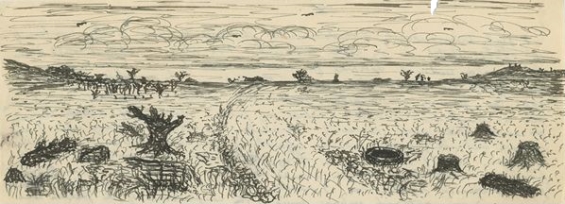
"blasted heath" illustrated by H.P.  Lovecraft in a letter to F.  Lee Baldwin March 27, 1934

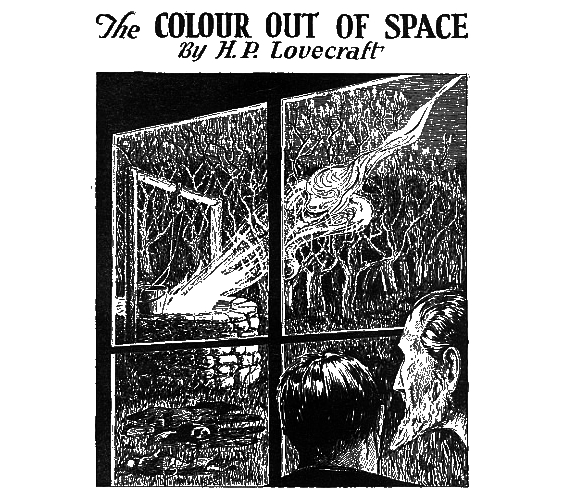
The Colour Out Of Space by H.P. Lovecraft

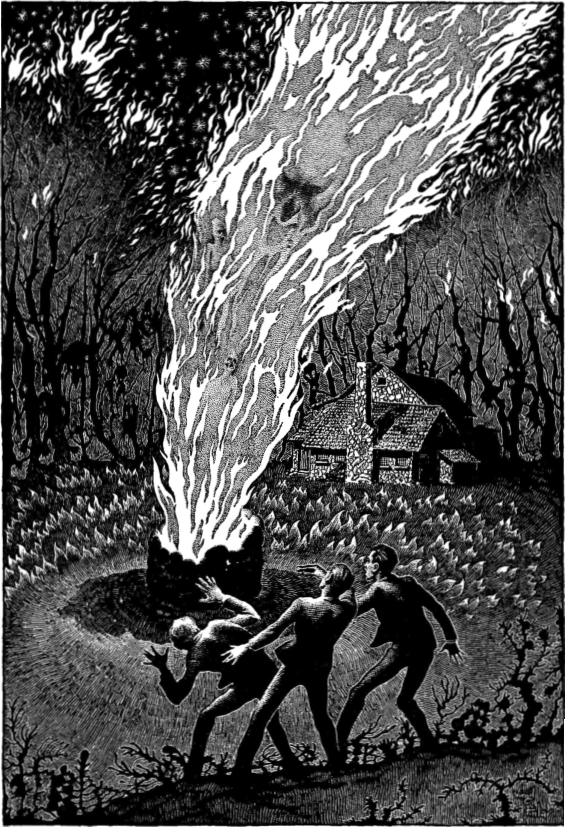
The Colour Out Of Space - illustration by Virgil Finlay

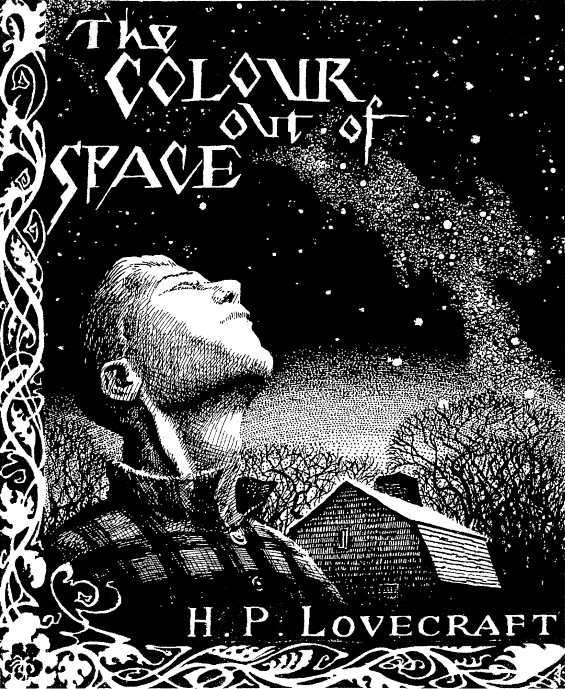
The Colour Out Of Space by H.P. Lovecraft

Die Farbe

The Colour Out Of Space - Illustrated by Jason Eckhart

Posted by Jesse Willis

Review of Seal Team 13 by Evan Currie

SFFaudio Review

SEAL team 13Seal Team 13
By Evan Currie, Read by Todd Haberkorn
Publisher: Brilliance Audio
Publication date: 15 November 2013
[UNABRIDGED] – 9 hours

Themes: / military sci-fi / Navy SEAL / supernatural / horror /

Publisher summary:

It’s been ten years since a mysterious, horrific incident in the South China Sea annihilated a US Navy destroyer and its Navy SEAL team. Only one man survived. Now, the US Navy is determined to put a stop to the new, frightening incidents taking place with alarming frequency. Enter SEAL Team 13, an elite group of soldiers led by sole survivor Harold “Hawk” Masters. Everyone on the team has survived contact with supernatural forces from “the other side.” Will their camaraderie and duty to country be enough to defeat the malevolent undead forces threatening the country? From world-building author Evan Currie, SEAL Team 13 is a dark, riveting, and action-packed tale of military intrigue and supernatural horror.

I hadn’t heard much about this one, but the description convinced me to give it a go. A military group is assembled to take on supernatural occurrences and with my experience with Myke Cole’s Shadow Ops series, which is really only similar in the fact that the military is involved, I thought I couldn’t miss.

Sadly, what started out as a fun romp with the military and monsters turned out to be a cliched and underwhelming frustration.

The Cliches

I don’t outright hate cliches. I think they can be used well and it’s an easy way to get people into the story or characters without having to waste time (i.e. pages) explaining things. The problem I had here was that once you make reference to “it’s like I’m in a movie” one too many times, it starts to pull you out of the immediate story. It’s no longer its own story, it’s someone else’s. And it just plain started to bug me since just about every character had to make mention of being in a bad horror movie.

And I was even impressed that the cliches weren’t so much in the monsters themselves. Obviously there were some monster cliches, but I liked the idea behind the vampires/zombies. Sadly it wasn’t enough.

Why I Was Underwhelmed

One of the big promises I felt that were made early on was that this team was collected to take on the supernatural occurrences in the world. Occurrences is plural right? So, I figured we would get more than one.

Okay, technically there are more than one because of the backstory of the characters, but the team itself only ever takes on one ridiculously long occurrence of the supernatural and that’s the end of this rather short book. Just a couple more would have made this so much better. Let’s see what else they can do. Are they really here for just the one event? It makes the whole idea behind supernatural threats seem much less … erm … threatening.

Longest Drawn Out Fight Scene Ever

This was the kicker. The last bit of the story has these guys throwing just about everything at the “boss” bad guy monster thing. They chase her through the building, then down the road, and it’s always just in the nick of time that she gets away/protagonist gets saved. And then it happens again … and again. I was so done with this scene. There’s tension and then there’s a time when you’ve built up the tension so much it breaks. When nothing has actually occurred in terms of resolution, I just can’t care anymore.

The Narrator

The narrator, Todd Haberkorn, did a good job. He definitely matched the cliches well and did solid work. I can’t say he was my favorite ever, but that may have been the lines he was given to work with as well. It’s hard to say.

Posted by Bryce L.

The SFFaudio Podcast #262 – NEW RELEASES/RECENT ARRIVALS

Podcast

The SFFaudio PodcastThe SFFaudio Podcast #262 – Jesse, Jenny, Tamahome, and Seth talk about NEW RELEASES and RECENT ARRIVALS.

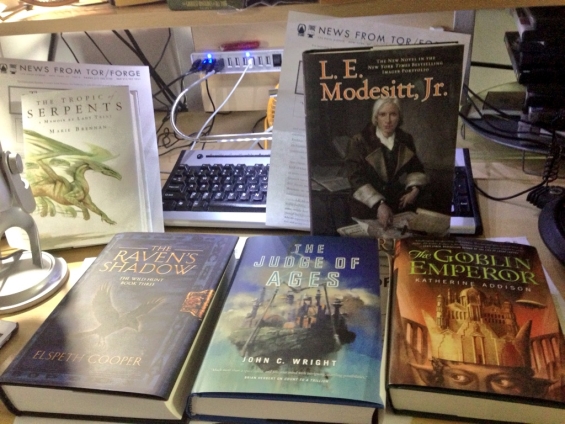
Talked about on today’s show: We help Jesse clear off his desk by discussing books in paper (dead trees and rags), “like e-books but thicker”; Tropic of Serpents by Marie Brennan, second in the Lady Trent series, gorgeously illustrated, Darwin meets dragons; why are illustrations dying out, even in e-books?; Scott Westerfeld’s Leviathan features good illustrations; The Raven’s Shadow, third in Elspeth Cooper’s Wild Hunt series; how many print pages in an hour of audio?; more from L.E. Modesitt Jr’s Imager series; John C. Wright’s The Judge of Ages, with allusions to Cordwainer Smith; The Goblin Emperor by Katherine Addison, smarter steampunk?; a tangent on translating page to screen; Tam likes more fantasy in his fantasy; a tangent on Game of Thrones; a tangent on Citizen Brick and the expiration of the LEGO patent; The Revolutions by Felix Gilman; science fiction was once planetary romance; The PrestigeBest Science Fiction and Fantasy of the Year vol. 8 edited by Jonathan Strahan, now published by Solaris, featuring a lot of great stories; and we finally reach audiobooks!; The Scottish Fairy Book, Volume 1; the timeless quality of folktales; Classics Lesson of the Day: Ovid’s a boy, Sappho’s a girl; Steles of the Sky by Elizabeth Bear; we try to puzzle out what a stele is; we praise Bear’s interview on Geek’s Guide to the Galaxy; Elizabeth Bear’s Hammered isn’t romance “because fifty-year-olds never have romance”; Without a Summer, third in Mary Robinette Kowal’s Glamourist Histories series, expertly narrated by the author; Dreamwalker by C.S. Friedman doesn’t seem to be your run-of-the-mill urban fantasy (suburban fantasy?); Indexing by Seanan McGuire, urban fantasy with a postmodern twist; mimetic incursion and Jorge Luis Borges’s Averroes’s SearchNight Broken by Patricia Briggs, eighth in her Mercy Thompson series; a tangent on midriff tattoos and names for tattoos on other parts of the body; Jenny has created a new genre, Scientific Near Future Thrillers!; in the future, iPods will be merged into our eyebrows; science and technology don’t evolve quite how we expect; Neil Gaiman discusses the influence of Ballard and other classic SF writers on the Coode Street PodcastSleep Donation by Karen Russell; Strange Bodies by Marcel Theroux; Boswell is Samuel Johnson’s biographer; Afterparty by Daryl Gregory is blowing up on Goodreads; pre- and post-apocalyptic fiction–no actual apocalypse this time; The End is Nigh, first in the Apocalypse Triptych edited by John Joseph Adams and Hugh Howey; the tech gremlins didn’t want us to discuss Dust, the third in Hugh Howey’s Silo series; Lagoon by Nnedi Okorafor; The Forever Watch by David Ramirez, Jesse thinks the protagonist has too many jobs; “pause resister”, WTF?; Dark Eden by Chris Beckett, already reviewed here at SFFaudio; we struggle to define Pentecostal; religious opposition to the film adaptation of Philip Pullman’s The Golden Compass; Hiroshi Sakurazaka’s The Edge of Tomorrow (originally entitled All You Need Is Kill), Groundhog Day meets Fullmetal Jacket, film adaptation features Tom Cruise; Red Planet Blues by Robert J. Sawyer, a hardboiled detective story on Mars; Noggin by John Corey Whaley; Decoded by Mai Jia; Desert of Souls by Howard Andrew Jones is a refresh of The Arabian Nights; Frank Herbert’s Direct Descent is about a library planet; novella is the best length for SF; Night Ride and Other Journeys by Charles Beaumont, a “writer’s writer” who wrote for The Twilight Zone; Christopher Moore’s The Serpent of Venice is an irreverent Shakespeare/Poe mashup.

Tor Books

Posted by Jesse Willis