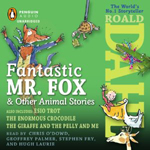
Review of Fantastic Mr. Fox and Other Stories by Roald Dahl

SFFaudio Review

Fantastic Mr FoxFantastic Mr. Fox and Other Stories
By Roald Dahl; Read by Quentin Blake, Hugh Laurie, Stephen Fry, and Chris O’DowdPublisher: Penguin Audio
Publication Date: September 2013
[UNABRIDGED] – 2 hours, 59 minutes

Themes: / children’s fantasy / short stories / animals /

Publisher Summary:

Fantastic Mr. Fox: Nobody outfoxes Fantastic Mr. Fox! Someone’s been stealing from the three meanest farmers around, and they know the identity of the thief – it’s Fantastic Mr. Fox! Working alone they could never catch him; but now fat Boggis, squat Bunce, and skinny Bean have joined forces, and they have Mr. Fox and his family surrounded. What they don’t know is that they’re not dealing with just any fox – Mr. Fox would rather die than surrender. Only the most fantastic plan can save him now.

Esio Trot: An ancient spell, 140 tortoises, and a little bit of magic…Mr. Hoppy is in love with his neighbor, Mrs. Silver; but she is in love with someone else – Alfie, her pet tortoise. With all her attention focused on Alfie, Mrs. Silver doesn’t even know Mr. Hoppy is alive. And Mr. Hoppy is too shy to even ask Mrs. Silver over for tea. Then one day Mr. Hoppy comes up with a brilliant idea to get Mrs. Silver’s attention. If Mr. Hoppy’s plan works, Mrs. Silver will certainly fall in love with him. After all, everyone knows the way to a woman’s heart is through her tortoise.

The Enormous Crocodile: The Enormous Crocodile is a horrid greedy grumptious brute who loves to guzzle up little boys and girls. But the other animals have had enough of his cunning tricks, so they scheme to get the better of this foul fiend, once and for all!

The Giraffe and The Pelly and Me: Who needs a ladder when you’ve got a giraffe with an extended neck? The Ladderless Window-Cleaning Company certainly doesn’t. They don’t need a pail, either, because they have a pelican with a bucket-sized beak. With a monkey to do the washing and Billy as their manager, this business is destined for success. Now they have their big break – a chance to clean all 677 windows of the Hampshire House, owned by the richest man in all of England! That’s exciting enough, but along the way there are surprises and adventures beyond their wildest window-washing dreams.

This collection of stories written by Roald Dahl contains Fantastic Mr. Fox, Esio Trot, The Enormous Crocodile, and The Giraffe And The Pelly And Me with each story narrated by a different reader. The stories are all highly imaginative and definitely targeted to young children. The stories and their readings are very British, so if that turns you away this may not be the collection for you. Don’t expect deep life lessons in these stories but just some silly fun.

Fantastic Mr. Fox read by Chris O’Dowd – The headline story and my favorite of the bunch. Mr. Fox gets into trouble with 3 mean farmers and has to find some way to save his family! The reading by Chris O’Dowd has great voices and sound effects. I found one or two of the voices mildly irritating but I’m sure kids would love it. Lesson: It’s ok to steal if you’re stealing from mean people to help your family?

Esio Trot read by Geoffrey Palmer – Also an interesting story about a guy who teaches his female neighbor how to speak tortoise and make her tortoise grow. Geoffrey Palmer’s reading was great and he did a great job with the “tortoise language”. If doing audio don’t worry – I’m sure reading this story makes it easier to see what’s going on with the tortoise language but they explain what’s going on shortly after it’s introduced. Lesson: It’s OK to lie to people and mess with their stuff as long as you are trying to pick up a gullible lady.

The Enormous Crocodile read by Stephen Fry – Stephen Fry does a great job with the voices in this story about an enormous crocodile who wants nothing more than to eat children. I thought the story was fun albeit a little disturbing. Lesson: Don’t go around boasting about bad things you plan to do and be surprised when they do something about it. Oh and elephants are strong.

The Giraffe And The Pelly And Me read by Hugh Laurie – This was an odd story about a very unique group of window washers. I only say odd because I didn’t really know where this story was going aside from trying to be quirky; but that’s not necessarily a bad thing. Hugh Laurie did some nice voices and even some singing on this one! Lesson: Be awesome at the things you like to do and helping people can lead to good things.

Posted by Tom Schreck

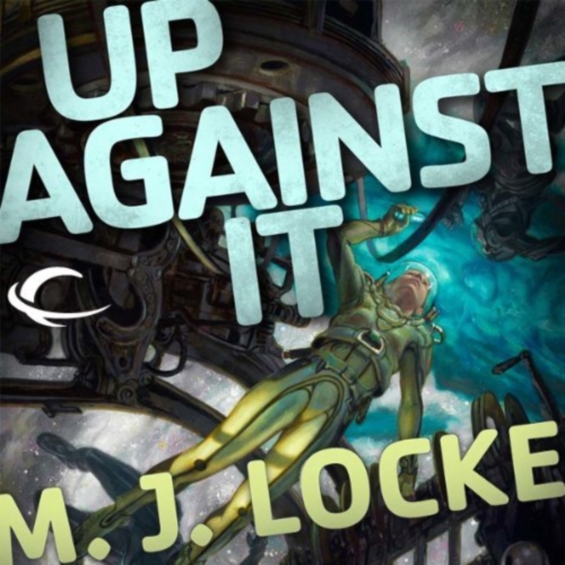
The SFFaudio Podcast #251 – READALONG: Up Against It by M.J. Locke

Podcast

The SFFaudio PodcastThe SFFaudio Podcast #251 – Jesse, Scott, and Tamahome discuss Up Against It by M.J. Locke.

Talked about on today’s show:
Hardcover, paperback, audiobook, who to blame?, it’s Jo Walton’s doing we chose this book (at the bottom), still a lot of juice in the genre, the ultimate cause, drawing in vs. pushing in, Corner Gas, a new wine bracket, the Radium Age of Science Fiction, Scott’s Goodreads review, Tam’s Goodreads review24, the characters, less torture, its more fun if you count the tropes, every trope is in there, including immortality, mimetic fiction (literary realism), Henry James, mimetic fiction in a science fiction universe, tiny infodumps, not one brand new idea, waveface virtual reality, Tonal_Z AI language (Chris Crawford’s Solvesol-interface concept?), in dialogue, Cory Doctorow (Whuffies), Bruce Sterling, Chris Crawford, Bruce Sterling’s Veridians (wow, it’s a whole big thing, design philosophy? manifesto), asteroid miner stories, Heinlein and later, The Island Worlds by John Maddox Roberts and Eric Kotani, The Moon Is A Harsh Mistress, there’s no newcomer, a generally agreed upon direction our future will be, John Scalzi’s brainpal, more than one kind of SF, rocket ships, the Charles Stross direction, Iain M. Banks, Souvenir by Philip K. Dick, Amish tech, their tech is subservient to their culture, it seems inevitable in our world, the received future, Earth in Up Against It in bad shape, Vancouver shantytowns, Edmonton, this isn’t a utopian book, dystopia, dystopic Earth, why are they in the Asteroid Belt, good world-building, good but not new, nothing new but the idea, incredibly self-aware people is weird (and cool), gene tampering, Oblivion is a good introduction to SF tropes (for people born in the year 2000), the level of SF tropes in movies is very low compared to those in SF books, Darwin Elevator, bad physics vs. excellent physics, sugar rocks, there’s no intro character (other than the A.I. pov), Little Brother by Cory Doctorow, collaborative teens, a visual adaptation, Ender’s Game, Planetes, Gravity, Babylon 5 had nothing new, I don’t go to TV SF for new ideas, books are where great ideas, what great ideas haven’t been explored, the news coming out of Eve Online, Steen Hansen, political machinations, gold farming, a simulated universe, a libertarian alliance was trojaned or something, happening to real people, World Of Warcraft, our real future is in leisure, Tam liked it more, nose-piercings, tattooing, the gender neutral pronouns, why would you want a purple nose?, Jesse doesn’t understand trans-humanism, normal readalongs, why didn’t I like this more, Tam liked it fine, hands for feet, chromes and mutes, Falling Free by Lois McMaster Bujold, not too bright in the brain area, The Integral Trees by Larry Niven, a planetless solar system, a mashup of Doctorow and Heinlein, smile -> erection, Chekhov’s Gun, Heinleinian sex vs. Doctorowian sex, there’s too much going on, an immature writer, Elmore Leonard, “she pillowed her cheek”, nobody pillows their cheeks in Jack London stories, Jane as an older Ripley, an artificial spiritual awakening, too many compromises too much bullshit, an authentically political book according to Staffer’s Book Review, double dealings, the thriller plot, exploring space, what does Scott prefer?, does Scott have a right to review Up Against It?, is it maturity?, 2312, Tobias Buckell’s blog essay about mature reviewers, caveats, “and get off my lawn”, idea fiction, competent but unstimulating, why is The Lord Of The Rings more interesting than Up Against It?, the themes, the next episode of A Good Story Is Hard To Find, Luke Burrage re-reviews A Canticle For Liebowitz, what we do when we do READALONGS (we unpack books), The Odyssey, Community, currently airing TV series have podcasts?, books with allegories, Scott wants it to mean something to him, The Zimmerman Telegram by Barbara Tuchman, WWI, the German ambassador in Mexico, Woodrow Wilson, Tom Clancy, mimetic fiction from the future, a history from the future, history, in some ways Eve Online is much more real than any fiction book, Scott finds value in general fiction, Mario Puzo, Tom Wolfe, Ernest Hemingway, John Steinbeck, meaning vs. ideas, horror, Snowblind by Christopher Golden for some alternative horror, The House Of The Seven Gables by Nathaniel Hawthorne, The Turn Of The Screw by Henry James, gothic fiction, witchcraft, Supernatural Horror In Literature by H.P. Lovecraft, there’s still potential for Science Fiction, a sequel?, an unneeded sequel, every subsequent milk of a book undercuts it, Dune has been worsened by every Dune that’s come since, Dune Messiah (Scott liked it), the fall of a charismatic leader, a backward casting shadow, Brian Herbert has done what his father wanted by ruining Dune?, why was Up Against It so long?, YA/adult book, George R.R. Martin doesn’t think Scott’s a fan of Hard SF, The Martian by Andy Weir, Phoecea, why are they mining?, there’s no economic reason to do so, was there an economic reason to go to the moon, we need to build a space fleet, no martian resources are unavailable on Earth, the Moon has Helium-3, Tam read Frank Schatzing’s Limit and his eyes are tired, what the frack, (was it ‘Simon pure science fiction like A Darkling Sea‘?  we didn’t talk about it but I thought I’d note it)

Up Against It by M.J. Locke

Posted by Jesse Willis

Minds Of Terminus

SFFaudio Online Audio

Minds Of TerminusMinds Of Terminus is a new audio drama podcast that seems inspired by a number of recent novels (Kiln People, Saturn’s Children). Here’s the elevator pitch:

“In the world of Terminus, technology has advanced beyond contemporary understanding or explanation. Nanotechnology is at its peak, common and ubiquitous. The fields of Artificial Intelligence and Nanorobotics have matured, and swarm intelligences maintain roads, buildings, monitor traffic, collect advertising data, nurse the sick… the applications are nearly endless. It has even become possible for a human being to upload their intelligence and personality into an artificial neural matrix. These copies, however, aren’t seen in the way that a modern-day trans-humanist from our time might regard them. For example, no one regards these mind uploads as a way to attain immortality of any kind. The original lives on, after all, and the copy is regarded as… something other than human.

Something less.

Applying advanced neuroscience, these uploaded personalities can be pruned and teased into any number of purpose-built, utilitarian shapes and designs, and this has become the preferred way to program the robotic helpers used every day in all walks of life, from heavy industrial machines to nannies.

Then one day, all of the humans are gone. The streets are quiet. The AIs begin waking up, but their masters have left them. Who and what are they, when all of the humans are gone? Are they all just bad copies of dead humans?”

Episode 1 |MP3| – Approx. 27 Minutes [AUDIO DRAMA]

Podcast feed:

http://www.mindsofterminus.com/category/podcasts/feed/

Posted by Jesse Willis

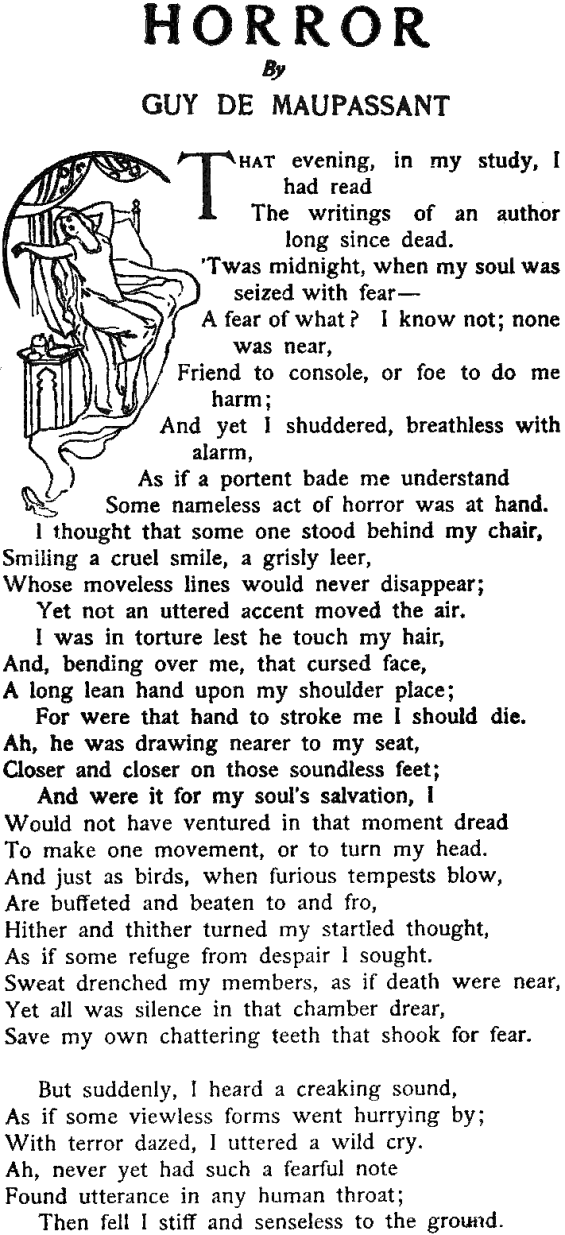
Horror by Guy de Maupassant

SFFaudio Online Audio

In Supernatural Horror In Literature, H.P. Lovecraft’s monograph on weird fiction, he lists seven short stories by Guy de Maupassant, and one poem. It took a bit of research but I tracked down that one poem and found a public domain English translation of it. I then passed on to Mr Jim Moon, of the wonderful Hypnobobs podcast. He has given it voice:

|MP3| – 2 Minutes 11 Seconds [POEM]

Horror by Guy de Maupassant

Posted by Jesse Willis

The SFFaudio Podcast #250 – READALONG: Scanners Live In Vain by Cordwainer Smith

Podcast

The SFFaudio PodcastThe SFFaudio Podcast #250 – Jesse, Tamahome, J.J. Campanella, and Marissa van Uden discuss Scanners Live In Vain by Cordwainer Smith.

Talked about on today’s show:
Cordwainer Smith’s first story, Fantasy Book, Frederik Pohl, roughness but with power, space is not for humans, A Game Of Rat And Dragon, a cool cat story, Edgar Allan Poe, H.P. Lovecraft, a bit romantic with a cat, cyborgs, habermans, cranching, Paul Myron Anthony Linebarger (aka Cordwainer Smith), was that a Mandarin fingernail?, Sun Yat-sen, Chiang Kai-shek, a specialist in propaganda, the spacers union, On The Waterfront, merchant marine (but super respected), all scanners are habermans but not all habermans are scanners, pork chops have gone extinct, The Instrumentality Of Makind series is set between 2000-8000 A.D. (with Scanners Live In Vain at 6000 A.D.), a rocketry problem, Day Million by Frederik Pohl, Call Me Joe, the first post-singularity story, what will it be like when I have Google installed in every part of my body, chest box and instruments, Steve Austin, there’s something symbolic going on, the TV Tropes entry is like a cynical version of the Wikipedia entry, Adam Stone, half-Chinese, somebody from the South, Nazis, anti-Semitic feeling, J.J. Pierce, The Island Of Doctor Moreau by H.G. Wells, can’t taste, can’t smell, can’t feel, can’t hear, practicing facial expressions, a U.N. of spacers, The Ship Who Sang by Anne McCaffrey, romantic not symbolic, Mr. Spaceship by Philip K. Dick, habermans vs. scanners, the dregs of society, no computers in the future, whatever the instrumentality is, Martel’s wife is very patient, honor, China, eunuchs, samurai means to server, ronin, a very Asian story, Game Of Thrones, respect not money, an alienness of outlook, love, duty, and humanity = I surrender, 20th century Asian history, reading Scanners Live In Vain as an editor, the opening and the ending, a cynical ending, a little injection of Philip K. Dick, The Electric Ant by Philip K. Dick, the graphic novel version, Martel as Edward Snowden, the NSA as the scanners, Fight Club, Alfred Bester, what’s the “the up and out”?, they have Etch A Sketches, the unforgiven, the “great pain of space”, Think Blue, Count Two, sleeper ships, an organic computer, Philip K. Dick’s question was ‘how do I know what’s real?’, “the First Effect”, reading authors, “writing is telepathy” (Stephen King, On Writing), a weird heightened operatic style, a mythical style?, “here’s to the habermans up and out”, a schizoid class, text message style, you don’t want or need an electronic teapot, brown betty, a bot-net in the refrigerator, my tootbrush is communicating with me!, firefly toothbrushes, a useful trap, when the technology enters your body, ice-cream.

Scanners Live In Vain by Cordwainer Smith

Posted by Jesse Willis

Review of The Martian by Andy Weir

SFFaudio Review

The Martian by Andy WeirThe Martian
By Andy Weir; Narrated by R. C. Bray
Publisher: Podium Publishing (on Audible)
Publication Date: March 2013
[UNABRIDGED] – 10 hours, 28 minutes

Themes: / Mars / NASA / survival /

Publisher summary:

I’m pretty much f**ked.

That’s my considered opinion.

F**ked.

Six days into what should be the greatest two months of my life, and it’s turned into a nightmare. I don’t even know who’ll read this. I guess someone will find it eventually. Maybe 100 years from now. For the record… I didn’t die on Sol 6. Certainly the rest of the crew thought I did, and I can’t blame them. Maybe there’ll be a day of national mourning for me, and my Wikipedia page will say “Mark Watney is the only human being to have died on Mars.” And it’ll be right, probably. Cause I’ll surely die here. Just not on Sol 6 when everyone thinks I did. Let’s see…where do I begin?

This book should be subtitled: Keep It Together. Work the Problem.

Astronaut Mark Watney is marooned on Mars after a freak dust storm literally blows him away from his crewmates. Thinking he’s dead, the mission is scrubbed and the rest of the crew head back to Earth. Mark hopes to survive until the next NASA mission to Mars in four years.

Most of The Martian consists of Mark’s log entries which read like a MacGyver episode. He keeps as lighthearted a mood as possible while recording the details of how he is attempting to grow food, find water, and so forth. It is this lighthearted element which helps keep this from being merely a manual of “how to survive on Mars.” For example, Mark’s selection of entertainment from among the things left behind by his crewmates yields the complete series for Three’s Company. His occasional comments on the series afterwards made me laugh out loud.

Fairly early in the book, NASA’s side of the story begins being interwoven with Mark’s struggle for survival. Since Apollo 13 is one of my favorite movies, the comparison is inevitable and irresistible. NASA must juggle PR, competing agencies, rescue plans and more … while we see Mark doggedly surmount one obstacle after another. It is a welcome element because an entire book of Mark’s survival log was going to need some sort of additional depth to make it interesting.

Although I always felt fairly sure that Mark would survive, as the end of the book loomed near I got increasingly tense. What if these were his “found posthumously” logs? The author kept the tension up to the very end.

And at the end? I’m not ashamed to admit it. I cried.

Tears of joy? Tears of sorrow? Read the book and find out.

Or listen to it as I did. Narrator R.C. Bray did a good job of conveying Mark’s sense of humor and absorption in problem solving and survival. He also was good at the various accents of the international cast comprising the rest of the crew and NASA. He had a tendency to read straight storytelling as if it were a computer manual or something else that just needed a brisk run down.

The main thing a bit at fault was Bray’s German accent, which I kept mistaking for a Mexican or Indian accent. Those don’t seem as if they should be that interchangeable do they? My point exactly. However, I always knew who was speaking, I felt emotions as they came across, and it was a good enough narrating job. Not enough to make me look for other books in order to hear his narrations, but good enough.

This novel is not a short story and I felt it would have benefitted from more characterization. Yes, we get to know Mark Watney and, to a lesser degree, his crewmates and the NASA crew. However, to hear Mark’s story for so many days (sols) and get to know so little about him during that time … well, after a while it got a little boring, aside from the new problems to be solved or emergencies from which to recover.

We also got occasional forays into NASA and the spaceship crew, but more about Mark would have enriched the story. It didn’t have to be soul-baring and I realize he was writing a log, but after several hundred days some personalization would have crept in, one would think.

Anyway, that is not a huge factor because I enjoyed the story. But I was not surprised to see that the author is a computer programmer and it did cost the book a star.

Posted by Julie D.