Review of Vision of the Future by Timothy Zahn

SFFaudio Review

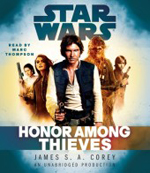
Vision of the Future Star WarsVision of the Future: Star Wars (The Hand of Thrawn Book II)
By Timothy Zahn; Narrated by Marc Thompson
Publisher: Random House Audio
Publication Date: December 2013
[UNABRIDGED] – 26 hours, 22 minutes

Listen to an excerpt: | MP3 |

Themes:  / Star Wars / New Republic / Thrawn /

Publisher summary:

The Empire’s master plan is under way. The New Republic is on the verge of civil war and the rumor that the legendary Admiral Thrawn has returned from the dead is rallying the Imperial forces. Now Luke Skywalker, Han Solo, Princess Leia, and their allies face the challenge of their lives. They must infiltrate a hidden fortress filled with Imperial fanatics, rendezvous with a double-dealing Imperial commander, and journey into enemy territory to learn the identity of those responsible for an act of unthinkable genocide. But most important of all is the truth about Thrawn.

Vision of the Future is 2nd book of The Hand of Thrawn duology. Zahn always does a great job with Star Wars and does not disappoint here. Is the New Republic going to enter a civil war over the atrocities some Bothans helped commit? How is the New Republic going to react to these rumors that Grand Admiral Thrawn is back from the dead? Will Luke manage to save Mara and discover the secrets behind these strange craft being spotted? What or who is The Hand of Thrawn?

So many questions to answer and it’s no surprise that this book is kind of long for a Star Wars book. The book keeps up a steady pace and does manage to resolve all the different threads and plot points introduced in Specter of the Past. There are many different threads at work in this book but Zahn manages to juggle them well. At one point I got the feeling that more than half of the threads involved characters trying to recover a copy of the Caamas document in their own ways which felt like a lot. At least they were all good reasons to have some crazy adventures.

All in all I’d say that you can’t go wrong with a Zahn Star Wars book but I would definitely start with his Thrawn trilogy (starting with Heir to the Empire) or Allegiance.

Marc Thompson does a great job with impressions of all our favorite characters and the special effects are great too. There was some great use of music during more sensitive moments that helped bring them to a nice crescendo. The pirate’s voice sounded just like ones you’d find in the Caribbean – which was interesting, and the Caamas apparently have an island accent. There were a few times I found the sound effects a bit distracting but overall they are awesome.

Posted by Tom Schreck

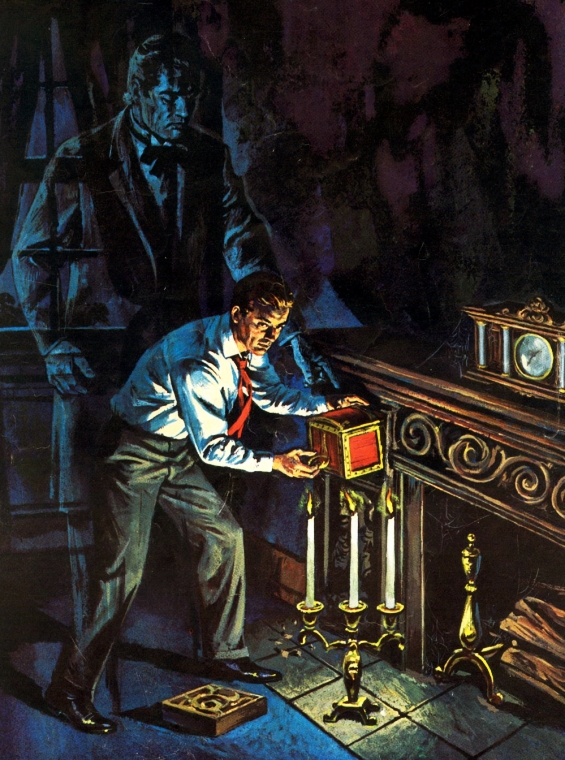
Suspense: Dunwich Horror

SFFaudio Online Audio

The Dunwich Horror - illustration by Hugh Rankin

SuspenseSuspense – Dunwich Horror
Adapted from the story by H.P. Lovecraft; Adapted by William Spier; Performed by a full cast
1 |MP3| – Approx. 26 Minutes [RADIO DRAMA]
Broadcaster: CBS Radio
Broadcast: November 1, 1945
Provider: Archive.org
On All-Hallows Eve Henry Armitage, the librarian of Miskatonic University, ascends the summit of Centennal Hill. First published in Weird Tales, April 1929.

Stars: Ronald Colman, William Johnstone, Joseph Kearns, and Elliott Lewis.

Posted by Jesse Willis

Review of The Gods Themselves by Isaac Asimov

SFFaudio Review

asimovThe Gods Themselves
By Isaac Asimov, read by Scott Brick
Publisher: Random House Audio
Publication Date: January 2014
[UNABRIDGED] – 11 hours, 26 minutes

Listen to an excerpt: | MP3 |

Themes: / aliens / electron pump / cosmic egg / multiple universe theory / sex in space /

Publisher summary:

Only a few know the terrifying truth – an outcast Earth scientist, a rebellious alien inhabitant of a dying planet, a lunar-born human intuitionist who senses the imminent annihilation of the Sun… They know the truth – but who will listen? They have foreseen the cost of abundant energy – but who will believe?These few beings, human and alien, hold the key to the Earth’s survival.

– Disclaimer –
I’m no physicist. This book, in parts, kind of torqued my noggin.

Isaac Asimov’s The Gods Themselves won the 1972 Nebula then the 1973 Hugo. The premise? Pretty straight forward. Will we destroy the universe?

I like this book. The first 2/3 kept me running. The last 1/3, I slowed to a stroll and enjoyed the pace change. The time spent with the aliens was intriguing, both in the differences and similarities to humanity. Asimov packs a punch, tackling the question of energy versus environmental cost. In some ways it’s comforting imagining that even in the future, we humans still salivate over a dangled free lunch. The characters in the other universe are stunning. I could have read twice the content volume on that environment alone. When I reached the lunar colony, it took some time to cultivate an interest in the people and their situation. By the time I was interested, it was ending. This left me feeling off-kilter and only slightly irritated. Don’t ask me to explain, but I found the chocolate bar with almonds scene very touching.

Scott Brick narrates this release. Early on, I didn’t know if I could handle listing to Brick’s performance. He has a nice voice, but he has a habit of injecting unneeded drama into almost anything he reads. Fortunately, within the first twenty minutes, I found Brick’s style quite suited to the content. After finishing and reflecting, I think Brick was the right choice for narrator.

Posted by Casey Hampton.

The SFFaudio Podcast #249 – AUDIOBOOK: Scanners Live In Vain by Cordwainer Smith

Podcast

The SFFaudio PodcastThe SFFaudio Podcast #249 – Scanners Live In Vain by Cordwainer Smith, read by J.J. Campanella.

First published in Fantasy Book, #6 in 1950. Scanners Live In Vain has been anthologized in such collections as The Science Fiction Hall of Fame, Volume I, Science Fiction 101 (aka Robert Silverberg’s Worlds Of Wonder), and The Great SF Stories 12 (1950).

This UNABRIDGED AUDIOBOOK runs (1 Hour 35 Minutes). We will discuss it in SFFaudio Podcast #250.

Scanners Live In Vain by Cordwainer Smith

Posted by Jesse Willis

Review of Jack London: An American Life by Earle Labor

SFFaudio Review

Cover for Jack London: An American Life by Earle LaborJack London: An American Life
By Earle Labor; Read by Michael Prichard
16 hours 50 minutes [UNABRIDGED]
Publisher: Tantor Media
Published: 2013
Themes: / biography / writing / politics / literature

As Earle Labor notes in his preface to this comprehensive biography, Jack London is a man who, nearly a century after his death, still looms large in the American imagination. Labor seeks to illuminate, or in some cases even dispel, some of the myths surrounding this literary genius (e.g. London was an alcoholic, London was a badass, London committed suicide). Labor also sets himself the task of reconciling London the rugged individualist with London the ardent socialist. With these lofty aims set forth, Jack London: An American Life might have become a programmatic attack, or defense, of London’s life and work. But this book is biography at its best: rich in its description and reliant on primary sources whenever possible not only to dole out facts but to lend an air of local color. The subtitle An American Life is thus appropriate, since the reader is treated to a glimpse into not just the life of Jack London, but into the America (parts of it, at any rate) of the late nineteenth and early twentieth centuries.

Unlike some modern biographies that attempt literary flourishes by beginning in medias res and then backtracking, or otherwise play with chronology or other tropes to heighten the narrative power, Labor’s work doesn’t pull any punches. It is a biography from start to finish, and only delves beyond London’s birth in an effort to shed some light on his less-than-Rockwellian parentage and upbringing. The biography then marches chronologically right up until the days of London’s final illness and death–which at only age 40 came much too soon. While at points this made for tedious reading–I felt I was stuck in the South Sea doldrums right along with London and crew–it left me with a sense of completion lacking in shorter or less thorough biographies. I really feel like I know London’s story from cradle to grave. Though not written for a scholarly audience by any means, the tight focus on London’s immediate life and surrounding does mean the reader should have some knowledge of turn-of-the-century world events. Labor does not deviate from the story, for example, to explain the origins of the Russo-Japanese War or the Mexican Revolution, which both figure into London’s life as a reporter.

This work might just as easily have been subtitled “American Lives”, since Jack London was not only a journalist but also an oyster pirate, a gold miner, a hobo, a convict, a captain, and a rancher, not to mention world-class writer. And Jack London is a prime specimen of the adage “write what you know.” After his time as a gold miner in the Great White North, he cranked out Klondike stories; after his stint reporting boxing matches, he tried his hand at writing a story about a prize match; and during his cruise in the Pacific, he wrote moving pieces about Hawaii and the South Sea, most notably Ko’olau the Leper. As a reader fascinated with wordcraft and the writing process, I found Labor’s observations on London’s writing life particularly insightful. Sadly (for me, at any rate), any sort of deeper criticism (in the scholarly sense of the word) of London’s writings or their far-reaching influence is beyond the scope of this biography. We do not learn whether Ernest Hemingway read London’s anti-bullfighting story The Madness of John Harned, for instance, nor do we discover whether his socialist writings had any impact during the Red Scare not long after his death. The lack of these literary insights isn’t so much a problem with the book as it is a casualty of its tight biographical focus. Most casual readers who don’t go in for literary trivia will probably actually be grateful for its absence.

What makes Jack London: An American Life such a joy to read is its frequent inclusion of source material, much of it written either by London himself or by his precocious and stalwart second wife Charmian. Labor weaves these glittering strands into the narrative’s tapestry so seamlessly that, at least to the audiobook listener, it’s occasionally difficult to ascertain where London’s words leave off and Labor’s prose picks up again. This is partly due to Labor’s own skill as a writer in his own right, and perhaps some of the literary prowess of his subject rubbed off on him as well. The strength of the biography’s prose easily buoys the text along through the book’s occasional slow spot. Michael Prichard’s narration complements the text well, and his accentuation and intonation of quoted text helps mitigate the aforementioned problem of distinguishing quoted material from Labor’s own pen. The few “mistakes” I noticed in the narration are more a matter of usage or stylistic debate than actual shortcomings. Overall, the audio presentation never detracted from, and in some ways added to, the power of the written work.

As I hinted earlier, the only real problem with Jack London: An American Life is that there isn’t enough of it. Earle Labor, curator of the Jack London Museum in Shreveport, Louisiana, clearly has a lot to say about London, and in fact has written other works about the literary giant. As with any great biography, this book is a springboard inviting readers to further exploration, which in this case means, above all, reading Jack London’s own work. Through his own powerful words, and through the able stewardship of scholars like Labor, Jack London continues to blaze a literary trail almost a hundred years after his passing.

An NPR piece on this new biography features not only snippets of an interview with Earle Labor, but also a wax cylinder recording of Jack London himself.

Posted by Seth Wilson

Protecting Project Pulp: In Destiny’s Clutch by Rafael Sabatini

SFFaudio Online Audio

In Destiny's Clutch by Rafael Sabatini

Protecting Project PulpProtecting Project Pulp No. 76 – In Destiny’s Clutch
By Rafael Sabatini; Read by Samuel Campbell
1 |MP3| – Approx. 44 Minutes [UNABRIDGED]
Podcaster: Protecting Project Pulp
Podcast: January 20, 2014
“Ordinarily Dragut-Reis—who was dubbed by the Faithful ‘The Drawn Sword of Islam’—loved Christians as the fox loves geese.” First published in Top-Notch Magazine, May 21, 1915.

Posted by Jesse Willis