Review of A New Beginning by Craig Brummer

SFFaudio Review

A New BeginningA New Beginning
By Craig Brummer; Narrated by Jack Nolan
Publisher: C&S Press
Publication Date: August 2013
[UNABRIDGED] – 7 hours, 32 minutes

Themes: / slavery / space / bureaucracy / mega-corporations / politics /

Publisher summary:

A New Beginning is the story of a young woman who is ordered by the courts of Earth to serve as an indentured slave to the corporation that held her college debt. Life as a slave brings her to the brink of suicide and an attempt to kill her tormentor. She is sold to Spacers, who are themselves rebelling against the corrupt control of Earth’s mega-corporations. In space she finds a chance at a new life, a chance to maybe help her sister avoid the same fate, but only if Spacers succeed in gaining their freedom. The course of her life will be determined by the outcome of politics far outside of her control… but she has a chance, however slim, to save her sister and start a new life herself.

In some way, this was a really odd book for me to read. The main character is named Kristin. She works on a space ship as a systems engineer. I work on satellites as a systems engineer. And, honestly, her description is really similar to mine when I was in my early 20’s. So it was seriously trippy to read this at times.

A New Beginning is set in the near future, a future where space travel is common place, as is living in space aboard ships or other space stations. On Earth, it’s a rather bleaker picture of the world today. Corporations have taken over the world, bought out most of the politicians. It’s a society, world-wide, where the class gap is as wide is it can be and only those born into or who marry into privilege have assurance of a “normal” life. The rest are sold into indentured service to pay of their debts, whatever they are; for main character Kristin, this is the price of her college education. It’s also a future where faster-than-light travel has been made possible, but communication–visual and audio (in the form of communiques between spacecraft)–is limited to light speed. I’m not quite sure how that is possible, to be honest, but it sets up some interesting potential so I decided not to worry about it.

As the story starts, a newly formed “Federation,” comprised of those living and working on the ships and stations, those without ties to Earth, decide to break ties with Earth and form their own…well, federation. Think of it like Star Trek. Where once they were tied to Earth, they now consider themselves independent entities, willing and happy to trade with Earth, but not bound by any of their laws–or taxes. This has important ramifications for Kristin Hayes, whose indentured service was just sold from an Earth corporation to a ship in the Federation. She left behind a life of debt and slavery (including sexual slavery) on Earth and, upon joining the ship, was freed. The Federation, her ship The Valiant Lad, bought her indenture contract (along with that of others) and gave her the option to return to Earth as a free woman or to join the Federation, join the ship’s crew. Kristin decided to join the ship’s crew and for the first time in her life, have a real job, earn real wages, and be allowed to be a “normal” person.

Kristin’s story comprises most of the book. There are two story lines (that are sort of broken into 3 in places), one of the Federation officers who are actually coordinating the secession from Earth, and Kristin’s story line, telling of her life, both on and off the ship. Kristin’s story is about 2/3 of this book, though I suspect that this is the first in a series and provides decent setup for the rest of the series. Kristin acclimates to life on the ship slowly, but without much adversity. If anything, it seems that everything is just too easy. She finds friends, support, a job she can do…which is interesting, given the description of how the space-ers grow up and are educated compared with how Earth-ers are raised. Growing up in space seems a lot more intense, it seems that anybody from Earth would be at a significant disadvantage. When the Federation makes new laws, allowing families to be on ships and for crew to “fraternize,” she enters into a relationship with a crew mate fairly easily, despite her emotional scars. Kristin decides that she should use this opportunity to earn money (and save it) so that she can get her sister and her father off Earth, to help them avoid the troubles she had. One way she earns money is by selling her journal as a book; the journal she wrote of what her life was like on Earth as a child and then as an indentured servant for one of the corporations. It became an overnight success (almost literally) and made her into a celebrity. As I said, the only “trouble” I really had with this part of the book is how easy everything was. Kristin had a few small stumbling blocks to overcome, but the narrative made it sound like they were easily triumphed over, so overall she didn’t face much adversity.

Similarly, the second story line–comprising a third or less of the book–seemed….easy. The main thrust is told from two viewpoints, one of the ship captain (Marshall?) who announced the secession, and one of another ship captain (Matthews? A woman, in either event, which was nice) who oversaw some of the battles between the Earth ships and the Federation ships. This is where I think the book truly had a miss. It was odd enough that it was all too easy–the battles were short, sweet, and rarely with any Federation losses–but there was an opportunity for Brummer to capitalize on some interesting tactics, an opportunity lost in this book. As I mentioned earlier in the review, technology has evolved to a point where faster-than-light travel is possible (and used) but faster-than-light communication is not. This means that when battling on a large scale, your information is only as good as your distance (in light years/hours) from the source. This was touched on briefly in Kristin’s narrative. One of her co-workers mentioned that for spare money, he makes games to teach kids about battle tactics and the math used in FTL travel and war. He mentioned that all kids who grow up in space have to learn this, and have to use it…but then, nobody did. In all of the battles, it seemed like the information at hand was “good enough” and that the Federation mostly won without issue. While the battle scenes were mercifully short (nothing drives me up a wall than too much detail on weaponry or super-detailed tactics), they were almost too dry. It seemed, once again, too easy.

Some of the issues with the battle scenes might have been owed to the narration. The narration, while mostly fine, was just that, fine. Nolan didn’t add much excitement or change in tone for any of the scenes. He didn’t use different voices for the characters (except maybe some of the characters on the primary Federation ship–the Freedom?–they sounded like they were lifted from the scenes in Star Trek). The recording itself occasionally echoed or sounded like it was recorded with an unfiltered microphone. It often sounded like there was a low-level hiss in the background, or air flowing. This was noticeable when I used earphones and in my car audio and was occasionally distracting.

All in all, the book wasn’t a bad entry novel for a first-time author, though the science fiction elements were more window dressing than actual story components. I suspect some of the audio issues were due to it not being one of the larger publication houses, and that’s okay. I would recommend this book to someone looking for some light science fiction that frankly isn’t much of a downer (because let’s be honest, a lot of it can be extremely depressing). It will be interesting to see where Brummer goes with this universe. If all the novels end up having this same tone/lack of adversity, it could get boring, but for a first-in-a-series by a new author, it was pretty alright.

Posted by terpkristin.
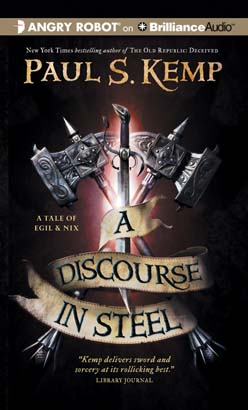
Review of A Discourse in Steel by Paul S. Kemp

SFFaudio Review

A Discourse in Steel Cover ArtA Discourse in Steel
By Paul S. Kemp; Read by Nick Podehl
10 hours 11 minutes [UNABRIDGED]
Publisher: Angry Robot on Brilliance Audio
Published: 2013
Themes: / sword and sorcery / magic / adventure / fantasy city

My first encounter with the sword-and-sorcery genre came when I discovered Fritz Leiber’s Fafhrd and the Gray Mouser stories, neatly packaged into audiobooks at Audible with introductions from no less a figure than Neil Gaiman. How could I refuse? While Leiber’s world-building was top-notch, though, I found fault with his lack of any real character development. Now, I know what you’re thinking: Seth, characters in a sword-and-sorcery novel aren’t supposed to be developed!  While I agree in principle that the genre is supposed to thrive on antiheroes like Michael Moorcock’s Elric, there’s a vast difference between making an intentional authorial decision not to develop characters, or to develop them in an unconventional way, and simply neglecting the care and feeding of a protagonist. Of this I found Leiber guilty. So I set the genre aside in hopes of finding a specimen more suited to my predilections.

Enter Paul S. Kemp’s Nix and Egil series. The eponymous heroes (it’s almost impossible to call them antiheroes) are, respectively, a sprightly little man of craft and cunning from the slums of Dur Follin, and a hulking, hammer-wielding priest of Ebenor, the momentary God. At first glance, you would be forgiven for mistaking this pair for Leiber’s Fafhrd and Gray Mouser, or, perhaps if you squint, Terry Pratchett’s Bravd and the Weasel. But where Leiber’s adventurers are often gray as the Mouser’s name, Kemp’s likable rogues flash and sparkle like a colored prism, reflecting and refracting their personae as the wheel of the story turns. And speaking of the city of Dur Follin, its twisting alleys, Low Bazaar, taverns, and guild houses are every bit as well-realized as Leiber’s Lankhmar.

I rediscovered fantasy in my teens through reading David and Leigh Eddings’s mammoth epics. While I now recognize that much of their work was middling at best, I still admire their capacity to write charming, amusing, and at times poignant dialogue. Kemp has honed this particular skill to a keen edge. The playful, good-natured banter between the two unlikely companions will have you laughing out loud one moment and pondering the mysteries of life itself the next. Their friendship is deep and genuine in the way that so many fictitious friendships simply aren’t. Nix and Egil each have their own past, present, and (it is to be hoped) future. Their hopes, fears, and regrets are writ large in the story’s pages, and this emotional element propels A Discourse in Steel beyond the mark of mere adventure into territory that far too fantasy novels explore.

You’ll notice I’ve said nothing of the plot. This is partly because I cordially dislike plot regurgitations in reviews, but also because the plot is, in a sense, unimportant. I don’t mean to suggest the plot is bad. In fact, it’s well-paced, intricate for a novel of this length, and not without its little surprises. But one comes away from reading this book with a sense that the plot served mostly as a backdrop for exploring these two remarkable characters, like set decorations in a theater performance. Of course, if all this emotional and philosophical discussion makes your eyes glaze over, and you just want to read fun stories of swashbuckling adventure, fear not, A Discourse in Steel has them in spades, or hammers. As you can probably tell by now, I am more captivated by the character development, and sometimes felt the plot barged in on a real moment of heart, but I confess that most readers will find the novel’s plot and pacing perfectly measured.

The novel isn’t without its faults. Nix and Egil are masterfully developed, but the book’s other dramatic personae, with a couple no notable exceptions, lack that same fit and finish. The villains, in particular, come across as fairly one-dimensional, even though they get a lot of stage time. Rusilla and Merelda, the tale’s damsels in distress, fare slightly better, especially towards the end, but as the series title suggests, this is the Nix and Egil show. The novel also flags a bit once the plot maneuvers the characters out of the stress of Dur Follin, which as a city is complex enough to be a character in its own right. To paraphrase one of the characters, Nix and Egil seem to belong in Dur Follin, and watching them out of their element, like fish out of water, takes a moment’s adjustment. The book’s last fault, if you could call it that, is that it ends too soon, leaving several key questions unanswered, questions about Egil and Nix, questions about the city of Dur Follin, and questions about the wider world beyond.

The audiobook is narrated by Nick Podehl, who, to me at least, has become synonymous with epic fantasy in audio, thanks in no small part to his narration of Patrick Rothfuss’s Kingkiller Chronicles. His bag of vocal tricks just seem to be a natural fit for the genre. He is able to glide smoothly between Egil’s rumbling curses and Nix’s falchion-sharp witticisms, and during the action sequences his sense of timing is impeccable. Podehl is the narrator equivalent of what’s called in Hollywood a character actor. He lacks the star power and name recognition of a Simon Vance or a William Dufris, but if you’ve listened to many audiobooks recently, you’ve probably heard his voice. He certainly does justice to Kemp’s work.

A Discourse in Steel is the second Nix and Egil adventure, but it can be read on its own, though its predecessor, The Hammer and the Blade, is nearly as good. I’m grateful to the efforts of Paul S. Kemp and his creations Nix and Egil for showing me that the sword and sorcery genre can embody both style and substance. Maybe it’s time I revisit Leiber and the other S&S greats; maybe I’ll find they’re not as soulless as I thought.

Reviewed by Seth Wilson.

Review of Lockdown: Star Wars (Maul) by Joe Schreiber

SFFaudio Review

Maul Lockdown Star WarsLockdown: Star Wars (Maul)
By Joe Schreiber; Read by Jonathan Davis
Publisher: Random House Audio
Publication Date: January 2014
[UNABRIDGED] – 12 hours, 24 minutes

Listen to an excerpt: | MP3 |

Themes: / Star Wars/ Sith Lords / horror /

Publisher summary:

Set before the events of Star Wars: Episode I The Phantom Menace, this new novel is a thrilling follow-up to Star Wars: Darth Plagueis.

It’s kill or be killed in the space penitentiary that houses the galaxy’s worst criminals, where convicts face off in gladiatorial combat while an underworld gambling empire reaps the profits of the illicit blood sport. But the newest contender in this savage arena, as demonic to behold as he is deadly to challenge, is fighting for more than just survival. His do-or-die mission, for the dark masters he serves, is to capture the ultimate weapon: an object that will enable the Sith to conquer the galaxy.

Sith lords Darth Plagueis and Darth Sidious are determined to possess the prize. And one of the power-hungry duo has his own treacherous plans for it. But first, their fearsome apprentice must take on a bloodthirsty prison warden, a cannibal gang, cutthroat crime lord Jabba the Hutt, and an unspeakable alien horror. No one else could brave such a gauntlet of death and live. But no one else is the dreaded dark-side disciple known as Darth Maul.

Star Wars: Maul: Lockdown is a Science Fiction/Horror prominently featuring Darth Maul that shows some of the darkest sides of prison life and organized crime the Star Wars universe has to offer. The story and characters are interesting but the sheer violence really seems to be the main point behind this novel. Don’t discount that “horror” part either – this book features some serious violence, gore, and other things that will make many cringe…especially with some of the sound effects that accompany the audiobook version.

The premise of the novel is that Darth Maul goes to a prison undercover for Darth Sidious to find an arms dealer running out of that prison. The prison makes money by running a gambling racket pitting inmates against each other in fight to the death. The twist is that Sidious has forbidden Maul from using the Force so that observers don’t know he is really a sith lord in disguise.

When you were a kid, did you ever sit around with friends talking about who would win in a fight between two of your favorite comic book characters? Batman vs. Superman, Wolverine vs. Cyclops, etc? Those would sometimes devolve into arguments like, “well what if Batman didn’t have kryptonite while fighting Superman” or something like that. Well this novel is the Star Wars equivalent of that in which Darth Maul is pitted against a gamut of different creatures from the Star Wars universe that get more and more difficult. While the danger of these fights is definitely recognizable, this becomes more of a question of how Darth Maul defeats his foe than if he will survive since we all know when his character really dies.

Truth be told, I did not realize this novel was horror when I first started it. Joe Schreiber also wrote Death Troopers and Red Harvest but I didn’t realize this until I was a bit into the book. Star Wars is not a universe in which you’d expect to encounter horror but I have to say that Schreiber pulls it off well in this book with a fairly believable premise. It didn’t feel like a horror novel shoe horned into the Star Wars universe. My only gripe would just be that some things mentioned are more from our world and felt like anachronisms in a Star Wars novel. They didn’t detract much from the story but nagged me a bit at times.

Jonathan Davis did a great job as usual with his work in the Star Wars universe. There weren’t really any impersonations for him to work with here except for Maul and Sidious so voices were mainly left up to him to make up. The sound effects and music were up to par with any Star Wars novel but I have to say, they really went big on the squelching, breaking, smashing sounds that accompany many of the violent/gore filled scenes in the book…to the point that I think I may have cringed a few times.

Posted by Tom Schreck

The SFFaudio Podcast #252 – NEW RELEASES/RECENT ARRIVALS

Podcast

TheSFFaudioPodcast600The SFFaudio Podcast #252 – Jesse, Tamahome, and Jenny talk about NEW RELEASES and RECENT ARRIVALS.

Talked about on this episode: Original fiction from Tor.com featuring stories from Brandon Sanderson, John Scalzi, Charles Stross, and others; The Man Who Sold the Moon short story collection by Robert A. Heinlein; Jesse has fun trying to pronounce “elegiac”; the Internet Speculative Fiction Database (ISFDb); “Simon pure” science fictionThe Caves of Steel by Isaac Asimov; Heinlein’s short fiction versus his novels; Have Spacesuit Will TravelAnnihilation by Jeff VanderMeer and comparisons to The Martian Chronicles by Ray Bradbury; The Hunger Games by Suzanne Collins and the merits of the Catching Fire film; the politics of dresses in the Hunger Games universe; Archetype by M.D. Waters; gender in dystopia; listening to audiobooks at 2x speed; The Loon by Michaelbrent Collings; Christopher Golden’s SnowblindPhantoms by Dean Koontz; 30 Days of Night; Marko Kloos’s Terms of Enlistment and Lines of DepartureThe Master of the World by Jules Verne; find out where grits came from; Jules Verne’s science is awful; The Wreck of the Nebula Dream by Veronica Scott; “I’m the king of the world!”; A New Beginning by Craig Brummer; Honor Among Thieves, a Star Wars novel by James S.A. Corey; Tam gets a Star Wars geography lesson; Jenny gets a Star Wars fashion lesson (hint: the guys in white are NOT the good guys); Tam is dressed as Princess Leia; The Gods Themselves, a strange book by Isaac Asimov; Shovel Ready by Adam Sternbergh; Mystery MenAtopia by Matthew Mather; Influx by Daniel Suarez; The Emperor’s Blades by Brian Staveley; Dawn of Swords by David Dalglish and Robert J. Duperre; The Land Across by Gene Wolfe; ruritanian romance and Bangsian fantasy; don’t call if Kafka-esque; Moon over Parador starring Richard Dreyfuss and Double Star by Robert A. Heinlein; A Darkling Sea by James Cambias (not yet in audio); V-S Day by Allen Steele (Locus review); The Martian by Andy Weir; The Scorpion Game by Daniel Jeffries (no audio, Tam’s Goodreads review); Eldrich Tales: A Miscellany of the Macabre by H.P. Lovecraft on Downpour;  Stories of your Life collection by Ted Chiang now available in audio.

Posted by Jesse Willis

Review of Archetype by M.D. Waters

SFFaudio Review

ArchetypeArchetype (Archetype #1)
By M.D. Waters; Read by Khristine Hvam
Publisher: Penguin Audio
Publication Date: 2 February 2014
[UNABRIDGED] – 10 hours, 22 minutes

Themes: / dystopia / reproduction / romance / near future / suspense / thriller /

Publisher summary:
Emma wakes in a hospital, with no memory of what came before. Her husband, Declan, a powerful, seductive man, provides her with new memories, but her dreams contradict his stories, showing her a past life she can’t believe possible: memories of war, of a camp where girls are trained to be wives, of love for another man. Something inside her tells her not to speak of this, but she does not know why. She only knows she is at war with herself.

Suppressing those dreams during daylight hours, Emma lets Declan mold her into a happily married woman and begins to fall in love with him. But the day Noah stands before her, the line between her reality and dreams shatters.

In a future where women are a rare commodity, Emma fights for freedom but is held captive by the love of two men – one her husband, the other her worst enemy. If only she could remember which is which….

This audiobook kept me listening until I finished. I couldn’t stop! Comparisons to The Handmaid’s Tale by Margaret Atwood are unavoidable with this book, but in this world where women are valued and imprisoned in order to bear children, M.D. Waters has also added in an element of romance. This means descriptions of the men Emma is interested in, and sex. I don’t mind romance, but I think if I were a woman being controlled and manipulated by men, I would be less obsessed with marriage and sex. But Emma has very little memory, and at first no reason not to trust her husband. All she wants is to get past her accident and back to normal life.  She can’t fully recover because of her dreams.

I can’t say much more without giving it away, and the best part about the book is how all the details are revealed. Archetype is suspenseful and creepy up until the end, and the end leads nicely into the setup for the next novel (Prototype) while being its own self-contained story.

I enjoy Khristine Hvam as a narrator – I had listened to her performance of Daughter of Smoke and Bone, and her voice is well suited to a near-future dystopian romance.

Posted by Jenny Colvin

The Weird Circle: The Werewolf (aka The White Wolf Of The Hartz Mountains)

SFFaudio Online Audio

“Capt. Marryat, besides writing such short tales as The Werewolf [aka The White Wolf Of The Hartz Mountains], made a memorable contribution in The Phantom Ship (1839), founded on the legend of the Flying Dutchman, whose spectral and accursed vessel sails for ever near the Cape of Good Hope.”

-H.P. Lovecraft, Supernatural Horror In Literature

Normally I wouldn’t contradict H.P. Lovecraft, but he didn’t have the internet to do his research. The Werewolf he is referring to, we think, is actually Chapter 39 of The Phantom Ship – that chapter is a story within the greater narrative and has often been reprinted without the surrounding novel.

This 1944 radio drama adaptation is very tame compared with the savageness of the original (for more on that see the PDF below).

The Weird CircleThe Weird Circle – The Werewolf
Adapted from the novelette by Captain Frederick Marryat; Performed by a full cast
1 |MP3| – Approx. 29 Minutes [RADIO DRAMA]
Broadcaster: MBS, NBC, ABC
Broadcast: May 7, 1944
Provider: Archive.org
A widower, living in the Hartz Mountains, takes a new wife to help raise his children, but the strange wedding vows he makes will come back to haunt him.

Here’s a |PDF| of The White Wolf Of The Hartz Mountains.

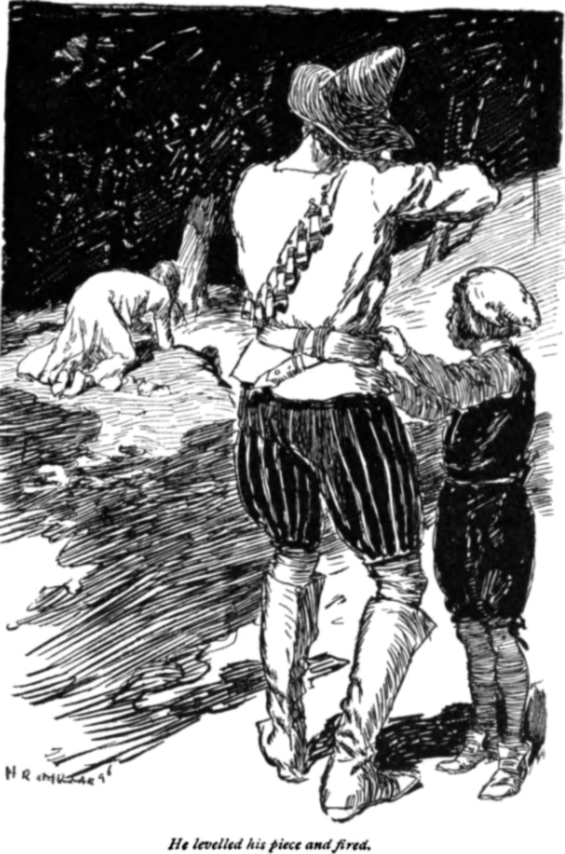
The White Wolf Of The Hartz Mountains - illustration by H.R. Millar

The White Wolf Of The Hartz Mountains -illustration by H.R. Millar

Posted by Jesse Willis