Review of Between Two Thorns by Emma Newman

SFFaudio Review

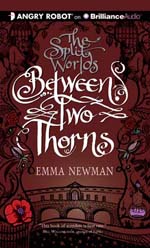
Between Two ThornsBetween Two Thorns (Split Worlds #1)
By Emma Newman; Performed by Emma Newman
Publisher: Angry Robot on Brilliance Audio
Publication Date: 26 February 2013
[UNABRIDGED] – 11 hours; 59 minutes

Themes: / alternate worlds / England / fantasy /

Publisher summary:

Something is wrong in Aquae Sulis, Bath’s secret mirror city. The new season is starting and the Master of Ceremonies is missing. Max, an Arbiter of the Split Worlds Treaty, is assigned with the task of finding him – with no one to help but a dislocated soul and a mad sorcerer. There is a witness, but his memories have been bound by magical chains only the enemy can break. A rebellious woman trying to escape her family may prove to be the ally Max needs. But can she be trusted? And why does she want to give up eternal youth and the life of privilege she’s been born into?

Between Two Thorns is the first book in Emma Newman’s Split Worlds trilogy. The universe was debuted by the author in a series of weekly free short stories released over a year-long period leading up to this book’s release. The short stories are independent of the trilogy in the sense that it is not necessary to read them prior to the starting the trilogy, but can be read later to enhance the characters and the universe. The stories are available both as text and as audio and can be found on the Split Worlds website.

In regards to the audio, Emma Newman also happens to be a professional audiobook narrator with credits including science fiction and romance titles as well as recordings for Dark Fiction Magazine. I always find it interesting to hear an author narrate their own work, as there is arguably a certain degree of credibility gained which could be lost with another narrator. In the case of the Split Worlds series, I find it interesting to hear the author’s own take on the wide variety of characters in the universe ranging from angels, sorcerers, and gargoyles to wish-granting faeries. On a couple occasions, however, the characters seem to blend together and I had a little difficulty keeping track of who was who which is surprising given the diversity.

The Split Worlds universe provides an immersive and addictive environment for the reader. Part real-world Bath and part netherworld Aquae Sulis, the author has even conducted role-playing games set in the book’s world and invited reader participation. Between Two Thorns sets the tone pulling the reader in and it’s cliffhanger ending leaves one anxious to dive right into the sequel Any Other Name. (And I’m sure from that installment onto the conclusion.) I certainly plan myself to continue on with the next installment soon.

Posted by Dan VK.

The SFFaudio Podcast #229 – NEW RELEASES/RECENT ARRIVALS

Podcast

The SFFaudio PodcastThe SFFaudio Podcast #229 – Jesse, Jenny, Tamahome, and Paul Weimer talk about NEW RELEASES and RECENT ARRIVALS.

Talked about on today’s show:
Tam is back, Haruki Murakami, Kafka On The Shore, magic realism, Japan, kafkaesque, surrealism, 1Q84, The Wind-Up Bird Chronicle, pretty books, Chip Kidd, rice paper, Requiem by Ken Scholes, Julie Davis, Tor, magic staff, earth in the future, The Steel Remains, “oh crap this is the future”, Gene Wolfe, Happy Hour In Hell by Tad Williams, Bobby Dollar, The Dirty Streets Of Heaven, urban fantasy, demoness tangling, Lankhmar, urban fantasy => a certain kind of fantasy, noir/detective => hardboiled, Otherland, Luke Burrage, cats, “the Walter Jon Williams effect”, MaddAddam by Margaret Atwood, mostly dystopian, Oryx and Crake, quasi-humans, The Year Of The Flood, genetic engineering, racoon-pigs, storytelling mode, listening at 2X speed, competitive debate, Margaret Atwood’s preview of a review of Doctor Sleep by Stephen King, a sequel to The Shining, Atwood’s weakness for horror and terror, “because he’s Stephen King”, Will Patton, “don’t judge me people”, is there a stigma in literary circles?, Zoomer magazine’s profile of Margaret Atwood as “Queen Of The Nerds”, Twitter, tweetalong?, a genuine literary reputation, poetry, Orson Scott Card, does it matter?, dystopia, Dreamscape Audiobooks, The Night Lands by William Hope Hodgson, The House On The Borderlands, a very daunting book, big and ambitious, Lovecraftian?, The Scarlet Plague by Jack London, Earth Abides, class, mainstream post-apocalypse, Alas Babylon by Pat Frank, a toothless grandfather, Drew Ariana, Goslings by J.D. Beresford, plague talk!, The Children Of Men, Y: The Last Man, the newspapers, HiLoBooks, “Radium Age” Science Fiction, Gweek, The Road To Science Fiction, classicism, sexism, barbarism, The Iron Heel, numeracy and literacy, the size of the universe or the age of the Earth, Simon & Schuster Audio, Rivers by Michael Farris Smith, Jenny loves destroying the earth, wiping the slate clean, Fallout, Tobias Buckell, Interrupt by Jeff Carlson, Hunter Davis, Brilliance Audio, simultaneously published with print, Neanderthals, the pronunciations, Robert J. Sawyer, Discover Magazine, literally means not literally anymore, it’s figuratively raining cats and dogs, The Darwin Elevator by Jason M. Hough, Julie Davis, Simon Vance, science fiction thrillers, John Scalzi, plague, space elevator, working for the enemy?, a compressed schedule, writing 2X, a first novel!, military SF, “we’ve complinished everything”, Reflex by Steven Gould, Jumper, the physical audiobook industry (is it mostly for libraries), Paperback Audio, William Dufris, The Stars My Destination by Alfred Bester, innate teleportation, the Jumper movie, Portal, post-humans, Nightcrawler without the bad smell, BAMFless, The Clockwork Man by E.V. Odle, Ralph Lister, no introductions makes Jesse sad, are there audio previews?, Affliction: An Anita Blake, Vampire Hunter Novel (#22) by Laurell K. Hamilton, The Lord of Opium (Matteo Alacran #2) by Nancy Farmer, The Midnight Heir (Bane Chronicles #4) by Cassandra Clare and Sara Rees Brennan, building on The Hunger Games, Untouchable (Immortals After Dark #8) by Kresley Cole, Robert Petkoff, The Hunt or Capture, the reality TV version of The Hunger Games in The Hunger Games would be very boring, The Truman Show would be a very boring show to actually watch, in fiction the TV shows are without narrative, TVtropes show with an show, Hamlet, William Shakespeare did meta 500 years ago, epic traditional fantasy, traditional epic fantasy marriage, Crown Thief (Tales Of Easie Damasco #2) by David Tallerman, Giant Thief, sword and sorcery, golem or gollum?, Witch Wraith: The Dark Legacy of Shannara by Terry Brooks, Rosalyn Landor, , “Tolkien with the serial numbers filed off”, “its all about the elfstones”, The Lord Of The Rings, questing, trilogy vs. endless series, the Wikipedia entry for Shannara, a magical cataclysm, “a richer broader universe”, Revolution, S.M. Stirling, Robert Jordan, the Dragonlance series, Daniel Abraham, subverting the quest trope, The Eye Of The World, George R.R. Martin, gathering forces and subverting expectations, children’s fantasy, Roald Dahl, Matilda is read by Kate Winslet!, the musical of Matilda, The Twits, Charlie And The Chocolate Factory, Charlie And The Great Glass Elevator Futurama, Fry and the Slurm factory, Gene Wilder, great character names!, Dickensian names, The BFG, biography, crime, thriller, JFK’s Last Hundred Days: The Transformation Of A Man And The Emergence Of A Great President, Death Angel (Alexandra Cooper #15) by Linda Fairstein, The Kill List by Frederick Forsyth, George Guidall, “now it’s personal”, Penguin Audio, adding heat urgency of character development, adding a baby, Breaking Bad babies, the invisible baby or worse the artificially aging child syndrome, Mork & Mindy, Shaman by Kim Stanley Robinson, 30,000 years ago, prehistorical romance, hard edged scientific, Clan Of The Cavebear, Monsters Of The Earth by David Drake, Seanan McGuire, Soldier by Harlan Ellison, The Terminator, The Outer Limits, James Cameron, Philip Wylie, Tomorrow!, John Wyndham, When Worlds Collide, The Answer, nuclear war with angels, The End Of The Dream, The Murderer Invisible.

Dreamscape Audiobooks - Goslings by J.D. Beresford

Posted by Jesse Willis

Review of Space Magic by David Levine

SFFaudio Review

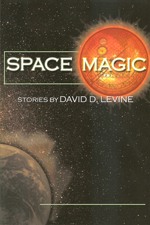
Space Magic by David D. LevineSpace Magic
By David D. Levine; Read by David D. Levine
Publisher: Book View Café
Publication Date: 25 June 2013
ISBN: 978-1-61138-281-5
[UNABRIDGED] – 7 hours; 56 minutes

Themes: / short stories / interstellar salesman / comic book fantasy / space  magic /

Publisher summary:

This Endeavour Award-winning collection pulls together 15 critically acclaimed science fiction and fantasy stories that take readers from a technicolor cartoon realm to an ancient China that never was, and from an America gone wrong to the very ends of the universe. Including the Hugo Award-winning Tk’Tk’Tk, the Writers of the Future Award winner Rewind, Nucleon, The Tale of the Golden Eagle, and many other highly-praised stories, Space Magic shows David D. Levine’s talents not only as a gifted writer but as a powerful storyteller whose work explores the reaches of space as well as the depths of the human heart.

Space Magic is a collection of short stories by David D. Levine that are either Science Fiction, Fantasy, or some combination of those together. I really enjoyed this short story collection. Short stories in general sometimes feel underdeveloped or trivial, but the stories in this collection each do a great job of introducing a whole new world, what’s going on, and coming to a satisfying conclusion. If you like science fiction or fantasy of any kind, this is a great collection of stories.

Here were some of my more favorite stories:

Nucleon – This was like Mr. Magorium’s wonder imporium at a junkyard. A fun concept and likeable characters.

Zauberschrift – Really cool story about a scribe who used to apprentice with feuding wizards needs to help a village plagued by bad magic. Really cool magic ideas and insights into mob mentality.

Rewind – This story really reminded me of Equilibrium in how you have someone from an elite force of some totalitarian government join in with the rebellion with his super abilities/powers. So many possibilities in this story.

Brotherhood – A great story of the labor force in their struggles with the man that will have you wondering why it’s in this collection for most of the story…(in a good way)

Tk’Tk’Tk – This story takes the problems of a salesman selling to a different culture to the extreme. What if you were an interstellar salesman coping with the cultures of another species you could barely understand?

Charlie the Purple Giraffe Was Acting Strangely – This story is crazy. What happens to comic characters between the cells and between the comics?

The Ecology of Faerie – This story is like Faerie horror. I don’t know how Mr. Levine did it, but he made a Faerie story like Night of the Living dead and it’s awesome!

David D. Levine does his own reading for this book, and does a decent job.

Posted by Tom Schreck

Review of The Elephant Vanishes by Haruki Murakami

SFFaudio Review

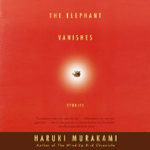
The Elephant VanishesThe Elephant Vanishes: Stories
By Haruki Murakami; Translated by Alfred Birnbaum and Jay Rubin
Read by Teresa Gallagher, John Chancer, Walter Lewis, Rupert Degas, Tim Flavin, Mark Heenehan, Jeff Peterson
Publisher: Random House Audio
Publication Date: 6 August 2013
[UNABRIDGED] – 10 hours, 31 minutes
Download excerpt: |MP3|

Themes: / light fantasy / personal identity / life’s meaning / a dwarf inside of me / short stories / surrealism /

Publisher summary:

With the same deadpan mania and genius for dislocation that he brought to his internationally acclaimed novels A Wild Sheep Chase and Hard-Boiled Wonderland and the End of the World, Haruki Murakami makes this collection of stories a determined assault on the normal. A man sees his favorite elephant vanish into thin air; a newlywed couple suffers attacks of hunger that drive them to hold up a McDonald’s in the middle of the night; and a young woman discovers that she has become irresistible to a little green monster who burrows up through her backyard.

By turns haunting and hilarious, The Elephant Vanishes is further proof of Murakami’s ability to cross the border between separate realities – and to come back bearing treasure.

Some of the stories in this collection originally appeared in the following publications: The Magazine (Mobil Corp.): “The Fall of the Roman Empire, the 1881 Indian Uprising, Hitler’s Invasion of Poland, and the Realm of the Raging Winds” (in a previous translation; translated in this volume by Alfred Birnbaum), The New Yorker: “TV People” and “The Wind-up Bird and Tuesday’s Women” (translated by Alfred Birnbaum), “The Elephant Vanishes”, and “Sleep” (translated by Jay Rubin), and “Barn Burning” (in a previous translation; translated in this volume by Alfred Birnbaum) Playboy: “The Second Bakery Attack” (translated by Jay Rubin, January 1992).

In Haruki Murakami’s The Elephant Vanishes, Murakami tries to bind a collection of stories with a few common threads woven through the various narratives.  At this, Murakami failed to hold my interest.  But Murakami does manage to seduce the reader, if only from time to time, with glimpses of brilliant storytelling.  And it became the prospect of discovering these hidden gems that kept me going.

I don’t think that Murakami shines in the short story genre.  His style of writing requires time for the odd sense of surrealism to grip the reader, sometimes like a lover, other times like an anaconda.  But in these short works, Murakami’s talent for making the odd seem normal, had too much of a rushed sensation.  Instead of being seduced, I was narratively groped.

I didn’t appreciate the numerous narrators that this audio production contains.  It would have been far better to have two or perhaps three readers, but this audiobook simply has too many voices.  I ended up feeling detached for too much of the time.  I liked that this audio production doesn’t use musical interludes to mark new stories or sections of change.

Should you read this book?  Well, if you like Murakami, then yes.  But you should go into this with the understanding that some of these stories just flop with all the grace of a sweat-soaked sock on a locker-room floor.  But a few of these tales possess a magic vitality that lingers in the consciousness long after you are through.  It is for these stories that make the reading worthwhile.

Posted by Casey Hampton.

The Canal by H.P. Lovecraft

SFFaudio News

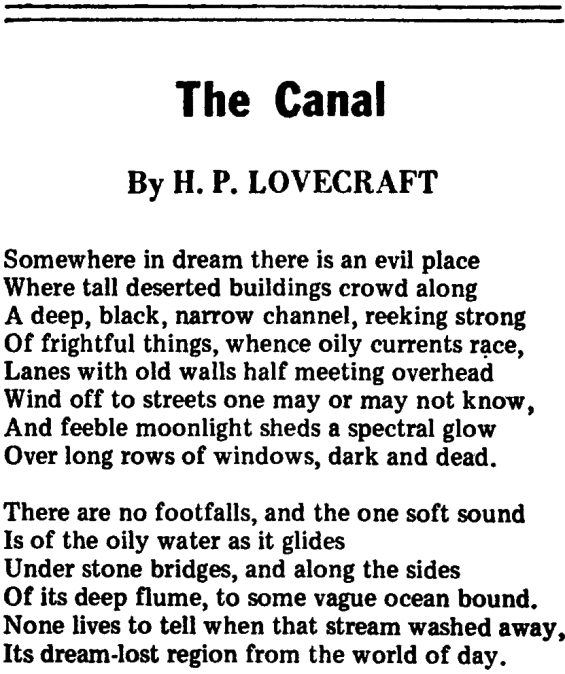
The Canal by H.P. Lovecraft is a short 1932 poem usually published as a part of the “Fungi from Yuggoth” sequence. Some printings mistakenly change the last word from “clay” to “day.”

The Canal by H.P. Lovecraft

Somewhere in dream there is an evil place
Where tall, deserted buildings crowd along
A deep, black, narrow channel, reeking strong
Of frightful things whence oily currents race.
Lanes with old walls half meeting overhead
Wind off to streets one may or may not know,
And feeble moonlight sheds a spectral glow
Over long rows of windows, dark and dead.

There are no footfalls, and the one soft sound
Is of the oily water as it glides
Under stone bridges, and along the sides
Of its deep flume, to some vague ocean bound.
None lives to tell when that stream washed away
Its dream-lost region from the world of clay.

The Canal by H.P. Lovecraft

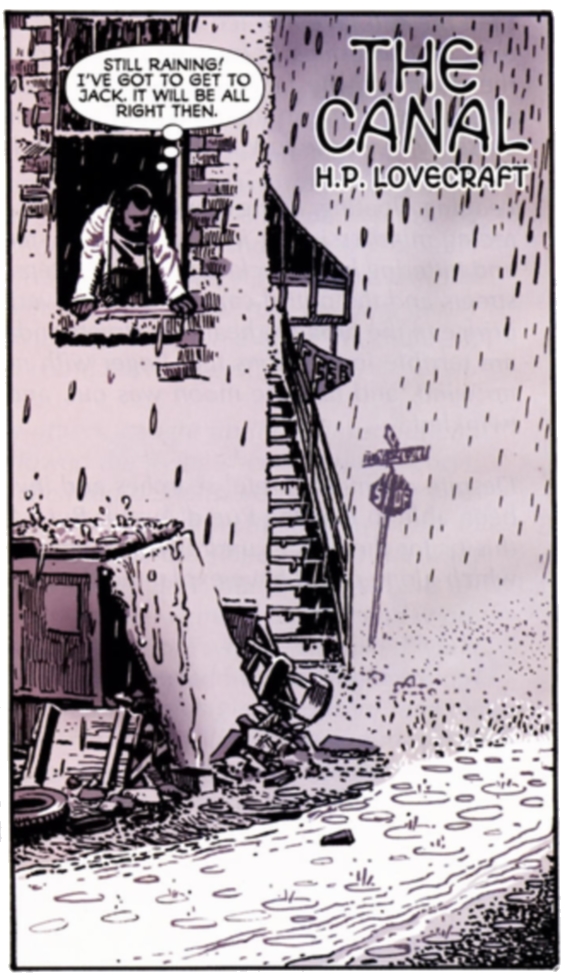
There was a very very loose comics adaptation of The Canal found in Richard Corben’s Marvel Max series H.P. Lovecraft’s Haunt of Horror (issue 2):

The Canal adapted from the poem by H.P. Lovecraft - for Marvel Max series H.P. Lovecraft's Haunt of Horror, #2

Posted by Jesse Willis

The House by H.P. Lovecraft

SFFaudio News

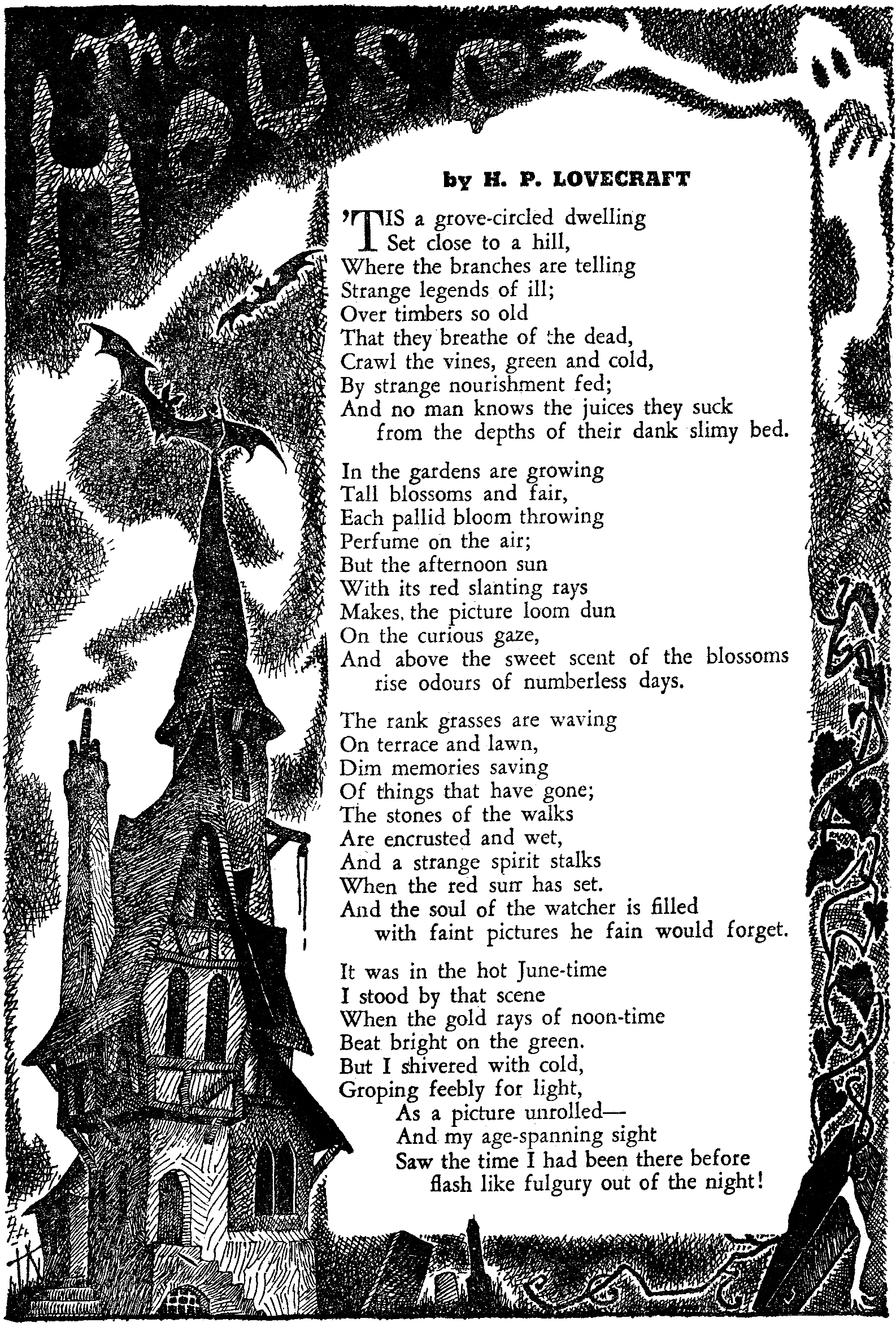
The House, by H.P. Lovecraft, is a short poem first published in The Philosopher 1, No. 1, December 1920. The illustrated version, below, came from Weird Tales, March 1948. The artist was Boris Dolgov. Based on the at you’d think it was a Halloween poem. But the poem is explicitly set in June.

The House by H.P. Lovecraft

The House by H. P. Lovecraft

’Tis a grove-circled dwelling
Set close to a hill,
Where the branches are telling
Strange legends of ill;
Over timbers so old
That they breathe of the dead,
Crawl the vines, green and cold,
By strange nourishment fed;
And no man knows the juices they suck from the depths of their dank slimy bed.

In the gardens are growing
Tall blossoms and fair,
Each pallid bloom throwing
Perfume on the air;
But the afternoon sun
With its shining red rays
Makes the picture loom dun
On the curious gaze,
And above the sween scent of the the blossoms rise odours of numberless days.

The rank grasses are waving
On terrace and lawn,
Dim memories sav’ring
Of things that have gone;
The stones of the walks
Are encrusted and wet,
And a strange spirit stalks
When the red sun has set,
And the soul of the watcher is fill’d with faint pictures he fain would forget.

It was in the hot Junetime
I stood by that scene,
When the gold rays of noontime
Beat bright on the green.
But I shiver’d with cold,
Groping feebly for light,
As a picture unroll’d—
And my age-spanning sight
Saw the time I had been there before flash like fulgury out of the night.

Posted by Jesse Willis