
The SFFaudio Podcast #234 – AUDIOBOOK/READALONG: Who Knows? by Guy de Maupassant

Podcast

The SFFaudio PodcastThe SFFaudio Podcast #234 – Who Knows? by Guy de Maupassant; read by Mark Turetsky. This is a complete and unabridged reading of the story (39 minutes) followed by a discussion of it. Participants in the discussion include Jesse, Mark Turetsky, and Professor Chris Coski of Ohio University.

Talked about on today’s show:
One of the last Guy de Maupassant stories, fantasy podcasts, what genre is this story?, the mysterious, the macabre, the morbid, do we buy the narrator’s story?, Am I Insane? by Guy de Maupassant, the events that happen are insane, a horror story?, a satire of Gothic horror, it is a ridiculous premise, a mental institution, is he lying?, is he deluded?, the servants, very thorough thieves, the title, Maupassant is intentionally ambiguous, there’s always a grain of the opposite, a syphilitic brain crafts a masterful short story, is it a true-ish story?, Maupassant was kind of a loner, boating among other things, Maupassant liked his solitude, touring all the European cities, THE SIGN OF DEATH PRECEDES STRANGE EVENTS, “several hours”, if the furniture is taking the place of other people…, affection for objects, The Golden Braid (aka The Tress Of Hair), falling in love with an object, the writing desk and its contents, where did the writing desk go?, his letters his papers, his personal history is now gone, deracinate , visiting new places, the history of his heart, the photographs, his emotional life, the furniture is the mental faculties, the house is him,

“Then I suddenly discerned, on the threshold of my door, an armchair, my large reading easy-chair, which set off waddling [LIKE A DUCK]. It went away through my garden. Others followed it, those of my drawing-room, then my sofas, dragging themselves along like [CROCODILES] on their short paws; then all my chairs, bounding like [GOATS], and the little foot-stools, hopping like [RABBITS].”

his desk is like a wife who’s trying to run away, the repeated refrains, “imagine my feelings”, you stop being the reader and become a participant, the revolver, marauders, the doors are alive too, Rouen, his arms were there, gun nuts, the presentiments, the river Robec, the black nauseous waters, the second hotel scene mirrors the first, is the hotel an asylum, you found your mental faculties, he checks himself in (to the hotel and the asylum), are you a private gentleman?, is the asylum is a prison?, the fat bald little yellow bearded man from Rouen with a head like a moon, grammatically it doesn’t make sense, ambiguity, THE MOON, the witch’s sabbath crescent, the play “beautiful music and fairy life drama”, he’s had a spell cast on him, “a serious accident would certainly take place”, a paralytic stroke, the sound from outside his body, a humming, trains passing, clocks, marching multitudes, “the big one”, the crescendo, “Signad” in Swedish means “designed”, Sigurd, the ring cycle, dwarves, fantasy and reality mixing, were the cops playing along?, “this house communicates with it’s neighbors”, very weird, Jesse’s tweeted dream explanation: “Dreamt an explanation for WHO KNOWS? By Guy de Maupassant – the furniture was deleted, & their dissolution was confabulated.”, not a psychological interpretation, an ontological interpretation, accidentally deleting something, SimCity, ctrl-z, not a useful miracle, an incompetent higher power, “My god, my god”, “Merciful heaven”, no grudge against, Who knows?, God knows!, a murderous schoolteacher, Revenge by Guy de Maupassant, a higher power that deletes, the short story is the only form that can be perfect, there’s something perfect, any lacuna, “a missing section of text”, the oxymoron, rude gentleness, an unbalanced situation, the insane sanity or the sane insanity, the widow Bidoin,

“He ordinarily passes his evenings at the house of a female neighbor, who is also a furniture broker, a queer sort of sorceress, the widow Bidoin”

is she married to the bald man, that Disney movie, maybe it isn’t a perfect short story, etymological searches, the tour of Africa, Sicily, Normandy, “where there hover no vague hauntings”, the missing night, a different sort of desert, Fear by Guy de Maupassant, “I had a presentiment in Africa”, “the sun dissipates it like a fog”, fear vs. panic, the spiritual gnawing of northern cultures, The Inn by Guy de Maupassant, H.P. Lovecraft, “God is dead but he never really was alive. The universe is real but we’re alone in it. Looking up at the starry night we are pointless, alone, with nothingness behind us, nothingness ahead of us, and its horrible.” he goes crazy because he’s alone, in the tumult of the crowd (with it’s light pollution), “there’s a shop for that down the street”, very very very small and unimportant, Lovecraft made it a monster, Eric S. Rabkin, light as the symbol for knowledge, inside the interesting chest cavity, a cosmic vastness and emptiness in which we are lost, solitude, Rouen, Rotomagus (round market or round plain) – but the word magus, J.R.R. Tolkien’s dwarves, great craftsmen, is the man from Roen really God?, yesterday I was in a private asylum, three months, a descent into madness, is there no lacuna in the inflexible sequence of his observations, a lacuna in which the end took place.
Qui Sait?

Who Knows by Guy de Maupassant

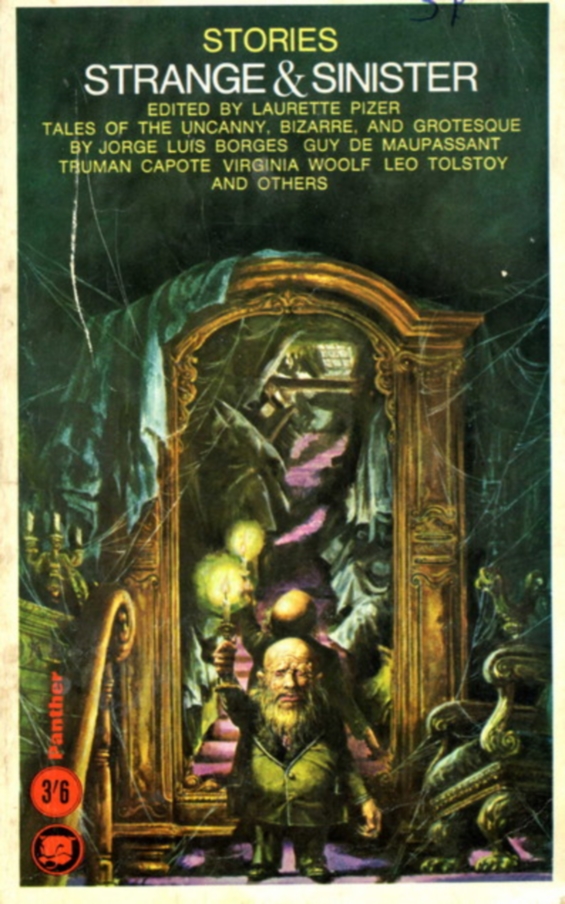
Stories Strange And Sinister

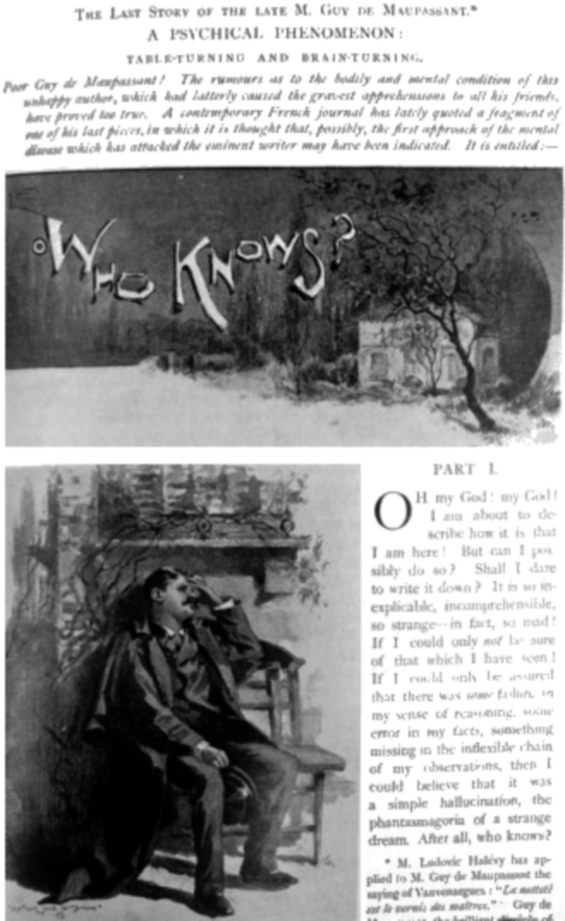
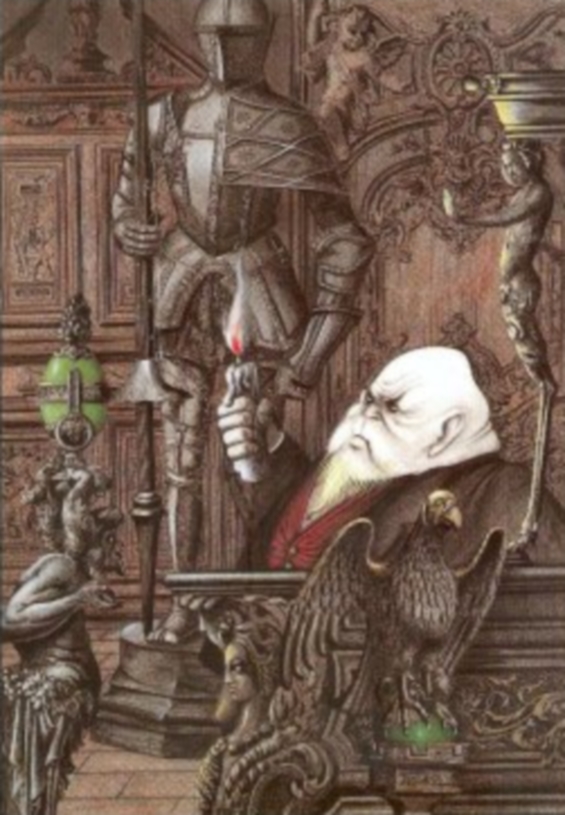
Pall Mall Magazine, June 1894 - Who Knows? by Guy de Maupassant - illustrated by Arthur Jule Goodman

Posted by Jesse Willis

Kubla Khan or a Vision of Dream by Samuel Taylor Coleridge (read by Wayne June)

SFFaudio Online Audio

Kubla Khan is a wondrous dream inspired poem by Samuel Taylor Coleridge. Written in 1797, but published in 1816, it is said to have been composed one night after Coleridge had been taking opium and reading a work describing Xanadu (the summer palace of the Mongol ruler and Emperor of China, Kublai Khan).

The way the great narrator Wayne June reads it you can almost feel the narcotic vapours enveloping you in their ethereal somnifacience.

After you’ve astral projected into the audio, feel free to grab hold of this ever so slighty more tangible |PDF|.

Kubla Khan by Samuel Taylor Coleridge

In Xanadu did Kubla Khan
A stately pleasure-dome decree:
Where Alph, the sacred river, ran
Through caverns measureless to man
Down to a sunless sea.
So twice five miles of fertile ground
With walls and towers were girdled round:
And here were gardens bright with sinuous rills
Where blossomed many an incense-bearing tree;
And here were forests ancient as the hills,
Enfolding sunny spots of greenery.
But oh! that deep romantic chasm which slanted
Down the green hill athwart a cedarn cover!
A savage place! as holy and enchanted
As e’er beneath a waning moon was haunted
By woman wailing for her demon-lover!

And from this chasm, with ceaseless turmoil seething,
As if this earth in fast thick pants were breathing,
A mighty fountain momently was forced;
Amid whose swift half-intermitted burst
Huge fragments vaulted like rebounding hail,
Or chaffy grain beneath the thresher’s flail:
And ‘mid these dancing rocks at once and ever
It flung up momently the sacred river.
Five miles meandering with a mazy motion
Through wood and dale the sacred river ran,
Then reached the caverns measureless to man,
And sank in tumult to a lifeless ocean:
And ‘mid this tumult Kubla heard from far
Ancestral voices prophesying war!

The shadow of the dome of pleasure
Floated midway on the waves:
Where was heard the mingled measure
From the fountain and the caves.
It was a miracle of rare device,
A sunny pleasure-dome with caves of ice!
A damsel with a dulcimer
In a vision once I saw:
It was an Abyssinian maid,
And on her dulcimer she played,
Singing of Mount Abora.
Could I revive within me
Her symphony and song,
To such a deep delight ‘t would win me
That with music loud and long,
I would build that dome in air,
That sunny dome! those caves of ice!
And all who heard should see them there,
And all should cry, Beware! Beware!
His flashing eyes, his floating hair!
Weave a circle round him thrice,
And close your eyes with holy dread,
For he on honey-dew hath fed,
And drunk the milk of Paradise.

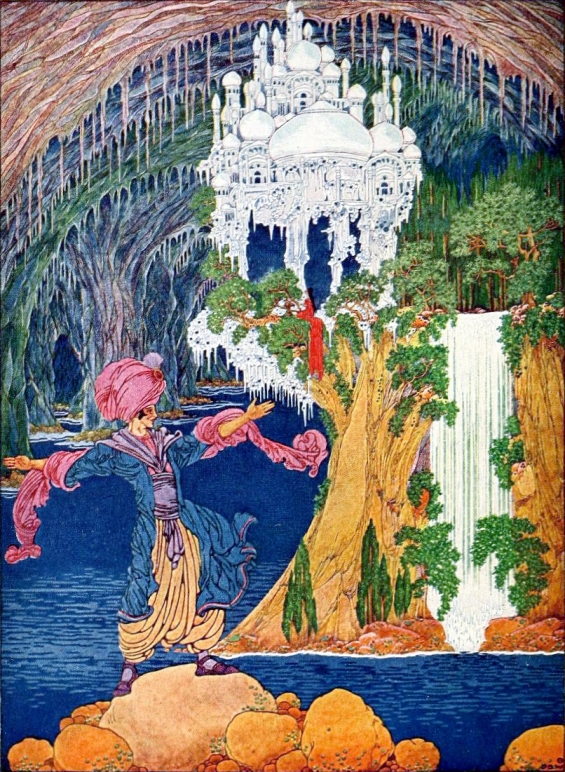
Kubla Khan illustrated by Dugald Walker

Posted by Jesse Willis

Pulp Crazy: Panels from the first World Fantasy Convention, 1975

SFFaudio Online Audio

Pulp CrazyJason Aiken’s Pulp Crazy is a video (and audio) podcast, and blog “dedicated to spreading the word on classic pulp literature.” It mostly features brief reviews of pulp stories and characters, but a recent show pointed me to some previously unknown material!

This |MP3|, podcast on September 27, features a pair of panels recorded at the first World Fantasy Convention in 1975.

Podcast feed: http://pulpcrazy.com/podcast/rss.xml

Here’s the official description:

This video features two panel discussions recorded at the First World Fantasy Convention, held in Providence, Rhode Island (home of the late H.P. Lovecraft) in 1975. The first panel features fantasy & horror authors speaking about how they came to write fantasy and supernatural fiction. Moderated by cartoonist Gahan Wilson, authors include Joseph Payne Brennan, Robert Bloch, Frank Belknap Long and Manly Wade Wellman (speaking in that order). All authors on this panel were published by Arkham House.

The second panel discussion is about fantasy and supernatural horror publishing. It is again moderated by artist & cartoonist Gahan Wilson, the speakers include publisher Donald A. Wollheim and author Robert Bloch.

The audio was recorded in October 1975 by and for Myrddin Press, which published the fanzine Myrddin. The recordings were made with a Sony monophonic cassette recorder, and parts of it appeared on a paper-thin flexible vinyl disc that came with the third issue of Myrddin. The three files uploaded here contain the clearest and most interesting portions from the tapes. Much of the rest is inaudible.

Panel discussion on how authors got their start |MP3|
Publishing and writing discussion, with emphasis on the business end |MP3|
Fantasy publishing discussion, part 2 |MP3|

Myrddin Three edited by Lawson W. Hill

Posted by Jesse Willis

Review of Conquest by B.V. Larson

SFFaudio Review

ConquestConquest – (Star Force #4)
By B.V. Larson, Performed by Mark Boyett
Publisher: Brilliance Audio
[UNABRIDGED] – 12 hoursThemes: / aliens / military sci-fi / fighting bugs / machines / invasion /

Publisher summary:

Conquest is the next chapter in the great interstellar war between all living creatures and the machines. Star Force must stop the machine invaders once again – but how? In the fourth book of the Star Force series, Kyle Riggs has freed Earth from the chains of the Macros – but at what cost? The Macros no longer trust him. He is a mad dog that must be put down – and all Star Force must be stamped out with him. The war expands in this story, and mankind is once again faced with annihilation.

Conquest is the fourth book in the Star Force series by B. V. Larson and, while it continues the well-established tradition of this series for thrilling military action, it also brings several of the flaws of the series into sharp focus.

Over the course of the previous three novels in the Star Force series, Kyle Riggs has made some bad calls. He has sworn Earth to provide troops for a dangerous enemy, ordered thousands of his troops to their deaths, and cast aside strategic alliances with little thought to the long-term consequences of his actions. Throughout it all, I continued to root for Riggs and the rest of his band, even as I questioned his actions. Now, though, I can’t help but wonder if Star Force is the right team for the job.

Of course, they never were supposed to be the first best choice. Riggs and Crow, the co-leaders of Star Force, were plucked from their homes by brutal machines and only came to command the most technologically advanced army in human history because they managed to survive a brutal series of tests, so it should come as little surprise that these two often resort to brute force to solve their problems. Still, I couldn’t help feeling that these two men were woefully unfit for command when the first few chapters of this book consisted of little more than a super-powered grudge match between them. Riggs, as the narrator and protagonist, does his best to justify his actions to the reader, but many of his arguments can be boiled down to, “I did my best, but I’m not really a soldier.” Meanwhile, Crow is written as a chameleon who repeatedly vacillates between careless pirate and brilliant strategist, with little to no transition between.

One might expect that the return of the giant Macro robots would bring some unity to Star Force, or at least some sound strategic planning, but it doesn’t. Instead, Crow runs away (as usual) and Riggs comes up with some brilliant modifications to the Star Force battle equipment, then fails to use them to their potential (as usual). The one piece of brilliant strategizing that Riggs does manage to pull off, which results in the Macros focusing their attacks on Star Force’s home base rather than assaulting the entire planet, backfires spectacularly when he forgets the lessons learned in his previous fights against both the Macros and the Helios Worms. Riggs knows the Macros are underground, but makes no plans to defend against an attack from below. He gives his troops the ability to fly, but rarely uses that to his strategic advantage. Mistake compounds mistake until only nuclear weapons and convenient force-field failures can save Earth.

Apparently I am not the only one dissatisfied with the leadership of Kyle Riggs, as the author included a subplot of ongoing assassination attempts in Conquest. Obviously, I won’t say who or what was behind the attempts, but I like to imagine that there was some level of symbolism to B. V. Larson’s decision to introduce this plot element. I have to wonder if maybe there is some chance that, by the time he reached this book, Larson had realized that Riggs needs to develop further as a leader and a character.

Mark Boyett does an admirable job narrating this series, navigating the wide range of accents with ease. I did think, as I listened, that I caught a few errors, but I am more inclined to believe that these were missed during the editing of the book, rather than introduced in the recording of the audio. At a running time of just over eleven hours, spanning ten CDs, the book is just long enough to tell the story of the second invasion of Earth without overstaying its welcome. I plan to continue reading this series, but I truly hope to see some growth in strategic thinking from Riggs, or I could see myself beginning to feel sympathetic towards Conquest’s failed assassins.

Posted by Andrew Linke

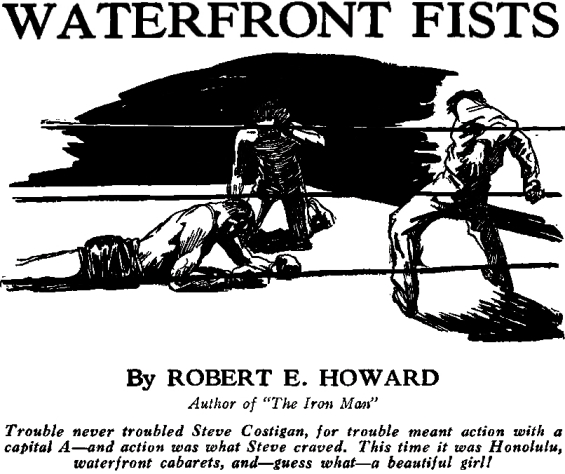
Protecting Project Pulp: Waterfront Fists by Robert E. Howard

SFFaudio Online Audio

Also known as “Stand Up And Slug” this humourous boxing story is told in the first person. Narrator Jim Philips does a great job characterizing the wharfies, boxers, and floozies that populate its seedy Honolulu docklands.

“I do not believe in too much thinking; it gives a fighter the headache.”

Waterfront Fists by Robert E. Howard

Protecting Project PulpProtecting Project Pulp No. 30 – Waterfront Fists
By Robert E. Howard; Read by Jim Philips
1 |MP3| – Approx. 1 Hour 4 Minutes [UNABRIDGED]
Podcaster: Protecting Project Pulp
Podcast: February 5, 2013
Trouble never troubled Steve Costigan, for trouble meant action with a capital A—and action was what Steve craved. This time it was Honolulu, waterfront cabarets, and—guess what—a beautiful girl! First published in Fight Stories, September 1930.

There’s a complete ETEXT, but even better I’ve made a |PDF| from a scan of Fight Stories, September 1930.

Posted by Jesse Willis

Review of MaddAddam by Margaret Atwood

SFFaudio Review

MaddAddam by Margaret AtwoodMaddAddam (MaddAddam #3)
By Margaret Atwood; Read by Bernadette Dunne, Bob Walter and Robbie Daymond
Publisher: Random House Audio
Publication Date: 3 September 2013
ISBN: 978-0-7393-8399-5
[UNABRIDGED] – 13 hours, 23 minutes
Listen to an excerpt: | MP3 |

Themes: / post-apocalypse / survival / religion / genetic engineering / megalomania / mythology /

Publisher summary:

Months after the Waterless Flood pandemic has wiped out most of humanity, Toby and Ren have rescued their friend Amanda from the vicious Painballers. They return to the MaddAddamite cob house, newly fortified against man and giant pigoon alike. Accompanying them are the Crakers, the gentle, quasi-human species engineered by the brilliant but deceased Crake. Their reluctant prophet, Snowman-the-Jimmy, is recovering from a debilitating fever, so it’s left to Toby to preach the Craker theology, with Crake as Creator. She must also deal with cultural misunderstandings, terrible coffee, and her jealousy over her lover, Zeb.

Zeb has been searching for Adam One, founder of the God’s Gardeners, the pacifist green religion from which Zeb broke years ago to lead the MaddAddamites in active resistance against the destructive CorpSeCorps. But now, under threat of a Painballer attack, the MaddAddamites must fight back with the aid of their newfound allies, some of whom have four trotters. At the center of MaddAddam is the story of Zeb’s dark and twisted past, which contains a lost brother, a hidden murder, a bear, and a bizarre act of revenge.

“There’s the story, then there’s the real story, then there’s the story of how the story came to be told. Then there’s what you leave out of the story. Which is part of the story too.”

Preach, Mother Atwood. This past week has had me reimmersed into the MaddAddam trilogy, starting with a fifth re-read of Oryx and Crake since we discussed it for a readalong.

When you read all the books of a trilogy close together, and you already know the story having read each of them at least once before, it is a lot easier to fill in the gaps and see the intricate detail that Atwood has built into this world. It isn’t just the Waterless Flood causing the dilemmas the Crakers are born into, the world was going to hell for decades before that. This book tells more of that story. While Oryx and Crake and The Year of the Flood were parallel narratives, MaddAddam starts from where those books end, and then traces back around to tell the story of Zeb. His story is told largely by Toby, to the Crakers, in the form of myth-like bedtime stories. What is the power of myth? The minute someone tells it, it has a high likelihood to change, whether that is to protect the listeners or to make it easier on the storyteller. There is so much about story in this novel.

“People need such stories, Pilar said once, because however dark, a darkness with voices in it is better than a silent void.”

I scanned these books for questions I had from the first novel, and I won’t include my discoveries here, but there are definitely answers in this novel.  And more questions.

The audiobook is a real treat – the three narrators do not share the job evenly, and by the time the third narrator comes along, there is a wonderful reason why he has waited so long.  Highly recommended, but do start with Oryx and Crake!

Posted by Jenny Colvin