
Review of The Elephant Vanishes by Haruki Murakami

SFFaudio Review

The Elephant VanishesThe Elephant Vanishes: Stories
By Haruki Murakami; Translated by Alfred Birnbaum and Jay Rubin
Read by Teresa Gallagher, John Chancer, Walter Lewis, Rupert Degas, Tim Flavin, Mark Heenehan, Jeff Peterson
Publisher: Random House Audio
Publication Date: 6 August 2013
[UNABRIDGED] – 10 hours, 31 minutes
Download excerpt: |MP3|

Themes: / light fantasy / personal identity / life’s meaning / a dwarf inside of me / short stories / surrealism /

Publisher summary:

With the same deadpan mania and genius for dislocation that he brought to his internationally acclaimed novels A Wild Sheep Chase and Hard-Boiled Wonderland and the End of the World, Haruki Murakami makes this collection of stories a determined assault on the normal. A man sees his favorite elephant vanish into thin air; a newlywed couple suffers attacks of hunger that drive them to hold up a McDonald’s in the middle of the night; and a young woman discovers that she has become irresistible to a little green monster who burrows up through her backyard.

By turns haunting and hilarious, The Elephant Vanishes is further proof of Murakami’s ability to cross the border between separate realities – and to come back bearing treasure.

Some of the stories in this collection originally appeared in the following publications: The Magazine (Mobil Corp.): “The Fall of the Roman Empire, the 1881 Indian Uprising, Hitler’s Invasion of Poland, and the Realm of the Raging Winds” (in a previous translation; translated in this volume by Alfred Birnbaum), The New Yorker: “TV People” and “The Wind-up Bird and Tuesday’s Women” (translated by Alfred Birnbaum), “The Elephant Vanishes”, and “Sleep” (translated by Jay Rubin), and “Barn Burning” (in a previous translation; translated in this volume by Alfred Birnbaum) Playboy: “The Second Bakery Attack” (translated by Jay Rubin, January 1992).

In Haruki Murakami’s The Elephant Vanishes, Murakami tries to bind a collection of stories with a few common threads woven through the various narratives.  At this, Murakami failed to hold my interest.  But Murakami does manage to seduce the reader, if only from time to time, with glimpses of brilliant storytelling.  And it became the prospect of discovering these hidden gems that kept me going.

I don’t think that Murakami shines in the short story genre.  His style of writing requires time for the odd sense of surrealism to grip the reader, sometimes like a lover, other times like an anaconda.  But in these short works, Murakami’s talent for making the odd seem normal, had too much of a rushed sensation.  Instead of being seduced, I was narratively groped.

I didn’t appreciate the numerous narrators that this audio production contains.  It would have been far better to have two or perhaps three readers, but this audiobook simply has too many voices.  I ended up feeling detached for too much of the time.  I liked that this audio production doesn’t use musical interludes to mark new stories or sections of change.

Should you read this book?  Well, if you like Murakami, then yes.  But you should go into this with the understanding that some of these stories just flop with all the grace of a sweat-soaked sock on a locker-room floor.  But a few of these tales possess a magic vitality that lingers in the consciousness long after you are through.  It is for these stories that make the reading worthwhile.

Posted by Casey Hampton.

The Canal by H.P. Lovecraft

SFFaudio News

The Canal by H.P. Lovecraft is a short 1932 poem usually published as a part of the “Fungi from Yuggoth” sequence. Some printings mistakenly change the last word from “clay” to “day.”

The Canal by H.P. Lovecraft

Somewhere in dream there is an evil place
Where tall, deserted buildings crowd along
A deep, black, narrow channel, reeking strong
Of frightful things whence oily currents race.
Lanes with old walls half meeting overhead
Wind off to streets one may or may not know,
And feeble moonlight sheds a spectral glow
Over long rows of windows, dark and dead.

There are no footfalls, and the one soft sound
Is of the oily water as it glides
Under stone bridges, and along the sides
Of its deep flume, to some vague ocean bound.
None lives to tell when that stream washed away
Its dream-lost region from the world of clay.

The Canal by H.P. Lovecraft

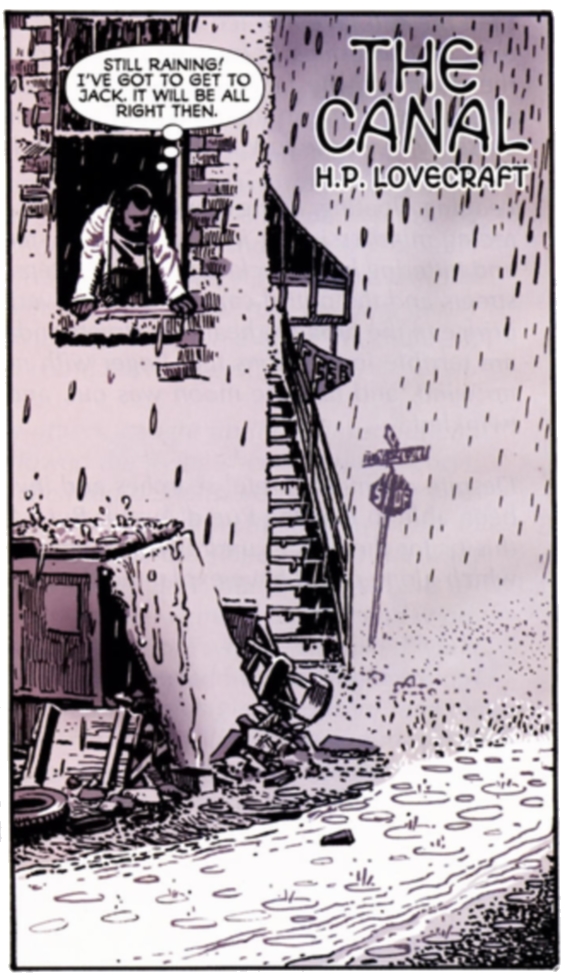
There was a very very loose comics adaptation of The Canal found in Richard Corben’s Marvel Max series H.P. Lovecraft’s Haunt of Horror (issue 2):

The Canal adapted from the poem by H.P. Lovecraft - for Marvel Max series H.P. Lovecraft's Haunt of Horror, #2

Posted by Jesse Willis

The House by H.P. Lovecraft

SFFaudio News

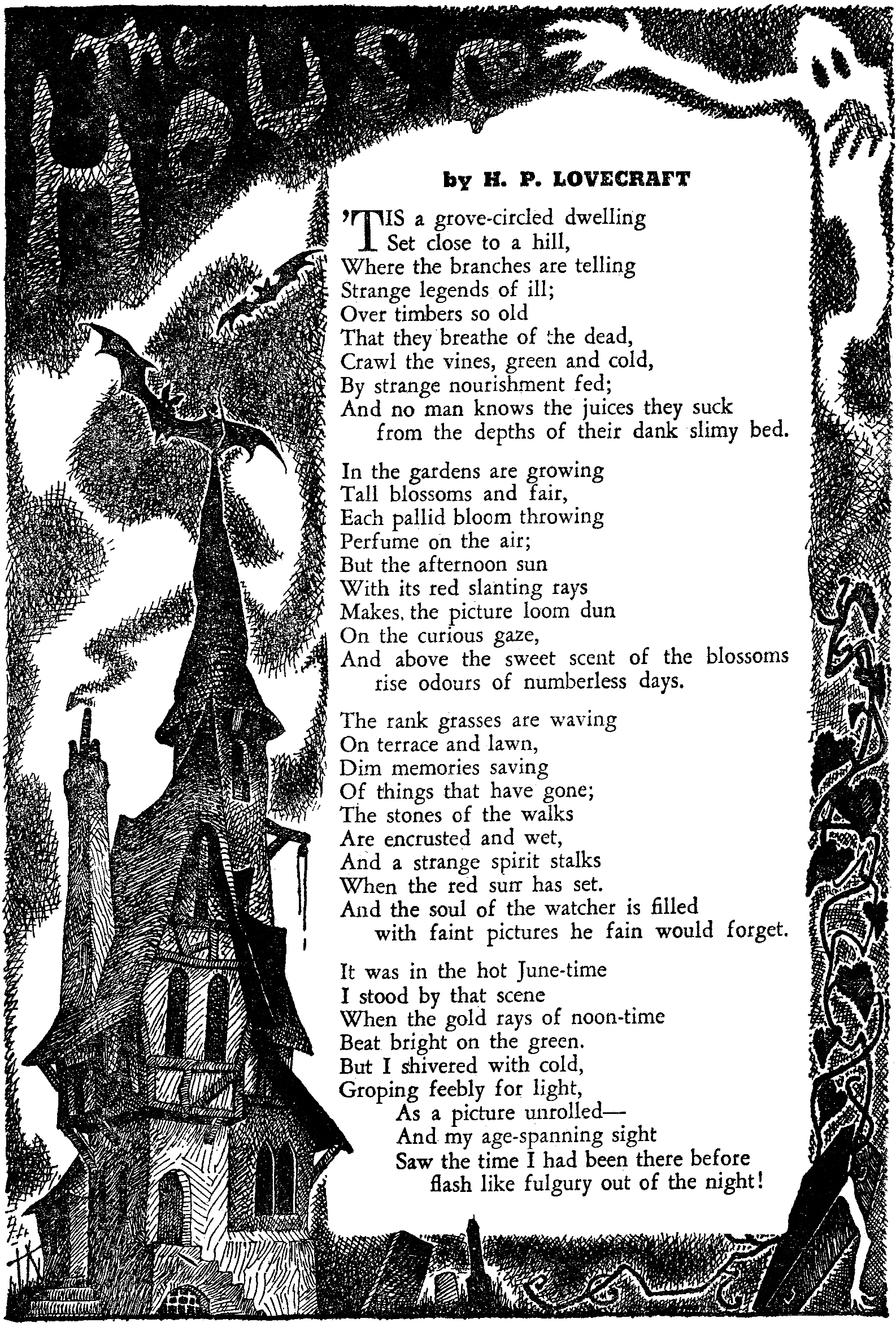
The House, by H.P. Lovecraft, is a short poem first published in The Philosopher 1, No. 1, December 1920. The illustrated version, below, came from Weird Tales, March 1948. The artist was Boris Dolgov. Based on the at you’d think it was a Halloween poem. But the poem is explicitly set in June.

The House by H.P. Lovecraft

The House by H. P. Lovecraft

’Tis a grove-circled dwelling
Set close to a hill,
Where the branches are telling
Strange legends of ill;
Over timbers so old
That they breathe of the dead,
Crawl the vines, green and cold,
By strange nourishment fed;
And no man knows the juices they suck from the depths of their dank slimy bed.

In the gardens are growing
Tall blossoms and fair,
Each pallid bloom throwing
Perfume on the air;
But the afternoon sun
With its shining red rays
Makes the picture loom dun
On the curious gaze,
And above the sween scent of the the blossoms rise odours of numberless days.

The rank grasses are waving
On terrace and lawn,
Dim memories sav’ring
Of things that have gone;
The stones of the walks
Are encrusted and wet,
And a strange spirit stalks
When the red sun has set,
And the soul of the watcher is fill’d with faint pictures he fain would forget.

It was in the hot Junetime
I stood by that scene,
When the gold rays of noontime
Beat bright on the green.
But I shiver’d with cold,
Groping feebly for light,
As a picture unroll’d—
And my age-spanning sight
Saw the time I had been there before flash like fulgury out of the night.

Posted by Jesse Willis

The SFFaudio Podcast #228 – READALONG: Last And First Men by Olaf Stapledon

Podcast

The SFFaudio PodcastThe SFFaudio Podcast #228 – Jesse and Jenny talk about the Last And First Men by Olaf Stapledon.

Talked about on today’s show:
the near and far future, not a novel, an imagined planetary history, the scope, Penguin Books, philosophy, the introduction, The Iron Heel by Jack London, a future history, human civilizations, two thousand million years (two billion years), universes => galaxy, man is a small part of the universe, Starmaker by Olaf Stapledon, Doctor Who, 2001: A Space Odyssey, what the plot would look like if there was one, the eighteen periods of man, evolution and construction, it’s set in 1930, is there ever an end to humanity?, Last Men In London by Olaf Stapledon, Last And First Men was popular in its day, Stapledon served in the ambulance service in WWI, plotlessness, period themes, the flying theme, the depletion of fossil fuels, The Mote In God’s Eye by Larry Niven and Jerry Pournelle, Venus, Mars, Neptune, the Martians, the Venusians, the genocide on Venus, Luke Burrage (the Science Fiction Book Review Podcast), racism, a Science Fiction mythology, the poetic musical ending, deep time, to the end of the Earth and beyond, Stapledon as an historian, civilizations always fall, there’s no one thing that ends civilizations, humanity as a symphony, the returns to savagery, establishing the pattern, Arthur C. Clarke, The House On The Borderlands by William Hope Hodgson, The Night Lands, The Time Machine by H.G. Wells, H.P. Lovecraft and cosmicism, the Wikipedia entry for Last And First Men, Fritz Leiber, Forrest Ackerman, scientificion, matchless poignancy, S. Fowler Wright, Lovecraft’s love of the stars (astronomy), one of the species of man is a monkey, another a rabbit, no jokes but perhaps humour, a cosmic joke, monkeys have made human their slaves, Planet Of The Apes, an ability to hear at the subatomic level, intelligence, a fourteen foot brain supported by ferroconcrete, obsession with gold, obsession with diamonds, pulping people, it’s written like a history textbook or essays, the Patagonia explosion, the upstart volcanoes, Earth Abides by George R. Stewart, The Scarlet Plague by Jack London, chiseling knowledge into granite, Olaf loved coming up with different sexual relationships, the 20 year pregnancy, suicide, euthanasia, an unparalleled imagination, groupthink, telepathy, oversimplification, we must press on, the baboon-like submen, the seal-like Submen, the divergence of man into other ecological niches, the number of ants in New York, ecosystems, nuclear weapons, robots are missing, where is the robot man?, the over-emphasis on fossil fuels as the only source of energy, if you could see us now, post-humans, ultimately a love letter to humanity, not aww but awwww!, Starmaker as a masterpiece, Sirius, uplifting a dog, a fantasy of love and discord, dog existentialism, who am I and where is my bone?, Olaf Stapledon in the PUBLIC DOMAIN, influential vs. famous, a very different read.

Last And First Men by Olaf Stapledon

Olaf Stapledon illustration by Neil Austin

Posted by Jesse Willis

Virtual Panel: The Future Of Audio Drama

SFFaudio News

Fred Greenhalgh, of Final Rune Productions (and Radio Drama Revival podcast) moderates this “virtual panel” entitled The Future Of Audio Drama – and though this thing needs serious editing, (not everybody has headphones) it does have the virtue of being brand new, recorded live from 3pm-4pm EDT, August 30th, 2013.

Participants include: Clare Eden (Minister of Chance), Christof Laputka (Leviathan Chronicles), Monique Boudreau (Aural Stage Studios), Joel Metzger (Hothouse Bruiser)

Posted by Jesse Willis

The Graveyard Shift: The Whisperer In Darkness by H.P. Lovecraft (read by Dudley Knight)

SFFaudio News

The Graveyard Shift - Readings by Dudley KnightI’m not sure when this reading would have been broadcast, likely sometime between the mid-1970s and the mid-1980s, but what we do know is the narrator, Dudley Knight. Knight was a U.C. Irvine professor of drama, who voiced a long running radio series called The Graveyard Shift. This is from that series.

Part 1 of 4:

Part 2 of 4:

Part 3 of 4:

Part 4 of 4:

Posted by Jesse Willis