Dimension X: Almost Human adapted from a story by Robert Bloch

SFFaudio Online Audio

Almost Human illustrated by Rod Ruth

This is a truly terrible story, by someone who is normally perceived to be a great author, Robert Bloch. I suspect Bloch chose the pseudonym for this one because it is so bad. Indeed, I suspect this is precisely the kind of story Isaac Asimov was trying to defeat with his Three Laws of Robotics. But beyond the dangerous robot trope it also features, at least to my ears, the most creepily lascivious robot ever!

Junior is oily, immoral, and oversexed.

Ewww!

Dimension XDimension X – Almost Human
Adapted from the story by Robert Bloch; Adapted by George Lefferts; Performed by a full cast
1 |MP3| – Approx. 29 Minutes [RADIO DRAMA]
Broadcaster: NBC
Broadcast: May 13, 1950
A gun moll answers an ad to be a nursemaid to a baby robot, things are fine until her boyfriend, a professional thief, shows up and teaches the robot a few things. First published in Fantastic Adventures, June 1943.

UPDATE:
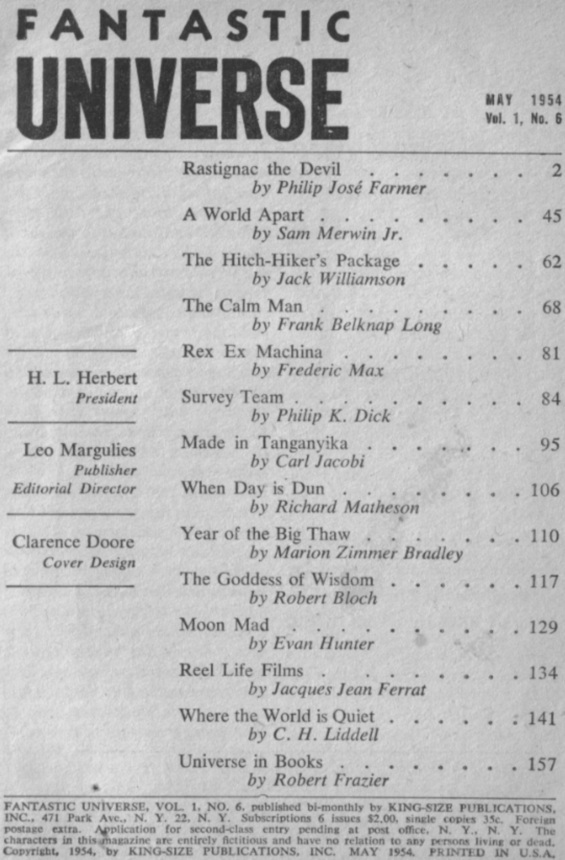
Here’s Robert Bloch’s introductory essay to Almost Human (as written for My Best Science Fiction Story a 1949 anthology edited by Leo Margulies and Oscar J. Friend):

Robert Bloch - "My Best Science Fiction Story" - Almost Human

Posted by Jesse Willis

Dimension X: The Potters Of Firsk adapted from the story by Jack Vance

SFFaudio Online Audio

The Potters Of Firsk - illustration by Edd Cartier

Here’s a hidden gem, a terrific adaptation of a sociological Science Fiction short story by the great Jack Vance! Plus it has materials science!

Dimension XDimension X – The Potters Of Firsk
Adapted from the short story by Jack Vance; Performed by a full cast
1 |MP3| – Approx. 25 Minutes [RADIO DRAMA]
Broadcaster: NBC
Broadcast: July 28, 1950
Provider: Archive.org
The native population of Firsk produce pots of every colour under the sun, save one. First published in the May 1950 issue of Astounding Science Fiction.

The Potters Of Firsk - illustration by Edd Cartier

Also check out this beautiful character study by Thomas Perkins:

The Potters Of Firsk illustration by Thomas Perkins

[via Tinkoo Valia’s Variety SF blog]

Posted by Jesse Willis

Review of Gather Yourselves Together by Philip K. Dick

SFFaudio Review

Gather Yourselves Together by Philip K. DickGather Yourselves Together
By Philip K. Dick; Read by Luke Daniels
Publisher: Brilliance Audio
Publication Date: July 17, 2012
ISBN: 978-1-4558-1435-0
[UNABRIDGED] – 9 compact discs; 11 hours

Themes: / Loss of innocence / Communist China / philosophy /

Publisher summary:

Gather Yourselves Together is one of Philip K. Dick’s earliest novels, written when he was just twenty-four years old. It tells the story of three American workers left behind in China by their employer, biding their time as the Communists advance. As they while away the days, both the young and naïve Carl Fitter and the older and worldly Verne Tildon vie for the affections of Barbara Mahler, a woman who may not be as tough-as-nails as she acts. But Carl’s innocence and Verne’s boorishness could end up driving Barbara away from both.

Prior to writing the complex reality-bending science fiction novels and stories that Philip K. Dick is best known for, he strived to be accepted as a mainstream writer; writing a handful of novels that on the surface bear little resemblance to the works that later became the source material for such films as Bladerunner and Total Recall. Gather Yourselves Together is one of these very early novels and one of a few to still be intact and published posthumously. The story revolves around three Americans left deserted among themselves in communist China to oversee the changing of the guard as their company is turned over to the Chinese.

At first the very basic and sparse plot spanning a few day period seems to bare little resemblance to the often sprawling narratives of Philip K. Dick’s better known alter-universes, but closer examination reveals several themes that would later re-occur in many of his better known stories. Additionally for enthusiasts, many autobiographical aspects of the author’s own life seem to be worked into the story. Although only mentioned in passing, a topic that would become a lifelong obsession and reappear in later novels is first mentioned in this novel: that of the time of the fall of the Roman and birth of Christianity being constantly repeated throughout history including during what Philip K. Dick thought was his own lifetime.

Narrator Luke Daniels does a great job breathing life into a novel that at 481 pages in length and which having little of substance actually take place in the span of the novel’s few days could easily have lost a listener’s interest. The story fills out the space by spending significant time on the past of the three characters while focusing on their current relationships in the present. The overall tone of the book is fairly dismal, which each character being extremely self-absorbed in their own ways but being drawn together due to circumstance. That being said, much of the story has a theatrical feel that builds to a very satisfying conclusion. The audiobook ends with an afterword by Dwight Brown, also read by Luke Daniels. Gather Yourselves Together succeeds on many levels and is certainly not a book to be avoided simply due what would seem to be an uninteresting premise when compared some of Philip K. Dick’s wilder, better known works.

Review by Dan VK.

LibriVox: The Tomb by H.P. Lovecraft

SFFaudio Online Audio

An early tale of “unspeakable horror” this reading by D.E. Wittkower is very good.

"A Tomb To Die For" by Dr Faustus AU - H.P. Lovecraft's The Tomb

LibriVoxThe Tomb
By H.P. Lovecraft; Read by D.E. Wittkower
1 |MP3| – Approx. 32 Minutes [UNABRIDGED]
Publisher: LibriVox.org
Published: January 23, 2008
Jervas Dudley found an abandoned mausoleum in the forest near his home, then he found himself strangely attracted to it. First published in the March 1922 issue of The Vagrant.

Also be sure to check out DrFaustasAU’s unfinished Dr. Seuss style version that begins HERE.

Posted by Jesse Willis

Review of Two for Texas by James Lee Burke

SFFaudio Review

Two for Texas by James Lee BurkeTwo for Texas
By James Lee Burke; Read by Will Patton
Publisher: Simon & Schuster Audio (link includes an audio sample)
ISBN: 144235478X
Published: January 2013
[UNABRIDGED] – 5 discs

Themes: / Western / Alamo / Prison Break /


Publisher Summary:

Son Holland arrived in the Louisiana penal camp determined not to spend the rest of his days suffering in a chain gang—but he didn’t imagine for one minute that in order to escape he would need to kill a man. Terrified for his life, he flees the state across the river to Texas, taking with him a beautiful Indian squaw and a fellow prisoner. And as they make their way towards General Houston’s infamous Texas Rangers they find themselves in the midst of the final tragic battle for the Alamo. 

Two for Texas is one of James Lee Burke’s earlier works prior to him hitting his stride with the Robicheaux series of novels in the late 80s, which have through carried him to present day. In addition to these novels, two other Burke characters, cousins Hackberry Holland and Billy Bob Holland, have both had multiple books focusing on them – most recently the Hackberry Holland novel Feast Day of Fools released in 2011.

Two for Texas, first published in 1989, tells the story of the Holland’s great-grandfather Son and his escape into Texas from a Louisiana penal camp along with another hardened convict and their participation in a series of events leading to the battle for the Alamo. Actor Will Patton does a superb job handling the narration on this audiobook, easily tackling the various dialects of the many characters of diverse backgrounds in this story. Will Patton is no stranger of the work of James Lee Burke having recorded a dozen or more previous audiobooks of the author’s works. The combination works great and I am looking forward to checking out some of the others in the near future.

Review by Dan VK.

The SFFaudio Podcast #198 – READALONG: The Martian Chronicles by Ray Bradbury

Podcast

The SFFaudio PodcastThe SFFaudio Podcast #198 – Jesse, Tamahome, Jenny, and Professor Eric S. Rabkin discuss The Martian Chronicles by Ray Bradbury.

Talked about on today’s show:
Rock Hudson, The Martian Chronicles (TV adaption), Eric’s Coursera course (Fantasy and Science Fiction: The Human Mind, Our Modern World), The Million Year Picnic, I, Mars, The Moon Be Still As Bright, Usher II, the hot dog stand on Mars, fix-up, The Long Years (a robot family), Night Call Collect, There Will Come Soft Rains, a book of poems, novels of recurring characters, “composite novels”, “the culminating image of the whole book”, Cortez burning his ships, “were definitely going to need the daughters” (if the daughters are willing), Joanna Russ, Picnic On Paradise, The Million Year Picnic, “tamed nature”, the publisher’s motivation, Walter Bradbury, the market change (with Ballantine Books), “Mammon rules again”, the table of contents, Way In The Middle Of The Air, a more Edenic ending, 1984, North Korea, Earth Abides, the Golden Gate Bridge, getting a sense of the author, H.P. Lovecraft, colour, repetition, word choice, Spender, The Moon Be Still As Bright, Captain Wilder, the instinct to be cruel, the instinct to minimize the horror, the instinct to shoot the tomb robbers, feeling the emotion he’s trying to give us, the physics, nostalgic, seeing it from all sides, Farewell Summer, Bradbury’s gut reactions, The Martian Chronicles as a fairy tale, Isaac Asimov’s reaction, Fantasies set in space, Usher II and censorship, “the Poe machines”, the colour of Mars’ sky (blue and pink), the Martian canals, The Green Morning, Johnny Appleseed, the epigraph, “…space travel has again made children of us all.”, Christopher Columbus, the Chicken Pox plague, Another America, telepathy, the noble savage, a symbolic America, The Pedestrian, Bradbury was a strange guy, Fahrenheit 451, Edgar Rice Burroughs, the Martian high culture, the second expedition, “look up in space, we could go to the Moon!”, dinosaurs!, Mars Is Heaven, Science Fiction is supposed to have knowledge in it, imagery (sight, light, and fire), the brass band, Columbia, The Gem Of The Ocean, music, Humans are technological, Martians are emotional, the window, Beautiful Ohio, music dominates (not intellectual knowledge), Genevieve Sweet Genevieve, “fully lyrical”, the fire lay in the bed and stood in the window, the dog symbolizes the entire loss of the human race, the long monologues, getting it without filtering it, The Musicians, Rocket Summer, “it made climates”, the silences, the music as a symbol for American culture, the killing spree, The Off Season parallels with the second expedition, an inversion, Bradbury has it every way, Emma Lazarus, The New Colossus, Sam Parkhill, an epitome of perverted American ideals, Bradbury loves hot dogs, Dark Carnival, Something Wicked This Way Comes, mournful Mars, America by Ray Bradbury, the Wikipedia entry for The Martian Chronicles, The Taxpayer, the urge to improve, alas, the silhouettes on the house, Chernobyl vs Hiroshima, a grim meme, what gives this book it’s staying power?, Nightfall by Isaac Asimov, L’Anse aux Meadows and Roanoke, maybe it’s circular, “we’re the Martians now and we will be again”, Night Meeting, Stephen Hoye narrated Blackstone Audio, Bradbury’s reading, Bradbury’s first flight, Harlan Ellison, wasting time on the internet, Ylla, The Ray Bradbury Theater, Mardi by Herman Melville, making this book cohere, what part doesn’t fit?, reading it as short stories, “it’s an American book”, robots, decommissioning is murder, Ray Bradbury and Philip K. Dick had a shared contempt for litterers, crassness, The Electric Ant, Do Androids Dream Of Electric Sheep?, I Sing The Body Electric, Walt Whitman, “it’s the music!”, there’s no switch, gingerbread and tea, Helen O’Loy by Lester Del Rey, are there stories not included in The Martian Chronicles that should have been?, Way In The Middle Of The Air, The Other Foot, different editions of The Martian Chronicles, The Illustrated Man, The Fire Balloons, Stranger In A Strange Land, Grouch Marx (Lydia the Tattooed Lady), The Penal Colony by Franz Kafka, The Veldt, The City, Rod Steiger, Dandelion Wine, The Canterbury Tales by Geoffrey Chaucer.

The Martian Chronicles illustration by Michael Whelan
The Martian ChroniclesThe Off Season by Ray Bradbury - illustration by Vincent Napoli
Way In The Middle Of The Air by Ray Bradbury - illustrated by Robert Fuqua
The Earth Men by Ray Bradbury - Thrilling Wonder,  August 1948
Dwellers In Silence by Ray Bradbury - Planet Stories
The Million Year Picnic by Ray Bradbury - illustrated by Leydenfrost

Posted by Jesse Willis