
In which we ask relevant questions such as: “If you had to choose a universe without either Ray Bradbury or Neil Gaiman, which would you pick?” and “Which is the worst audiobook recording ever made?”
The shownotes are HERE.
Posted by Jesse Willis
News, Reviews, and Commentary on all forms of science fiction, fantasy, and horror audio. Audiobooks, audio drama, podcasts; we discuss all of it here. Mystery, crime, and noir audio are also fair game.

In which we ask relevant questions such as: “If you had to choose a universe without either Ray Bradbury or Neil Gaiman, which would you pick?” and “Which is the worst audiobook recording ever made?”
The shownotes are HERE.
Posted by Jesse Willis
 Jerry Stearns writes in to say:
“It’s the 15th Annual Mark Time Awards for Best Science Fiction Audio Theater.
The deadline for entry in the Mark Time Awards for SF audio theater, and the Ogle Awards for Fantasy/Horror audio theater is coming up. It must be postmarked by March 1. So, producers, get us your best material soon.
We’ve simplified it this year. You can send us only one (1) CD, either audio or MP3, or you can tell us where to download the files you want us to hear. The MP3s much be at least 256 kbps and 16 bit depth, though, so don’t skimp. You do still have to send in the entry form and entry fee.
Take a look at (http://www.greatnorthernaudio.com/MarkTime/MarkTime.html) for further information.
As an added incentive, whether you win a Mark Time or an Ogle this year or not, if you can attend ConVergence, the convention where we present the awards, you’ll get to hang out with the creators of Mark Time himself, the Firesign Theatre. Peter Bergman, David Ossman and Philip Proctor will be attending the convention to perform, present the awards, and share the Mark Time Breakfast with all the winners. You can pick up their new book of FST plays and get it autographed. Check out Convergence at (http://www.convergence-con.org/) for more.”
Posted by Jesse Willis
Studio One, a long running anthology series on CBS television, broadcast The Night America Trembled on September 9th, 1957. It was a one hour television recreation of the supposed effect of Orson Welles’ radio broadcast of The War Of The Worlds on October 30th, 1938.
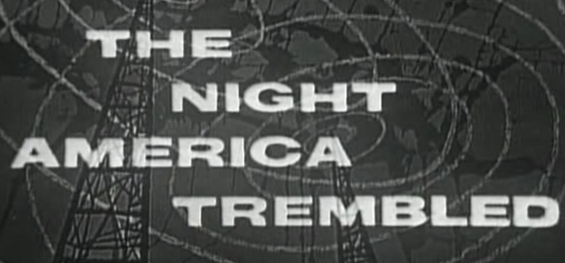
Conspicuous by it’s absence is the man himself. The actor portraying Orson Welles is described simply as the “host of the Mercury Theatre”. The cast includes a number famous actors in small roles, including James Coburn as a father who has his nioght out rudely interrupted by a hysterical teenage girl. Looking around the web I note that The Night America Trembled has garnered nothing but tremendously positive reviews. Thankfully you can decide that for yourself as the entire play PUBLIC DOMAIN and is available via Archive.org.
Download options |AVI|OGV|MP4|
My favourite part of it was all the Westinghouse commercials. Household appliances seem to have stopped evolving. My modern toaster looks like the Westinghouse model and cost about the same too.
Watch right to the end to see the intriguing descriptions for the next two shows (one a murder mystery based on a short story by John D. MacDonald and another a drama set on an atomic submarine).
I should also mention that there is second TV adaptation of the same story, entitled The Night That Panicked America, broadcast in colour on October 31, 1975. It has never been officially released but is available via torrent.
Posted by Jesse Willis
This is the story of the story of the story of The War Of the Worlds.
From House Of Mystery issue #50 (May 1956) George Kashdan tells the legend of the October 30th 1938 Mercury Theatre’s broadcast adaptation of The War Of The Worlds.
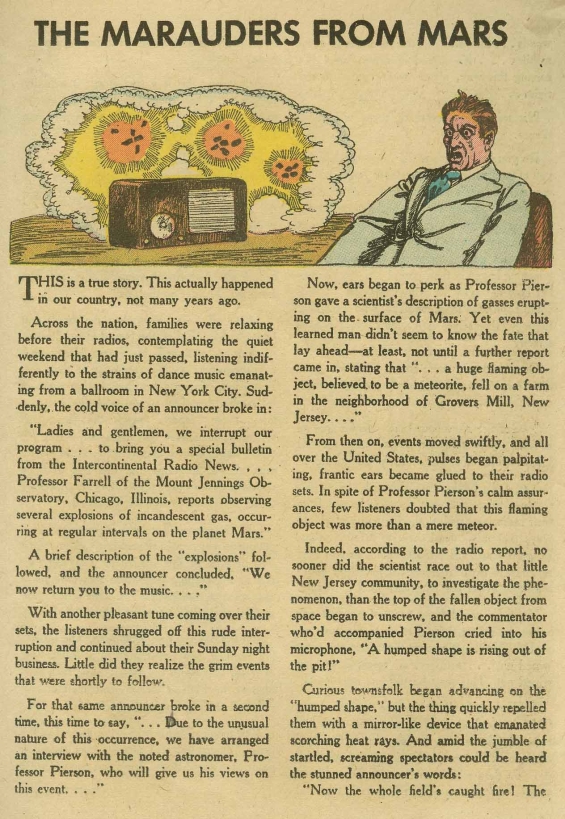
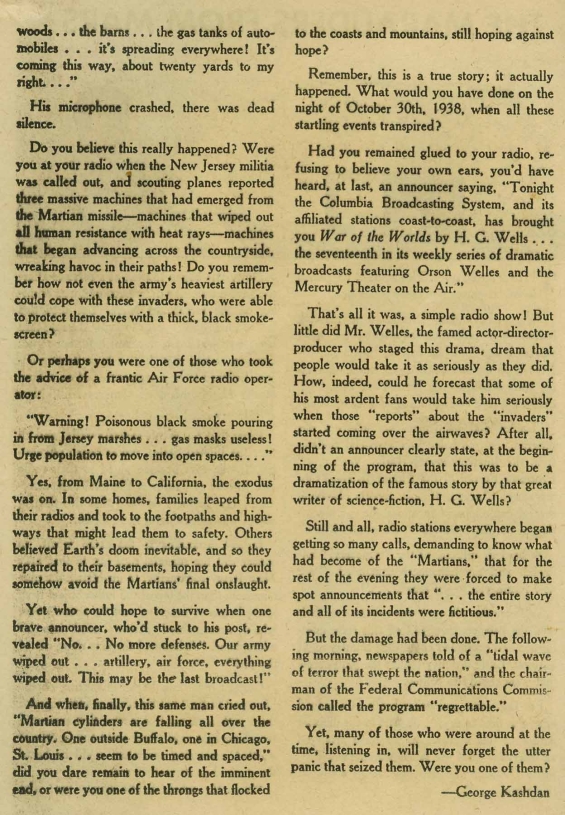
Here’s Orson Welles’ apology:
Posted by Jesse Willis

I’ve been listening to audiobooks my whole life.
It started as a young boy when adults would read me bedtime stories. Then, as I grew up, I turned to 8-tracks and LP records. Then for a long time in the 1980s and 1990s I was using cassettes almost exclusively.
For personal portability, with cassettes, I used about Sony Walkmans and Sanyo knock-off walkmans. At home I used ghetto blasters and clock radios with cassette players.
Eventually CDs came in, and I used them concurrently with cassettes. They were followed by MP3-CDs. Then I was using iPods (I owned four over the years, three Nanos and a Mini). Every technology that’s has come in has improved the accessibility and portability of audiobooks for me.
Today I pretty much use just one device for all my audiobook and podcast listening. That’s my iPhone 3GS.
I use it so much I had to start worrying about it holding a charge for the whole day.
The current solution I’ve come up with has been very satisfactory. I use three separate charging docking stations at home. All of them are identical, the Sony ICF-CS10iP. I have one at my computer, one in my bedroom, and one in my bathroom.
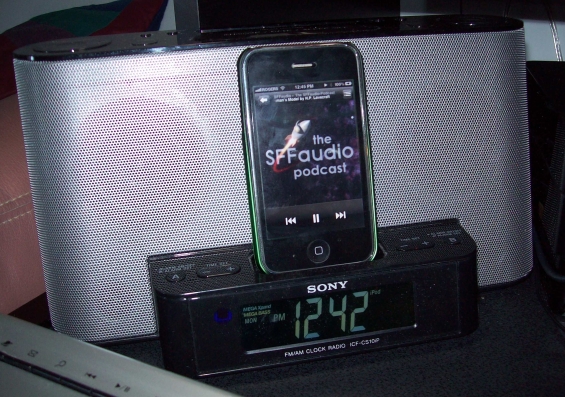
In fact, I’ve liked it so much I bought a fourth for work and use it in my classroom. I gave one to my niece and one to my sister and my mom bought one for herself and I bought one for a friend too. They come with a little remote control, but I tend to have them near at hand most of the time.
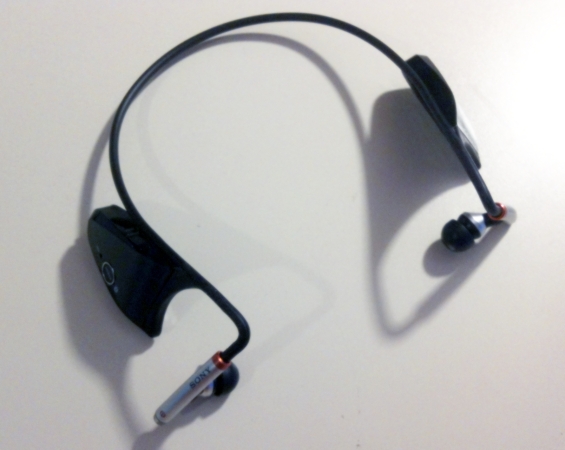
When not at home listening I’ve used light and cheap over the ear earphones for most of my life. But I’ve always disliked the burden of cords. So, for about six months now, I’ve been using a Sony DR-BT160AS headset. I don’t like the fact that it is an in-ear ear-bud model, but the fact that it combines stereo earbuds with a microphone with a behind-the-neck mount and NO CORD at all make them a substantial improvement over every pair of headphones I’ve used before. It is rechargeable (with an internal battery) and sustains a charge for several hours of use. It’s Bluetooth enabled and works incredibly well at a distance of up to ten meters or so. In fact it actually works a little better when at a distance than it does when close up.
Unfortunately, like any pair of earbuds they aren’t truly comfortable, but their compact size, the built in microphone, and the lack of cables makes me very pleased to have a pair. I actually bought a second set shortly after the first so that I’ve got as a backup for when the first dies.
What hardware do you use to listen to audiobooks and podcast?
Posted by Jesse Willis

 Nora Young interviewed Mary Robinette Kowal on CBC Radio’s Spark podcast #172. Kowal talked to Young about her Month Of Letters challenge and how writing a letter by hand has changed the way she writes and thinks about writing.
|MP3|
Podcast feed: http://www.cbc.ca/podcasting/includes/spark.xml
Posted by Jesse Willis