The Diamond Lens by Fitz James O’Brien

SFFaudio Online Audio

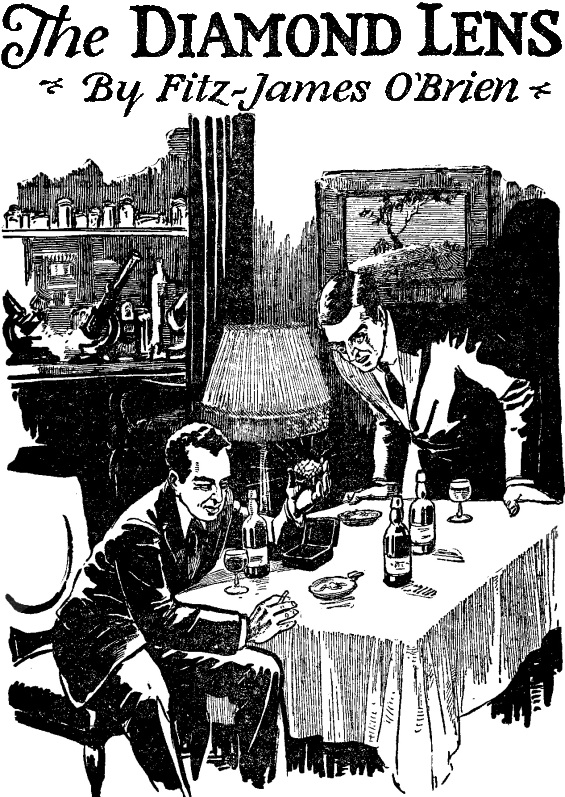
The Diamond Lens by Fitz James O'Brien - illustration uncredited - December 1926 issue of Amazing Stories

I’ve created a |PDF| from the printing in the December 1926 issue of Amazing Stories.

Introduction to the October 1933 issue of Amazing in which The Diamond Lens was published

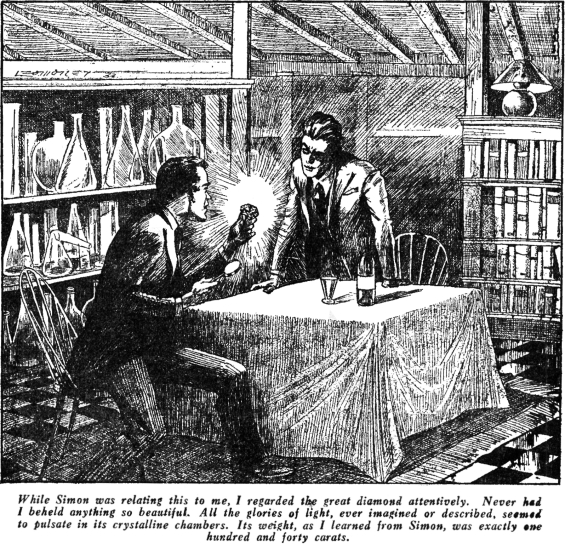
The Diamond Lens - Illustration by Morrey

I’ve created a |PDF| from the printing in the October 1933 issue of Amazing Stories.

In his introductory essay “Expanding The Lens“, found in to the story in The Road To Science Fiction: From Gilgamesh To Wells, editor James Gunn writes:

“[The Diamond Lens] is the first known story in which another world is perceived through a microscope… [this story] opened up another world, not just for readers, but for writers as well.” Gunn goes on to praise O’Brien’s “realistic treatment of the fantastic” and says that “‘The Diamond Lens‘” may be the first modern science-fiction story.”

LibriVox narrator Corrina Schultz describes The Diamond Lens this way:

“This story has a bit of everything – obsessive scientist, psychic medium contacting the dead, clever murder cover-up, racism, creepy stalker, college student shirking his studies, the painful results of pursuing forbidden knowledge, the noble savage…”

Atop those words I myself can heap a few other attractors:

1. The Diamond Lens is bizarre in both plot and focus, with episodic like writing <-Weird for a short story. 2. It has the sensibility of a foreign culture <-The 19th century attitude toward seances is pretty fucking foreign! 3. The protagonist is a mad microscopist. <-Perhaps he was demented by the illicit lure of science? 4. The story features a brutal killing. <-With a whackjob of added racism to complicate matters! 5. It has a noir ending. <-My favourite kind. As you may have guessed I quite enjoyed The Diamond Lens.

Stories like Harl Vincent’s Microcosmic Buccaneers (1929), Theodore Sturgeon’s Microcosmic God (1941) and both Sunken Universe (1942) and Surface Tension (1952) by James Blish all stem from the microscopic pioneering of The Diamond Lens. Whereas the theme, of an alien female object of adoration in an unreachable land, also brings to mind a mighty parallel with Jack Williamson’s The Green Girl (1930). And one final note, a quick read of the Wikipedia entry for Fitz James O’Brien makes me think some of the tale is autobiographical!

LibriVoxThe Diamond Lens
By Fitz James O’Brien; Read by Corinna Schultz
1 |MP3| – Approx. 57 Minutes [UNABRIDGED]
Publisher: LibriVox
Published: FORTHCOMING
A scientist, having invented a powerful microscope, discovers a beautiful female living in a microscopic world inside a drop of water. First published in the January 1858 issue of The Atlantic Monthly.

The Weird CircleThe Diamond Lens
Based on the story by Fitz-James O’Brien; Performed by a full cast
1 |MP3| – Approx. 25 Minutes [RADIO DRAMA]
Broadcaster: MBS, NBC, ABC
Broadcast: December 31, 1944
Provider: Archive.org

Arthur C. Clarke describes The Diamond Lens (from an article in Playboy)

Posted by Jesse Willis

Forgotten Classics: The Beautiful People by Charles Beaumont

SFFaudio Online Audio

“Beauty is no quality in things themselves: It exists merely in the mind which contemplates them; and each mind perceives a different beauty.”
– David Hume (Of The Standard Of Taste)

We tend to forget. Scott Westerfeld’s Uglies series seemed fresh and original when it came out a couple years ago. But that’s because we’d forgotten about Charles Beaumont and The Beautiful People. Westerfeld wrote four novels exploring territory that Charles Beaumont pioneered. It’s short story that packs a helluva punch. Imagine a world when everyone around you says that you are ugly, that you’re fat. that you’re unhealthy, that you’re self image is completely wrong, and most importantly that you’ve got to change because social position will be completely untenable.

Now imagine that world – our world – just a few years in the future. A world in which everyone wears a mask on all the days before and after October 31st.

Pure horror.

The Beautiful People has stuff to say about beauty and ugliness, the proper place of women, the value of book reading, as wells as the passing fads of sleeping and eating.

Here is a |PDF| version.

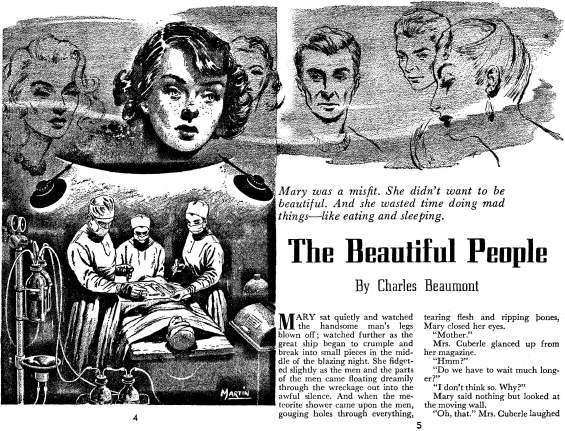
The Beautiful People illustration by Martin

Forgotten ClassicsThe Beautiful People
By Charles Beaumont; Read by Julie Davis
1 |MP3| – Approx. 47 Minutes [UNABRIDGED]
Podcaster: Forgotten Classics
Podcast: October 2011
|ETEXT|
Mary was a misfit. She didn’t want to be beautiful. And she wasted time doing mad things—like eating and sleeping. First published in the September 1952 issue of If Worlds of Science Fiction.

The Twilight Zone adapted The Beautiful People into an episode entitled Number 12 Looks Just Like You.

Posted by Jesse Willis

BBC Radio 4 Extra: The Eagle Of The Ninth RADIO DRAMA

SFFaudio Online Audio

Last weekend saw the re-broadcast of first episode (of four parts) of the 1996 BBC’s radio dramatisation of The Eagle Of The Ninth, that’s Rosemary Sutcliffe’s excellent YA novel. It was recently turned into a pretty good film (The Eagle). If you’re a fan of Henry Treece, as I am, you’ll probably also like Sutcliffe. The next three parts will air on subsequent weekends. I hope to collect them all over on RadioArchive.cc when it completes. Based on the first episode, listenable HERE, you may want to do the same. Sadly no unabridged version of the audiobook currently exists.

BBC Radio 4 ExtraThe Eagle Of The Ninth
Based on the novel by Rosemary Sutcliffe; Dramatised by Sean Damer; Performed by a full cast
4 (half-hour) Broadcasts – Approx. 2 Hours [RADIO DRAMA]
Broadcaster: BBC Radio 4 Extra
Broadcast: Sunday October 23, 2011 (and the subsequent three Sundays)
Can Marcus recover his father’s reputation and the lost Eagle from his legion in Rosemary Sutcliffe’s children’s adventure set during the Roman occupation of Britain?

Cast:
Tom Smith
Mark Coleman

Produced by Hamish Wilson

Here’s the trailer for the recent movie version:

Posted by Jesse Willis

BBC Radio 4: Something Wicked This Way Comes AUDIO DRAMA

SFFaudio Online Audio

The BBC is not noted for programming that specifically celebrates Halloween. There is, however, a new production of the Ray Bradbury classic Something Wicked This Way Comes (a full cast radio production), which is one thing that is wickedly coming this way this weekend:

BBC Radio 4The Saturday Play – Something Wicked This Way Comes
Adapted from the novel by Ray Bradbury; Dramatised by Diana Griffiths; Performed by a full cast
1 Broadcast – Approx. 1 Hour [RADIO DRAMA]
Broadcaster: BBC Radio 4
Broadcast: Saturday October 29, 2011 (14:30-15:30)
Set in 1960’s Illinois this gem of modern Gothic literature is the memorable story of two boys, James Nightshade and William Halloway, and the evil that grips their small Midwestern town with the arrival of a “dark carnival” one Autumn midnight. These two innocents, both aged 13, (Will is born one minute before Halloween, and Jim one minute after) save the souls of the town (as well as their own). This is a vivid variation on the eternal theme of the fight between Good and Evil. A thrilling, chilling, richly kaleidoscopic sound world ensues; a shimmering mirror maze that reflects your older or younger self, depending on your desires, and a magic carousel that plays Chopin’s Funeral March forwards – with each rotation you gain a year, and rotating backwards – you get younger.

Cast:
Will … Theo Gregory
Jim … Josef Lindsay
Charlie … Henry Goodman
Mr. Dark … Kenneth Cranham
Mr. Coogar/Lightening rod salesman … Gerard McDermott
Miss Foley … Barbara Barnes
Dust Witch … Buffy Davis
Robert … Taran Stanzler
Young Miss Foley … Amelia Clarkson
JED … Ethan Brooke
Composer … David Paul Jones
Sound … Paul Cargill
Produced/Directed by Pauline Harris

[Thanks Roy]

Posted by Jesse Willis

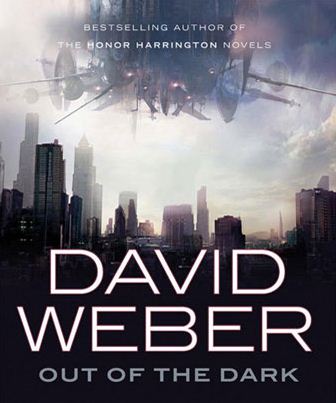
Review of Out of the Dark by David Weber

SFFaudio Review

Science fiction audiobook - Out of the Dark by David WeberOut of the Dark
By David Weber; Read by Charles Keating
17 hours – [UNABRIDGED]
Publisher: Macmillan Audio
Published: 2011
Themes: / Science Fiction / Military / Aliens / Alien invasion / Historical /

No one would have believed in the early years of the 15th Century that human affairs were being watched from the orbiting ships of the Galactic Hegemony’s Survey Force. No-one could have dreamed that we were being scrutinised as the French and English forces advanced towards each other across the field of Agincourt. Few men even considered the possibility of life more vegetarian than ours and yet, from their survey ships, minds immeasurably more craven than ours, regarded this Earth with horrified revulsion. And slowly and surely, they drew their plans against us.

David Weber attempts to take the traditional alien invasion and add an unusual twist. The twist, unfortunately, isn’t brought to fruition until very nearly the end of the book, where it clangs into place more like a late addition, a Deus Ex Machina.

Out of the Dark starts as a typical alien invasion: ships arrive in-system, observe us for a while to find where the big cities and military bases are, then strike them from orbit. Wipeout the majority of the population and then attempt to sweep in to rule over the cowering survivors. Shock and Awe. Unsurprisingly the aliens discover how tenacious we humans are. They struggle to comprehend why we are unhappy about having half the population of Earth wiped out in an afternoon. Is there something wrong with us? Are we not civilised?

In the Galactic Hegemony vegetarianism is the norm for intelligent star-faring races. Omnivores and carnivores being too aggressive to develop the required technological base required to reach the stars without wiping themselves out. There is one exception to this rule, the Shongairi, and they make the other races in the Hegemony nervous just by existing. So, in an attempt to weaken the Shongairi, the Hegemony grant them the right to colonise three other worlds, including one discovered some 500 years before. A world that also has the pacifistic Hegemony worried.

According to the Colonisation rules of the Hegemony, any race that has not advanced enough technologically are fair game to be colonised. Naturally their assumption is that Earth, being populated by a crazy race that commits such bloodthirsty battles as that observed at Agincourt five centuries earlier, will still be very low on their technology scale. The Shongairi are then somewhat surprised to find that we have developed so far as we have, indeed possessing some technologies that rival their own. We may still be trapped upon our home planet, but we have advanced computer technology and encryption techniques that make them think we should really be classed at a level where we would be granted a protected status. Considering the expense of the time and resources involved in the launch this offensive, the Shongairi Commander decides to sweep that data under the carpet and hope that no-one notices. Bombing us back to the stone-age to hide the evidence if necessary. And thus the invasion goes ahead and half the world’s population is lost to a kinetic bombardment.

The novel follows several characters, although most are expended showing how effective our weaponry is against an alien ground force that expected to face nothing more advanced than a bow and arrow. They are expended in that they demonstrate, repeatedly, that the Shongairi react with overwhelming orbital strikes. This pattern repeats several times through out the book and does become a little tedious.

The Shongairi alien nature is basically that of a predatory pack animal, almost canine in nature. Their philosophy is that when faced with an overwhelming opponent you surrender. That humans refuse to acknowledge the Shongairi’s superiority confuses them. This mentality reminded me a lot of the elephant-like aliens from Larry Niven and Jerry Pournelle’s Footfall from the ’80’s.

The characters include Master Sergeant Stephen Buchevsky who finds himself a passenger on a military cargo plane flying over Eastern Europe when the aliens strike and his plane is force to make a crash landing. With only a handfull of other US personnel from the plane he begins gathering locals around him as he becomes their protector. He joins up with a local group who’s charismatic leader seems to be too friendly, helpful and successful at defending against the Shongairi. Buchevsky is a gee-shucks hero doing the best he can.

One of the other main characters is Dave Dvorak. Or, as I think of him, Dave “Mary Sue” Dvorak. Dvorak is one of the most prepared people to hide out in the Carolina hills, in what reads like a palatial cabin with his family and friends. Although he actually does very little plot-wise he becomes a middle-man for lots of other survivors in the area and through these contacts we hear about much of what is happening in the world. When we aren’t watching sacrificial attacks against Shongairi troops. We do get to hear in excruciating detail how, over the previous few years, he and his brother-in-law converted a family cabin in the woods into a home away from home, complete with redundant power generators, hidden food and weapon caches and a huge underground fresh water tank.

We are also shown the invasion from the alien’s perspective. Much of their emotions are expressed in the positioning and twitching of their ears, reinforcing the K-9 impression that their omnivore and pack nature suggests. There is almost no physical description of them, that I remember, beyond this.

The cover blurb talks of the survivors receiving help from an “old enemy”. I’m not going to spoil this aspect of the book, although I guessed it just from reading the blurb and was actually looking forward to it. Other readers have claimed to have been blind-sided by it. I can see why, but only if they simply hadn’t read the book cover. It is not a genre I’m aware Weber has written in before. I was disappointed with the execution of this aspect. The surprise element doesn’t feel integrated into the book as a whole. It really felt like the story had originally been written without it, then realising that he had dug a hole too deep for humanity to get out of, he had to go back and add this in to tip the scales in our favour. The conclusion wraps up very quickly; like a TV series been told they are being cancelled and only have two episodes to wrap everything up. Or he got bored with the story and wanted to finish it and move on to something else.

And yet, this is not the worst aspect of this book for me. I have also been listening to Weber’s Safehold series, but have abandoned it after the third book, in large part due to this flaw. Weber has started writing massive monologues for many of his characters that run on for tens of minutes at a time. They are both internal and external discourses where the characters go into minute detail about what has already happened, their current position, beliefs, expectations and plans. Two or three times per book I could swallow, but this feels like it is becoming Weber’s go-to method of filling out a scene. They feel completely unnatural, especially when it is one character talking at another. In some situations this would be okay, a specific character who was prone to this sort of thing, or that the situation called for the character to speak for such an extended time, without any apparent aide-memoire or time to prepare. Even if it helped to move the plot on quickly, I might be tempted to forgive it, but it seldom does. It is often a repeat of information we already know, explained from the current character’s slightly different perspective. Yet not actually adding anything to the story other than word count. Unfortunately any interruption to my listen during one of these monologues meant that when I returned I had no little or no idea who was talking. I could eventually infer who was talking, after a few minutes, based on the geography and names of characters they mentioned, but seldom from how the character spoke. Neither the writing nor unfortunately the narration had enough colour when it came to most of the character voices.

The narrator, Charles Keating, does well with most of the book, especially the alien lisping Shongairi. Unfortunately he too struggles to bring life into Weber’s indigestible, interminable speeches.

This had the potential to be an interesting hybrid of genres, but really feels like something bolted on at the end. Weber’s editor needs to get tough with him and curtail those endless monologues.

Posted by Paul [W] Campbell

The Thousand-And-Second Tale Of Scheherazade by Edgar Allan Poe

SFFaudio Online Audio

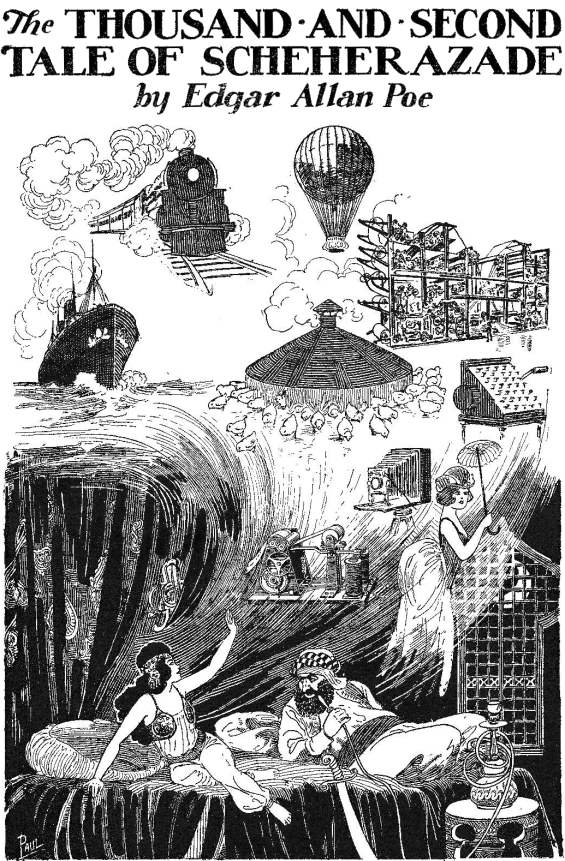
The Thousand-and-Second Tale of Scheherazade by Edgar Allan Poe - illustration by Frank R. Paul

Here’s the uncredited editorial introduction, presumably by Hugo Gernsback himself, to The Thousand-And-Second Tale Of Scheherazade as it appeared in the May 1928 issue of Amazing Stories:

“When we realize that this story was written nearly 100 years ago, we must marvel at the extraordinary fertile imagination of Poe. Poe was probably the inventor of “Scientifiction” as we know it today, and just because the story was written almost a century ago, certainly does not make it less valuable. On the contrary, it becomes more valuable as time passes. It is just as applicable to the modern man, who is mostly in the fog about what goes on around him in science today, as his predecessors were a century ago.”

Indeed, if you read it straight through, without pausing to read the footnotes, you’ll probably only get a vague sense of what’s going on in this story. And though I think I tumbled to the idea pretty early on, I still found myself in many places echoing the king’s many harrumphs. I’m not one to use the term “genius” lightly, but if anyone is worthy of the term, it is certainly Edgar Allan Poe. Even in his lesser works, like The Thousand-And-Second Tale Of Scheherazade, there is a wry brilliance that may be entirely matchless.

LibriVoxThe Thousand-And-Second Tale Of Scheherazade
By Edgar Allan Poe; Read by Gregg Margarite
1 |MP3| – Approx. 55 Minutes [UNABRIDGED]
Publisher: LibriVox
Published: October 1, 2009
First published in the February 1845 issue of Godey’s Lady’s Book.

And here’s the matching |PDF|.

Posted by Jesse Willis