News, Reviews, and Commentary on all forms of science fiction, fantasy, and horror audio. Audiobooks, audio drama, podcasts; we discuss all of it here. Mystery, crime, and noir audio are also fair game.
Yep, it’s another post on Bill C-32, Canada’s upcoming copyright legislation. Perhaps you are already aware that C-32, as currently written, exists to enshrine legal punishments for the circumvention of “technological protection measures [TPMs].” TPM, by the way, is a less sullied acronym for the widely opposed DRM (Digital Rights Management) – which is another word, in turn, for copy protection. Here is CBC’s Nora Young interviewing David Fewer, the director of The Canadian Internet Policy and Public Interest Clinic, for an upcoming Spark radio broadcast (and podcast).
The Canadian government is taking another crack at reforming our nation’s extremely outdated copyright laws. Two previous bills died when Parliament dissolved. But Bill C-32 is bright-eyed, bushy-tailed and before committee. How necessary are these changes? The current legislation includes mention of Beta Max machines. Meanwhile, Bill C-32 would finally make it legal to record a program on your VCR to watch at a later time. Yes – a practice that is technically illegal in Canada.
The SFFaudio Podcast #083 – Jesse talks with Jeremy Keith of HuffDuffer.com about his website. HuffDuffer can turn any MP3 file on the web into a podcast! HuffDuffer lets you make your own curated podcasts and share them with the world.
Talked about on today’s show: HuffDuffer.com, turning loose mp3 files on the web into podcasts, “the benefit of the website happens when you’re not at the website”, maybe planning ahead just isn’t popular?, the HuffDuffer extension for Firefox, Mozilla Firefox vs. Google Chrome, Bookmarklet, “HuffDuffer is the perfectly developed website”, website design, “all software evolves until it becomes an email client” (or Facebook), interacting with iTunes, “it just works”, you can HuffDuff any audio extension (no video thanks very much), audio vs. video, the stigma of audio (and radio), adactio.com (Jeremy Keith’s website), SalterCane.com, BBC, CBC, tagging your podcasts, the Science Fiction tag on HuffDuffer, Sage an RSS catcher for Firefox, the HuffDuffer people page, the HuffDuffer tag cloud page, the use of machine tags, flickr.com, the Philip K. Dick tag, each tag makes its own feed, the Orson Scott Card Selects podcast feed, get satisfaction from HuffDuffer, HuffDuffing computer voiced MP3 files (please don’t), exploring HuffDuffer as a social network, ClearLeft.com and Jeremy Keith’s profile there, the philosophy of website design, how to design a website for every browser, designing SFFaudio’s design, inertia of website design and designers, “website development is the most hostile environments”, three things have changed the internet for me: 1. podcasting 2. HuffDuffer 3. RSS readers, consuming the content the way you want, the Readability bookmarklet, Safari 5, sustainable business models, Dark Roasted Blend, why isn’t HuffDuffer HUGE?, you aren’t competing on the web, niche websites are empowering, what happens if Jeremy Keith gets hit by a bus?, the demise of websites, is Wikipedia too big to fail?, the further demise of websites, “feature creep“, you don’t buy a domain name (you rent it), the Seeing Ear Theatre story, Archive.org, the Science Fiction mindset, The Wayback Machine, the death of Geocities was a tragedy for the future archaeologists of the web, Isaac Asimov’s Foundation, A Canticle For Leibowitz by Walter M. Miller, Jr., Anathem by Neal Stephenson, The Long Now Foundation, we need servers on the moon, bury archive.org under the Sea Of Tranquility, Carl Sagan, the Voyager record (it’s the longest of the LPs), reconstructing the phonograph 10,000 years down the road, does Science Fiction make you smarter? Jeremy Keith’s answer: “Only Science Fiction fans can be smart.”
Hey folks! If you remember the wonderful The Time Traveler Show podcast you’ll be thrilled to hear it’s host, and my friend, Rick Jackson has a brand new Science Fiction podcast! It’s called The Space Dog Podcast and it is being presented by the SCIENCE FICTION ORAL HISTORY ASSOCIATION (a non-profit organization dedicated to the recorded history of Science Fiction.). After listening to the first episode I just know you’re gonna really Laika it too! Here’s the description:
The first audio episode is from 1976 and features Arthur C. Clarke, Isaac Asimov, Lester del Rey, Frederik Pohl, and Gordon R. Dickson. Yes, we pulled out the big guns for this one. They are all featured in a one hour show called The Ballantine Science Fiction Hour.
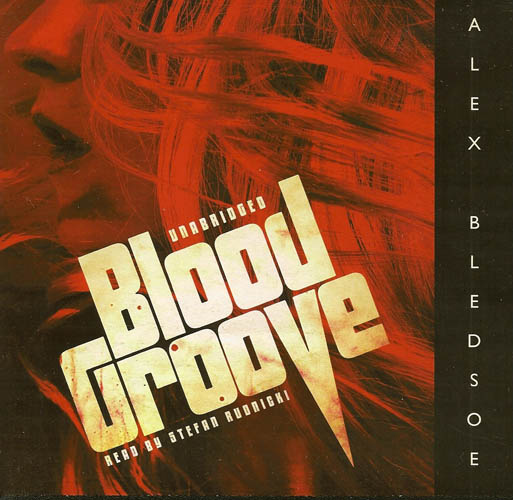
Blood Groove
By Alex Bledsoe; Read by Stefan Rudnicki
7 CDs – Approx. 8.5 Hours [UNABRIDGED]
Publisher: Blackstone Audio
Published: 2009
ISBN: 9781433243880
Themes: / Fantasy / Urban Fantasy / Vampires / Revenge / Love / 1970s / 1910s / Memphis / Wales /
When centuries-old vampire Baron Rudolfo Zginski was staked in Wales in 1915, the last thing he expected was to reawaken in Memphis, Tennessee, sixty years later. Reborn into a new world of simmering racial tensions, he must adapt quickly if he is to survive. Hoping to learn how his kind copes with this bizarre new era, Zginski tracks down a nest of teenage vampires, who have little knowledge of their true nature, having learned most of what they know from movies like Blacula. Forming an uneasy alliance with the young vampires, Zginski begins to teach them the truth about their powers. They must learn quickly for there’s a new drug on the street created to specifically target and destroy vampires. As Zginski and his allies track the drug to its source, they may unwittingly be stepping into a trap that can destroy them all.
The vampire is the Mr. Potato Head of Fantasy fiction. It’s an old and worn out monster, fully mythologized with more than 100 interchangeable preternatural powers and weaknesses from which to assemble a fully customized vampire. For what might be a complete list of them check out the terrific website TVTropes.org. It cites a wonderfully cynical list of vampire tropes under the title: “Our Vampires Are Different.” So then the question is: If there is nothing really new under the sunless skies of vampire fiction why do we pick up them up? It’s a good question and one worth pondering. I picked up Blood Groove in large part because of the title. I liked the pun, figuring it referred to a blood groove (or fuller) on a sword and/or the idea of groovy 1970s vampires and/or the dado in a forensic pathologist’s slab. And before I picked up Blood Groove I noticed other Bledsoe books (probably a pun to be made there too) had cute titles like: The Sword-Edged Blonde and Burn Me Deadly.
Alex Bledsoe doesn’t give any new power to the vampire that he hasn’t had before, but he does add a new figurative kryptonite (like sunlight and garlic and crosses) to the mix. In fact, it’s creation and dissemination is central to the plot of Blood Groove. Along the way we also get an historical setting (1975), a virtual tour of parts of Memphis, Tennessee, some trivia about Elvis Presley and a relatively unpredictable story.
One of the elements that surprised me was not knowing who the protagonist of Blood Groove was. The vampires seemed the focus, and yet there was almost nothing that could make them sympathetic in a heroic or anti-heroic way. We’d meet one, he’d be killed, and then I thought “Okay…and?” but the story wouldn’t explain – which was a nice move actually. So for a good chunk of the novel the characters, all well fleshed out, appeared in scenes, died or were killed, only to be replaced by new characters with new agendas and new back-stories. The period shifted too. First we are in 1975 Memphis, then 1915 Wales. Eventually it settles down and we’re given fresh references, almost devotionals actually, to two early 1970s movies Blacula and Vanishing Point. As with many an urban fantasy novel these days there’s a mixing up of sex and love. Blood Groove doesn’t feel particularly paranormal romancy – but it’s probably not too far from the edges of curve.
Narrator Stefan Rudnicki gives voice to about a dozen characters of mixed gender, ethnicity and accent. Most obviously the East European vampire Baron Rudolfo Zginski has a suitably Bela Lugosi type accent. As with every Rudnicki read audiobook I’ve heard his rich voiced narration in Blood Groove is always in service to the text. One reviewer on Amazon.com put it well: “[Reading Blood Groove] was like eating a brownie with nuts when you don’t like the nuts.”
The provocative sequel to the Hugo and Audie Award-nominated METAtropolis features interconnected stories by today’s top speculative fiction writers, performed by a galaxy of Star Trek ® stars.
As the mid-21st century approaches, the Pacific Northwest has been transformed — politically, economically, and ecologically — into the new reality of Cascadia. Conspiracies and secrets threaten the tenuous threads of society. The End of Days seems nearer than ever. And the legend of the mysterious Tygre Tygre looms large.
METAtropolis: Cascadia is the creation of Hugo and World Fantasy Award nominee Jay Lake; Mary Robinette Kowal, winner of the John W. Campbell Award for Best New Writer; New York Times best-selling author Tobias S. Buckell; Hugo Award winner Elizabeth Bear; Aurora Award winner Karl Schroeder; and critically-acclaimed author Ken Scholes.
The team of narrators is any sci-fi fan’s dream: Star Trek’s Rene Auberjonois (“Odo”), Kate Mulgrew (“Capt. Kathryn Janeway”), Wil Wheaton (“Wesley Crusher”), Gates McFadden (“Dr. Beverly Crusher”), Jonathan Frakes (“Cmdr. William Riker”), and LeVar Burton (“Geordi La Forge”). Jay Lake, who also served as Project Editor, introduces this stunning sequel, written and produced exclusively for digital audio.
Exciting! Audible is also offering one of the stories from last year’s METAtropolis for free – |DETAILS HERE|. And |HERE| is our review of that excellent collection.


 Yep, it’s another post on Bill C-32, Canada’s upcoming copyright legislation. Perhaps you are already aware that C-32, as currently written, exists to enshrine legal punishments for the circumvention of “technological protection measures [TPMs].” TPM, by the way, is a less sullied acronym for the widely opposed DRM (Digital Rights Management) – which is another word, in turn, for copy protection. Here is CBC’s Nora Young interviewing David Fewer, the director of The Canadian Internet Policy and Public Interest Clinic, for an upcoming Spark radio broadcast (and podcast).

![By V. Vizu (Own work) [CC-BY-SA-3.0 (www.creativecommons.org/licenses/by-sa/3.0) or GFDL (www.gnu.org/copyleft/fdl.html)], via Wikimedia Commons](https://www.sffaudio.com/images10/БелкаСтрелка565.jpg "БелкаСтрелка565")