
BBC R4: In Our Time: Unicorns

SFFaudio Online Audio

BBC Radio 4 - In Our Time with Melvyn BraggThe BBC Radio 4 program (and podcast) In Our Time has an interesting discussion about one of the most popular of unwinged mythological creatures. The unicorn has the honor of both adorning Canada’s coat of arms as well as being the only even-toed ungulate to be both wholly magical and completely kosher.

Here’s the description:

“Melvyn Bragg and his guests discuss the history and mythology of the unicorn.

In the 5th century BC a Greek historian, Ctesias, described a strange one-horned beast which he believed to live in a remote area of India. Later classical scholars, including Aristotle and Pliny, added to his account of this animal which they called the monoceros, a vicious ass-like creature with a single horn in the middle of its forehead.

For centuries the monoceros or unicorn was widely accepted to be a real – if rarely seen – beast. It appears in the Bible, and in the Middle Ages became a powerful Christian symbol. It continued to be represented in art and literature throughout the Renaissance, when ‘unicorn horn’ became one of the most valuable commodities on earth, thanks to its supposed properties as an antidote to poison. As late as the seventeenth century, scientists believed they had found conclusive proof of the existence of unicorns. It was some time before the animal was shown to be a myth; four hundred years on, the unicorn retains much of its fascination and symbolic power.

With:

Juliette Wood
Associate Lecturer in Folklore at Cardiff University

Lauren Kassell
Lecturer in the History and Philosophy of Science at the University of Cambridge

David Ekserdjian
Professor of the History of Art and Film at the University of Leicester.

Producer: Thomas Morris.”

Have a listen |MP3|

Or subscribe to the podcast feed:

http://downloads.bbc.co.uk/podcasts/radio4/iot/rss.xml

Posted by Jesse Willis

LibriVox: Mrs. Shelley by Lucy Madox Rossetti (a biography of Mary Shelley)

SFFaudio Online Audio

I cannot wholeheartedly recommend you listen to this biography of Mary Shelley. There’s far too much surmising and a great deal too much imagining what Mary Shelley’s life was like for my taste. And while it’s true that we probably know a great deal more about Mary Shelley’s life now, than her biographer knew at the time of the writing, Mrs. Shelley feels as if it was written as a writing assignment, rather than a work of keen interest. Further, the author, Lucy Madox Rossetti, takes it upon herself to do a kind of literary criticism of Shelley’s fiction in the biography! I find it rather catty, and given even my limited understanding of the subject (Mary Shelley), I suspect Rossetti it is badly informed. Take this bit, written about Shelley’s The Last Man, as a for instance:

To give an adequate idea of genius with all its charm, and yet with its human imperfections, was beyond Mary’s power. Adrian, the son of kings, the aristocratic republican, is the weakest part, and one cannot help being struck by Mary Shelley’s preference for the aristocrat over the plebeian. In fact, Mary’s idea of a republic still needed kings’ sons by their good manners to grace it, while, at the same time, the king’s son had to be transmuted into an ideal Shelley. This strange confusion of ideas allowed for, and the fact that over half a century of perhaps the earth’s most rapid period of progress has passed, the imaginative qualities are still remarkable in Mary. Balloons, then dreamed of, were attained; but naturally the steam-engine and other wonders of science, now achieved, were unknown to Mary. When the plague breaks out she has scope for her fancy, and she certainly adds vivid pictures of horror and pathos to a subject which has been handled by masters of thought at different periods.

It’s writing like that makes you wonder why she bothered writing the book at all. And Lucy Madox Rossetti is just plain wrong about some of it. Thomas Newcomen, the father of the atmospheric engine (steam-engine) created his apparatus almost a century before Mary Shelley was even born.

One saving grace, if this audiobook has one, are the capsule synopses of Shelley’s many novels and stories. They are actually rather handy!

But, to the biography, the fact remains this is the only public domain biography of Mary Shelley yet available on LibriVox. Until a better one appears we will have to make do with…

LibriVoxMrs. Shelley
By Lucy Madox Rossetti; Read by various
29 Zipped MP3 Files or Podcast – Approx. 6 Hours 44 Minutes [UNABRIDGED]
Publisher: LibriVox.org
Published: October 13, 2010
Mrs. Shelley is a biography of Mary Wollstonecraft Godwin Shelley, author of Frankenstein and other works, wife of Percy Shelley, daughter of Mary Wollstonecraft Godwin who penned The Vindication of the Rights of Women, and daughter of William Godwin, a philosopher and novelist. The life of this woman, who at nineteen wrote a story that has become a part of everyday culture, is its own story to tell. The author, Lucy Madox Brown Rossetti, was the daughter of the artist Ford Madox Brown and the wife of William Michael Rossetti of the Pre-Raphaelite Brotherhood.

Podcast feed: http://librivox.org/rss/4231

iTunes 1-Click |SUBSCRIBE|

[Thanks also to Amy Gramour, mim@can, Andreia, teanah and J.M. Smallheer]

Posted by Jesse Willis

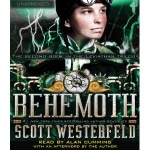
Scott Westerfeld Interviews His Audiobook Narrator, Alan Cumming

SFFaudio News

Scott Westerfeld’s new book, Behemoth, has just been released. It’s the second in the Leviathan Trilogy. He sits down and talks with Alan Cumming, the narrator of his audiobook version of the same title. Westerfeld mentions on how Cumming’s voice for one of his characters from his first book in the series, Leviathan, was the voice he heard in his head as he wrote that character’s dialogue for the new book. And they talk a bit about the different pronunciations of words.

Here’s Scott Westerfeld’s interview with Alan Cumming:

And here’s the book trailer for Behemoth:

And here’s a sizable audiobook excerpt from the title:

Posted by Rick Jackson

The D’Ampton Worm as performed by Emilio Perez Machado & Stephen Powys with Loise Newman

SFFaudio News

The D’Ampton Worm, as taken from the 1988 movie version of Lair Of The White Worm (based on Bram Stoker’s novel of the same name).

The D’Ampton Worm

John D’Ampton went a-fishing once, a-fishing in the weir,
He caught a fish upon his hook he thought looked mighty queer,
Now what the kind of fish it was John D’Ampton couldn’t tell,
But he didn’t like the look of it, so he threw it down a well.

Now the worm got fat and growed, and growed an awful size,
With great big teeth and a great big mouth and great big goggle eyes,
And when at night it crawled about all looking for some booze,
It fit fell dry upon the road, it milked a dozen cows.

This fearful worm would often feed on cows and lamb and sheep,
And swallow little babes alive when they lay down to sleep,
So John set out and got the beast and cut it into halves,
And that soon stopped it eating babes and sheep and lambs and calves.

So now you know how all the folks on both sides of the weir,
Lost lots of sheep and lots of sleep and lived in mortal fear,
So drink the health of brave Sir John, who kept the babes from harm,
Saved cows and calves by making halves of that famous D’Ampton Worm!

Posted by Jesse Willis

The Lambton Worm as performed by Tony Wilson

SFFaudio News

It turns out that Bram Stoker’s The Lair Of The White Worm was not wholly a product of his vivid imagination. Indeed, there is a fully formed legend from the North East of England that tells the story. And here is the tradition folksong, as operfromed by Tony Wilson, based on the legend:

The Lambton Worm

One Sunday morn young Lambton
Went a-fishin’ in the Wear;
He catched a fish upon his heuk,
He thowt leuk’t varry queer,

But whatt’na kind of fish it was
Young Lambton couldna tell.
He waddna fash to carry hyem,
So he hoyed it in a well.

Chorus:
Whisht! lads, haad ya gobs,
Aa’ll tell ye aall an aaful story,
Whisht! lads, haad ya gobs,
An aa’ll tell ye ‘boot the worm.

Noo Lambton felt inclined to gan
An’ fight in foreign wars.
He joined a troop o’ Knights
That cared for neither wounds nor scars,

An’ off he went to Palestine
Where queer things befel,
An’ varry seun forgot aboot
The queer worm in the well.

(Chorus)

But the worm got fat an’ graad an’ graad,
An’ graad an aaful size;
With greet big teeth, and greet big mooth,
An’ greet big goggley eyes.

An’ when at neets he craaled ‘oot
To pick up bits o’ news,
If he felt dry upon the road,
He milked a dozen coos.

(Chorus)

This feorful worm wad often feed
On calves an’ lambs an’ sheep
An’ swally little bairns alive
When they laid doon to sleep.

An’ when he’d eaten aall he cud
An’ he had had his fill,
He craaled away an’ lapped his tail
Seven times roond Pensher Hill.

(Chorus)

The news of this most aaful worm
An’ his queer gannins on,
Seun crossed the seas, gat to the ears
Of brave an’ bowld Sir John.

So hyem he cam an’ catched the beast
An’ cut ‘im in three halves,
An’ that seun stopped him eatin’ bairns
An’ sheep an’ lambs and calves.

(Chorus)

So noo ye knaa hoo aall the folks
On byeth sides of the Wear
Lost lots o’ sheep an’ lots o’ sleep
An’ lived in mortal feor.

So let’s hev one to brave Sir John
That kept the bairns frae harm,
Saved coos an’ calves by myekin’ halves
O’ the famis Lambton Worm.

(Final Chorus)

Noo lads, Aa’ll haad me gob,
That’s aall Aa knaa aboot the story
Of Sir John’s clivvor job
Wi’ the aaful Lambton Worm.

Posted by Jesse Willis

The SFFaudio Podcast #079 – AUDIOBOOK: Queen Of The Black Coast by Robert E. Howard

Podcast

Queen Of The Black Coast by Robert E. Howard

The SFFaudio PodcastThe SFFaudio Podcast #079 – Featuring a complete and unabridged reading of Queen Of The Black Coast by Robert E. Howard!

This is perhaps the greatest CONAN adventure ever written. It was first published in Weird Tales, May 1934.

It comes to us courtesy of Audio Realms and TheAudioBookShop.com. It can be found, along with a bunch of other great Howard yarns, in People Of The Dark: The Weird Works Of Robert E. Howard – Volume Two.

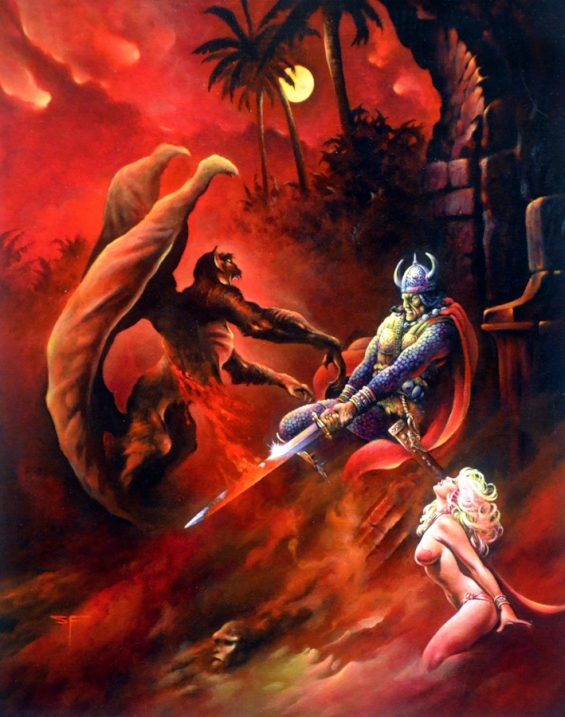
Queen Of The Black Coast by Robert E. Howard

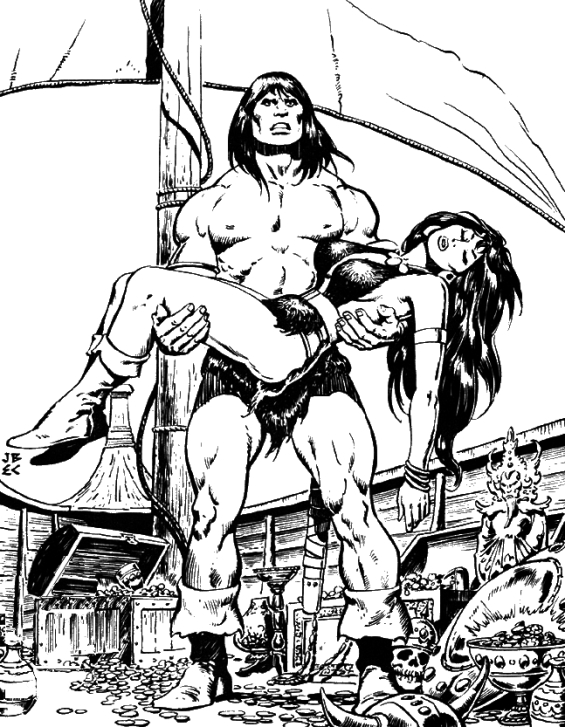
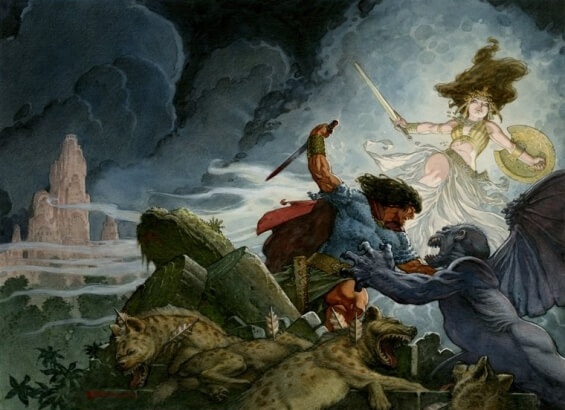
The Death Of Belit - illustration by Ernie Chan

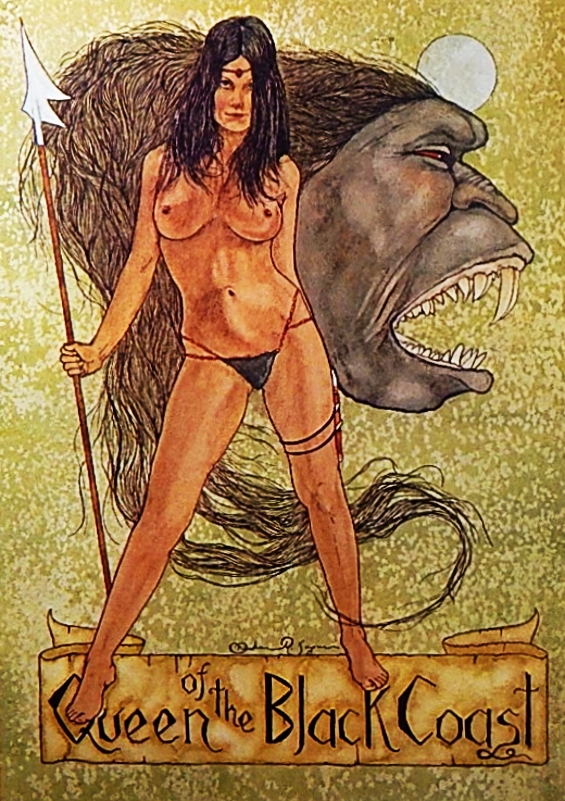
Queen Of The Black Coast by Robert E. Howard - illustration by Mark Schultz

Michael R. Hague illustration of Queen Of The Black Coast by Robert E. Howard

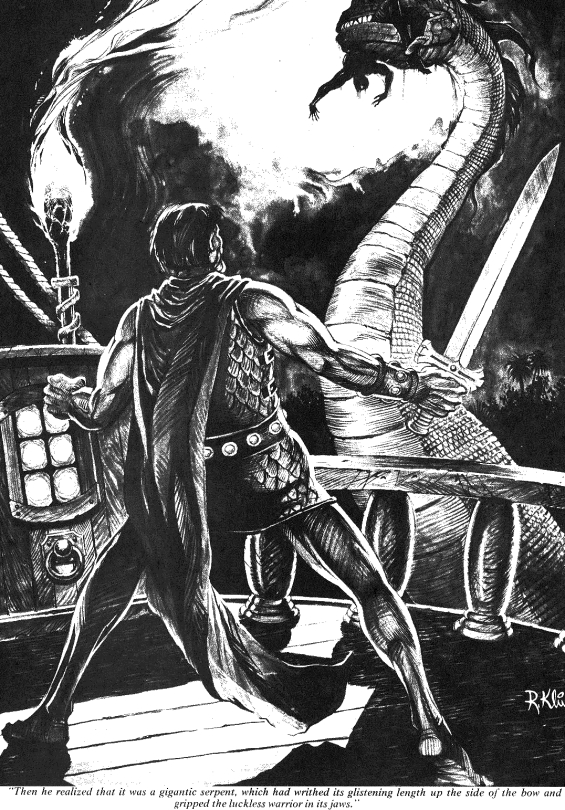
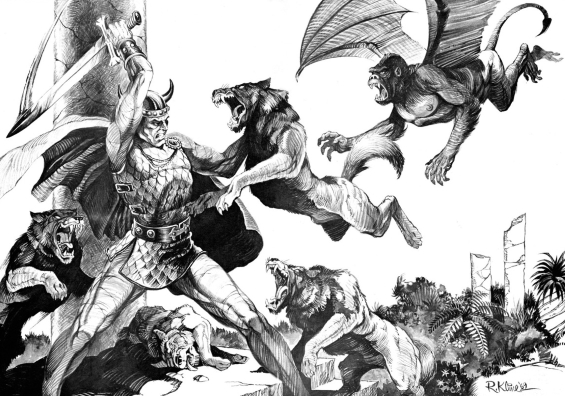
Queen Of The Black Coast - illustrated by Robert Kline

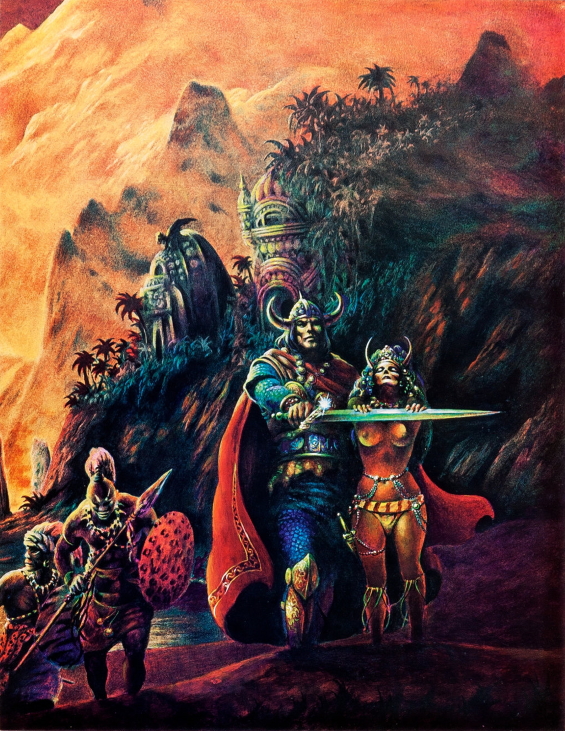
Stephen Fabian illustration of Queen Of The Black Coast

Stephen Fabian illustration of Queen Of The Black Coast

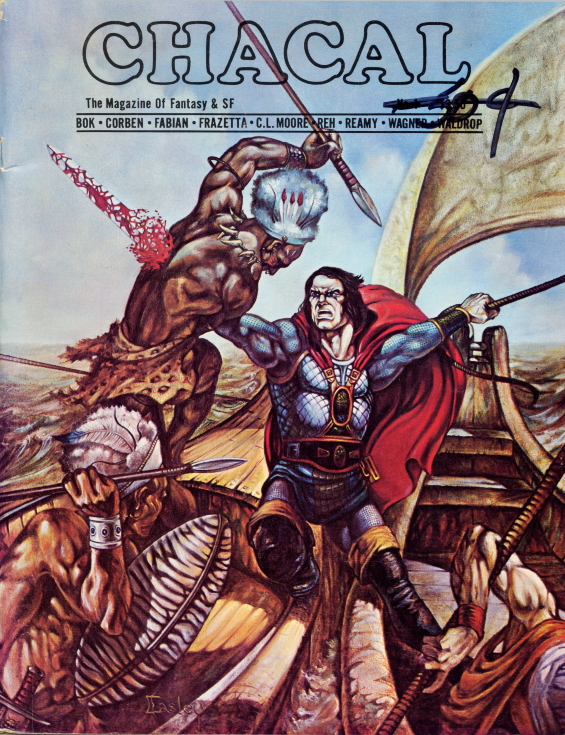
Jeff Easley illustration of Queen Of The Black Coast

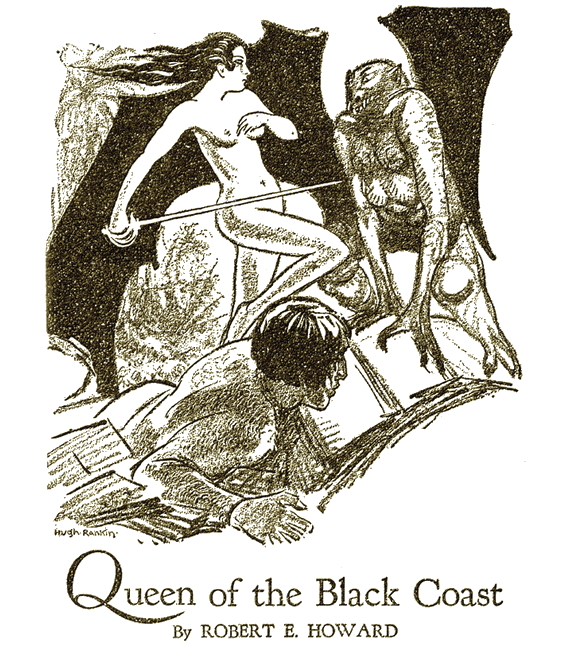
Queen Of The Black Coast - illustration by Hugh Rankin

Posted by Jesse Willis