LibriVox: If by Rudyard Kipling

SFFaudio Online Audio

I’m not much for poetry. Perhaps that’s because, as a published poet myself, I know just how crappy most poetry really is. Still, there are a few poems that do speak to me. Here’s one, a popular one, from 100 years ago, that I revisited recently.

LIBRIVOX - If by Rudyard KiplingIf
By Rudyard Kipling; Read by Chip
1 |MP3| – Approx. 2 Minutes [POEM]
Publisher: LibriVox.org
Published: January 29, 2006
Described as “a memorable evocation of Victorian stoicism” and the poetic crystalization of the British virtue of keeping a “stiff upper lip.” First published in 1910.

If

If you can keep your head when all about you
Are losing theirs and blaming it on you;
If you can trust yourself when all men doubt you,
But make allowance for their doubting too;
If you can wait and not be tired by waiting,
Or, being lied about, don’t deal in lies,
Or, being hated, don’t give way to hating,
And yet don’t look too good, nor talk too wise;

If you can dream—and not make dreams your master;
If you can think—and not make thoughts your aim;
If you can meet with triumph and disaster
And treat those two imposters just the same;
If you can bear to hear the truth you’ve spoken
Twisted by knaves to make a trap for fools,
Or watch the things you gave your life to broken,
And stoop and build ’em up with wornout tools;

If you can make one heap of all your winnings
And risk it on one turn of pitch-and-toss,
And lose, and start again at your beginnings
And never breathe a word about your loss;
If you can force your heart and nerve and sinew
To serve your turn long after they are gone,
And so hold on when there is nothing in you
Except the Will which says to them: “Hold on”;

If you can talk with crowds and keep your virtue,
Or walk with kings—nor lose the common touch;
If neither foes nor loving friends can hurt you;
If all men count with you, but none too much;
If you can fill the unforgiving minute
With sixty seconds’ worth of distance run –
Yours is the Earth and everything that’s in it,
And—which is more—you’ll be a Man my son!
—Rudyard Kipling

And also:

Posted by Jesse Willis
Golden Age Stories: FREE AUDIOBOOK – Pearl Pirate by L. Ron Hubbard

SFFaudio Online Audio

GoldenAgeStories.com (aka Galaxy Press) has a new FREE audiobook download for their newsletter’s subscribers:

Pearl Pirate by L. Ron HubbardPearl Pirate
By L. Ron Hubbard; Read by ????
1 |MP3| – Approx. 47 Minutes [UNABRIDGED?]
Publisher: Galaxy Press
Published: March 2010
American captain Smoke Engel loses his ship, the Witch, to a corrupt Chinese money lender and must then embark on a deadly errand to regain his rightful property—by stealing a fortune in black pearls from the most ruthless pirate on the South Seas.

Posted by Jesse Willis

Review of The Magicians by Lev Grossman

SFFaudio Review

Fantasy Audiobook - The Magicians by Lev GrossmanThe Magicians
By Lev Grossman; Read by Mark Bramhall
17 Hours – [UNABRIDGED]
Publisher: Penguin Audio
Published: 2009
Themes: / Fantasy / Magic / Wizard School / Meta Fiction / Alternate Worlds / Fictional fictional characters /

It would be too easy to simply compare this book to the Harry Potter series. There are obvious elements that are present in both, specifically the magic school. But Lev tells a story that only uses that as a means to bring the characters together and move onto the main story, which really kicks off once they graduate.

The main character, Quentin Coldwater, is a very bright high school kid who is busy applying to Universities. Despite his academic excellence, Quentin struggles to connect with the real world. He has a fascination with a series of fantasy books about a land called Fillory. In those books he can see a purpose to existence that he can’t find in his own life.

One university, Brakebills Academy, takes an interest in him and gives him an exam. It is during this exam that Quentin discovers that he is one of those few who have a talent for magic. He is enrolled in the school and goes from the smartest kid in his school to about average in his year. He pushes himself to excel and eventually finds that he is being skipped ahead a year. He makes friends and finds love. But his time there is not without upset. Eventually he and his friends graduate and we are not even half-way through the book.

Struggling to decide what to do with their lives, Quentin and his college friends drift through life for a short time. The world of the wizards isn’t challenging to them. This secret culture looks after their own, keeping a low profile and pretty much doing whatever interests them. Lacking direction and guidance Quentin and his friends have too much money and no responsibilities. They party. Drink, drugs and sex. But then they discover something that even their tutors didn’t know about. Fillory, the land from Quentin’s books, is real and they have a way to get there. They gear up and mount a small expedition to find adventure and fill the hole in their lives. They go into this with a tactics and planning of a group of fantasy role-players. They see everything in terms of the stories of Fillory. They expect quests will turn up to tell them what they need to do, and indeed one does.

The parallels between Fillory and Narnia are much stronger than those with the Harry Potter series, and pervades through much more of the novel. In the Fillory novels, a family of children, the Chatwins, from rural England in the early 1900’s keep finding secret paths into Fillory where they have adventures, defeat enemies to the land and return home as if no time has passed. While there isn’t a Lion god, there is Ember and Umber the twin Ram gods, who clean up any remaining mess and sends the Chatwin children back home. The events and characters in these books are real and have a serious impact on Quentin and his friends as they try to figure out what really happened in Fillory. There are hints and clues throughout that a second reading would put into a clearer context after knowing the ending.

The narrator, Mark Bramhall, gives an excellent performance, keeping most of the voices distinct.

Although this is described as a coming of age novel, I would hesitate to recommend it to younger teen readers. There are several strong uses of offensive language, all fitting with the characters and their situation. Definitely not aimed at the same primary market Harry Potter was.

Posted by Paul [W] Campbell

Graphic Audio Interviews E.E. Knight

SFFaudio News

Graphic Audio Logo


Graphic Audio Director Ken Jackson interviews E.E. Knight (aka Eric Frisch) about his series Vampire Earth that will be released in GraphicAudio® this August.

Here’s the link: |LINK|
And the Graphic Audio podcast feed is: http://www.graphicaudio.net/t-rss.aspx

About the Vampire Earth series:

The story begins in 2065 in a post-apocalyptic American setting. Forty-three years ago, in 2022, an alien race known as the Kurians triggered a series of natural disasters (as well as artificial ones) that enabled them to gain control of the planet and subjugate humanity. A plague has reduced the world population to 25% of its pre-cataclysm level; nuclear explosions have created a mild form of nuclear winter, cooling the earth, and smaller events everywhere have added to the chaos. In America, the New Madrid fault let go, destroying much of the Midwest. Major rivers such as the Mississippi have been unleashed.

In the year 2022 CE, a seemingly immortal extraterrestrial race called “Kurians” has wrested control of the Earth from its inhabitants. The Kurians derive their endless lifespans from draining the “vital aura” of other life forms. To facilitate this addiction to life energy, the Kurians employ killing machines known as “Reapers”.

Following the Kurian takeover, many humans made the decision to serve the new overlords. These traitors, known as Quislings, are set up as members of the police and supervisory government for the Kurian Order. Nearly every other human who is not a Quisling is known as a Territorial, and is either a slave scratching out a living in various trades, or fighting with rebel organizations such as the Southern Command.

After a time, the Kurian Order reduced Earth to a technological and social Dark Age, with only the few remaining pre-2022 machines and transportation networks surviving, with most of these under Kurian control. As an incentive to good and loyal service to the Kurian Lords, Quislings are awarded “ten year badges”, which protect the wearers from the Reapers. Even more sought after is the “Brass Ring”. A Brass Ring ensures that one never has to fear being randomly taken by the Reapers at night, although it can be revoked and cannot be passed to one’s children.

Pockets of resistance do exist, however. The main rebel group fighting the Order at the beginning of the series is known as Southern Command. A formal military (though classified by the Order as terrorists) is charged with the defense of the Ozark Free Territory; Southern Command would be doomed were it not for the Hunters.

Definitely would like to try this one…

Posted by Scott D. Danielson

Aural Noir Review of Gentlemen Of The Road by Michael Chabon

Aural Noir: Review

RANDOM HOUSE AUDIO - Gentleman Of The Road by Michael ChabonGentlemen Of The Road: A Tale Of Adventure
By Michael Chabon; Read by Andre Braugher
Audible Download – Approx. 4 Hours 13 Minutes [UNABRIDGED]
Publisher: Random House Audio
Published: October 2007
Provider: Audible.com
Themes: / Adventure / Crime / Jewishness / War / Politics / Mercenaries / Con-men / Khazaria /

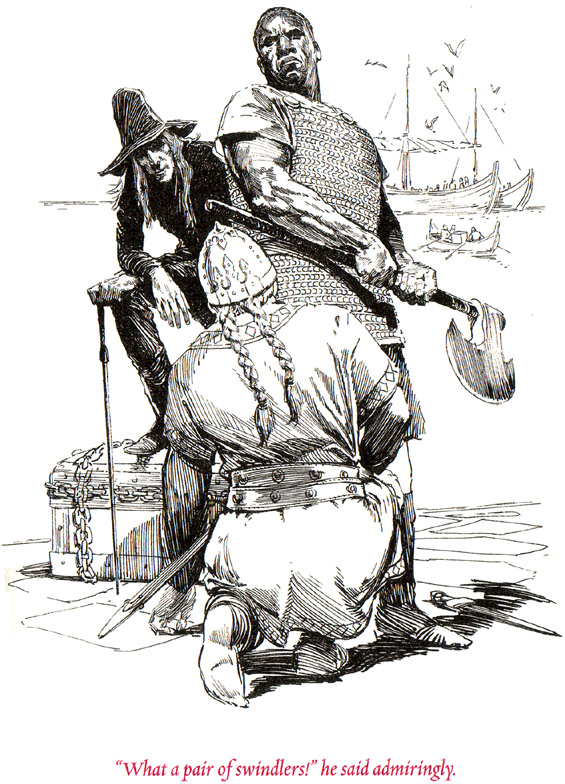
Gentlemen Of The Road was first published as a serial in The New York Times Magazine. Despite it’s sword and sorcery feel, it is not actually a Fantasy novel, but is instead a “swashbuckling adventure” set in an obscure, but real, historical setting. Its heroes, Amram and Zelikman, are an odd, but vaguely familiar, pair. Familiar in their companionable rivalry and clearly inspired by Fritz Leiber’s famed pair of characters: Fafhrd and Grey Mouser. But, instead of one being a short, urban thief and the other a hulking Northern barbarian, the two are instead the titular gentlemen of the road, wandering Jews, or as Chabon himself states in the audiobook’s afterword “Jews With Swords.” And that’s what was really important in this story; though each of these two Jews looks entirely unalike from the other, they are tied together by far flung tradition, common heritage and similar tales of woe. The larger of the pair is Amram, a swarthy Abyssinian with a penchant for shatranj and quite literally an axe to grind. The slighter and paler of the pair is Zelikman, a fair haired Frank, who far from being a member of the thieves guild is actually a doctor (he wields an “over-sized bloodletting lance as a rapier”). Together they are a neat pair of dark age sell-swords/con-men, working the taverns and inns of southern Eurasia. It is, all in all, one of the neatest set-ups for a book I’ve ever heard. And you couldn’t find a funner fictional premise for illustrating the Jewish diaspora in an adventure novel.

One evening (circa AD 950), a chance encounter at a roadside inn in the kingdom of Aran leads to a body-guard job. The job involves a journey to the neighboring khaganate of Khazaria. Along the way they meet many a fellow road traveler and have some less than polite encounters. Eventually, Amram and Zelikman (A & Z) find themselves fully entangled in a rebellion and plot aimed at restoring a displaced Khazar prince to the throne.

Narrator Andre Braugher is a television actor that I’ve admired since his portrayal of the unwaveringly professional detective Frank Pembelton on Homicide: Life on The Street. Braugher has a powerful voice that he uses to deliver Chabon’s ornately constructed descriptive scenes and dialogue. You can tell, with every sentence of Braugher’s delivery, that Chabon loves language. I thoroughly enjoyed the book after I got into it. But it wasn’t easy, I really had to shift gears. This is embellished storytelling, it feels both old-fashioned and unrepentantly ostentatious. It has very little of the usual fantasy stylings, it dumps any ordinary flat or prosaic description in favour of the deliberately lavish. Once I did get into it, I loved it. There’s a lot of detail to enjoy here. Chabon’s hulking Abyssinan, for instance, has a battle-axe. He gained it after combat with the Varangian Guard in Byzantium. A runic inscription on it roughly translates into “defiler of your mother.” Another writer would have done it another way – another writer wouldn’t have done it at all. This is what makes Chabon, his books and this novella in particular so special.

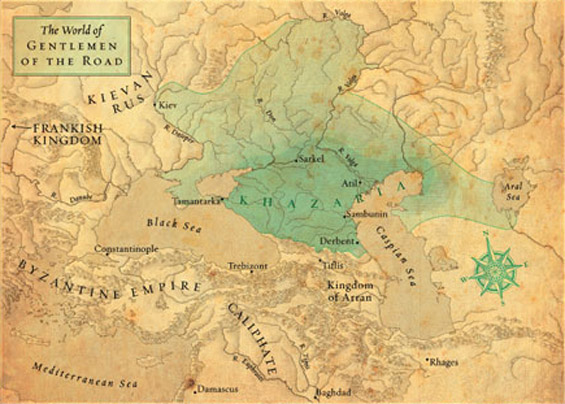
Sadly, the audiobook lacks the map and the 15 terrific black and white illustrations (by Gary Gianni ) found in the paperbook. Here is a peek at both:

Gentlemen Of The Road - MAP

Gentlemen Of The Road - PAGE 161

Posted by Jesse Willis

The SFFaudio Podcast #060

Podcast

The SFFaudio PodcastThe SFFaudio Podcast #060 – Jesse and Scott talk about recently arrived audiobooks!

Talked about on today’s show:
Roger Ebert’s review of The Human Centipede, BoingBoing, World Horror Convention 2008, Salt Lake City, how the horror genre has changed, Hater by David Moody |READ OUR REVIEW|, anti-Americanism, Your Movie Sucks by Roger Ebert, Awake In The Dark by Roger Ebert, Roger Ebert’s review of Reservoir Dogs, recent arrivals, Tantor Media, The Horror Stories Of Robert E. Howard, Pigeons From Hell, Worms Of The Earth, The Cairn On The Headland, I Am Not A Serial Killer by Dan Wells, Dexter as a teenager, Columbine by Dave Cullen |READ OUR REVIEW|, the Writing Excuses Podcast, LUTE Brigham Young University, Mr. Monster by Dan Wells, The Eerie Silence by Paul Davies, science, SETI, Scott’s Pick Of The Week: Goodreads.com, social networking that works, Beowulf by Anonymous, Seamus Heaney‘s translation, The Epic Of Gilgamesh BBC Audio Drama, RadioArchive.cc, City Of Dragons by Kelli Stanley, the Bish’s Beat blog, private investigation, San Fransisco, The Spanish Civil War, Brilliance Audio, High Deryni by Katherine Kurtz, The Tales Of Dying Earth, Rhialto the Marvelous by Jack Vance, Seeing Ear Theatre, The Moon Moth by Jack Vance |READ OUR REVIEW|, social science fiction, Tale Of The Thunderbolt by E.E. Knight, vampires, alien invasion, The Space Vampires by Colin Wilson, Lifeforce, Vampires by John Steakley, what Steakley is doing with his novels (examining one small aspect of violence), The Guns Of August by Barbara Tuchman, Heist Society by Ally Carter, Luke Burrage’s review of Robert J. Sawyer’s Calculating God on the Science Fiction Book Review Podcast, WWW: Watch by Robert J. Sawyer, The Windup Girl by Paolo Bacigalupi, the Nebula awards, reading the Hugo nominees, Sinner, Baker, Fabulist, Priest; Red Mask, Black Mask, Gentleman, Beast by Eugie Foster |READ OUR REVIEW|, Lawrence Santoro, Eros Philia Agape by Rachel Swirsky, Blackstone Audio, Enchantment by Orson Scott Card, Stefan Rudnicki, Sleeping Beauty, Jesse’s Pick Of The Week: Snow Glass Apples by Neil Gaiman, Snow White And the Seven Dwarfs, Bebe Neuwirth, The Dreaming blog, Murder Mysteries by Neil Gaiman, Nadya by Pat Murphy, werewolves, Poland, California, 19th century, Rachel In Love by Pat Murphy, Vampire Zero by David Wellington, civil war, The Bradbury Report by Steven Polansky, The Island, did Ray Bradbury write a cloning story?, what’s the best cloning novel you’ve ever read?, cloning doesn’t really live in fiction, Surrogates, Kiln People by David Brin, Cyteen by C.J. Cherryh, Where Late The Sweet Birds Sang by Kate Wilhelm, Mimic by Donald A. Wollheim, Red Dwarf is a great hard Science Fiction series!, “what’s the best cloning novel?”, Blood Oath by Christopher Farnsworth, Bronson Pinchot, “shadowy conspiracy” = “secret secret”, The Bradbury 13 by Ray Bradbury, radio drama, The Hitch-hiker’s Guide To The Galaxy isn’t audio drama’s best exemplar (The Bradbury 13 is), City Of Truth by James Morrow, satire, religion, The Invention Of Lying, This Is The Way the World Ends by James Morrow, PaperbackSwap.com, Dan Carlin’s Common Sense podcast, oligarchy, talking points, The Daily Show with Jon Stewart, Obamacare, “-gate” is not a suffix meaning scandal, the difference between English and French, words map the world, words are the magic in our world, ZBS Foundation, Dinotopia: The World Beneath (audio drama), Yuri Rasovsky, a kid who doesn’t like dinosaurs?, Blake’s 7: The Early Years: Zen: Escape Velocity, Robin Hood, Zen and the Liberator is like Blake’s Sherwood Forest! Babylon 5, J. Michael Straczynski’s City Of Dreams.

Posted by Jesse Willis