BBC World Service: Pontypool [the radio drama]

SFFaudio Online Audio

BBC World ServiceThe BBC World Service commissions an annual collection of new radio plays from around the world each year. They call it “Worldplay” and this year’s theme was “science.” Entries came in from the UK, Australia, New Zealand, Ireland, the USA and Canada. It was Canada’s entry that has drawn my ear. Not only because it is Science Fictional (and Horror-ish) but also because it happens to be related to a movie that I told you radio drama fans would probably dig. Here’s a CBC Edmonton review of the movie |MP3| (now on DVD). Perhaps this Pontypool radio drama would have been broadcast on CBC Radio One too, had not the CBC radio drama department been virtually mothballed. Luckily, the BBC and ABC Radio National seem interested in airing new Canadian radio drama even if CBC itself isn’t.

Now for a few caveats. As the Horror Squad blog points out this is not, strictly speaking, a new recording but rather a radio drama created by editing the movie’s dialogue and sound effects tracks. Ultimately, this does hurt the piece; it would have been better to have had these terrific actors in the studio to recreate their performances (as was done by the likes of Lux Radio Theatre). But to my ears this edit is good, if not the ideal. Here’s what Horror Squad said:

“This is actually not a new recording, but simply the original audio of the film re-cut as a play. If you haven’t seen the film, I’d highly recommend you do before giving it a complete listen. As fantastic as the audio side is, one of the best things about the film is Bruce McDonald’s [he’s the film’s director] ability to visually trap you within the confines of the radio station, which is something I fear this 40 minute shorter take on the material is without.”

I myself have a couple factoids about Pontypool the radio drama. I’ll throw out there. First, this AD has a different ending than does the film. Second, it’s substantially abridged. The movie runs 97 minutes, with dialogue running over the opening and closing credits; whereas the AD runs only 53 minutes. The AD’s end credits also, by the way, say that Pontypool, was directed by Gregory J. Sinclair as a production for CBC. This is news to me considering I haven’t heard it broadcast on CBC radio this year, or even announced for the fall. Sinclair, incidentally, is the producer of CBC Radio’s last standing radio drama series, Afghanada. Have a listen to Pontypool. It’s a very Canadian zombie story. I really liked it a lot!
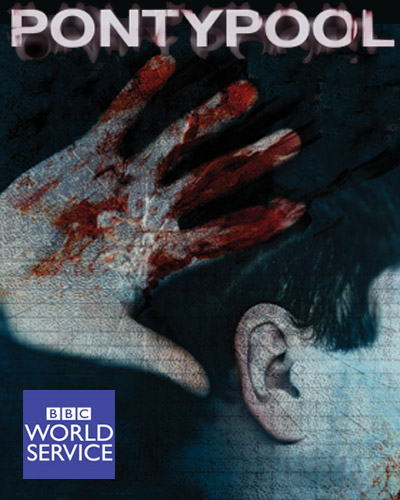
BBC World Service - Pontypool by Tony BurgessPontypool
By Tony Burgess; Performed by a full cast
Streaming Audio – Approx. 58 Minutes [RADIO DRAMA]
Broadcaster: BBC World Service / Worldplay
Broadcast: June 21, 2009
“Shock jock Grant Mazzy has, once again, been kicked-off the Big City airwaves and now the only job he can get is the early morning show at CLSY Radio in Pontypool Ontario, which broadcasts from the basement of the small town’s only church. What begins as another boring day of school bus cancellations, due to yet another massive snow storm, quickly turns deadly when reports start piling in of people developing strange speech patterns and evoking horrendous acts of violence start piling in. But there’s nothing coming in on the news wires. Is this really happening? Before long, Grant and the small staff at CLSY find themselves trapped in the radio station as they discover that this insane behaviour taking over the town is actually a deadly virus being spread through the English language itself. Do they stay on the air in the hopes of being rescued or, are they in fact providing the virus with its ultimate leap over the airwaves and into the world? Based on the novel Pontypool Changes Everything. Starring Stephen McHattie, Lisa Poole, Georgina Reilly, Rick Roberts, Hrant Alianak and Daniel Fathers .

This is also available in MP3 format via RadioArchive.cc along with more of the Worldplay dramas.

And, for australian listeners without torrent capability, via ABC Radio National |STREAMING|.

[via Monster Rally]

Posted by Jesse Willis

P.S. I think perhaps it’s time for CBC to sell the J. Michael Straczynski radio drama series that they produced and never aired, to a station that will actually broadcast it! Maybe BBC:WS?

LibriVox: Nightmare Abbey by Thomas Love Peacock

SFFaudio Online Audio

LibriVoxMark F. Smith, of Simpsonville, South Carolina, is the sole narrator of the latest LibriVox gothic novel. It’s author, Thomas Love Peacock, was a close friend of Percy Bysshe Shelley’s and an employee of the East India Company. Writes Mark F. Smith:

“Peacock wrote Nightmare Abbey as a satire, and he has folded in allusions to or quotations from literally dozens of other works [the details of which are HERE]. He makes use of many long, impressive-sounding words (some of which he very possibly made up!). Ignore these and his occasional Latin phrase, treat the rest as a farce, and you’re on track for a fun listen!”

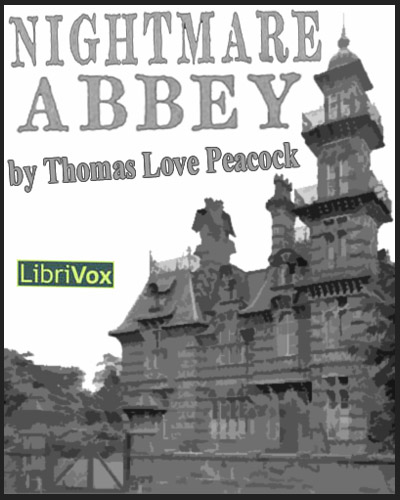
LibriVox - Nightmare Abbey by Thomas Love PeacockNightmare Abbey
By Thomas Love Peacock; Read by Mark F. Smith
15 Zipped MP3 Files or Podcast – Approx. 3 Hours 23 Minutes [UNABRIDGED]
Publisher: LibriVox.org
Published: August 26, 2009
Deep in the fens of the British coast sits the gloomy mansion that goes by the name Nightmare Abbey. It is inhabited by persons of very low opinion of the human race, and in fact they pride themselves in the depths of their detestation. Others of its denizens believe the ultimate exercise and product of the human mind ought to be chaos. Now let the young master of the house get snared by the wiles of a beautiful young lady. And for good measure, toss in another beautiful young lady. Now Scythrop (named in honor of an ancestor who became bored with life and hanged himself) is about to find that two such make too much of a good thing!

Podcast feed:

http://librivox.org/bookfeeds/nightmare-abbey-by-thomas-love-peacock.xml

iTunes 1-Click |SUBSCRIBE|

Posted by Jesse Willis

FREE @ Audible.com: 20,000 Leagues Under The Sea [IN SPANISH]

SFFaudio Online Audio

S’il vous plaît excusez-moi. Je ne parle pas bien le français. En fait, je suce à elle. Mais j’ai encore moins en espagnol. Mais je veux encore parler de ce drame audio. C’est une version GRATUITE de 20,000 Leagues Audio Drama Jule Verne Under The Sea est disponible à l’Audible.com – en espagnol. Confus? Oui, moi aussi.

Fono Libro - 20,000 Leagues Under The Sea [IN SPANISH]20 Mil Leguas Viaje Submarino [20,000 Leagues Under the Sea in Spanish]
Based on the novel by Jules Verne; Performed by a full cast
FREE Audible Download – Approx. 1 Hour 40 Minutes [AUDIO DRAMA]
Publisher: FonoLibro Inc.
Published: 2007
Provider: Audible.com
FonoLibro se enorgullece en presentar el audiolibro en español 20,000 Leguas de Viaje Submarino de Julio Verne considerada la primera y mejor novela de ciencia ficción de la literatura universal. Era el año 1866, y el océano pacifico estaba aterrorizado por monstruo marino. El gobierno americano envía a bordo del buque de guerra Abraham Lincoln al especialista en vida marina Pierre Aronnax a que investigue este hecho. Cuando esta nave es hundida por esta misteriosa criatura, el Profesor Aronnax y otros dos supervivientes descubren que no era un monstruo, sino un maravilloso submarino, el Nautilus, comandado por el enigmático Capitán Nemo. Nemo se rehúsa a llevar los sobrevivientes a tierra, sin embargo los lleva a bordo del maravilloso submarino en un fantástico viaje lleno de aventuras, tormentas, monstruos marinos, tesoros, y hasta la fabulosa ciudad perdida de Atlantis. FonoLibro les trae la obra maestra de Julio Verne en una impresionante dramatización, con un elenco completo, maravillosa música y efectos especiales que le harán sentir que esta en el fondo del mar a bordo del Nautilus viviendo esta maravillosa aventura.

Posted by Jesse Willis

Review of The Steel Remains by Richard K. Morgan

SFFaudio Review

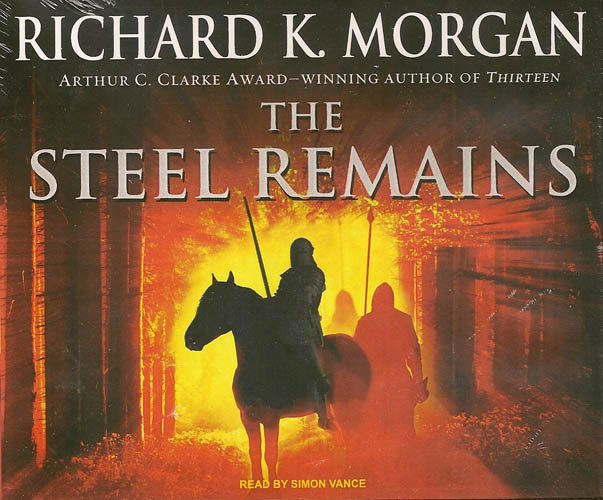
Science Fiction Audiobook - The Steel Remains by Richard K. MorganThe Steel Remains
By Richard K. Morgan; Read by Simon Vance
[UNABRIDGED]
Publisher: Tantor Media
Published: 2009
ISBN: 9781400139637
Themes: / Fantasy / Noir / Hard Boiled / Magic / War / Homosexuality /

“Men were like blades, they would all break sooner or later, you included. But you looked around at the men you led, and in their eyes you saw what kind of steel you had to hand, how it had been forged and tempered, what blows, if any, it would take.”

—Richard Morgan, The Steel Remains

With his new book The Steel Remains, Richard Morgan sets out to (as main character Ringil Eskiath might say) “prick the bloated arse” of J.R.R. Tolkien and post-Tolkien fantasy. Elsewhere on the web Morgan has expressed his deep dissatisfaction with traditional high fantasy, which often pits stainless forces of good against hordes of irredeemable evil in bloodless, antiseptic sword play. He’s accused Tolkien of the same shortcomings (a flawed analysis with which I vehemently disagree). Against this backdrop, Morgan set out to write The Steel Remains as a deliberately gray, grimy, alternative viewpoint. His book succeeds in sliding cold steel into the lie of childlike fantasy, with which my favorite genre of fiction is admittedly littered.

But when the screaming of gutted men and the skirling of steel dies down, and the full extent of the destruction is laid bare for us to see, The Steel Remains does not have much to offer. The old cliché that it’s easier to tear down and destroy than to build anew applies here. In its falling over itself desire to slice and dice fantasy’s traditional conservatism, The Steel Remains indulges in plenty of its own predictable clichés: Every priest is a religious fanatic and a sex fiend, every leader a morally and ethically corrupt, egotistic blowhard, for example. The book lacks a moral compass; Morgan the author’s world view must be a bleak one, indeed.

The action of The Steel Remains focuses on the converging storylines of three uneven characters—one very well done (Ringil, a sarcastic, war-weary, homosexual master swordsman), one middling (Egar, a brawling, boisterous, randy barbarian from the steppes), and one rather forgettable (Archeth, a black, female half-breed of human and Kiriath, deadly with throwing knives and hooked on drugs). All three are veterans of a recent war against an invading race of “scaly folk,” in which humanity staved off utter destruction at a very high price. Ringil, a war hero but now combat- and world-weary, has retreated from his mercenary lifestyle and is living a slothful, under-the-radar existence, until he’s summoned by an urgent message from his mother: Ringil’s cousin, Sherin, has been sold into slavery to repay a debt, and Ringil’s mother wants her back. Ringil reluctantly agrees.

Soon Ringil finds out that the slavery web in which Sherin has been caught is very dark, wide, and sinister. At its centre are a race of alien beings called the dwenda—tall, attractive, human-like, magic-using creatures that are a combination of Michael Moorcock’s Melniboneans with their cruel and alien immorality, and Poul Anderson’s Nordic-inspired, haughty, and warlike elves (Morgan lists Anderson and Moorcock as two of his sources of inspiration; the third is, unsurprisingly, Karl Edward Wagner). The dwenda are planning to incite a second war on earth and then destroy the victor, taking back their ancestral lands (the dwenda dwelled on earth many years ago). The dwenda require the sacrifice of barren human females to fuel the dark powers that are the source of their sorcery.

There’s much to like in The Steel Remains. Morgan’s prose is sharp and highly readable, and he shows a fine eye for detail and realism in his culture and city-building. Trelayne—a nasty, sprawling, brawling city in which whoring, slavery, and public executions are practiced openly—feels real. Egar’s Majak culture is based on pre-colonized North American Indians, and is well-done with its shamans and superstitions, trade in vast herds of buffalo, and armor and weapons suited to a nomadic lifestyle on the plains.

In addition, if you like your battles bloody and realistic, Morgan is your man. His fight scenes are well-done and you get a great sense of Ringil’s skill with his deadly broadsword of Kiriath steel, and Egar’s brutal butcher’s work with his two-bladed Majak lance. Disembowelings, beheadings, and other ghastly wounds are rife.

Much of the book passed under my eyes as well-oiled but heartless machinery producing graphic combat carnage and highly explicit sex (I’ll pause here to state that the blood and semen-soaked pages of The Steel Remains would make George R.R. Martin blanch, and Eric Van Lustbader—author of The Ninja—green with envy). I found the characters rather unlikeable and unengaging, and the plot fair at best. Very little actually clicked with me until the concluding act, in which Ringil, Egar, and Archeth reunite to fight a desperate last stand against the duenda. This was one of the few moving scenes in the book in which I actually felt some measure of concern and identification with our heroes. Ringil’s rousing speech is of the stuff with which great heroic fantasy is made. I wish there was more like this.

In summary, we know that life is can be dirty and horrible. War is hell, yes, and men are weak and piggish. But Morgan drives the same points home, again and again, over 400 dark, cynical, iconoclastic pages of The Steel Remains, which by the end is too one-note and sacrifices story at the expense of the author’s agenda.

Narrator Simon Vance does a terrific job as narrator, changing his voice to suit the temperaments and personalities of the various characters in Morgan’s novel. Clarity and precision are among Vance’s strengths as a reader and he does not disappoint here. When I began listening to The Steel Remains, and before I had seen the narration credits, I recognized Vance’s distinctive voice from his wonderful depiction of Count Dracula and the rest of the characters from Bram Stoker’s Dracula (Blackstone Audiobooks). For unknown reasons Vance performed Dracula under the pseudonym, Robert Whitfield.

[For more of Brian’s thoughts on The Steel Remains check out The SFFaudio Podcast #034]

Posted by Brian Murphy

Review of By Heresies Distressed by David Weber

SFFaudio Review

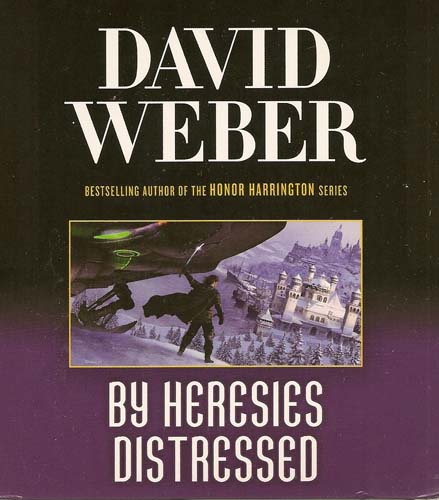
Science Fiction Audiobooks - By Heresies Distressed by David WeberBy Heresies Distressed
By David Weber; Read by Jason Culp
Approx. 25 Hours [UNABRIDGED]
Publisher: Macmillan Audio
Published: 2009
ISBN: 9781427206794 (CD)
Themes: / Science Fiction / Empires / Religion / War /

The Empire of Charis has been founded out of the marriage between King Cayleb of Charis and Queen Sharleyan of Chisholm, and further expanded by the annexation of Charis’ enemy Emerald. Now Cayleb and Merlin go on the offensive. Sharleyan stays behind to construct the new government out of the former Kingdoms, while Cayleb leads their Navy and tens of thousands of Charisian Marines against the League of Corisande and Prince Hektor. Hektor was the willing puppet of the Church of God Awaiting when he led an armada from several of Safehold’s nations against Charis. That armada was defeated with the aid of the technologies introduced by Merlin, but not before Cayleb’s father, King Haarahld, was killed.

Retribution is also dealt against the Kingdom of Delferahk, greatly offending the Church in the process when the priests responsible for the massacre are called to account. Merlin’s SNARCs, autonomous flying, invisible spy cameras, continue to provide a massive tactical advantage and help to solidify Cayleb’s reputation as a master tactician especially as the battle moves onto land. Some of the advances hinted at in the previous books are seen in action and their effects, amounting to almost two centuries of advancement in our history, are somewhat predictable. Unfortunately, the SNARCs can’t be everywhere, and Merlin and his A.I., Owl, can’t review everything that they record. The Church loyalists manage to slip past Merlin’s security, and target Empress Sharleyan in an attempt to break the new Empire.

Being the third book in the series, Weber brings the anticipated final conflict with Mother Church several steps closer. There is less focus on the new technologies being introduced in this book than in those that proceed it. The tactics and politics assume much more the focus. The land battles are clearly drawn, and the narrator, Jason Culp, keeps the back and forth between the combatants clear.

There are a noticeable number of lengthy monologues, in some cases in the middle of what was a normal conversation. They could have been more concise, however Jason delivers them well. He brings all of the many characters to life with ease, from the lowest soldier in the middle of a battle to the nobility and the priesthood.

Merlin is a magical character to the inhabitants of Safehold, but of Arthur C. Clarke’s variety: sufficiently advanced technology. Although that technology plays an important part in the events, it doesn’t really intrude. Merlin’s visions are provided by his SNARCs and the explanation of, what amounts to a mobile phone, in one scene is as intrusive as it gets. Weber’s Safehold series should appeal to fans of alternate history as well as fantasy and Science Fiction.

Posted by Paul [W] Campbell

The SFFaudio Podcast #034 – READALONG: The Steel Remains by Richard K. Morgan

Podcast

The SFFaudio PodcastThe SFFaudio Podcast #034 – Jesse and Scott have invited a roster of internet celebrities on for this podcast to talk about Richard K. Morgan‘s novel The Steel Remains. Listen in as…

Brian Murphy (of The Silver Key blog and The Cimmerian),

Gregg Margarite (LibriVox.org narrator and book coordinator),

and Luke Burrage (professional juggler and host of the Science Fiction Book Review Podcast) discuss…

The Steel Remains by Richard K. Morgan [AN UNABRIDGED AUDIOBOOK from TANTOR MEDIA]!

Talked about on today’s show:
The Cimmerian blog, Deathworld by Harry Harrison @ LibriVox.org, The Real Fantastic Stuff an essay by Richard K. Morgan, J.R.R. Tolkien, The Lord Of The Rings, noir, Sci-Fi Dimensions interview with Richard K. Morgan (not Dark Horizons), homosexuality, nihilism, anti-hero, the Takeshi Kovacs novels (Altered Carbon, Broken Angels, Woken Furies), Morgan’s Thirteen (aka Black Man), Tolkien’s The Silmarillion, Adam Robert’s letter to Hugo fans (about the Hugo nominees), Cory Doctorow’s Little Brother, Neil Gaiman’s The Graveyard Book, the Hugo Awards, Morgan’s Market Forces, Lord Valentine’s Castle by Robert Silverberg, George R.R. Martin’s A Song Of Ice And Fire, David Eddings, Warbreaker by Brandon Sanderson, Terry Brooks, the Dragonlance series, magic, Tolkien’s use of magic, Morgan’s use of magic in The Steel Remains, characterization in The Steel Remains, recurring themes in Morgan’s novels, Robert E. Howard‘s Conan, what is Ringil Eskiath’s motivation?, what does everyone think of The Steel Remains?, what is the nature maps in Fantasy novels?, The Darkness That Comes Before by Scott Bakker. Next week we’ll talk about more audiobooks with these guys too.

Posted by Jesse Willis