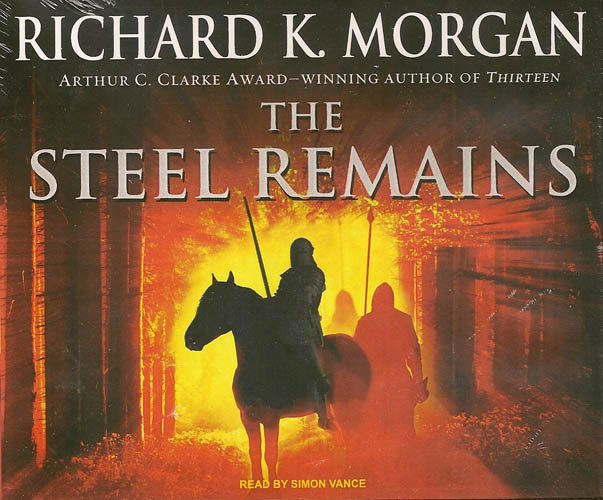
Review of The Steel Remains by Richard K. Morgan

SFFaudio Review

Science Fiction Audiobook - The Steel Remains by Richard K. MorganThe Steel Remains
By Richard K. Morgan; Read by Simon Vance
[UNABRIDGED]
Publisher: Tantor Media
Published: 2009
ISBN: 9781400139637
Themes: / Fantasy / Noir / Hard Boiled / Magic / War / Homosexuality /

“Men were like blades, they would all break sooner or later, you included. But you looked around at the men you led, and in their eyes you saw what kind of steel you had to hand, how it had been forged and tempered, what blows, if any, it would take.”

—Richard Morgan, The Steel Remains

With his new book The Steel Remains, Richard Morgan sets out to (as main character Ringil Eskiath might say) “prick the bloated arse” of J.R.R. Tolkien and post-Tolkien fantasy. Elsewhere on the web Morgan has expressed his deep dissatisfaction with traditional high fantasy, which often pits stainless forces of good against hordes of irredeemable evil in bloodless, antiseptic sword play. He’s accused Tolkien of the same shortcomings (a flawed analysis with which I vehemently disagree). Against this backdrop, Morgan set out to write The Steel Remains as a deliberately gray, grimy, alternative viewpoint. His book succeeds in sliding cold steel into the lie of childlike fantasy, with which my favorite genre of fiction is admittedly littered.

But when the screaming of gutted men and the skirling of steel dies down, and the full extent of the destruction is laid bare for us to see, The Steel Remains does not have much to offer. The old cliché that it’s easier to tear down and destroy than to build anew applies here. In its falling over itself desire to slice and dice fantasy’s traditional conservatism, The Steel Remains indulges in plenty of its own predictable clichés: Every priest is a religious fanatic and a sex fiend, every leader a morally and ethically corrupt, egotistic blowhard, for example. The book lacks a moral compass; Morgan the author’s world view must be a bleak one, indeed.

The action of The Steel Remains focuses on the converging storylines of three uneven characters—one very well done (Ringil, a sarcastic, war-weary, homosexual master swordsman), one middling (Egar, a brawling, boisterous, randy barbarian from the steppes), and one rather forgettable (Archeth, a black, female half-breed of human and Kiriath, deadly with throwing knives and hooked on drugs). All three are veterans of a recent war against an invading race of “scaly folk,” in which humanity staved off utter destruction at a very high price. Ringil, a war hero but now combat- and world-weary, has retreated from his mercenary lifestyle and is living a slothful, under-the-radar existence, until he’s summoned by an urgent message from his mother: Ringil’s cousin, Sherin, has been sold into slavery to repay a debt, and Ringil’s mother wants her back. Ringil reluctantly agrees.

Soon Ringil finds out that the slavery web in which Sherin has been caught is very dark, wide, and sinister. At its centre are a race of alien beings called the dwenda—tall, attractive, human-like, magic-using creatures that are a combination of Michael Moorcock’s Melniboneans with their cruel and alien immorality, and Poul Anderson’s Nordic-inspired, haughty, and warlike elves (Morgan lists Anderson and Moorcock as two of his sources of inspiration; the third is, unsurprisingly, Karl Edward Wagner). The dwenda are planning to incite a second war on earth and then destroy the victor, taking back their ancestral lands (the dwenda dwelled on earth many years ago). The dwenda require the sacrifice of barren human females to fuel the dark powers that are the source of their sorcery.

There’s much to like in The Steel Remains. Morgan’s prose is sharp and highly readable, and he shows a fine eye for detail and realism in his culture and city-building. Trelayne—a nasty, sprawling, brawling city in which whoring, slavery, and public executions are practiced openly—feels real. Egar’s Majak culture is based on pre-colonized North American Indians, and is well-done with its shamans and superstitions, trade in vast herds of buffalo, and armor and weapons suited to a nomadic lifestyle on the plains.

In addition, if you like your battles bloody and realistic, Morgan is your man. His fight scenes are well-done and you get a great sense of Ringil’s skill with his deadly broadsword of Kiriath steel, and Egar’s brutal butcher’s work with his two-bladed Majak lance. Disembowelings, beheadings, and other ghastly wounds are rife.

Much of the book passed under my eyes as well-oiled but heartless machinery producing graphic combat carnage and highly explicit sex (I’ll pause here to state that the blood and semen-soaked pages of The Steel Remains would make George R.R. Martin blanch, and Eric Van Lustbader—author of The Ninja—green with envy). I found the characters rather unlikeable and unengaging, and the plot fair at best. Very little actually clicked with me until the concluding act, in which Ringil, Egar, and Archeth reunite to fight a desperate last stand against the duenda. This was one of the few moving scenes in the book in which I actually felt some measure of concern and identification with our heroes. Ringil’s rousing speech is of the stuff with which great heroic fantasy is made. I wish there was more like this.

In summary, we know that life is can be dirty and horrible. War is hell, yes, and men are weak and piggish. But Morgan drives the same points home, again and again, over 400 dark, cynical, iconoclastic pages of The Steel Remains, which by the end is too one-note and sacrifices story at the expense of the author’s agenda.

Narrator Simon Vance does a terrific job as narrator, changing his voice to suit the temperaments and personalities of the various characters in Morgan’s novel. Clarity and precision are among Vance’s strengths as a reader and he does not disappoint here. When I began listening to The Steel Remains, and before I had seen the narration credits, I recognized Vance’s distinctive voice from his wonderful depiction of Count Dracula and the rest of the characters from Bram Stoker’s Dracula (Blackstone Audiobooks). For unknown reasons Vance performed Dracula under the pseudonym, Robert Whitfield.

[For more of Brian’s thoughts on The Steel Remains check out The SFFaudio Podcast #034]

Posted by Brian Murphy
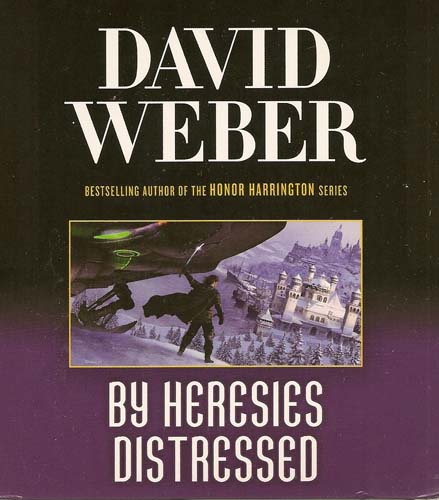
Review of By Heresies Distressed by David Weber

SFFaudio Review

Science Fiction Audiobooks - By Heresies Distressed by David WeberBy Heresies Distressed
By David Weber; Read by Jason Culp
Approx. 25 Hours [UNABRIDGED]
Publisher: Macmillan Audio
Published: 2009
ISBN: 9781427206794 (CD)
Themes: / Science Fiction / Empires / Religion / War /

The Empire of Charis has been founded out of the marriage between King Cayleb of Charis and Queen Sharleyan of Chisholm, and further expanded by the annexation of Charis’ enemy Emerald. Now Cayleb and Merlin go on the offensive. Sharleyan stays behind to construct the new government out of the former Kingdoms, while Cayleb leads their Navy and tens of thousands of Charisian Marines against the League of Corisande and Prince Hektor. Hektor was the willing puppet of the Church of God Awaiting when he led an armada from several of Safehold’s nations against Charis. That armada was defeated with the aid of the technologies introduced by Merlin, but not before Cayleb’s father, King Haarahld, was killed.

Retribution is also dealt against the Kingdom of Delferahk, greatly offending the Church in the process when the priests responsible for the massacre are called to account. Merlin’s SNARCs, autonomous flying, invisible spy cameras, continue to provide a massive tactical advantage and help to solidify Cayleb’s reputation as a master tactician especially as the battle moves onto land. Some of the advances hinted at in the previous books are seen in action and their effects, amounting to almost two centuries of advancement in our history, are somewhat predictable. Unfortunately, the SNARCs can’t be everywhere, and Merlin and his A.I., Owl, can’t review everything that they record. The Church loyalists manage to slip past Merlin’s security, and target Empress Sharleyan in an attempt to break the new Empire.

Being the third book in the series, Weber brings the anticipated final conflict with Mother Church several steps closer. There is less focus on the new technologies being introduced in this book than in those that proceed it. The tactics and politics assume much more the focus. The land battles are clearly drawn, and the narrator, Jason Culp, keeps the back and forth between the combatants clear.

There are a noticeable number of lengthy monologues, in some cases in the middle of what was a normal conversation. They could have been more concise, however Jason delivers them well. He brings all of the many characters to life with ease, from the lowest soldier in the middle of a battle to the nobility and the priesthood.

Merlin is a magical character to the inhabitants of Safehold, but of Arthur C. Clarke’s variety: sufficiently advanced technology. Although that technology plays an important part in the events, it doesn’t really intrude. Merlin’s visions are provided by his SNARCs and the explanation of, what amounts to a mobile phone, in one scene is as intrusive as it gets. Weber’s Safehold series should appeal to fans of alternate history as well as fantasy and Science Fiction.

Posted by Paul [W] Campbell

The SFFaudio Podcast #034 – READALONG: The Steel Remains by Richard K. Morgan

Podcast

The SFFaudio PodcastThe SFFaudio Podcast #034 – Jesse and Scott have invited a roster of internet celebrities on for this podcast to talk about Richard K. Morgan‘s novel The Steel Remains. Listen in as…

Brian Murphy (of The Silver Key blog and The Cimmerian),

Gregg Margarite (LibriVox.org narrator and book coordinator),

and Luke Burrage (professional juggler and host of the Science Fiction Book Review Podcast) discuss…

The Steel Remains by Richard K. Morgan [AN UNABRIDGED AUDIOBOOK from TANTOR MEDIA]!

Talked about on today’s show:
The Cimmerian blog, Deathworld by Harry Harrison @ LibriVox.org, The Real Fantastic Stuff an essay by Richard K. Morgan, J.R.R. Tolkien, The Lord Of The Rings, noir, Sci-Fi Dimensions interview with Richard K. Morgan (not Dark Horizons), homosexuality, nihilism, anti-hero, the Takeshi Kovacs novels (Altered Carbon, Broken Angels, Woken Furies), Morgan’s Thirteen (aka Black Man), Tolkien’s The Silmarillion, Adam Robert’s letter to Hugo fans (about the Hugo nominees), Cory Doctorow’s Little Brother, Neil Gaiman’s The Graveyard Book, the Hugo Awards, Morgan’s Market Forces, Lord Valentine’s Castle by Robert Silverberg, George R.R. Martin’s A Song Of Ice And Fire, David Eddings, Warbreaker by Brandon Sanderson, Terry Brooks, the Dragonlance series, magic, Tolkien’s use of magic, Morgan’s use of magic in The Steel Remains, characterization in The Steel Remains, recurring themes in Morgan’s novels, Robert E. Howard‘s Conan, what is Ringil Eskiath’s motivation?, what does everyone think of The Steel Remains?, what is the nature maps in Fantasy novels?, The Darkness That Comes Before by Scott Bakker. Next week we’ll talk about more audiobooks with these guys too.

Posted by Jesse Willis

Spider Robinson reads two Theodore Sturgeon SF stories

SFFaudio Online Audio

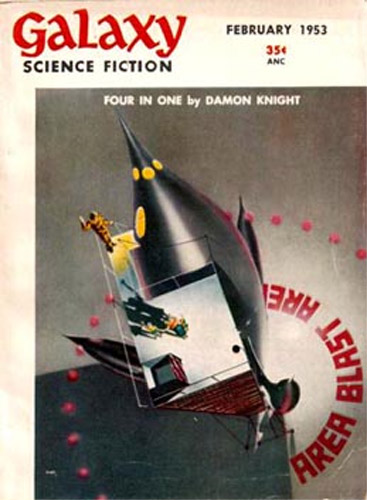
Spider On The Web - Spider Robinson’s podcastSpider Robinson‘s latest podcast features what he calls a “a suicide prevention kit” of an episode. The kit‘s contents includes more of Spider’s favorite music, and TWO unabridged readings of short Science Fiction stories about suicide from the pen of Theodore Sturgeon! The first of the two is A Saucer Of Loneliness. It was first published in Galaxy Magazine’s February 1953 issue. It was adapted into a radio drama for X-Minus One in 1957. Was again adapted, for television this time, into a segment of one episode of The Twilight Zone in 1986. Finally in 2004 it received a ‘Retro Hugo’ award. A well deserved honor for this very solid story. The second, Suicide, was first published in 1970 in Adam Bedside Reader (this same issue included Harlan Ellison’s Wanted In Surgery).

Galaxy Science Fiction - February 1953Adam Bedside Reader - June 1970 [Number 43]A Saucer of Loneliness” and “Suicide
By Theodore Sturgeon; Read by Spider Robinson
1 |MP3| – Approx. 79 Minutes [UNABRIDGED]
Podcaster: Spider On The Web
Podcast: August 22, 2009

Podcast feed:

http://www.spiderrobinson.com/iTunes_feed.xml

iTunes 1-Click |SUBSCRIBE|

[via Quasar Dragon]

Posted by Jesse Willis

Canadian Copyright Consultations – now with Robert E. Howard’s CONAN

SFFaudio News

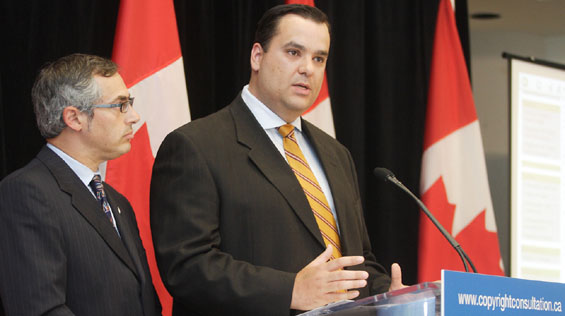
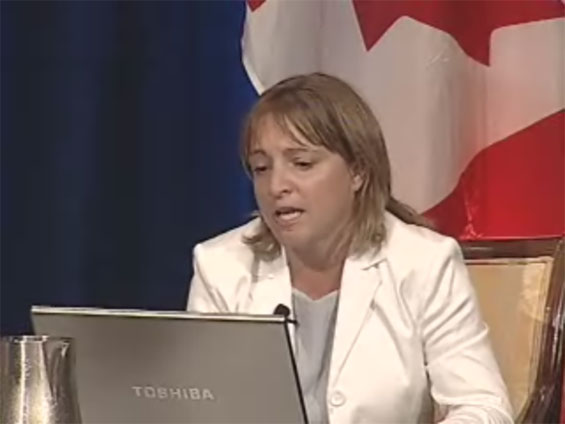
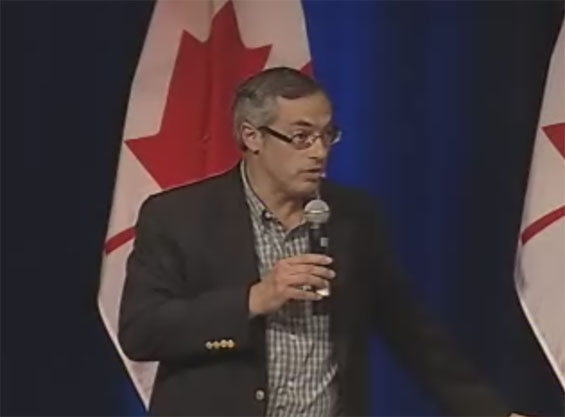
Tony Clement (Minister Of Industry) and James Moore (Minister of Heritage) announcing copyright consultation

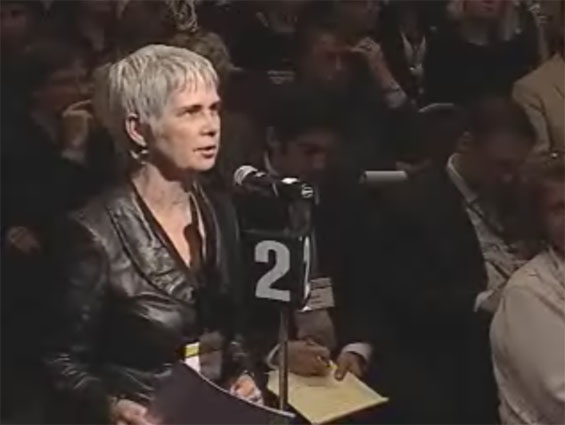
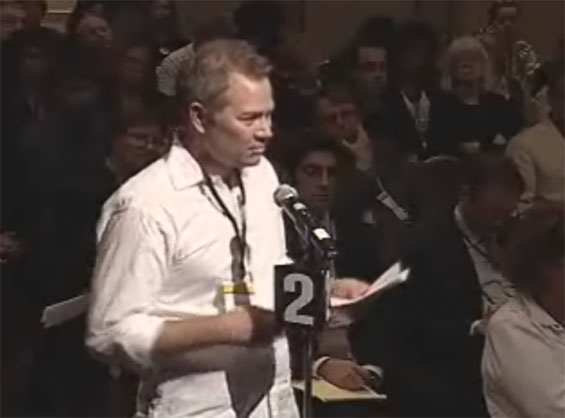
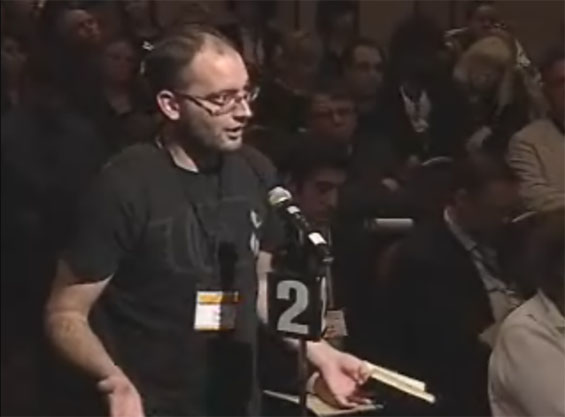
As you’re aware I’ve been following the Canadian Copyright Consultations run by Industry Minster Tony Clement and Heritage Minster James Moore. The most recent one, held in Toronto yesterday, was the most vehement of them all. The participants were heavily weighted towards music industry executives and lawyers (I counted at least 19 of them). They told us how badly their industry has been suffering and how their lawyers don’t have the legislation they need to deal with it. Execs from Sony Music Canada, Warner Music Canada and Universal Music Canada all spoke. Nearly all of them asked the minister to pass the ten year old WIPO treaties that make the breaking of DRM a copyright crime.

Several other non-music industry attendees brought up some non-music related points too. Most of these were not concerned about propping up a dying business model, but rather with how to prevent making criminals out of Canadians or how a new copyright law can address the new industries that technology allows. The librarians, for example, had some very serious concerns about the ability to provide services to patrons with any law that protects digital locks and lists statutory damages for their violation. A few others pointed out the problem of Crown Copyright [why don’t we just replace it with creative commons?]. Others insisted that the new copyright law, whatever its content, must be crystal clear and easy to understand – ‘spend some money on education’ – they said [this too is a great idea]. Several folks thought any new legislation should definitely address the problem of “fair dealing” [that we have no parody exemption in Canada is nuts]. A web commenter also suggested that because of the long response time, the current standard of getting permission from a copyright holder, was not-feasible for photocopied materials used in classrooms [this needs to be addressed by any new copyright bill]. And one of the smartest points was from a software guy who pointed out that a ‘retroactive term extensions doesn’t ‘encourage dead artist to create more work.’ It really needed to be said.

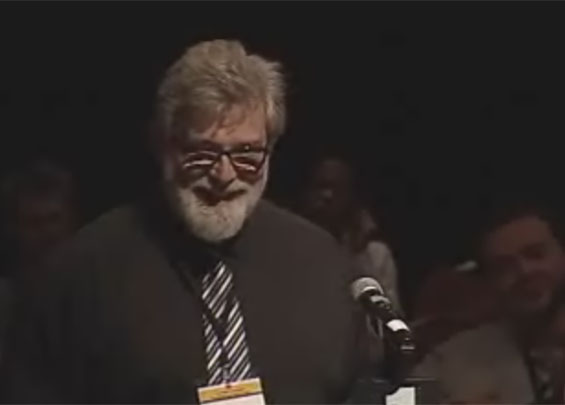
Below is a chronological sampling of some of the less representative comments (I’ve included just a few of the many music industry execs and lawyers who spoke). And, I’ve included one commenter’s speeches in full; Jonathan Dry’s words will really hit home with some of our readers in particular. I thought his comments were absolutely terrific.

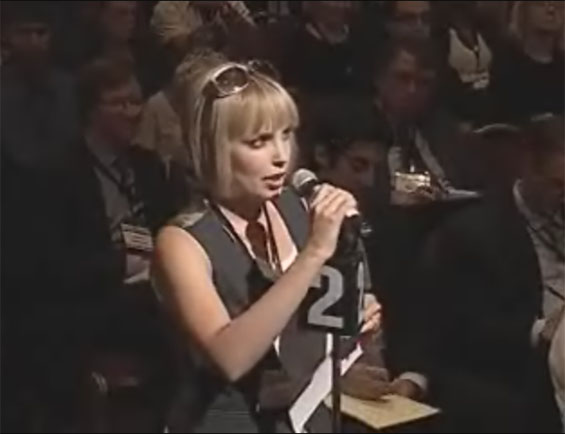
Jamie Kidd @ Approx. 5:21
Jamie Kidd (jazz musician) – “my new album won’t be marketed in Canada”

Martha Rans @ approx. 5:27
Martha Rans (outreach lawyer) – “return to Vancouver and hold a town hall”

Sophie Milman @ approx. 5:30
Sophie Milman (jazz artist) – “extend the copying levy to iPods”

Dan Glover @ approx. 5:35
Dan Glover (lawyer) – “I make my living by copyright”

Steve Kane @ approx. 5:38Steve Kane (President of Warner Music Canada since 2004) “When I began my tenure as President of President of Warner Music Canada we had about 180 employees. We currently have 85.” [woots from the crowd]

Sylvana (WEB COMMENTER) @ approx. 5:41
Sylvana (from the web) – “I’m appalled that Canada was recently placed on the U.S. piracy list along with such countries as China, Russia…” [Sylvana is likely referring to this article. I wonder if she read the follow up article by the same author that debunks it?]

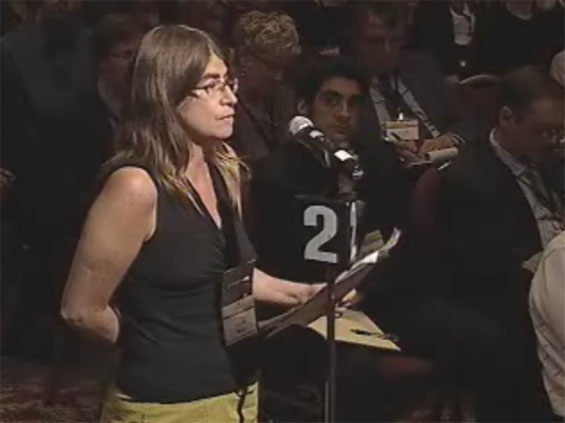
Leslie Weir @ approx. 5:50
Leslie Weir (librarian @ University Of Ottawa) – “copyright law must not make it illegal to circumvent a digital lock”

Rob Bolton @ approx. 5:54
Rob Bolton (digital marketing manager @ Warner Music Canada) – “what we have in this country is truly a lawless society and it’s very difficult to build legitimate businesses here”

Paul Vett @ approx. 5:54
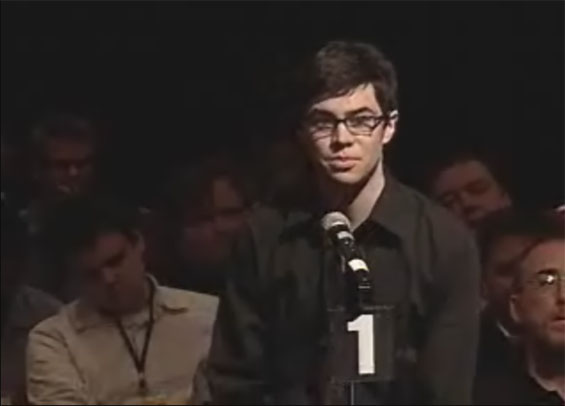
Paul Vett (BlackBerry software developer) – “it’d be nice to drop some of the rhetoric and focus on the nuances because it’s quite complicated”

Brian P. Isaac @ approx. 6:03
Brian Isaac (chairman of Canadian Anti-Counterfeiting Network, lawyer @ Smart & Biggar) – “I make my living enforcing intellectual property”

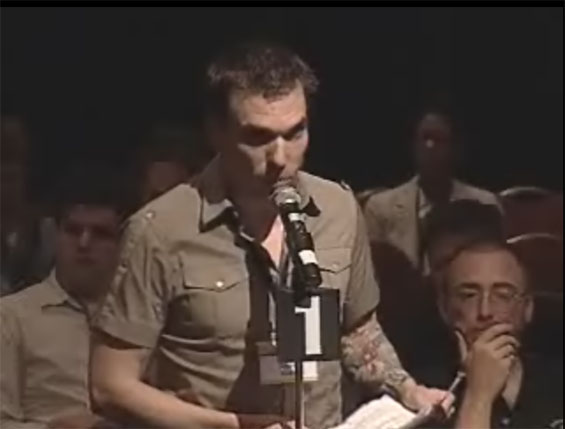
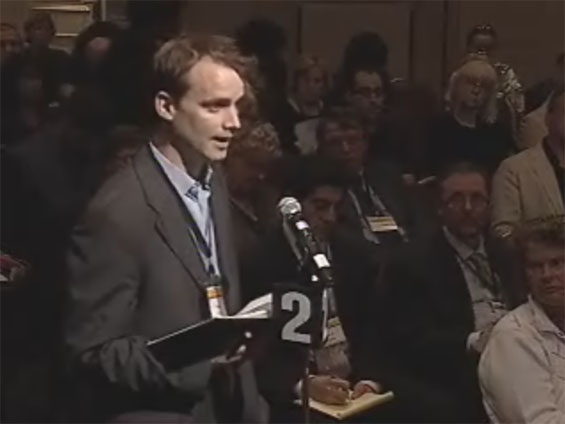
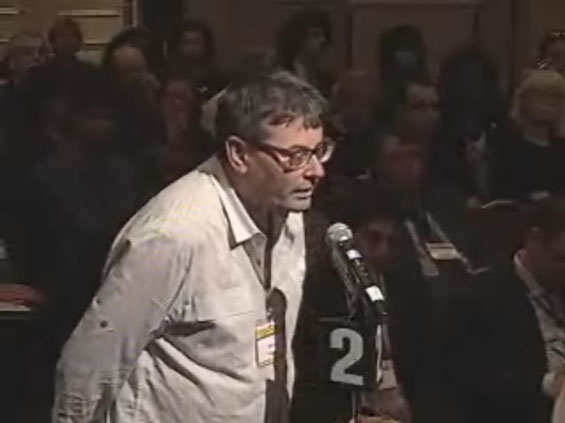
Jonathan Dry @ approx. 5:20
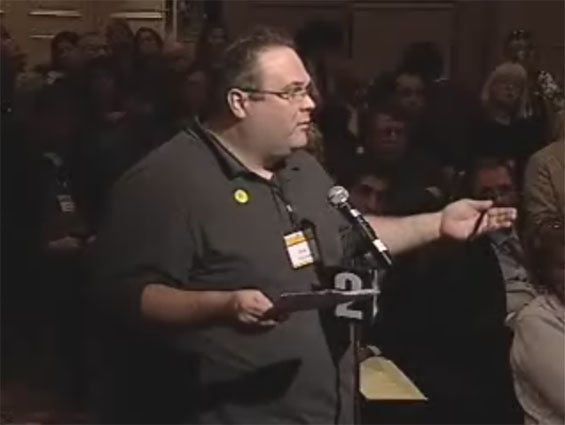
Jonathan Dry – (Mechanical Designer) –“I’m a mechanical designer from Mississauga. I don’t work in the entertainment industry. [audience claps] I believe we are in this situation because of eternal copyright laws. I’ll start by saying that copyright is meant to foster a broad and diverse culture of creation and derivative works in a country. And we don’t have that now. The eternal copyright has created a vacuum and pulled away the culture of the people from the general populace. I grew up in the 1990s, that was how it was then. In its place was placed a load of mass produced rubbish… music… you could turn on the TV any time [and hear it?]. It’s pretty much the same nowadays and this damages the youth. It takes away a formative decade, the teenage years. Instead of creating a culture of production and of personal achievement we’re given self destructive teenage rebellion. We’ve put all the power to create culture into the hands of a few corporations with eternal copyright. They just buy it up and that’s the end of it.

If we’re going to reform the system… [looks at the timer] three minutes… Okay. As far as the public domain goes we need shorter copyright terms. [points to the timer] Thank you. [moderator offers an apology]

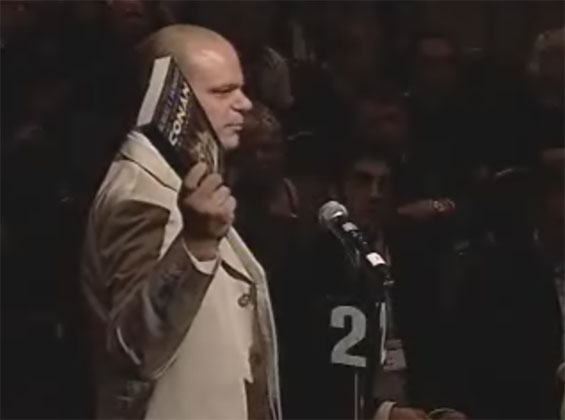
This book [holds up Blood Of The Gods and Other Stories] is published in Mississauga, Ontario. It is by Robert E. Howard. His work is falling into the public domain. [holds up The Coming Of Conan The Cimmerian] He is most known as the creator of Conan The Barbarian. If you like books about screaming barbarians and monsters it’s great stuff. There’s a publishing boom going on, of his work, right now. Del Rey [has] his stuff with annotations, scholarship, letters, all sorts of other stuff – because everything else, the original stories, are now in the public domain. And guys like these guys in Mississauga [indicates Blood Of The Gods] are publishing it. It’s being driven by the entrance of his work into the public domain.

What we need is shorter copyright terms. This is going to drive innovation. Canada could attract a large number of publishers and artists from all over the world if we reduce copyright terms. We are sitting on a gold mine people. It’s being withheld from the general public by a small amount of copyright holders. If we were to loosen that up there would be a cultural explosion and industrial explosion in that industry. I would ask that the Conservative government to go back to your entrepreneurial roots. We have a small publisher in Mississauga making money from the public domain, it’s also driving big ones in the states.

[points to audience member] – no interruptions please. Okay?

We need to go back and allow these entrepreneurial companies, these small startups, to grow big. To exist! Because, right now, they can’t.”

Denis McGrath @ approx. 6:26Denis McGrath (TV writer and blogger) – “as an artist I want my work to be seen by as many people as possible”

Daniel Seyer @ approx. 6:55Daniel Seyer (student at University Of Ontario Institute of Technology)- “hello music industry” [audience laughs] I’m a student… [audience member says something] “Hello entertainment industry I guess. It’s nice for everyone to be here” – “keep the playing field open and let the market decide” – “extend tariffs [levies] to hard drives and blank media” – “put a tax on bandwidth” – “don’t do anything that the Americans are doing” [audience laughs]

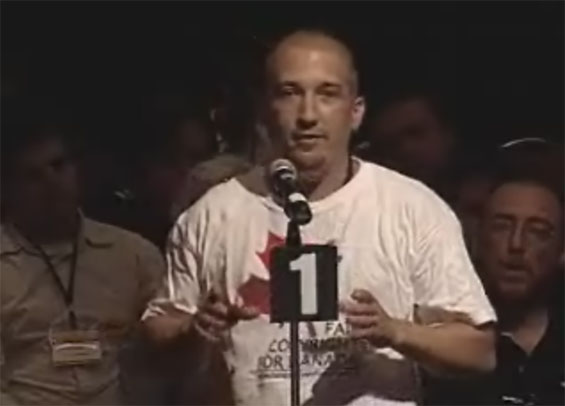
Simon Shaw @ approx. 7:05Simon Shaw [movie pirate wearing a Fair Copyright For Canada t-shirt] – “I operate six terabyte servers of movies that I share freely with my friends all around the world. Most of your works are on my servers”
speaker #143 -m @ approx. 7:10
Speaker #143 (anonymous lawyer) – “The previous speaker mentioned this was ‘not a debate about two extremes’ I take offense to that. … On the one hand we continue to be the laughing stock of the world through our outdated copyright laws, and continue to be a cesspool for online pirates such as the last speaker [woots and claps from the audience] or we update the copyright act as the rest of the modernized world has done to protect creator’s rights.”

Speaker number 43? or 93? @ approx. 7:16
Speaker #43? or #93? (anonymous speaker) – [approaches the microphone] “…kinda funny how there’s so many people from the music industry here – not many normal people.” “The corporations are trying to extend copyright… [something someone in the audience flusters this speaker] …any Cinar executives here? – Ya? You guys never steal.”

The honorable Minister of Indusrty Tony Clement @ approx. 7:18
Tony Clement (Minister Of Industry) – “we got through it all in one piece. It has not degenerated into a U.S. health care town hall meeting”

Watch the whole video for yourself in the (very lame) |WMV| format.

Updates:

Posted by Jesse Willis

Cory Doctorow’s review of Sandman Slim by Richard Kadrey

SFFaudio News

Brilliance Audio - Sandman Slim by Richard KadreyCory Doctorow is singing the praises of a cool sounding audiobook by Richard Kadrey called Sandman Slim. It’s available now from Brilliance Audio

“I’ve just finished listening to the unabridged, 10-hour audiobook of Sandman Slim, which is available on a single MP3 CD without DRM from Brilliance Audio. The reading is performed by Macleod Andrews, who does the narration in a perfect whiskey voice that’s 80 percent Tom Waits, 20 percent Clint Eastwood. The performance and production are marvellous, a great interpretive reading that really brought the novel to life for me. I also love that I could get it without having to suffer through either DRM through one of the audiobook download stores or through ripping ten CDs’ worth of material, which is how I normally get my audiobooks onto my computer.”

[via BoingBoing]

Posted by Jesse Willis