The SFFaudio Podcast #107

Podcast

The SFFaudio PodcastThe SFFaudio Podcast #107 – Scott, and Jesse talk about new audiobooks, recent arrivals, new releases, the theatre and and comics too!

Talked about on today’s show:
Little Women, Louisa May Alcott, Pride And Prejudice, Charlie’s Aunt, 1776, John Hancock, John Adams, Thomas Jefferson, David McCullough, Penguin Audio, Across The Universe by Beth Revis, generation ship, murder, “earth is nowhere new the final frontier”?, Hamlet, A Discovery Of Witches by Deborah Harkness, “he loves yoga and he’s a vampire?”, history, wine, the multiple meanings of discovery, Christopher Columbus DID (in a sense) discover North America, uncover vs. discovery, WWW: Wake by Robert J. Sawyer |READ OUR REVIEW|, “mining the same ideas” in a trilogy, Seth Wilson, Spirit Blade a christian audio drama, Pilgrim’s Progress |READ OUR REVIEW|, comicbookjesus.com’s review, An Accidental Adventure: We Are Not Eaten By Yaks by C. Alexander London, Stormbreaker by Anthony Horowitz, GoodReads.com, Ranger’s Apprentice: Book 10 – The Emperor Of Nihon-Ja by John Flanagan, the Ranger’s Apprentice Wiki, The Lord Of The Rings, Blackstone Audio, Sweep: The Coven by Cate Tiernan, Dreamhouse Kings: Book 6 – Frenzy by Robert Liparulo, Aural Noir, Silent Mercy by Linda Fairstein, the Alex Cooper series, series Crime/Mystery vs. series Fantasy/Science Fiction, Sue Grafton, Star Trek, Star Trek: The Next Generation, Star Trek: Deep Space Nine, Star Trek: Voyager, Star Trek: Enterprise, SFSignal.com’s Which SciFi Series Should You Watch on NetFlix? This Handy Flowchart Will Help You Decide!, Night Vision by Randy Wayne White, the extremely negative reviews on Amazon.com, When The Thrill Is Gone by Walter Mosley, Blue Light, Futureland, John DeNardo’s review of Blue Light, Bell Air Dead by Stuart Woods, Strategic Moves by Stuart Woods, “Stuart Woods is a writing machine”, Richard Ferrone, Tamahome got bogged down in the Martian sand (of Kim Stanley Robinson’s Red Mars), Buried Prey by John Sanford, kidnapping, “this dude has other dudes as well”, the Virgil Flowers series, Bad Blood, the next readalong is 361 by Donald E. Westlake, Port Mortuary by Patricia Cornwell, the Kay Scarpetta series, forensic detection, Kathy Reichs, Bones, new releases, Hachette Audio, Consider Phlebas by Iain M. Banks, space opera, Coruscant, extremely detailed strange stuff, Audible.com, Recorded Books, Glasshouse by Charles Stross, Hard Magic: Book I of the Grimnoir Chronicles by Larry Correia, Audible Frontiers, Monster Hunter International by Larry Correia, Second Variety and Other Stories by Philip K. Dick, William Coon, The Most Dangerous Game, The Variable Man by Philip K. Dick, Buffalito Destiny, David Drake’s Hammer’s Slammers series, military SF, The Collected Stories Of Arthur C. Clarke Vol. 5, Bronson Pinchot, The Alchemy of Desire by Crista McHugh, Cormac McCarthy’s The Road (translated into Danish), The Stress Of Her Regard by Tim Powers, The Broken Sword by Poul Anderson, Orion And The King by Ben Bova, The Automatic Detective by A. Lee Martinez, robot detective vs. femme fatale, “satisfying conclusion, clever, twisty, fast” = good, Monster: A Novel, Divine Misfortune, The Stainless Steel Rat Book 8, Too Many Curses, FREE COMIC BOOK DAY, Criminal: Bad Night by Ed Brubaker and Sean Phillips, The League Of Extraordinary Gentlemen Vol. 2 by Alan Moore, Listening For The League’s Gentlemen, Mars, aliens, H.G.Wells, The War Of The Worlds, Allan Quatermain, Bongo Comics, The Simpsons, Baltimore, Mike Mignola, Hellboy, Fafhrd And The Gray Mouser, Civil War Adventure, Locke & Key, Blair Butler, Joe Hill, TV version of Locke & Key, DMZ, Brian Wood, Fables, Y: The Last Man, The Boys: Highland Laddie, Garth Ennis, 361 by Donald E. Westlake, Hard Case Crime, Charles Ardai, Memory by Donald E. Westlake, The Comedy Is Finished by Donald E. Westlake, The King Of Comedy, Getting Off by Lawrence Block, James M. Cain, David Morrell, Stephen King, John D. MacDonald.

Posted by Jesse Willis

The SFFaudio Podcast #103 – TOPIC: Food in Science Fiction and Fantasy

Podcast

The SFFaudio PodcastThe SFFaudio Podcast #103 – Scott, Jesse, Eric S. Rabkin and Luke Burrage talk about FOOD in Science Fiction and Fantasy. It is rather unpleasantly like being drunk.

Talked about on today’s show:
Luke’s got a twelve hour hunger, fairy tales, Fantasy, food sharing is coming to know the alien, what food is served in a Canadian restaurant?, Kwakiutl vs. Kwakwaka’wakw, pemmican, voyageurs, THE YELLOW PERIL podcast (The SFFaudio Podcast #051), Frankenstein by Mary Shelley, Frankenstein’s creation was a vegetarian, Paradise Lost, Genesis, Cain vs. Abel, Eifelheim by Michael Flynn, the three stages of eating: veggies -> meat -> people, aliens, crazy vs. odd, inedia (fasting), breatharianism, Scott Pilgrim, Scott Pilgrim Vs. The World, inspired by spirits, Neuromancer, communion, puns, Foods of the Gods: Eating And The Eaten In Fantasy And Science Fiction (Proceedings Of The J. Lloyd Eaton Conference On Science Fiction And Fantasy Lite) edited by Eric S. Rabkin, Gary Westfahl and George Edgar Slusser, more puns, The Futurological Congress by Stanisław Lem, consuming books, The Divine Comedy by Dante Alighieri, Michael Kandel, The War Of The Worlds by H.G. Wells, evolution and food, food in pill form, Tang, Firefly, Science Fiction: prediction of the future vs. sign of the future, jetpacks, capsulized food is symbolic, lembas is super-power bread, energy drinks, food as a representation of our relationships with our bodies, The Invisible Man by H.G. Wells, yet more puns, The Hunger Games by Suzanne Collins, food and pretty dresses, baking and bread have deep roots, Voyage To The Moon by Cyrano de Bergerac, no one ever sees a baker eating, food imagery, the centrality of bread in SFF only matches that of religion, the bread yes – the blood no, Osiris, Egypt, Greece, The Hitchhiker’s Guide To The Galaxy by Douglas Adams, The Restaurant At The End Of The Universe, List of races and species in The Hitchhiker’s Guide to the Galaxy, the babel fish, “it’s not the babel worm”, fish as a symbol, Pythagoras, professor smackdown, Tower Of Babel, food and sexuality, urban romance, Eat Prey Love, “man does not live by bread alone” vs. “forbidden fruit”, bread as technology, breadfruit, the garden of Eden, the tree of knowledge vs. the tree of immortality vs. the rubber tree, Trantor, Isaac Asimov’s Foundation, Coruscant, Star Wars, Sam Parkhill, The Off Season by Ray Bradbury, The Martian Chronicles, the best hot dog stand on Mars, The New Colossus by Emma Lazarus, the national food of America is the hot dog, the hot dog is the symbol of America, Manhattan, “hot dog stands all the way down”, meat paste, man as food, To Serve Man by Damon Knight, Alien, The Logic Of Fantasy by John Huntington, cannibalism, The Time Machine by H.G. Wells, Galápagos by Kurt Vonnegut, The Genocides by Thomas M. Disch, The Screwfly Solution by James Triptree Jr., Beyond Lies The Wub by Philip K. Dick, further punning, vat grown meat, breeding animals to be less intelligent, a very meaty topic, Caviar by Theodore Sturgeon, vegetarianism, Fallen Dragon by Peter F. Hamilton, Luke is on the wrong side of meat history, being as unnatural as possible is what makes us human, a continuing journey towards humanity (marching on our stomachs?), social animals, mothers make food for you – witches make food of you, choosing not to eat meat vs. choosing to be monogamous, dolphin eating habits (are they porpoiseful eaters?), eating dolphin is out of line (for Luke), exploring the possibilities of empathy, Do Androids Dream Of Electric Sheep? by Philip K. Dick, empathy vs. compassion, Technovelgy.com’s entry on food, an overly inclusive notion of what constitutes invention, CBC Spark, visiscreens and visiplates, Ralph 124C 41+ by Hugo Gernsback, Minding Tomorrow by Luke Burrage, Technovelgy needs more wiki, Wikipedia is endlessly useful, automated restaurant, The Food Of The Gods by H.G. Wells, food has functions beyond just sustaining our bodies, George Birdseye, Pan Galactic Gargle Blaster, coffee, sharing meals via Skype.

Posted by Jesse Willis

19 Nocturne Boulevard: An adaptation of Robert Sheckley’s The Leech

SFFaudio Online Audio

19 Nocturne BoulevardJulie Hoverson’s long running and prolific anthology podcast, 19 Nocturne Boulevard, features original and adapted “strange stories.” Since it began back in 2009 I’ve pretty much ignored it completely. This is pretty odd considering that Hoverson’s output rivals that of the mighty Bill Hollweg and that she’s been doing something I’m always boosting (adapting public domain Science Fiction, Fantasy and Horror). To be fair though, I had heard a couple of shows, most recently Snafu, but every time I’d listened to a 19 Nocturne show I’d come away with nothing to say. It took a recent email from Hoverson to get me to write something. Hoverson pointed out her new adaptation of Phillips Barbee’s The Leech. That title stirred a vague memory, then piqued my interest greatly, as I recalled that Phillips Barbee was actually the great Robert Sheckley!

When it was first published, in the December 1952 issue of Galaxy magazine, The Leech was credited to “Phillips Barbee” – a one-off pseudonym, presumably it was only used at all because there were two Sheckley stories running in that issue. All subsequent publications have credited The Leech to Sheckley alone.

As one of the first ever Sheckley stories to be published, The Leech is interesting in itself. But as a kind of precursor to The Blob – which itself has an ancestor of sorts in H.P. Lovecraft’s The Colour Out of Space (which Hoverson has also read) it is even more interesting. The trope of a knowledgeable professor character investigating a dangerous object from space would be picked up for the 1953 BBC serial The Quatermass Experiment. In structure, however, The Leech more closely resembles the 1959 Manly Wade Wellman novel Giants From Eternity (look for a review of that soon). And it also bears some small resemblance to John W. Campbell’s 1938 novella Who Goes there? (and thus the movies The Thing and The Thing From Another World). Even Dean Koontz’s Phantoms |READ OUR REVIEW| has some sort of ancestry or parallel in The Leech. In short this is a kind of a subgenre’s subgenre that I don’t know the name of.

As for Hoverson’s adaptation of The Leech, it’s pretty darned slick, with good acting and sound effects. There’s even a theremin! It’s also fairly faithful to Sheckley’s story going with the humor, using much of the dialogue, the setting and the period. But, as with most audio drama, Hoverson’s script completely disposes with the third person omniscient narration, opting instead for to give the alien a voice – or voices in this case (the Leech seems to be performed as a kind of hive mind). This choice leaves the ending more open to interpretation than does the original text. The Leech is one of the best amateur audio drama adaptations of a public domain story yet! Highly recommended.

19 Nocturne Boulevard - The Leech19 Nocturne Boulevard – The Leech
Adapted by Julie Hoverson; From the story by Robert Sheckley; Performed by a full cast
1 |MP3| – Approx. 40 Minutes [AUDIO DRAMA]
Podcaster: 19 Nocturne Boulevard
Podcast: February 23, 2011
Classic era science fiction about a very odd visitor from outer space. The Leech was first published in the December 1952 issue of Galaxy Science Fiction.

Cast:
Professor Michaels … Grant Baciocco
Frank Connors … Bryan Hendrickson
Mrs. Jones … Kimberly Poole
Sheriff Flynn … Glen Hallstrom
General O’Donnell … Chuck Burke
Allenson, scientist … Cary Ayers
Moriarty, physicist … Eleiece Krawiec
Brigadier-General … H. Keith Lyons
Driver … Cary Ayers
Soldier1 … John Carroll
Soldier2 … Lothar Tuppan
Pilot … Mark Olson
The Leech … Suzanne Dunn, Will Watt, James Sedgwick, Julie Hoverson

Music by misterscott99
Editing and Sound: Julie Hoverson
Cover Design: Brett Coulstock

Podcast feed: http://nineteennocturne.libsyn.com/rss

And since we’re talking The Leech, I should also point out there is a new reading, found in the recently completed LibriVox Short Science Fiction Collection Vol. 042 collection…

LibriVox - The Leech by Robert SheckleyThe Leech
By Robert Sheckley; Read by Gregg Margarite
1 |MP3| – Approx. 40 Minutes [UNABRIDGED]
Publisher: LibriVox.org
Published: November 28, 2010
Etext: Gutenberg.org
A visitor should be fed, but this one could eat you out of house and home … literally! From Galaxy Science Fiction December 1952.

Posted by Jesse Willis

Human Intelligence: A Holiday Tale – adapted from a story by Kurt Andersen

SFFaudio Online Audio

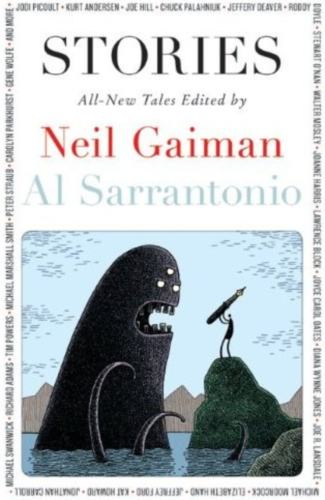
From Stories: All-New Tales (edited by Neil Gaiman and Al Sarrantonio) here is an “audio cinema adaptation” (a reading with sound effects) – produced by Jonathan Mitchell for WNYC’s Studio 360. I was looking throughthe Amazon.com reviews of the paperbook. This Xmasy Science Fiction story got top marks from all the reviewers!

Stories: All New Tales edited by Neil Gaiman and Al SarrantonioHuman Intelligence: A Holiday Tale
By Kurt Andersen; Adapted by Jonathan Mitchell; Performed by Ed Herbstman, John Ottavino and Melanie Hoopes
1 |MP3| – Approx. 22 Minutes [DRAMATIZED READING]
Podcaster: Studio 360 with Kurt Andersen
Podcast: December 23, 2010
“…a geologist meets an explorer from another planet who has been studying humans for the past 1,600 years.”

[Thanks to Barry Haldiman for the find!]

Posted by Jesse Willis

A conversation between Wernher von Braun and Willy Ley

SFFaudio Online Audio

Archive.org has a wonderful 90 minute English language conversation between two famous German rocket scientists!

Check it out |MP3|

A historic conversation between German rocket scientists Wernher von Braun and Willy Ley. Highlights include the development of the German rocket programs during WWII, and the space program in the 1950’s. Recorded June 9th and 23rd, 1959, in New York City and Redstone Arsenal, Huntstville, Alabama.

Indeed hearing Wernher von Braun and Willy Ley talk is very cool.

Ley and von Braun talk about:
old school days in Germany, Hermann Oberth‘s influential book Die Rakete zu den Planetenräumen (“By Rocket Into Interplanetary Space“), Fritz Lang movie Woman In The Moon, rocketry and rockets from the V-2 to the Saturn rocket family, geosynchronous satellites, the Mercury project, space stations, weather satellites, the Van Allen radiation belt, the role of humans in space, sending men around the Moon, the logistics of photographing and visiting Venus and Mars, space probes, a “semi-philosophical question about Man’s rights in space”, theological objections (and blessings), the compatibility between religion and science, Blaise Pascal, extraterrestrial life, vegetation on Mars, smart aliens, Arthur C. Clarke’s first law.

As you can see it is very historic!

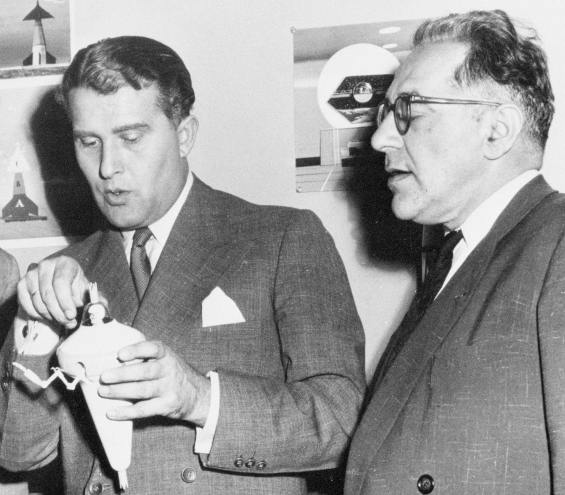
Wernher von Braun (left) and Willy Ley (right)

I won’t say much more about the fascinating Wernher von Braun as I recently posted a biographical radio dramatization about him. But I will point out that Willy Ley is pretty damn amazing. Ley was an avid reader of Science Fiction, contributed science articles to Astounding Stories and Galaxy Magazine and was a member of the Trap Door Spiders – there is a wonderful Wikipedia entry about him to explore HERE.

Posted by Jesse Willis

Review of The Big Time by Fritz Leiber

SFFaudio Review

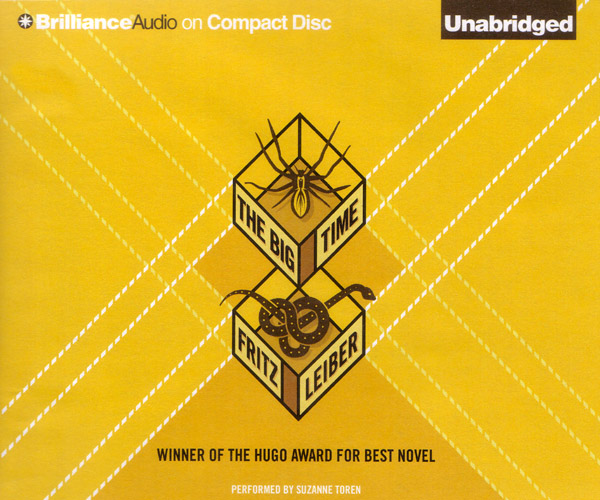
BRILLIANCE AUDIO - The Big Time by Fritz LeiberThe Big Time
By Fritz Leiber; Read by Suzanne Toren
4 CDs – Approx. 5 Hours [UNABRIDGED]
Publisher: Brilliance Audio
Published: August 2010
ISBN: 9781441875129
Sample: |MP3|
Themes: / Science Fiction / Mystery / Locked Room Mystery / Time Travel / Sex / Aliens / War / History /

Have you ever worried about your memory because it doesn’t seem to recall exactly the same past from one day to the next? Have you ever thought you might be changing because of forces beyond your control? Have you ever thought that the whole universe might be a crazy, mixed-up dream? If you have, then you’ve had hints of the Change War. It’s been going on for a billion years and it’ll last another billion or so. Up and down the timeline, the two sides – “Spiders” and “Snakes” – battle endlessly to change the future and the past. Our lives, our memories, are their battleground. And in the midst of the war is the Place, outside space and time, where Greta Forzane and the other Entertainers provide solace and R and R for tired time warriors. The Big Time was first published in two two issues of Galaxy Science Fiction magazine, March and April 1958.

When I finish reading an old Science Fiction novel like this one I pick-up my copy of The Dictionary Of Science Fiction Places (by Brian Stableford) and see if there’s an entry for it. There is one for The Big Time. It’s listed under “Place, The” on pages 238 and 239. Here are a couple of descriptive passages therefrom:

“[The Place is a] safe haven established outside the cosmos while infinity and eternity were undergoing the continual upheavals of the Change War, in order to serve as a Recuperation Station for soldiers fighting on the side of the Spiders against the Snakes. Its female staff were officially categorized as Entertainers and quite rightly thought of their work as nursing rather than whoredom.”

and

“The Place was midway in size and atmosphere between a fair-sized nightclub and a cramped Zeppelin hangar.”

As other reviewers have pointed out this is essentially a stage play, and as such, the stage for The Big Time is “The Place.” Now given that it won a Hugo Award, for the Best Novel of 1958, I’m kind of surprised how lightweight and compact The Big Time is. The entirety of the action takes place in just the one location and over a very short period of time. Adding to the oddness, it’s narrated in first person, by a resident/worker in what is essentially an quasi-bar-brothel (or bawdy house) for military personnel. That’s actually a very good thing in terms of storytelling as The Big Time is actually a locked room mystery tale, a mutiny and a variation on Edgar Allan Poe’s The Purloined Letter. The whole book is chock-full of allusions, historical details and notable quotations (one for each chapter in fact). The plot doesn’t really get rolling until about half-way through, at which point you’ve learned nearly enough to play along with the mystery aspect. I liked how it was resolved, and found that the process had me both suitably and appropriately buffaloed with it’s many Agatha Christie-style red-herrings.

There’s a nice description of this novel’s uniqueness on the Wikipedia entry: “The Big Time is a vast, cosmic back story, hidden behind a claustrophobic front story with only a few characters.” That’s it precisely. Now to the question I turned over and over in my mind after hearing it. “Is The Big Time a classic for the ages?” Upon long consideration I’m thinking that it is not. It is a good story, but it’s nowhere near that vaunted class of SF greatness. The idea of time travelers fighting a war across time and space isn’t a particularly original or interesting. And it isn’t an idea that is thoroughly exhausted in this story. But, for what this story is, and how it’s done, The Big Time is definitely worth reading if you’re in a mood for a locked room tale.

I’m sad to report a couple of minor blemishes mar this otherwise excellently produced audiobook version. First there’s the music. Each disc in the CD set ends and begins with music that absolutely does not fit the novel’s atmosphere. This problem may be entirely avoided by getting the original Audible Frontiers version, or perhaps mostly (or completely) eliminated with the MP3-CD edition.

Second, more serious, and entirely unavoidable, there is a lyrical song in the text, which I will reproduce to illustrate the problem. This comes at the end of Chapter 3:

Standing in the Doorway just outside of space,
Winds of Change blow ’round you but don’t touch your face;
You smile as you whisper tenderly,
“Please cross to me, Recuperee;
The operation’s over, come in and close the Door.”

Given the number of references I got, this one must be Fritz Leiber’s nod to the immortal Lili Marleen. But Suzanne Toren, who is otherwise absolutely fantastic, doesn’t use Lilli Marlene as the melody. And that is a small, but very real shame.

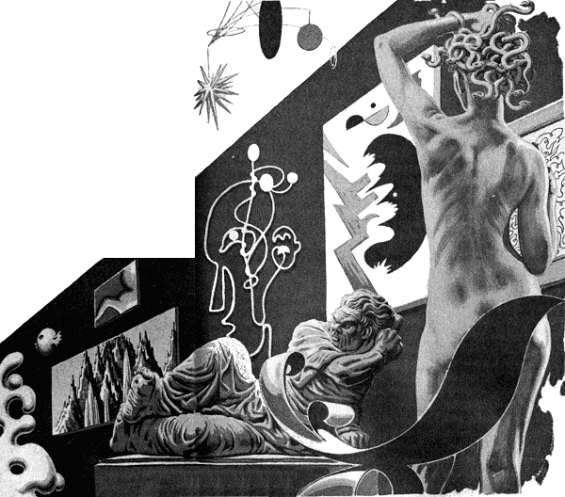
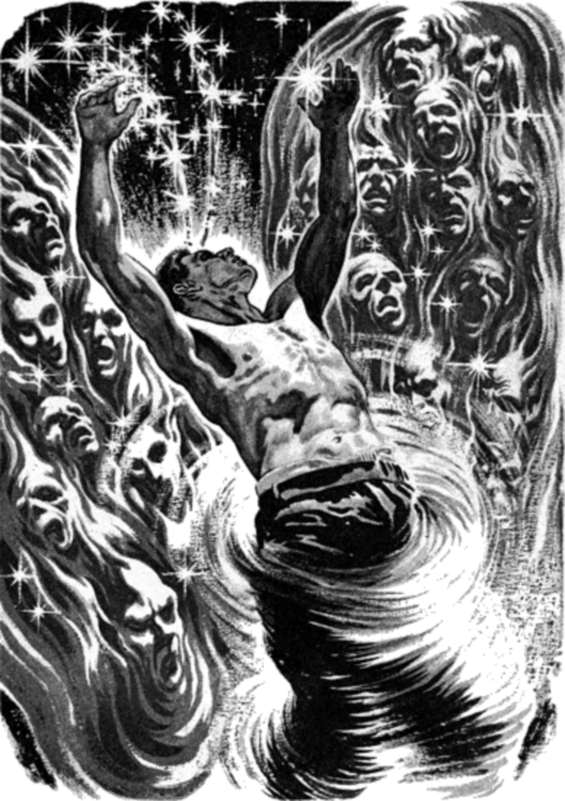
By the way, here are three of several cool Virgil Finlay illustrations from the original Galaxy publication:

The Big Time by Fritz Leiber - Illustrated by Virgil Finlay

The Big Time by Fritz Leiber - Illustrated by Virgil Finlay

The Big Time by Fritz Leiber - Illustrated by Virgil Finlay

Posted by Jesse Willis