Review of The Hitch-Hiker’s Guide to the Galaxy By Douglas Adams

Science Fiction Audio Drama - The Hitchhiker's Guide to the GalaxyThe Hitch-Hiker’s Guide to the Galaxy
By Douglas Adams, performed by a Full Cast
6 Cassettes, 6 hours [AUDIO DRAMA]
Publisher: The Mind’s Eye
Published: 1988
ISBN: 0881425671
Themes: / Science Fiction / Audio Drama / Humor / Aliens / Space travel / Time travel /

I have to cringe whenever an important milestone in Dr. Seuss’s surprisingly robust afterlife comes around, because it is inevitably greeted with a hundred grating “Seuss-like” paeans from every journalist, columnist and otherwise admittedly illiterate citizen who makes the amazing discovery that the English language is crammed to bursting with words that rhyme. More, even, if you make up a few of the words yourself. Douglas Adams can be similarly “inspirational”. Much of what is written about him is filled with disorientingly obscure citations and facile imitations. I appreciate why: He and Seuss made it look so easy, we can scarcely resist attempting to recreate their magic ourselves. But I will admit right now that if I could write like Adams, I wouldn’t be sitting here bashing out brief audio book reviews for an utter lack of pay. I will also admit that I have incorporated much of Adams’ prose into my own genome, and hope to transfer it genetically to my offspring (an aspiration my wife does not seem to regard with the same urgency). I will not, however, take a crack at trying to impress you with my abilities to mimic and quote. I don’t want to embarrass myself.

These tapes are of the very first incarnation of The Hitch-Hiker’s Guide to the Galaxy, the Ur-myth that inspired a trilogy of four novels, a diabolical computer game, a television show, and an upcoming movie. More than just a recording of a funny radio play, these tapes represent the annunciation of Douglas Adams as the major talent in science fiction humor: a veritable shot heard round the world. The story itself is an ambling monstrosity of interplanetary adventure, time travel, and hidden questions about the meaning of the universe and the origin and fate of the planet earth. Of course, with all successful humor, what it is really about are the characters (in this case, chiefly Arthur Dent, Ford Prefect, Zaphod Beeblebrox, Trillian, and Marvin the android) and the way they interact and bicker as wave after wave of crazy crap happens to them. The prose is exquisite (“They hung in the air exactly the way bricks don’t.” Oop! That was a quote, wasn’t it?), the settings range from imaginative (Magrathea) to bizarre (Milliways), and the information provided by the Guide itself is always tangential and hilarious.

But for fans of the books or the television show, what is truly remarkable about the first and second half of the tapes (the primary and secondary phases of the radio play) is not their utter perfection, but Adams’s uncanny ability to tweak them to even greater heights. The escape from Milliways is an excellent example. In these tapes, the use of an alien navy commander’s space ship is a little weak, but in the latter versions, the material Adams adds about the band “Disaster Area” and their cataclysmic concerts not only makes a better doomed escape, but contains some of the most memorable lines and images in the whole series. And the way he combines the primary and secondary phases of the radio show to produce an interweaving of the Dent/Prefect and Beeblebrox/Zarniwoop story lines in the novels not only increases the dramatic tension more organically, but also fills many of the logic holes that perforate the second half of these tapes. It’s like a graduate-level class in editing, only funny.

Of course, this radio play is not simply a virtuoso performance by the author, but a monumental ensemble production, as well. Mark Wing-Davey’s spacey portrayal of Zaphod Beeblebrox makes even Bill Murray’s Peter Venkman look pretty well plugged in, and Stephen Moore’s Marvin the android is a walking mechanical disaster of painfully amusing dimensions. Those are my two favorite performances, but the others are similarly tight: Simon Jones captures the bewilderment and hysteria of Arthur Dent perfectly; Geoffrey McGivern delivers a Ford Prefect who is helpful, roguish, and enigmatic; Peter Jones gives the voice of the book a zany, reassuring sound like a kindly but mad uncle; and Susan Sheridan provides a smart yet seductive Trillian Add in the myriad voices of mice, computers, doors, and smug waiters; the wonderful special effects of the BBC Radiophonic Workshop; and the loopy grandeur of the Eagles’ “Journey of the Sorcerer” as the main theme and you have a work of audio magic that will tickle your brain and delight your ears.

But don’t believe for a minute that we all walk around quoting this radio play in our daily speech simply because it provides hours of silly hijinx.. Adams ventures beyond situational and linguistic surprise to grapple with the humiliating vastness of the universe and the mind-boggling possibilities of infinity, and it is this theme that anchors the series so firmly in the subconscious. Philosophy, religion, and calculation are shown to be helpless before the unrelenting immensity of everything, and the only response we are left with is either suicidal hopelessness or laughter. We are forever indebted to Douglas Adams and the BBC cast for saving us with laughter. So I urge you to buy, rent, or steal these tapes as soon as you can and begin stuffing as much of the prose into your memory as it will hold. What else are you saving all that underpowered gray matter for?

Posted by Kurt Dietz
Review of Fruitcake Theory By James Patrick Kelly

Fruitcake Theory by James Patrick KellyFruitcake Theory
By James Patrick Kelly; Read by James Patrick Kelly
FREE MP3 DOWNLOAD (link to jimkelly.net) – 30 Minutes (14.33 MB) [UNABRIDGED]
Publisher: www.jimkelly.net
Published: March 2004
Themes: / Science Fiction / Aliens / First Contact / Christmas / Immortality /

“This one hears much of the information of fruitcake.”

Maggie is a tour guide. Her job is to escort an alien that looks like a rooster, and acts as dumb as one, during the yuletide season. The rooster is just one of two kinds of aliens from a bifurcated species visiting Earth. This is a story that posits some very interesting aliens, something Kelly is good at, but the heart of the story is the Christmas theme. It’s a bit silly, but I liked it that way. Told in the first person, Kelly does a great muppetish voice for the alien rooster that creates some great mental images to go along with the description. The reading concludes with a very appropriate Christmas music. It was great!

First published in the December 1998 issue of Asimov’s Science Fiction Magazine, “Fruitcake Theory” and this great recording of it will certainly get you in the mood for Christmas. As with the all the other audio stories of Jim Patrick Kelly’s we’ve reviewed, “Fruitcake Theory” is available for download on Kelly’s website for FREE – you’d have to be as nutty as a fruitcake not to try a deal like that! Kelly only asks that if you enjoyed hearing the tale you consider making a donation to his PayPal account. Donate as little or as much as you like, but seeing as the Christmas spirit is fast approaching be generous.

Posted by Jesse Willis

Review of Ringworld’s Children by Larry Niven

SFFaudio Review

Ringworld's Children by Larry NivenRingworld’s Children
By Larry Niven; Read by Barrett Whitener
8 CDs – Approx. 9.5 Hours [UNABRIDGED]
Publisher: Blackstone Audio
Published: 2004
ISBN: 0786185384
Themes: / Science Fiction / Hard SF / Physics / Genetics / Aliens / Nanotechnology / Evolution /

The Ringworld is a landmark engineering achievement, a flat band three million times the surface of the Earth, encircling a distant star. Home to trillions of inhabitants, not all of whom are human, and host to amazing technological wonders, the Ringworld is unique in all of the universe.

The blurb above is a bit of a lie, no longer is Ringworld unique. There is Rama, Arthur C. Clarke’s giant tube shaped alien habitat, Bob Shaw’s Orbitsville, a huge Dyson’s Sphere built by mysterious aliens and the hungry alien construct called Gaea of John Varley’s Titan. Indeed, there have also been three other books in the Ringworld series – admittedly all of them are set on the same Ringworld. But the first Ringworld novel, published in 1970, was the first of this new kind of SF novel; the novel of the big big thoughts, or as David Gerrold calls it, “the enormous big thing”. An idea, a ‘what if’ so massive and so imaginative, so rife with unforeseen consequences that the characters must investigate it just as we do. Kind of like science fiction for science fiction characters! Ringworld was such a big idea in fact, that the three sequel novels were published in an effort to examine the impossible gigantitude of the consequences of its existence. In this the fourth, and perhaps final installment of the Ringworld series, we see more of the problems of existence of such a structure fixed, visit with old characters (Louis Wu, Acolyte, The Hindmost and Tunesmith being major players) and meet some new ones too. There are some genuine surprises here, and some edge of your seat excitement, but as with the previous two sequels the biggest surprise is still the same one from the first novel – and that of course is, just how massively huge the Ringworld is! Its size still staggers the imagination… a narrow ring, only 0.997×10⁶ miles wide, with two perimeter walls climbing 1000 miles high, to hold in the air, the ring itself is 93 million miles in radius, a single spinning world shaped like a ribbon around a star – with a habitable area of over 3 million Earths. What couldn’t happen in a place that big?

Author Larry Niven cemented himself as the standard barer of Hard Science Fiction, with the publication of Ringworld. If he had done nothing else, he’d still be thought of as a prodigious figure in the field. But he’s not rested upon his laurels; he’s expanded, refined and continued the Ringworld adventure. In a way, that was a mistake. You can’t top an idea this big by telling more adventures about the same world. On the other hand, I personally wouldn’t have had it any other way. I enjoyed nearly every minute of the nine and a half hours of listening in Ringworld’s Children. In fact, I would have been happy with another nine hours! There were a few parts that were dry, sure, but they didn’t last very long and they moved the plot along. I do wish Niven had spent some more time exploring the inhabitants of his creation; we meet only a few new hominid species, and unlike in previous installments, we don’t get a full sense of their ecological niches. But given that much of the action takes place in space around the Ringworld perhaps it couldn’t be helped. Much of this action is necessary though as many threads from the previous two sequels needed tying up, especially if this is indeed the final chapter in the Ringworld series.

Barrett Whitener, who seems to be recording nearly every Blackstone science fiction title coming out these days, was actually not a great choice as reader for Ringworld’s Children. It’s not that his reading is poor – it wasn’t. In fact, I like the way Whitener read it, I just think that his tone was all wrong for this particular novel. His various alien voices didn’t sound at all alien. Mark Sherman, who did such a terrific job with the alien voices in Larry Niven’s Protector (also recorded for Blackstone Audio) would have been a much better choice to give voice to Ringworld’s Children and its many alien characters. That said, I still enjoyed the heck out of the audiobook, and I can’t fault Whitener’s performance in the least. When the numbers and the physics are coming fast and furious it’s nice to be given the words by a good reader who can handle the text. Ringworld’s Children, all in all, is truly a worthy addition to the Ringworld novels. Long live Larry Niven!

Posted by Jesse Willis

Review of Volitar: Murder, Mystery, Mayhem Music

Volitar: Murder, Mystery, Mayhem
Music by Andrew Engstrom; Dramatic scenes performed by a full cast
1 Music CD with dramatized connecting scenes – 47 Minutes [UNABRIDGED]
Publisher: www.volitar.com
Published: 2002
UPC: 803680208120
Themes: / Music / Science Fiction / Experimental / Mystery / Suspended Animation / Aliens /

“Well according to the Navi-computer we’re right on target Mr. Braiden. We should be landing on Volitar in oh…. a quick year and a half.”

The year is 2117. Mining moon owner Trevor Braiden, along with planetary geologist Dr. Desiree Lear, return to Volitar in search of a new mining site. Just hours after their arrival a bomb blast rips through the mining compound leaving Trevor bewildered from the loss of his best friend. Someone is trying to him, but why?

Tracks included:
1. Blast-off
2. Deep Freeze
3. Soul Searching
4. Landing
5. Gateway Theatre
6. Faces
7. The Secret
8. Just One Look
9. Machine Shop
10. Nightmare
11. Laser Research
12. The Fire of Section 17
13. Dead
14. Mourning
15. Desiree For Dessert
16. Free

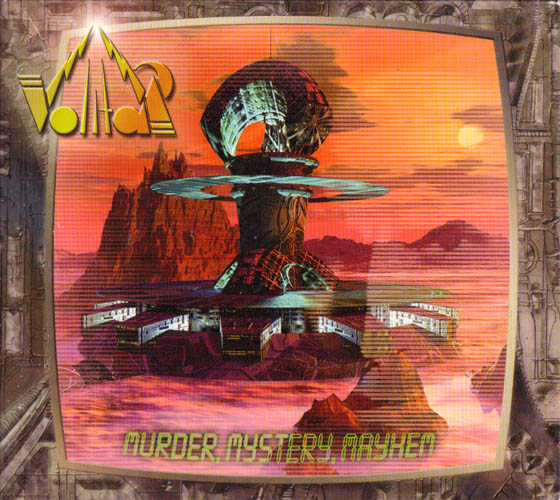
Volitar’s creator, Andrew Engstrom, wrote this concept album as a hybrid between science fiction audio drama and straight rock music CD. He personally wrote and played multiple instruments in all of the songs, sang in others, co-wrote the dramatic storyline and even performed the lead character’s role. I’m of two minds on this one, I liked the idea, though I admit to not being a devotee of the concept album, but I didn’t come away from it thoroughly convinced. The dramatic elements are probably most to blame here. Unfortunately Engstrom came up with a milieu and some characters but the story isn’t quite finished. What little of it I could follow didn’t make a whole lot of sense to me, and each of the eight dramatic scenes that it is composed of seemed to be written only as introduction to the following song. One example of this is where our characters go into a seedy bar, where an alien rock group is just taking the stage. Before the band starts to play one of the characters asks another to dance. – Cue the music track. – After that song finishes, they tell each other how much they enjoyed the dance they just had and ask to dance again…

While I really and truly appreciated the enthusiasm and the follow through in production of the CD and fit and finish of the packaging, the content itself left me bewildered. The voice acting was only fair and for some scenes the actors sounded like they were simply reading their lines straight off the page. And though the album was recorded between 1998 and 2002, the music felt very 1985, with lots of heavy metal riffs and indecipherable or inaudible lyrics. Not my favorite. But then my tastes in music may not be yours; several other reviewers have noted how much they enjoyed the music. Musically it may work well for you. As far as the fiction goes … I like to be able to follow the story. And I couldn’t here. BUT, taking it in as a serious attempt at SF, that should be followable may have been a mistake on my part.

Becky Jo Engstrom, who plays one of the characters, noted in an exclusive audio interview available with the bonus eBook CD “The Making of Volitar,” that they planned the CD as an homage to “The Rocky Horror Picture Show” and the ‘B-movie’ influences of their youth. So, if before you insert the CD and hit play, you tell yourself, ‘this is light entertainment, just music with dramatic scenes’ and not ‘dramatic scenes with music’, you may have a heck of a lot of fun with it! As an aside, special mention should go to artist, Bud Curtis (http://www.alaskagrafix.com/), who’s responsible for the CD’s digital imagery in the fold out packaging; he’s done a terrific job! I found the bonus eBook quite interesting too, well presented and chock full of production details. Andrew Engstrom and his team seem like really cool people and I look forward to their follow up album tentatively titled “Volitar: War In Ganthros.”

Posted by Jesse Willis

Review of Martian Time-Slip By Philip K. Dick

Science Fiction Audiobooks - Martian Time-Slip by Philip K. DickMartian Time-Slip
By Philip K. Dick; Read by Tom Parker
6 Cassettes – 9 hours [UNABRIDGED]
Publisher: Blackstone Audio
ISBN: 0786113529
Date Published: 1998
Themes: / Science Fiction / Mars / Politics / Time-travel / Mental Illness / Aliens / Philosophy /

On the arid colony of Mars the only thing more precious than water may be a ten-year-old schizophrenic boy named Manfred Steiner. For although the UN has slated “anomalous” children for deportation and destruction, other people–especially Supreme Goodmember Arnie Kott of the Water Workers’ Union -suspect that Manfred’s disorder may be a window into the future.

While the Mars of our reality is a fascinating planet in its own right, the Mars of fiction is far more accessible, and nearly as alien! Ray Bradbury’s Mars was a walk through the pastoral and allegorical mind of Bradbury’s youth. Edgar Rice Burrough’s Mars, a fantasyland where many buckles were swashed and princesses were saved. But Philip K. Dick’s Mars is the strangest of them all, a place where everyday reality is malleable and where political corruption continues as it does on Earth. Martian Time-Slip, as read exceedingly well by Tom Parker, is a poignant and utterly fascinating journey both across the newly colonized Martian landscape and through the lives of its varied central characters. A journey not to be missed, I have no doubt that eventually the real colonists on the real Mars will be reading Philip K. Dick’s Martian Time-Slip – and a few of them may even be listening to Parker’s excellent performance of this amazing novel.

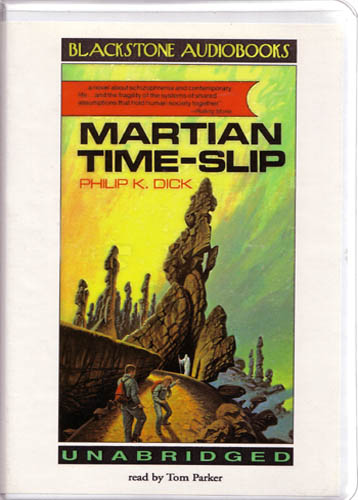
More and more it seems you can count on Blackstone Audio to pick a great book, match it with an appropriate narrator and follow through with high production values. Martian Time-Slip just adds to this reputation. It comes in a library style clamshell binding with a cool cover featuring the original art from the paperback release. And to top it all off this superb production includes every single word in the book, including the teaser back cover. There is little else to say except: Martian Time-Slip, highly recommended!

Posted by Jesse Willis

Review of To Your Scattered Bodies Go By Philip Jose Farmer

Science Fiction Audiobooks - To Your Scattered Bodies Go by Philip Jose FarmerTo Your Scattered Bodies Go
By Philip Jose Farmer; Read by Paul Hecht
6 Cassettes – 7.75 Hours [UNABRIDGED]
Publisher: Recorded Books Inc.
Published: 2000
ISBN: 0788763261
Themes: / Science Fiction / Resurrection / Society / Aliens /

Paul Hecht reads this Hugo Award-winning novel by Philip Jose Farmer. The novel begins with the resurrection of millions of people from throughout human history. They awaken in a great river, swim to the surface, and emerge onto the shore.

The story’s main character is Sir Richard Burton, an adventurer who lived from 1821 to 1890. He immediately finds himself leader of a small group of people which includes a prehistoric man, a Victorian woman, and an alien. This afterlife is no heaven, though, as people barely get over the fact that they are alive again before they start fighting each other for the usual reasons humans do.

Burton’s attention turns to the river itself, and he decides to build a boat and find its source, hoping then to find the answers to his questions – Who resurrected them? And why? The answer to this question changes throughout the book as more is revealed and the characters figure things out.

Another significant character is Nazi Hermann Goering who picks up from where he left off on Earth, enslaving Jews and engaging in battle wherever he can find it. The exchanges between Goering and Burton are the highlight of the book. That humankind can be resurrected without changing is a dismal thought, and I think the main theme of this novel. But mankind’s adventurous spirit is also represented as honorable in Burton’s character.

Paul Hecht is a good reader who does well with this material. He was a bit dry at times, but was very listenable and successfully held my attention.

Posted by Scott D. Danielson