BBC4 & RA.cc: Stephen Fry – In The Beginning Was The Nerd

SFFaudio Online Audio

BBC Radio 4RadioArchive.ccI’ve been enjoying quite a lot of Stephen Fry on television lately. He’s been following in the footsteps of Douglas Adams in the recent series Last Chance To See, doing an autobiographical examination of a fascinating disorder in Stephen Fry: The Secret Life of the Manic Depressive and criss-crossing the USA in Stephen Fry in America. But the programme that I’ll draw your attention to is a very nice hour long documentary that aired on BBC Radio 4 a couple weeks back. I picked it up through RadioArchive.cc, and I recommend you do the same.

Fry brings quite a bit to the show, delving back into computer history, talking about Alan Turing (and how that connects to where the Apple company’s logo came from), sliding tangentially into Mary Shelley’s Frankenstein, Karel Čapek’s Rossum’s Universal Robots, E.M. Forster’s The Machine Stops and plenty more besides. The “Y2K disaster” seems more and more relevant these days, not because of the disaster itsel (which didn’t happen) but rather because the fixity of poorly informed media opinion is more and more likely despite our increasing ability to digitally record and rehash our poor predictions. We just don’t do it – except with programmes like this!

Stephen FryStephen Fry – In The Beginning Was The Nerd
By Stephen Fry
1 Broadcast – Approx. 56 Minutes [DOCUMENTARY]
Broadcaster: BBC Radio 4
Broadcast: October 5, 2009
The Western world, with a few notable exceptions, poured billions of dollars into electronic pesticides to defeat the Y2K bug. Only to find that for the most part it could have been defeated by turning the systems off then on again. So, why the silence when the bug didn’t bite? The answer’s in the programme. Politicians, experts and businessmen all profited in status or cash from the threat. In the media – to paraphrase the crime reporters – it bled so it led. In the USA, government brazenly claimed victory for its defeat. In reality, the enemy was almost totally imaginary. But it’s useless blaming the great and the good. It was inevitable. We’d been told repeatedly that this brilliant new technology would change the world. Then we were told it could all stop on the stroke of one spookily special midnight. We were the newly addicted, suddenly faced with the prospect that our supply was fatally endangered. There was only one thing we could do. Panic. Then spend millions fixing it. Sorry, that’s two things.

Here’s a 15 minute selection from the doc:

You can pick up the rest, via torrent, from RadioArchive.cc.

Posted by Jesse Willis

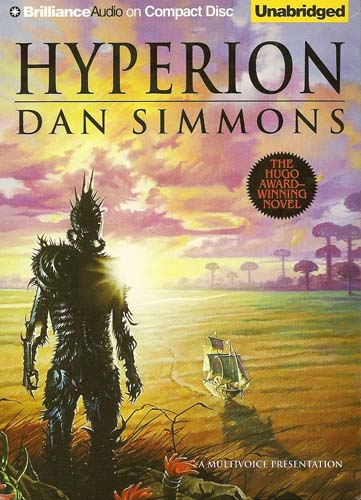
Review of Hyperion by Dan Simmons

SFFaudio Review

Hyperion by Dan SimmonsSFFaudio EssentialHyperion
By Dan Simmons; Read by Various
19 CDs – 21 hours – [UNABRIDGED]
Publisher: Brilliance Audio
Published: 2009
ISBN: 9781423381402
Themes: / Science Fiction / Artificial Intelligence / Aliens / Religion / Starships / Simulations / Transportation /

Seven people, all headed to the planet Hyperion to visit the Shrike, find themselves on the same ship. Regular pilgrimages are made to the Shrike, but these seven have been granted a visit to the Shrike together. To find out why this is, they all agree to tell each other their personal stories of what brought them. The result is a Canterbury Tales in space. A priest, a soldier, a poet, a scholar, a detective, and a consul each tell their story; all separate, all intensely personal, all very different, yet all involving the Shrike in some way.

The book is set in the distant future, and the ideas are plenty. There’s farcasting, where doorways are created to other worlds. One character has a house where every room is on a different world. Costs a fortune, but it can be done. There are artificial intelligences, starships, and sims. Against this backdrop is the Shrike, an alien creature that lives in the Time Tombs, and the seven on a pilgrimage who land in a city on the planet Hyperion, then make their way to see the Shrike over land. “Pilgrimage” is definitely the right word here, because the whole book has a mythic-religious quality. Each person is dealing with very difficult stuff, and what each person hopes to gain from the Shrike when they finally get to see it is nothing short of intervention of a higher power.

Audible Frontiers did a wonderful job with this audiobook. It used to be available only through Audible, but now Brilliance Audio is offering a hardcopy version on CD, which is how I listened. Each story is told by a different character, and each one uses a different narrator. The narrators were all excellent, so this is a perfect presentation of this book.

All seven of the stories are fascinating, well-written stories. There isn’t a weak one on the bunch. This is a top-shelf science fiction novel, up there with the greatest books of the genre.

Highly recommended, without question an SFFaudio Essential! The single caveat is that you must plan to read the next book in the Hyperion Cantos, (called The Fall of Hyperion), because the story doesn’t end with the end of this book. The Fall of Hyperion is also available from Audible (digital) and Brilliance Audio (CD), as are the two books that complete the series, Endymion and The Rise of Endymion. This is the only one I’ve read, but I expect I’ll be reading them all.

Posted by Scott D. Danielson

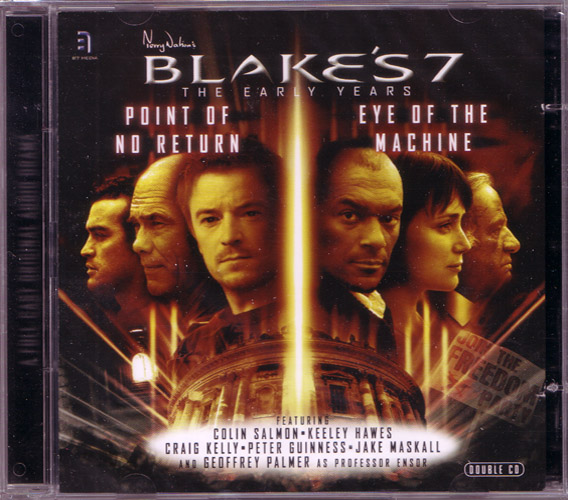
Review of Blake’s 7 – Point Of No Return and Eye Of The Machine

SFFaudio Review

Blake's 7 - Point Of No Return and Eye Of The MachineSFFaudio EssentialBlake’s 7 – Point Of No Return and Eye Of The Machine (Vol. 1.2 & 1.3)
By Ben Aaronovitch and James Swallow; Performed by a full cast
2 CDs – Approx. 70 Minutes [AUDIO DRAMA]
Publisher: B7 Media
Published: November 2008
ISBN: 9781906577063
Themes: / Science Fiction / Politics / Crime / Artificial Intelligence / Terrorism / Noir /

‘Blake’s 7 draws much of its inspiration from the legend of Robin Hood. It follows a small band of outlaws, under a figurehead leader, leading a rebellion against a tyrannical regime.’

A History and Critical Analysis of Blake’s 7 by John Kenneth Muir

This is the second release in the first season of Blake’s 7 prequel stories. For more information on the original the Trilogy Box Set and Volume 1.1 of the prequel series read our reviews HERE and HERE.

Point of No Return and Eye Of The Machine are two more rousing and unconventional adventures in the Blake’s 7 reimaginging. As is typical with most excellent series the music, sound design and acting are absolutely stellar. But, it is the writing which amazes me the most. There are two ways you can go with remakes of old television series. One is to write it so that the dumbest people in your audience won’t have any trouble following it (New Doctor Who I’m looking at you). The other is to re-imagine, re-construct and re-engage with those who loved a smart Science Fiction series for its intelligence. I’m happy to say that this new Blake’s 7 series is in the latter category. Feelings of surprise and utter engagement followed from the opening moments of a rainswept city soundscape to the final credit sequence. I was rapt, imagining the goings-on as vividly as if they were projected onto 1,000 foot screen. Here are my thoughts on each of the two episodes in this set…

Point of No Return – (Episode 1.2)
Written by James Swallow, directed by Andrew Mark Sewell

Point of No Return depicts a critical juncture in the life of Major Stefan Travis. Travis is a Blake’s 7 baddie, the Guy of Gisborne to Roj Blake’s Robin Hood. In this prequel story we find Travis assigned to investigate Carl Varon. Varon is a kind of proto-Blake – a political troublemaker who claims to have been setup by the powers that be. The evidence is against Varon is damning. There’s a laundry list of horrific charges against him. Plus, there’s all the video evidence. So what’s Travis’ problem? Just that Varon may be entirely innocent. Travis has two duties. 1. A duty to the state. 2. A duty to the truth. Which will he choose?

Actor Craig Kelly plays Travis. To my ears his voices sounds pretty similar to the original TV series actor Brian Croucher. What benefits Kelly here is that he gets a much meatier role than poor Croucher (the TV Travis) ever got. He also benefits by playing against a veteran like Peter Guinness. Guinness has a Jekyll And Hyde-like role in this story, we get him as the innocent man in jail and as a political terrorist (during some video playback sequences). Jake Maskall has the least to do here, playing Sub-Lieutenant Garcia. His role being to mostly act as a naive assistant to Travis.

Eye Of The Machine – (Episode 1.3)
Written by Ben Aaronovitch, directed by Andrew Mark Sewell

Eye Of The Machine also follows a baddie (but one of the less bad baddies). Kerr Avon (the Will Scarlet of Blake’s 7) in this prequel story is a brilliant and geeky post-graduate student at Oxford in 2230. The university’s campus, like so many on Earth, is roiling with political protest movements. Avon wants nothing to do with politics, but a fellow student is hot for two things – political change and Kerr Avon. Meanwhile Avon’s brilliance in his chosen studies has caught the eye of a respected cyberneticist professor. Professor Ensor is working on an artificial intelligence breakthrough – he needs a mind like Avon’s. Will Avon’s attendance at Freedom Party meetings or the ambitious Professor Ensor be his undoing?

Colin Salmon (playing Avon) is a movie star with stage acting chops. Anna Grant (played by Keeley Hawes) is fast talking and passionate. She’s terrific. Ensor, is played by Geoffrey Palmer, a veteran of virtually every television series made in the U.K.. In this he’s slimy, mean-spirited and perfect. The script jumps back and forth between the events as they unfolded chronologically and sometime shortly after ‘what happened’ wherein Ensor and Grant give one sided answers to an interrogator’s questions. Both Episode 1.2 and 1.3 use just three actors each but we don’t need even more. These scripts are perfectly polished audio drama gems. Highly recommended.

Posted by Jesse Willis

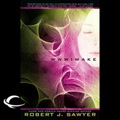
Review of WWW: Wake by Robert J. Sawyer

SFFaudio Review

WWW: Wake by Robert J. SawyerWWW: Wake
By Robert J. Sawyer; Read by Jessica Almasy, Jennifer Van Dyck, A. C. Fellner, Marc Vietor, and Robert J. Sawyer
Audible Download – 12 hours 13 minutes [UNABRIDGED]
Publisher: Audible Frontiers
Published: 2009
Themes: / Science Fiction / Artificial Intelligence / Cyberpunk / Cybernetic Implants / Technothriller / Consciousness /

I don’t normally inject personal anecdotes or experiences into my reviews. It just isn’t my style. In the case of WWW: Wake, however, I simply can’t resist. I’m legally blind, and Robert J. Sawyer’s latest novel concerns itself with ways of seeing, in both the purely physical sense and in more metaphorical ways. It tells the story of 15-year-old blind math genius Caitlin Decter, whose family has just relocated from Austin, Texas to Waterloo, Ontario. She receives an email from a scientist in Tokyo who believes he can restore her sight by means of a behind-the-eye implant linked via Bluetooth to a pocket-sized transmitter and decoder which the ever-witty Decter dubs her “Eye-Pod”. Instead of seeing the real world, Caitlin initially sees only a kaleidoscope of criss-crossing lines and circles transposed on a flashing checkerboard of seemingly random lights. After some initial puzzlement, researchers determine that Decter is actually seeing the inner workings of the World Wide Web.

This premise is already intriguing enough, but add to it a nascent consciousness growing inside the raw data transmitted through cyberspace, and you have the makings of a great technothriller. Fortunately, Sawyer’s writing doesn’t fall victim to many of the clichéd tropes of that genre. There’s very little in the way of the sensationalism of films like Lawnmower Man or Ghost In The Machine. Instead, Sawyer explores the philosophical implications of a growing, learning artificial intelligence. Meanwhile, of course, Caitlin Decter must come to grips with her new “web sight”, as she calls it, in addition to facing the normal teenage challenges of adjusting to a new high school.

WWW: Wake strikes a good balance between the cerebral and the emotional. The novel stops just short of qualifying as “hard science fiction”, but it also, as I said, shies away from becoming a popcorn thriller. Decter is a complex and ultimately likable character. She’s a brilliant mathematician–in the online world she goes by the alias Calculass–and she’s confident in her mental prowess, but at the same time she faces the insecurities caused by her blindness in addition to the standard turbulence of adolescence. The supporting cast of characters in Caitlin’s life are just as three-dimensional. Her mother is loving and generous, while her father, a theoretical physicist, is well-meaning but emotionally distant. The interactions and conflicts between the characters are subtly portrayed, lending WWW: Wake a sense of realism despite the bizarre goings-on behind Caitlin’s eyes.

Is Caitlin’s blindness realistic? This is where my own personal experience comes into play. I’ve been legally blind since birth, although since I have some residual vision the comparison isn’t exact. Even so, it’s evident to me that Robert J. Sawyer has done his homework in this regard. Caitlin’s life is replete with all the trappings associated with blind life: white canes (which I just traded in for my first guide dog), text-to-speech screen-reading software, and braille displays. More importantly, Sawyer understands how the world is conceived and constructed for those of us with either no vision or limited vision. This becomes apparent as Caitlin’s sight changes throughout the novel in interesting ways, and as she struggles to pin names and concepts to the new visual stimuli that are firing down her optic nerves.

The Audible Frontiers production of Wake is stellar in its production value. As the voice of Caitlin Decter, Jessica Almasy does most of the heavy lifting, and her performance shines. Sound and voice is especially important in the world view of a character who, through much of the novel, lacks any kind of visual stimuli, and Almasy deftly handles these complex nuances. Of course, Decter is also a precocious and spunky teenage girl, and Almasy rises to the challenge of matching Decter’s dynamic character. The other narrators also do an excellent job, and Sawyer himself even lends his voice to occasional passages.

The book’s one weakness lies in its plotting. Along with Caitlin’s story and the development of the “web consciousness”, two other storylines weave in and out of the novel. While they’re interesting in their own right, they never come to a satisfying conclusion and never intersect in a meaningful way with the main story. I understand that Wake is merely the first in the WWW trilogy of novels, and that Sawyer will likely resolve them in upcoming volumes. Still, an author as talented as Sawyer should be able to bring these narrative threads to enough of a climax to maintain the novel’s cohesion.

Minor structural shortcomings aside, WWW: Wake is both an emotionally satisfying story of a blind girl coming to grips with ways of seeing, and an intellectually stimulating examination of technology and consciousness. Along with William Gibson’s Neuromancer and Neal Stephenson’s Snow Crash,Wake presents a unique perspective on information technology. I eagerly await its sequels Watch and Wonder.

Update: I didn’t realize this at the time, but apparently I wrote this review on the birthday of Annie Sullivan, who taught the deaf-blind Hellen Keller how to communicate with the world. Sullivan is a strong symbolic and thematic presence in Wake. Coincidence, or fate?

Posted by Seth Wilson

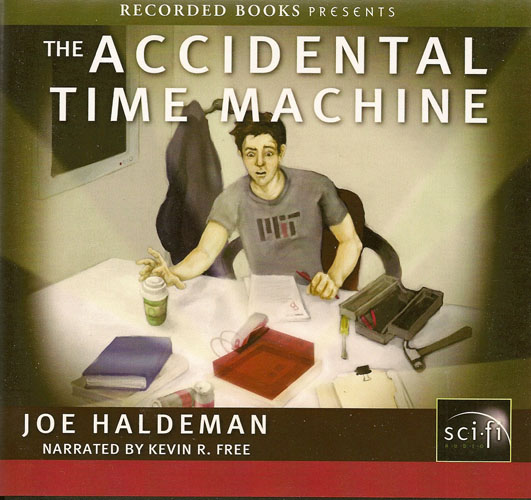
Review of The Accidental Time Machine by Joe Haldeman

SFFaudio Review

Science Fiction Audiobook - The Accidental Time Machine by Joe HaldemanThe Accidental Time Machine
By Joe Haldeman; Read by Kevin R. Free
7 CDs – 8 Hours [UNABRIDGED]
Publisher: Recorded Books
Published: 2008
ISBN: 9781436120418
Themes: / Science Fiction / Time Travel / Artificial Intelligence / Religion / Academia / Los Angeles / Massachusetts / MIT /

Things are going nowhere for lowly MIT research assistant Matt Fuller—especially not after his girlfriend drops him for another man. But then while working late one night, he inadvertently stumbles upon what may be the greatest scientific breakthrough ever. His luck, however, runs out when he finds himself wanted for murder—in the future.

When an MIT graduate student Matt Fuller accidentally invents a time machine he get’s himself into a load of trouble. Not only is his supervising professor a hard-ass thief of academic proportions, the stupid time travel machine can only travel forward into the future! Every time Matt presses the ‘go button‘ he ends up twelve times farther than last time, he’s invented a time machine that only got a one way ticket to the future. Fueled by caffeine, job worries, and a murder charge, Matt blasts himself forward 12 x 12 x 12 into the future – where the only thing stranger than Jesus returning to Earth is a visit from the personified city of Los Angeles. Haldeman’s inventiveness is unparalleled in time travel SF. His hero Matt is picaresque, he’s on an inventive journey and the adventure is unpredictable and compelling. I loved it.

Kevin R. Free, a narrator new to my ears, performs this novel to perfection. Everyone I’ve recommended this novel to has enjoyed the heck out of it – if Recorded Books keeps picking novel/narrator combinations like this we’re in for a real treat. Speaking of Recorded Books, The Accidental time Machine is one of the inaugural publications in their new Sci-Fi imprint. Also terrific, there’s cool art custom cover just this edition [see above], it features actual details from the book – that’s refreshing. A great and peppy novel, an excellent, excellent, reading, fast moving and not too long. This is the kind of Science Fiction story I want to see more of. Speed on over to RecordedBooks.com, or your local library, and request a copy of this audiobook.

Posted by Jesse Willis

The SFFaudio Podcast #002

Podcast

The SFFaudio PodcastThe first one they made was so good they recorded a sequel! Indeed, The SFFaudio Podcast #002 is even more blockbustery (with 20% more bluster).

In show double-oh-two Scott D. Danielson and Jesse Willis talk about audiobooks, audio drama, and the correct pronunciation of the word “orgy.” We also talked about Recent Arrivals, New Releases, LibriVox, what we’ve been listening to, and where. It’s a big, big, show!

Topics under discussion include:

The Last Theorem, Carnival, Elizabeth Bear, L. Ron Hubbard, Galaxy Press, Zeppelins, airships, Michael Chabon, our new Publishers page, Grover Gardner, The Number 23, Scott Brick, Paul Of Dune, Brian Herbert, Kevin J. Anderson, The Little Book, Selden Edwards, Brad Meltzer, The Book Of Lies, Superman, Orhan Pamuk, the Entitled Opinions podcast, Turkey, Ottoman Empire, Michael Flynn, Blackstone Audio, The January Dancer, Eifelheim, Podiobooks.com, The Kiribati Test, Jim Thompson, The Grifters, Philip K. Dick, Macmillan Audio, Anathem, Neal Stephenson, Snow Crash, The Diamond Age, Cryptonomicon, Waldentapes, Star Trek, LibriVox, Space Viking, Mark Douglas Nelson, H. Beam Piper (and our new AUTHOR PAGE for him), The Green Odyssey, The Second SFFaudio Challenge, Brandon Sanderson, Orthopedic Horseshoes, Edo van Belkom (he’s the ex-school bus driver), The Accidental Time Machine, Joe Haldeman, The Forever War, “Our Last Words”, Damon Kaswell, time travel, Peter Watts, Blindsight, Recorded Books, the Chinese room argument, artificial intelligence, Spin, Axis, Robert Charles Wilson, Robert J. Sawyer, David Brin, Startide Rising, The Immortal, Roger Zelazny, Audiofile Magazine, George R.R. Martin, A Clash Of Kings, Temüjin, audio drama, Gate, The Sonic Society, Jack J. Ward, Wormwood, acting, Michael Caine, Irwin Allen, The Swarm, Star Wars, Liam Neeson, Thulsa Doom vs. Luke Skywalker, pronunciation, mis-pronunciation, The Savage Sword Of Conan, John Varley, Audible Frontiers.

Posted by Jesse Willis