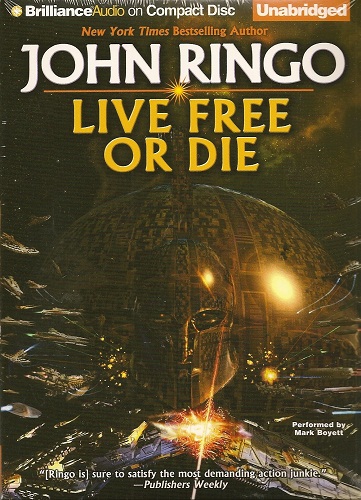
Review of Live Free or Die by John Ringo

SFFaudio Review

Science Fiction Audiobook - Live Free or Die by John RingoLive Free Or Die
By John Ringo; Read by Mark Boyett
17 Hours – [UNABRIDGED]
Publisher: Brilliance Audio
Published: 2010
Themes: / Science Fiction / Military / Politics / Aliens / First contact /

All authors have political opinions. Those opinions reveal themselves in authors’ novels. Most authors reveal those opinions subtly, probably figuring an in-your-face approach will only turn off some readers.

John Ringo is not most authors. In Troy Rising: Live Free or Die, Ringo (and his Mary Sue protagonist, named Tyler Vernon) wear their politics on their sleeves. It is a robust libertarian brand of politics. This is a little refreshing, and a lot distracting. Readers who dislike celebrations of conservative culture and Don’t Tread On Me economics are going to have to work very hard to ignore the constant needling. In particular, “socialist p***ies” are urged to approach this novel with deflector shields set to maximum.

Even plot points fulfill Ringo’s wishes in surprising ways. When aliens drop rocks on our cities, the result is that the surviving electorate skews rural. . .and conservative. This is just the kind of thinking-through-the-implications work that a good speculative fiction author is required to do. Yet, Ringo takes just a tiny bit of, well, satisfaction from the deaths of millions of misguided liberal urbanites. More blatantly self-indulgent is a plot point involving an alien-engineered virus that makes all the blond women in the world soooper horny. No joke.

You can call this space opera; ear candy; action-packed. The prose is breezy and the plot is intelligently constructed. The narration, by Mark Boyett, is a pleasure to listen to. He’s either an enthusiastic conservative, or a liberal with superb acting skills. (Either scenario is plausible.)

The novel divides into three clear sections. The first act describes a first-contact scenario, with aliens installing an interstellar transport gate in our solar system with precious little warning. The resulting transformation of all human civilization into a galactic third-world country is quite plausible. It’s a disturbing reminder of the way colonial powers are viewed by the colonized.

The second act tells of the ascendancy of Tyler Vernon from unemployed everyman to the richest tycoon in human history. He finds the one commodity unique to Earth that aliens value. Here, the novel becomes less plausible—a little silly, really—and worse, the idea is not original, resembling a plot device in Harry Turtledove’s WWII alt history, where gingerroot turns aliens into crackheads. I won’t give away what the substance is in this case; suffice it to say it comes from a region of the world known for its culture of prickly independence, which dovetails with Ringo’s politics with neat precision. A nifty authorial trick, that.

The third act is the longest, and it describes the building the Troy, an excellent Big Dumb Object—a fantastically massive battle station. Even more impressive is a system of mirrors that concentrate sunlight into powerful beams measured in terawatts or even petawatts. These weapons give Earth a fighting chance against the oppressors. The question nags: could humans think up technology that surprises millennia-old civilizations? Very unlikely.

This book brings to mind another tale of lowly humans besting an established galactic order. Poul Anderson’s The High Crusade describes how medieval knights commandeer an alien space ship and, ultimately, overthrow a space empire. That book is more enjoyable because it’s not even remotely serious. Live Free or Die aspires to a more serious level, but ultimately works only if the reader’s sense of fun can withstand the concentrated sunlight of plausibility.

Posted by the Fredösphere

Review of Darkside by Tom Becker

SFFaudio Review

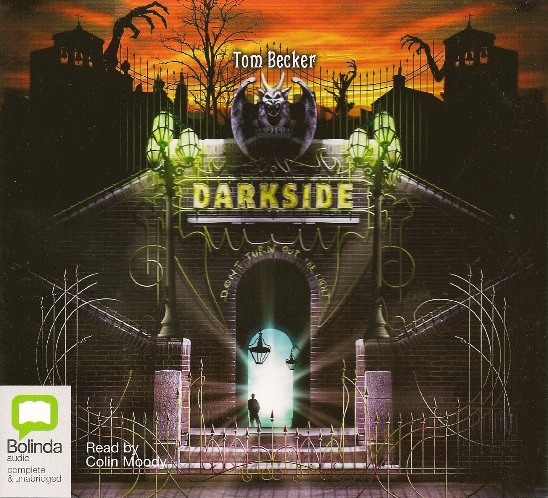
Darkside by Tom BeckerDarkside
By Tom Becker; Read by Colin Moody
6 CDs – Approx. 6 Hours 12 Minutes [UNABRIDGED]
Publisher: Bolinda Audio
Published: 2008
ISBN: 9781921415340
Themes: / Fantasy / Urban Fantasy / Crime / London / Werewolves / Vampires / Magic / Kidnapping / Evil / Jack The Ripper /
Your home’s been attacked. Your dad’s in an asylum. You’re running for your life. And there’s nowhere to hide.

You’ve stumbled on the city’s greatest secret: Darkside. Incredibly dangerous and unimaginably exciting. Darkside is ruled by Jack the Ripper’s children – a place where nightmares walk the streets. You think you’re in trouble now, but your problems have just begun…

I usually do a fair mount of research about the books I plan to read. Before I pick one up I’ve usually either heard an author interview, read a review, discussed it with people who’ve already read it, or at least got a recommendation from an author whose work I already respect. But I also know these techniques aren’t a very good way to branch out beyond what’s already familiar to me, and so, every so often I just pick up a book, almost at random, and start reading. That’s what I did with Darkside by Tom Becker.

Maybe one of the initial appeals of Darkside, other than the terrific cover, was that it was from a publisher whose audiobooks I’d never heard before. Bolinda Audio is from Australia. And because of that it’s doing things a little differently. First off, it’s narrators are Australian. And second, they’ve got a lot of authors in their catalogue that I’ve never heard of. That’s cool!

Darkside is an interesting tale in itself. In terms of plot, it kind of falls halfway between two Neil Gaiman novels: Neverwhere and The Graveyard Book. It features Jonathan Starling, an unremarkable misfit fourteen-year-old with an ailing father and a deceased mother. He lives in London and is mostly taken care of by a kindly neighbor woman. Other than her, he’s nearly friendless and spends most days skipping-out of school and hanging out at one of the city’s many libraries. His father, an avid book collector himself, suffers some sort of recurring full body paralysis and perhaps it’s related to some of the books he collects. One day, right out in the open on a London street Jonathan is nearly kidnapped by a seemingly invisible giant and a woman with fluorescent hair. He quickly learns that London isn’t going to be safe for him anymore and so his father sends him away. He is to flee, for his own safety, into the arms of a protector. Jonathan takes with him a knife and a bullet. The knife is for protection from the kidnappers, and the bullet is for protection against his would-be protector, a mysterious old friend of his father’s, a man named Carnegie. Plot ensues.

Where the novel falls short is in comparison to the two Neil Gaiman novels I mentioned earlier. A hidden city within London isn’t really new. And neither is a young kid being protected by a paranormal monster-man. More importantly, Becker doesn’t have anywhere near the mastery of English fiction that Gaiman has. But that’s really not a fair comparison. For my money very few living English authors can compare favorably with Neil Gaiman. Apparently Darkside was written when Becker was just 25! When Gaiman was 25 he hadn’t written a single novel, comic, nor even Don’t Panic, his wonderful biography of Douglas Adams. As a result I think Darkside can stand pretty proudly on its own. It’s quickly paced, pretty fun and most of all it’s got a story that keeps your attention all the way through. Good job new guy.

Narrator Colin Moody, a talent stage trained actor, has an Australian accent, except when performing the dialogue of the characters. When in character Moody cowls him reading with various Londoner regionalisms. There are many sinister sounding villains in this novel and he voices all of them extremely well. If you’re a voracious reader looking for swiftly plotted urban fantasy novel (for the juvenile set), and you’ve already read both Neverwhere |READ OUR REVIEW| and The Graveyard Book |READ OUR REVIEW| do check out Darkside. Series fans will also be pleased to hear that four more Darkside novels follow this one, and that Bolinda has the “audio sequel forthcoming.”

Posted by Jesse Willis

Review of The Blade Itself by Joe Abercrombie

SFFaudio Review

The Bade Itself by Joe AbercrombieThe Blade Itself (The First Law: Book One)
By Joe Abercrombie; Read by Steven Pacey
Audible Download – 22 Hours 18 Minutes [UNABRIDGED]
Publisher: Orion Publishing Group
Published: 2010
ISBN: 9781409111443
Provider: Audible.com
Sample |MP3|
Themes: / Fantasy / Sword and Sorcery / Dark Humor / Revenge / Violence /

For a couple years now, Joe Abercrombie’s The First Law Trilogy has been at the top of my to-read list, but as I’m a slow print reader, the series inevitably yielded to more readily available audiobooks. Imagine my delight, then, when I recently realized that Orion Publishing Group had published the series in audio last June. The wait was worth it. The opening volume, The Blade Itself is a darkly humorous tale full of antiheroes and intrigue. Abercrombie’s strong writing and wry wit set The Blade Itself a cut above other novels in the reactionary subgenre of fantasy spawned by George R.R. Martin.

At first blush, the world of the First Law Trilogy looks like your average fantasy world. The bulk of the action takes place in Adua, capital city of The Union, a land with a dotard king facing imminent war on two fronts: the newly-unified North and the Gurkish Empire to the South. The city, and especially its central citadel the Agriont, is teaming with ambitious councilman, posturing soldiers, and brutal inquisitors. The North, as one might epect, is a sparse unwelcoming land peopled by warrior clans recently unified under the iron fist of King Bethod. In The Blade Itself we see only snatches of the Gurkish Empire, but it follows the usual desert formula for southern kingdoms. (Why do most fantasy series seem to be set in the Northern hemisphere?) This opening volume hints at an intricate magic system that underlies and informs the world, but so far it’s rather underdeveloped.

The viewpoint characters bring this seemingly run-of-the-mill fantasy world to life in vibrant color. Each character is an antihero, in some sense of the word. Like George R. R. Martin, Richard K. Morgan, and other recent writers, Abercrombie is writing against the tropes of the traditional good-versus-evil format of epic fantasy. Unlike some other writers in this vein, though, Abercrombie rarely seems too self-conscious about what he’s doing. Logen Ninefingers, dubbed the “bloody-nine” in the North, does not read like an anti-Aragorn, nor does Bayaz, First of the Magi, read like an anti-Gandalf. Rather, they’re fully developed characters in their own right.  Then there’s San dan Glokta, survivor of a horrible ordeal of torture at the hands of the Gurkish Empire who has in turn become a torturer for the inquisition. Rounding out the cast is Jezal, a headstrong noble youth determined to win the year’s fencing contest. With the exception of Jezal, these characters have endured tremendously hard lives, so naturally their thoughts aren’t filled with sunshine and butterflies. This is a dark book.

The fun lies in watching these characters come together and interact with one another. As in any good book, too, it’s fun to watch these characters, who we’ve come to empathize with even if we don’t actually like them, overcome their internal and external challenges. The most obvious case is Jezal and his fencing contest, which is brought to a most satisfying concentration. Then there’s Glokta, trying to stay afloat in the political post of Inquisitor, all while struggling merely to get out of bed. Then there’s Logen, fleeing his reputation as the “bloody-nine.” And at the heart of it all is Bayaz, First of the Magi, whose story hints at the direction the series may ultimately take. Bayaz, though not a point-of-view character, drives the plot in many ways, either subtly or overtly manipulating events to suit his needs.

If the book has a weakness, it’s the ending. Endings are always tricky things to pull off, especially in the first novel of a trilogy, where an author must bring the present volume to a satisfying conclusion while enticing the reader to continue with the series. Unfortunately, Abercrombie leans too far towards the latter. While the last hour or two of audio will be a treat for fans of vividly-depicted action sequences, they’re light on any satisfying story development. The ending certainly isn’t bad, it just left me a bit disappointed. On the other hand, it also did its job in whetting my appetite for the next volume.

As alluded to earlier, the standout character in The Blade Itself is perhaps Abercrombie’s deft writing style. Admittedly, it took some getting used to. I remember complaining on Twitter back when I first had a go at reading the print edition that the book was too full of sentence fragments and “said bookisms.” I stand by that complaint. The thing is, the style really fits the world and especially the characters. The dialogue reads like you’re sitting in on the conversation, especially under the standout narration by Steven Pacey. And while I’m not personally a fan of long action sequences, there’s no doubt that Abercrombie writes them masterfully. You can feel every bone-jarring sword blow and taste the tang of blood in the air.

I approached this audiobook with some hesitation. I feared that no narrator could match Michael Page’s performance of Abercrombie’s Best Served Cold. At best, I feared, I’d be disappointed; at worst, I wouldn’t even be able to listen to the book in its entirety. Fortunately, Steven Pacey is equal to the task of narrating such an ambitious work. His narration walks the fine balance of capturing the characters’ voices–literally and figuratively–without calling too much attention to them and thereby detracting from the story. The toothless Glokta, for instance, speaks with just a hint of a lisp, a slight slurring. Every now and then, his narration moves a touch too far toward the dramatic, but for the most part it’s spot on.

The Blade Itself, if it were a film, would carry a solid R rating, and therefore isn’t for everyone. Strong language and violence abound. Under its dark veneer of brutality, however, the novel shines with complex characters, compelling writing, and a story that, though not yet fully baked, promises to yield great rewards in subsequent novels.

Posted by Seth Wilson

Recent Arrivals: Gilgamesh The King by Robert Silverberg

SFFaudio Recent Arrivals

Gilgamesh the King by Robert SilverbergGilgamesh the King
By Robert Silverberg; Read by William Coon
MP3 Download – Approx. 13 Hours 22 Mins – [UNABRIDGED]
Publisher: Eloquent Voice, LLC
Published: September 2010
ISBN: 9780984413898

We’re used to hearing about the latest tell-all memoir from one of today’s sports figures, political insiders, or celebrity wannabes. But what if we discovered that one of history’s greatest heroes had written his life story? That’s the premise behind Robert Silverberg’s amazing novel “Gilgamesh the King.” The journey begins when six-year-old Gilgamesh’s father dies. As he grows to manhood and eventually ascends to the throne, he faces many challenges along the way: political intrigue, war, the burden of leadership. But none are as difficult as his intense internal struggles against loneliness and his own mortality. Weaving together historical data, the Epic of Gilgamesh, and his own fertile imagination, Silverberg creates a rich and compassionate portrait of a man who lived about 2500 B.C.

Posted by Jesse Willis

FREE LISTENS REVIEW: The Curse of Capastrano

Review

The Curse of Capastrano by Johnston McCulley

Source: Librivox (zipped mp3s)Curse of Capistrano
Length: 6 hr, 34 min
Reader: Barry Eads

The book: Never heard of this book? Perhaps that’s because it’s the secret identity of its more famous alter-ego. Following the successful Douglas Fairbanks movie based on The Curse of Capastrano, McCulley reissued his novel under the same name as the silent film: The Mark of Zorro.

It’s easy to see why this book became a blockbuster film; it’s full of action, humor, romance, and plot twists. McCulley has a great sense of pacing, building up suspense and taking Zorro from scene to scene with great efficiency. Each short chapter ends with a mini-cliffhanger. Many of the supporting characters are one-dimensional, but I was happily surprised to find the main female character, Lolita, to be a self-reliant woman with a brain, rather than a damsel in distress.The Curse of Capastrano is a great short action-adventure book, perfect for putting a little pep in your morning commute or gym routine.

Rating: 9/10

The reader: Barry Eads does a terrific job with this narration. There are a number of speaking characters in this book, and Eads does a distinct voice for each one, making it easy to figure out who is talking. Even his female voices are believable. He varies the pacing and tone of his narration to keep up with the changes in action, making it easier to follow Zorro’s spectacular feats. The only fault I could find is that Eads tends to mispronounce some of the many Spanish words, but if you’re not a Spanish speaker, you will have no problem with this.

Posted by Seth

Review of Suck It Wonder Woman by Olivia Munn and Mac Montandon

SFFaudio Review

MACMILLAN AUDIO - Suck It Wonder Woman by Olivia Munn and Mac MontandonSuck It, Wonder Woman: The Misadventures Of A Hollywood Geek
By Olivia Munn and Mac Montandon; Read by Olivia Munn
4 CDs – Approx. 5 Hours [UNABRIDGED]
Puiblisher: Macmillian Audio
Published: July 2010
ISBN: 9781427209825
Themes: / Autobiography / Sexuality / Oklahoma / California / Japan / Robots / Zombies / Pie /

Sample |MP3|

Today’s hottest geek and host of G4’s Attack Of The Show dishes her unique brand of humor of on everything from Star Wars, gadgets, and her love of banana cream pie. Olivia Munn is an actress, comedian and television host, best known for being the face of the G4 network. She also occasionally likes to get dressed up as Wonder Woman. SUCK IT WONDER WOMAN is her paean to Geeks everywhere. Using her trademark humor in essays like THOUGHTS ABOUT MY FIRST AGENT’S GIRLFRIEND’S VAGINA she skewers what it’s like to live in Hollywood. In “SEX: WHAT YOU CAN DO TO HELP YOURSELF HAVE MORE OF IT” she frankly gets down to the business of getting it on. In “WHAT TO DO WHEN THE ROBOTS INVADE (YES, WHEN!),” Olivia offers valuable information on… what to do when the robots invade! And just when you thought she couldn’t get any more Geeky, she can. This book also includes an Olivia Munn timeline of great moments in Geek history and her answers to the Unofficial Geek FAQ. Is it any wonder that Olivia Munn is quickly becoming the most powerful Geek on the planet? SUCK IT WONDER WOMAN is a humorous look at geeks, gadgets, Hollywood, and huge heapings of banana cream pie.

When this audiobook arrived I didn’t recognize the author or what exactly it was. I’d seen Attack Of The Show, and at least one of the episodes of The Daily Show in which she appeared, but something dimly pinged and I decided to give it a listen. Maybe part of it is that I’ve been a sucker for biographical audiobooks since I first stumbled across Michael Caine’s amazing reading of his autobiography What’s It All About?. Since then I’d read maybe a half dozen more. I’m sad to say most were only marginally interesting, but they never sucked, and I’ve found you can learn a hell of a lot about history by hearing about individual lives. The only biography that’s come as close to recreating that first experience was perhaps, rather strangely, a Blackstone Audio version of The Most Dangerous Man In America: Scenes From The Life Of Benjamin Franklin by Catherine Drinker Bowen. Weird huh? Yeah, Michael Caine and Benjamin Franklin have very little in common, other than being male and speakers of English. What they do share, however, is a kind of an ineffable interestingness. Caine’s story was full of a bewildering matter-of-factness, performed by the actor himself, and offered dozens of surprises and a whole lifetime’s worth of experience in the movies in less than three hours. Franklin, that auto-didactic man of letters, inventor, humorist and well … you’ll just have to go listen to the audiobook yourself … was completely and utterly amazing. Olivia Munn, and her book Suck It Wonder Woman are, on the other hand, entirely and completely effable. And by that I don’t only mean that there’s a lot of potty mouth in this audiobook.

Suck It Wonder Woman is potty mouthed and full of dirty stories about crazy people in Hollywood. There are also brief chapters on seemingly random, hip-sounding dos and don’ts. I’m not sure why these bits were added in. The audiobook works best when operating in the more serious storytelling sections. Munn’s description of herself as a child are fun and retrospectively insightful. One chapter, relating her relationship with her grandparents, is highly poigniant. That isn’t fluff. But not all of these stories are all that serious either. Her relating meetings with celebrities (named and unnamed) are surprising and frightening. And while the generalities of Munn’s life story, so far, aren’t particularly unique, she has some fun tales to tell. Munn makes for quite a sympathetic figure in all of the specifics of her life. And, her almost puppy-like eagerness to tell you about it, with her narration, is very endearing. When she relates her sadnesses, you are truly disheartened. But, as Munn reminds us, we can’t be too downcast, there’s always pie.

Posted by Jesse Willis