LibriVox: A Knyght Ther Was by Robert F. Young

SFFaudio Online Audio

LibriVoxRobert F. Young (1915-1986) was an American public school janitor. In addition to maintaining what I can only assume to have been immaculate hallways and washrooms in Bufallo, NY schools, he is also remembered for having written five novels, as well as a few dozen short Science Fiction stories, novellas and novelettes. His authorial production started in 1953 with a sale to Startling Stories. Later sales were made to Playboy, The Saturday Evening Post, Collier’s and Analog.

This story is inspired in part by Geoffrey Chaucer’s The Canterbury Tales and features a rogue time traveler named Tom Mallory who transits to 6th century Europe in search of an unparalleled treasure. Perhaps Terry Gilliam or Michael Palin filched this as a story seed for their 1981 classic Time Bandits?

LibriVox - A Knyght Ther Was by Robert F. YoungA Knyght Ther Was
By Robert F. Young; Read by Roger Melin
6 Zipped MP3 Files or Podcast – Approx. 2 Hours 19 Minutes [UNABRIDGED]
Publisher: LibriVox.org
Published: January 23, 2010
“But the Knyght was a little less than Perfect, and his horse did not have a metabolism, and his ‘castle’ was much more mobile—timewise!—than it had any business being!” In 2178, once time travel had become a simple task, it had also been outlawed. Those who chose to ingnore this law were known as time-thieves, and Tom Mallory was among the best of them. When he learns the precise whereabouts of the Holy Grail in 542, he sets out to obtain it with the intention of returning it to the 22nd century to make a handsome profit and to settle on Get-Rich-Quick Street. Off to the year 542 he travels to the castle of Carbonek where the great Knight Sir Launcelot is said to have possession of the Sangraal. First published in Analog Science Fact & Fiction July 1963.

Podcast feed: http://librivox.org/rss/3941

iTunes 1-Click |SUBSCRIBE|

Trailer for Time Bandits (1981):

[Thanks also to Betty M. and Annise]

Posted by Jesse Willis

Review of The Invisible Man by H.G. Wells

SFFaudio Review

Science Fiction Audiobook - The Invisible Man by H.G. WellsThe Invisible Man
By H.G. Wells; Read by James Adams
5 CDs – Approx. 5.5 Hours [UNABRIDGED]
Publisher: Blackstone Audio
Published: 2009
ISBN: 9781433277528
Themes: / Science Fiction / Invisibility / Chemistry / Biology / Crime / 19th Century / Sussex / Morality / Personal Responsibility /

On a freezing February day, a stranger emerges from out of the gray to request a room at a local provincial inn. Who is this out-of-season traveler? More confounding is the thick mask of bandages obscuring his face. Why does he disguise himself in this manner and keep himself hidden away in his room? Aroused by trepidation and curiosity, the local villagers bring it upon themselves to find the answers. What they discover is a man trapped in a terror of his own creation, and a chilling reflection of the unsolvable mysteries of their own souls.

While nobody could really deny H.G. Wells was an amazing and talented Science Fiction author I think we can all agree that some of his fictions are superior to others. Among those that are not superior is The Invisible Man. This is not from any serious defect in the novel’s writing. Indeed, I cannot see anything that H.G. Wells has really done badly or that he could have done better. So, if it couldn’t have been done better then why isn’t it better? I think the problem stems from two interrelated factors: One is a serious technical gripe, something in the book and unavoidable, and the other being the smallness of that idea. Taken together they make it difficult to fully engage with. What holds back The Invisible Man from an utter perfection is at the weak premise at the very core of the novel, invisibility. Invisibility is both impossible and small. I’ve expanded on its impossibility in another essay. Its smallness is a problem I will tackle here.

Invisibility is a long standing meme in human culture: Plato describes invisibility in the legend of The Ring Of Gyges, Tolkien used a similarly endowed ring in The Lord Of The Rings, and even modern scientific versions of invisibility (the invisible-like camouflage in Predator) are still with us. The problem is invisibility isn’t a story, its barely a half of an idea in terms of ideas – its a place to take a story, but it isn’t a very fruitful one. I felt the same way when I read Richard Matheson’s The Incredible Shrinking Man |READ OUR REVIEW|READ OUR REVIEW|. I though: “A man shrinking, that’s new!” It was new and completely unfruitful. See the fallout from the idea of a man shirking inexorably towards nothingness is a feeling of emptiness. The man shrinks, the world gets bigger. A man shrinks, everyday objects become like mountains and house pets like dragons. Its interesting, to be sure, but it isn’t a story. Like invisibility, no amount of hand-waving can make the explanation scientifically plausible. Unlike, the The Incredible Shrinking Man however I can still recommend The Invisible Man – Wells is the master of Science Fiction. In The Invisible Man he takes a fatally flawed concept, invisibility, and writes the shit out of it. When Griffin, the scientist and anti-hero of the title goes about explaining his methodological reasoning in a Socratic dialogue, he is fully persuasive. Check this passage out:

“Phew!” said Kemp. “That’s odd! But still I don’t see quite … I can understand that thereby you could spoil a valuable stone, but personal invisibility is a far cry.”

“Precisely,” said Griffin. “But consider, visibility depends on the action of the visible bodies on light. Either a body absorbs light, or it reflects or refracts it, or does all these things. If it neither reflects nor refracts nor absorbs light, it cannot of itself be visible. You see an opaque red box, for instance, because the colour absorbs some of the light and reflects the rest, all the red part of the light, to you. If it did not absorb any particular part of the light, but reflected it all, then it would be a shining white box. Silver! A diamond box would neither absorb much of the light nor reflect much from the general surface, but just here and there where the surfaces were favourable the light would be reflected and refracted, so that you would get a brilliant appearance of flashing reflections and translucencies—a sort of skeleton of light. A glass box would not be so brilliant, not so clearly visible, as a diamond box, because there would be less refraction and reflection. See that? From certain points of view you would see quite clearly through it. Some kinds of glass would be more visible than others, a box of flint glass would be brighter than a box of ordinary window glass. A box of very thin common glass would be hard to see in a bad light, because it would absorb hardly any light and refract and reflect very little. And if you put a sheet of common white glass in water, still more if you put it in some denser liquid than water, it would vanish almost altogether, because light passing from water to glass is only slightly refracted or reflected or indeed affected in any way. It is almost as invisible as a jet of coal gas or hydrogen is in air. And for precisely the same reason!”

“Yes,” said Kemp, “that is pretty plain sailing.”

So, I’m of two minds on The Invisible Man. It derives its heart from a weak concept – and like the phlogiston theory of combustion it is discredited, and undeserving of serious consideration. Despite all this I still find myself willing to recommend you read the novella. The psychological rigor that Wells brings to the novel makes The Invisible Man quite possibly the first and last straight Science Fiction story worthy of our attentions.

Narrator James Adams is a capable reader, he reads the third person perspective text with what sounds like an authentic English accent. The clam-shell style case, for the library CD edition that I received, features a bit of fading text on the cover, a design inspired by the invisibility of the title. Unfortunately this makes the details hard to make out in anything other than a bright light environment. Blackstone Audio has four other formats available too: Cassette, MP3-CD, digital download (via Audible.com) and playaway (a kind of disposable MP3 player that can only play one book). Given the widespread availability of The Invisible Man by other audiobook publishers I’d like to have seen some value added materials, perhaps a specially commisioned introduction by Professor Eric Rabkin and or an afterward by Professor Michael D.C. Drout.

One thing I like about paperbooks that rarely (if ever) gets included in an audiobook is a map. Maps are fun and informative. One of the funnest paperback series ever was the old Dell Mapbacks. Here’s the Map from the back of Dell’s edition of The Invisible Man:

The Invisible Man by H.G. Wells - A Dell Book (MAPBACK)

Posted by Jesse Willis

Recent Arrivals: The Time Machine by H.G. Wells

SFFaudio Recent Arrivals

Tantor MediaDid you read our post about how to get FREE SWAG from Tantor Media? If you did you know Tantor Media is actually delivering on its promise of a FREE AUDIOBOOK for feedback about their new website!

And now I’ve got the physical proof in hand!

After I checked out out their improved website I left some feedback (I actually suggested they start a podcast) and waited two weeks for my audiobook’s delivery. I picked it up at the PO Box yesterday. Two weeks isn’t too shabby for a delivery to Canada.

If you haven’t already go on over to Tantor Media, check out their new website, and get your own FREE audiobook by mail!

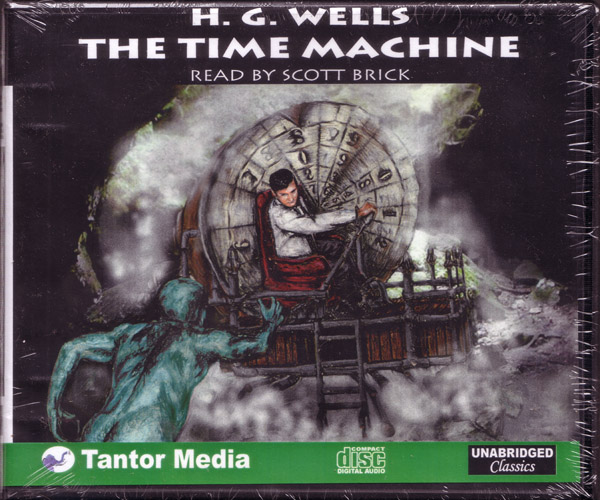
TANTOR MEDIA - The Time Machine by H.G. WellsThe Time Machine
By H.G. Wells; Read by Scott Brick
4 CDs – Approx. 3 Hours 58 Minutes [UNABRIDGED]
Publisher: Tantor Media
Published: 2002
ISBN: 1400100771

They’ve also got their February 2010 catalogue available in a downloadable |PDF|!

Posted by Jesse Willis

LibriVox: The People of the Crater by Andre Norton

SFFaudio Online Audio

Looking for a quick entry into the worlds of Andre Norton? Looking for an excellent reading of a FREE audiobook? Look no farther than this…

LIBRIVOX - People Of The Crater by Andre NortonThe People of the Crater
By Andre Norton; Read by Gregg Margarite
2 Zipped MP3 Files or Podcast – Approx. 1 Hour 35 Minutes [UNABRIDGED]
Publisher: LibriVox.org
Published: January 16, 2010
An air force pilot adrift in peacetime is recruited to join an Antarctic expedition. When a strange mist downs his plane he discovers an ancient alien civilization which has prophesized his arrival. Now he and his faithful pet Ana must descend to the depths of the crater and face the Black Ones in order to rescue the fair Thrala, daughter of the Ancient Ones. First published in volume 1 number 1 of Fantasy Book in 1947.

Podcast feed: http://librivox.org/rss/3936

iTunes 1-Click |SUBSCRIBE|

[special thanks also to Betty M. and Laurie Anne Walden]

Posted by Jesse Willis

LibriVox: Treasure Island by Robert Louis Stevenson

SFFaudio Online Audio

LibriVoxStrange Maps is a fun blog (and now a book) by Frank Jacobs. Here is a smidgen of the proprietor’s post on Treasure Island:

“…was there a real-life model for the generically named Treasure Island – and if so, where was it? It seems to have been a chance invention by Lloyd Osbourne, RLS’s stepson, while holidaying with the family in a Scottish Highland cottage. As Osbourne later recalled:

‘… busy with a box of paints I happened to be tinting a map of an island I had drawn. Stevenson came in as I was finishing it, and with his affectionate interest in everything I was doing, leaned over my shoulder, and was soon elaborating the map and naming it. I shall never forget the thrill of Skeleton Island, Spyglass Hill, nor the heart-stirring climax of the three red crosses! And the greater climax still when he wrote down the words Treasure Island at the top right-hand corner! And he seemed to know so much about it too – the pirates, the buried treasure, the man who had been marooned on the island … . ‘Oh, for a story about it’, I exclaimed, in a heaven of enchantment …’

And that is how Stevenson got started writing Treasure Island – as a back story to the map originally drawn by his stepson.”

Cool hey?

There’s more to the story, and I encourage you to have a read of the original post |HERE|. After that you should be sufficiently primed to download the public domain audiobook version from LibriVox.org…

LibriVox - Treasure Island by Robert Louis StevensonTreasure Island
By Robert Louis Stevenson; Read by Adrian Praetzellis
17 Zipped MP3 Files or Podcast – Approx. 7 Hours 33 Minutes [UNABRIDGED]
Publisher: LibriVox.org
Published: December 14, 2007
A mysterious map, pirates, and pieces of eight! When young Jim Hawkins finds a map to pirates’ gold he starts on an adventure that takes him from his English village to a desert island with the murderous Black Dog, half-mad Ben Gunn, and (of course) Long John Silver. Arr Jim lad! R.L. Stevenson (1850-1894) was born in Scotland and travelled extensively in California and the south Pacific.

Podcast feed: http://librivox.org/bookfeeds/treasure-island-by-robert-louis-stevenson-2.xml

iTunes 1-Click |SUBSCRIBE|

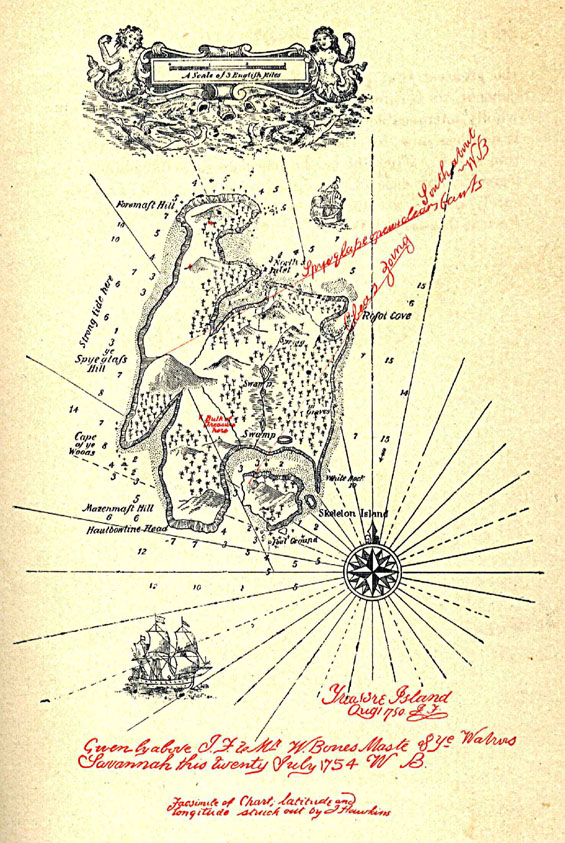
A map of Treasure Island:

Treasure Island Map

And the 1934 film version:

Posted by Jesse Willis

Review of The Year Of The Flood by Margaret Atwood

SFFaudio Review

RANDOM HOUSE AUDIO - The Year Of The Flood by Margaret AtwoodThe Year Of The Flood
By Margaret Atwood; Read by Bernadette Dunne, Katie MacNichol and Mark Bramhall
11 CDs – Approx. 14 Hours [UNABRIDGED]
Publisher: Random House Audio
Published: September 22, 2009
ISBN: 9780739383971
Themes: / Science Fiction / Dystopia / Disaster / Environmentalism / Environmental Disaster / Ecology / Planetary Ecology / Religion / Genetic Engineering / Sex / Activism / Genetics /

The long-awaited new novel from Margaret Atwood. The Year of the Flood is a dystopic masterpiece and a testament to her visionary power. The times and species have been changing at a rapid rate, and the social compact is wearing as thin as environmental stability. Adam One, the kindly leader of the God’s Gardeners—a religion devoted to the melding of science and religion, as well as the preservation of all plant and animal life—has long predicted a natural disaster that will alter Earth as we know it. Now it has occurred, obliterating most human life. Two women have survived: Ren, a young trapeze dancer locked inside the high-end sex club Scales and Tails, and Toby, a God’s Gardener barricaded inside a luxurious spa where many of the treatments are edible. Have others survived? Ren’s bioartist friend Amanda? Zeb, her eco-fighter stepfather? Her onetime lover, Jimmy? Or the murderous Painballers, survivors of the mutual-elimination Painball prison? Not to mention the shadowy, corrupt policing force of the ruling powers . . .Meanwhile, gene-spliced life forms are proliferating: the lion/lamb blends, the Mo’hair sheep with human hair, the pigs with human brain tissue. As Adam One and his intrepid hemp-clad band make their way through this strange new world, Ren and Toby will have to decide on their next move. They can’t stay locked away . . .By turns dark, tender, violent, thoughtful, and uneasily hilarious, The Year Of The Flood is Atwood at her most brilliant and inventive.

Margaret Atwood’s book The Year Of The Flood spans several years, before, after and during the waterless flood which is a plague that affects only humans. There are three readers, Bernadette Dunne, Katie MacNichol and Mark Bramhall. Throughout the eleven discs (14 hours), I enjoyed listening to the women, and began to dread the onset of the male reader. He was certainly professional. Was it his character, Adam One, a religious cult leader of God’s Gardeners? Was it the inevitable sermon he would read in a church-appropriate voice? Or was it the hymns, written by Atwood and set to “original” music that would have me engaging in positive procrastination in order to avoid finishing this audiobook.

The loveliest parts of the book take place from the point of view of Ren, a child in God’s Garden. The religion is a logical outcome for a near future on Earth following environmental disasters not too difficult to imagine. Technologies we toy with today lead to some A Clockwork Orange style vocabulary. Words such as “garboil” (a kind of petroleum made from trash) lend a frighteningly vital immersion into this eco-nightmare. Other wonderful vocabulary delights come through the genetic alterations of food and creature such as soydines and bugs with little smiley faces engineered thereon so thoughts of squishing them would be repugnant. The Gardeners have a host of saints to celebrate, showing Atwood’s ability to relate some important environmentalists and peaceniks to her tale including Saint Rachel Carson, Saint David Suzuki and Saint Mahatma Gandhi.

The main female characters, Ren and Toby, both fully developed, are compelling. Throughout the story, one is interested in them as human beings, in their suffering, in their losses, in their desires. Despite the time shifts, the readers manage to keep the characters believable; one is lost in the story (as one should be!) until the final disc. Maybe Atwood can’t write optimistic endings. With all the violence, sadistic sex and death in the world of the Gardeners who are staunch vegetarians who don’t even kill the insects that invade their gardens; with spray guns, layabout body parts and a world of human-pig hybrids conducting funerals, the last disc felt wrong. Ren’s character becomes childish. Toby becomes a murderous cold-blooded killer and then suddenly has another personality shift. The only character to remain true is the one-dimensional ADAM ONE. I was strung along on the brilliant imagination, left flat on story line, and confused in the end by the characters I thought I liked.

Am I waiting for that third expected book in a TRILOGY featuring some of these characters? My interest in Atwood’s “exfernal” world is now lukewarm.

Posted by Elaine Willis