Review of Proven Guilty by Jim Butcher

SFFaudio Review

Proven Guilty by Jim ButcherProven Guilty
By Jim Butcher; Read by James Marsters
Audible Download – approx. 16 hours [UNABRIDGED]
Publisher: Penguin Audio
Published: 2009
Themes: / Fantasy / Urban Fantasy / Magic / Chicago / Wizard / Faeries / Vampires / Black Magic

By the time most fantasy series reach their eighth novel, they’re usually showing their age. For proof, one need look no further than Robert Jordan’s Wheel of Time, in which the eighth book, Path of Daggers, is seen as the beginning of the cycle’s decline, although some would place this event significantly earlier. In any case, Jim Butcher’s Dresden Files series certainly doesn’t follow this trend. In fact, Proven Guilty suggests that the series just keeps getting better.

The novel initially follows the series formula: Chicago wizard-for-hire Harry Dresden faces a series of seemingly-disconnected incidents which, as the plot progresses, reveal themselves to be connected in a sinister way. The White Council is on the lookout for black magic; monsters from the big screen are wreaking havoc at a horror fan convention; and Molly Carpenter, daughter of Harry’s good friend Michael, is in some kind of mysterious trouble. Harry must juggle all these fly balls and, as usual, keep himself from getting killed. He’s aided by the usual cast of supporting characters like officer Karin Murphy and the elemental Bob the Skull., and White Court vampire Thomas.

Harry soon discovers that the faerie courts of Summer and Winter have taken an interest in recent events. Perhaps this is why I enjoyed Proven Guilty so much, since it evoked themes from the other faerie-centric novel in the series so far, Summer Knight, which is also one of my favorites. Butcher writes about the fae as if they are both inscrutably beautiful and incalculably terrifying. In general, the Summer Court tends to side with the “powers of good”, while the Winter Court allies itself with “evil”, but faerie politics aren’t quite that simple. Summer can be incredibly crafty and deceptive, while denizens of Winter are prone to occasional acts of kindness and sacrifice.

This moral ambiguity cuts to the heart of the success of Proven Guilty. Themes of morality, self-control, parenthood, and responsibility abound. Butcher’s early novels felt like little more than exciting detective thrillers with a supernatural twist–entertaining, witty, humorous, but lacking any real depth. In later Dresden Files novels, Butcher has cultivated a heightened emotional sensitivity. in Proven Guilty, this manifests most prominently in Harry’s complex relationship with the Carpenter family. Without giving too much away, suffice to say that the execution of a young boy at the hands of the White Council for misuse of magic holds more than a hint of foreshadowing.

James Marsters, of Buffy the Vampire Slayer fame, narrates the novel flawlessly. His hard-boiled narrative style perfectly fits the book’s genre as a detective story, and his dust-dry rendition of Harry Dresden’s dialogue captures the wizard’s lonely character perfectly. Marsters also handles the female characters deftly, avoiding the pitfall of overacting that some other male vice actors fall prey to.

Readers might get away with reading Proven Guilty as a stand-alone novel, since it does a passable job of weaving backstory into the plot in an unobtrusive manner, but it’s worth reading the Dresden Files series from the beginning. Unfortunately, books six and seven (Blood Rites and Dead Beat) haven’t yet received the audio treatment, though they’re schedules for release sometime in the coming months.  It’s well worth plodding through those two volumes in print.

Also take a look at SFFaudio’s favorable review of Small Favor, book ten in the series, which I’m immensely looking forward to once I’ve read the intervening White Night.

Posted by Seth Wilson
Review of Daemon by Daniel Suarez

SFFaudio Review

Daemon by Daniel SuarezDaemon
By Daniel Suarez; Read by  Jeff Gurner
Audible Download – approx. 16 hours [UNABRIDGED]
Publisher: Penguin Audiobooks
Published: 2009
Themes: / Science Fiction / Cyberpunk / Techno-Thriller / Virtual Reality / Online Gaming / Politics /

Daemon‘s success as a self-published novel that crossed over to attain mainstream success is a testament to its cultural relevance, especially among the technorati. Suarez, who moonlights (sunlights?) as a systems analyst, promoted the novel to the movers and shakers in the technology community, Its positive reception even among this tech-savvy elite suggests that Daemon has its finger on the pulse of technological developments and their implications for politics and culture.

Daemon opens with the death of game developer Matthew Sobol, acclaimed developer of multiplayer games such as first-person shooter Over the Rhine and RPG The Gate, which bears a strong resemblance to World Of Warcraft. Some successful entrepreneurs leave money to their kids when they die, others give it all away to charity. Not Sobol. His legacy is the book’s eponymous daemon, a background process which through distributed computing has spread itself across the net and continues to carry out the developer’s will through a series of intricate commands. The capabilities of this daemon, and Sobol’s talent as a developer of artificial intelligence, become apparent when the police raid Sobol’s mansion in Thousand Oaks, California, and find themselves outclassed by a network of elaborate automated booby-traps, including an almost-sentient Humvee.

The novel pans cinematically between several characters who, in one way or another, become embroiled in the daemon’s plot, which ultimately proves to be global in scale. Dramatis personae include police detectives, government agents, a gamer, a laid-off fashion reporter, a white-hat hacker, ad a convict. It’s not clear from the outset whether these characters will become heroes or villains as the story progresses, and even when battle lines are more firmly drawn most of them still defy simple caricature, exhibiting complex motives and emotions.

The real show-stopper, of course, is the daemon itself, who possesses a high degree of intelligence and resourcefulness despite residing in lines of code. The novel’s conceit still demands the willing suspension of disbelief, but the concept and the technical specifics are so finely conceived and executed that the reader is left with a small but nagging suspicion that somewhere, sometime in a future that may be all too near, Daemon could become a reality. Suarez achieves this feat by investigating the wider political, economic, and social implications of a self-aware autonomous computer system.

The living Matthew Sobol embedded many elements of his daemon into his multiplayer games, and several characters venture into these online worlds in search of clues. These scenes are among the strongest in the book, and they carry favorable resonances with both the Metaverse in Neal Stephenson’s Snow Crash and the simulator in Orson Scott Card’s Ender’s Game. Like the virtual reality elements in these novels, the online gaming sequences in Daemon succeed because they maintain a strong causal relationship to events in the “real” world.

The action battle sequences in Daemon are high-octane, and like all good action sequences they manage to incorporate the book’s themes rather than standing as mere set pieces. For the most part, the protagonists are fighting against computer-controlled contraptions. Nevertheless, I felt that these ultimately visceral and superficial scenes occupy too much space in the novel, and detract from the book’s otherwise deep and intellectually stimulating themes. Paramount Pictures has optioned the movie rights for Daemon, and I shudder to think that the cultural significance of this novel may be boiled away, leaving only two hours of car chases.

The pacing of Daemon also leaves something to be desired. Suarez has revealed that a sequel is in the works, and the book’s cliffhanger ending promises an exciting continuation to the story. Lots of loose ends also remain dangling free, mostly in the arc of character development. The novel’s ending was certainly climactic, but it somehow failed to provide satisfactory closure. As I’ve said in other reviews, even books in a multi-volume series need to retain a high level of internal cohesion.

Jef Gurner’s narration for Daemon is spot-on. His performance is varied enough that each character’s unique identity extends into the aural sphere. Through some tricks of distortion, Penguin Audio has turned the dialogue of the daemon itself into a performance worthy of classic cinematic computerized villains.

Fans of cyberpunk in particular should consider Daemon essential reading, but any science fiction fan looking for an intriguing and visionary techno-thriller should add this audiobook to their summer reading list. The novel’s fascinating themes make it worth slogging through some scenes of gratuitous violence and tugging in vein on a few loose plot threads. Daemon is an impressive debut novel by Daniel Suarez, hopefully presaging an illustrious writing career.

Posted by Seth Wilson

Review of Slaughterhouse-Five by Kurt Vonnegut

SFFaudio Review

Slaughterhouse Five by Kurt VonnegutSFFaudio EssentialSlaughterhouse-Five
By Kurt Vonnegut; Read by Ethan Hawke
5 CDs – 6 hours – [UNABRIDGED]
Publisher: Blackstone Audio
Published: 2009
ISBN: 9781433269691
Themes: / Science Fiction (or maybe not) / World War II / Time Travel / War / Aliens / Mind /

And Lot’s wife, of course, was told not to look back where all those people and their homes had been. But she did look back, and I love her for that, because it was so human.

So she was turned to a pillar of salt. So it goes.

—Kurt Vonnegut, Slaughterhouse Five

During World War II, author Kurt Vonnegut was taken prisoner by the Germans and held captive in the city of Dresden, which was later reduced to flaming rubble during a harrowing fire-bombing by American forces. According to Vonnegut, the city was a gorgeous center of art, architecture, and fine civilian life; its value as a military target was negligible. “What I’ve said about the firebombing of Dresden is that not one person got out of a concentration camp a microsecond earlier, not one German deserted his defensive position a microsecond earlier,” Vonnegut said.

Somewhere between 25,000 and 120,000 civilians (the upper figure is an early estimate, which has since been revised downward to 25,000-40,000) were killed in the inferno of incendiary and high explosive bombs. As such, Dresden remains a controversial, dark chapter of America’s involvement in the war.

Slaughterhouse-Five is Vonnegut’s look back on this dreadful event. It’s not a traditional biography, but a modified account of his own experiences as seen through the eyes of Billy Pilgrim, a tall, awkward, disconnected dreamer who is drafted into the army and thrust into combat. Pilgrim is a pathetic soul with the appearance of a “filthy flamingo,” involved in tragic events beyond his control.

Captured during the Battle of the Bulge, Pilgrim and 100 other soldiers are shipped to Dresden to serve as prison-labor. At night they sleep in a storage-cave beneath a slaughterhouse amidst the butchered carcasses of animals, and it’s this arrangement that allows them to survive the attack. After the firebombing, they emerge the next morning to find the once-beautiful Dresden so utterly destroyed that it resembles the surface of the moon.

A part of me feels guilty for reviewing Kurt Vonnegut’s Slaughterhouse-Five on a science fiction/fantasy Web site. The connections of this classic anti-war novel to the science fiction genre are tenuous, but it attains this designation (in some circles) due to the presence of the Tralfamadorians, a race of aliens that capture Pilgrim and bring him back to their planet for examination. During his months on Tralfamadore, Pilgrim is placed in a sort of zoo, his body and mind laid bare to the curious aliens.

The Tralfamadorians may be simply the imagination of an unwell, traumatized mind. Pilgrim is emotionally unbalanced, suffers a head injury after the war, and reads voraciously of the novels of science fiction writer Kilgore Trout, one of whose novels concerns an alien abduction that sounds suspiciously like Pilgrim’s own experiences on Trafalmadore. But the Tralfamadorians—real or not—allow Vonnegut to explore the concept of time and our place in it, which is the larger theme of the novel. The Tralfamadorians can see in four dimensions and have no concept of time; life just is, and human existence is a series of events and happenings with no beginnings and ends. Events simply occur; wars are fought, we are powerless to stop them and it’s ridiculous to think we can. Free will is a farce.

Pilgrim’s time among the Tralfamadorians allows him to experience his life in this fourth dimension, moving his mind back and forth to the past and future, seemingly at will. He is able to see his own death, and relive events from his childhood, his marriage, and his career as an optometrist. But Pilgrim’s wandering, time-traveling mind returns again and again to the terrible events of Dresden, an experience so powerful that his mind is unable to make sense of it. It just is, and all he can do with the rest of life is to try and look upon the good times in his life, the moments of joy, and not linger too long over the blackened, shrunken bodies, or a fellow American and friend executed for salvaging a teapot from the ruins.

Actor Ethan Hawke (of Dead Poets Society and Hamlet fame) serves as the narrator and does a nice job reading with an understated, dispassionate voice that perfectly fits the tone of the novel. This Blackstone Audio production also includes an unexpected and enlightening 10-minute interview with Vonnegut on the final disc. Here Vonnegut reveals that Pilgrim’s character was based on a real person, Edward Crone, an American who died in Dresden. “He just didn’t understand the war at all, what was going on, and of course there was nothing to understand—he was right,” Vonnegut says.

Posted by Brian Murphy

LibriVox: The Stars, My Brothers by Edmund Hamilton

SFFaudio Online Audio

LibriVoxMy favourite new LibriVox up-and-comer is Gregg Margarite. I’m totally loving his reading of Harry Harrison’s Deathworld. After I finish that I’ll be turning my attention to this…

Edmond Hamilton (1904 – 1977) had a career that began as a regular and frequent contributor to Weird Tales magazine. The first hardcover publication of Science Fiction stories was a Hamilton compilation, and he and E.E. “Doc” Smith are credited with the creation of the Space Opera type of story. He worked for DC Comics authoring many stories for their Superman and Batman characters. Hamilton was also married to fellow author Leigh Brackett.

Published in the May, 1962 issue of Amazing Stories The Stars, My Brothers gives us a re-animated astronaut plucked from a century in the past and presented with an alien world where the line between humans and animals is blurred.

LibriVox Science Fiction - The Stars, My Brothers by Edmund HamiltonThe Stars, My Brothers
By Edmond Hamilton; Read by Gregg Margarite
2 Zipped MP3 Files or Podcast – Approx. 83 Minutes [UNABRIDGED]
Publisher: LibriVox.org
Published: April 26, 2009
“He was afraid—not of the present or the future, but of the past. He was afraid of the thing tagged Reed Kieran, that stiff blind voiceless thing wheeling its slow orbit around the Moon, companion to dead worlds and silent space.”

Podcast feed:
http://librivox.org/bookfeeds/the-stars-my-brothers-by-edmond-hamilton.xml

iTunes 1-Click |SUBSCRIBE|

Posted by Jesse Willis

LibriVox: Rebels Of The Red Planet by Charles L. Fontenay

SFFaudio Online Audio

LibriVoxPaul Campbell writes in to say:

Last year I read Rebels of the Red Planet for the Second Audiobook Challenge. Now Mark Douglas Nelson has just released his own recording of the same title through LibriVox.

Cool! I’m a big fan of Mark Douglas Nelson’s narration.

Check it out folks…

LibriVox Science Fiction - Rebels Of The Red Planet by Charles L. FontenayRebels Of The Red Planet
By Charles L. Fontenay; Read by Mark Douglas Nelson
9 Zipped MP3 Files or Podcast – Approx. 5 Hours 9 Minutes [UNABRIDGED]
Publisher: LibriVox.org
Published: April 24, 2009
Dark Kensington had been dead for twenty-five years. It was a fact; everyone knew it. Then suddenly he reappeared, youthful, brilliant, ready to take over the Phoenix, the rebel group that worked to overthrow the tyranny that gripped the settlers on Mars. The Phoenix had been destroyed not once, not twice, but three times! But this time the resurrected Dark had new plans, plans which involved dangerous experiments in mutation and psionics. And now the rebels realized they were in double jeopardy. Not only from the government’s desperate hatred of their movement, but also from the growing possibility that the new breed of mutated monsters would get out of hand and bring terrors never before known to man.

Podcast feed:

http://librivox.org/bookfeeds/rebels-of-the-red-planet-by-charles-l-fontenay.xml

iTunes 1-Click |SUBSCRIBE|

And check out Paul’s original recording too… it’s HERE and over on Podiobooks.com.

[Thanks Paul!]

Posted by Jesse Willis

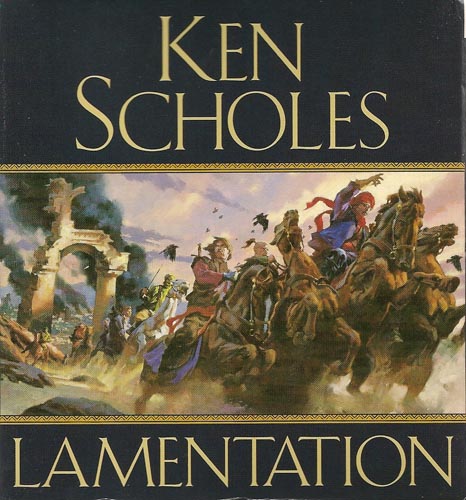
Review of Lamentation by Ken Scholes

SFFaudio Review

Lamentation by Ken ScholesSFFaudio EssentialLamentation
By Ken Scholes; Read by Scott Brick, William Dufris, Maggi-Meg Reed, and Stefan Rudnicki
12 CDs – 15 Hours [UNABRIDGED]
Publisher: Macmillan Audio
Published: 2009
ISBN: 9781427206251
Themes: / Fantasy / Epic Fantasy / Religion / Politics /

A pillar of black smoke rises from the plains where the ruins of a city lie. Four people watch it. Petros, an old fisherman; Nebios, a boy who is the only eyewitness; Rudolfo, the Gypsy King and Lord of the Ninefold Forest; and Jin Lee Tam, consort of a powerful madman. Each takes up the story in turn and we learn as they do what has happened and what changes it bodes for the Named Lands.

Through their eyes, Ken Scholes masterfully unfolds layer upon layer of complexity to reveal an epic tale of the struggle not only for power but to serve the Light. This struggle between vengeance, knowledge, mercy, and justice is what drives the main characters. Scholes takes us into a world where Machiavellian politics are constantly intertwined between characters’ motivations. However, because he uses interesting characters to tell his story, it always feels personal and we realize the “epic” quality only as we look back over storyline development. As well, he skillfully manipulates these believable people (and, let us admit it, his readers as well) so that I literally went from worrying about one character being killed to hating him to coming back into sympathy and understanding again by the end of the book. In the end, what we see is that despite epic qualities, the question the book is asking is a simple one. Who was the evil mastermind that destroyed Windwir and why?

Scholes’ world is a mesh of societies that come from disparate sources but which blend seamlessly into an intriguing whole. Reminiscent of medieval times are the city-states and trading factions wielding great power. The people of the Ninefold Forests put one in mind of Robin Hood with their wood-wise ways that shun large, established cities. The Church has a pope and an Androfrancine order that seeks ceaselessly to acquire knowledge and store it for the common good. This too hearkens back to our historical past, yet there are also distinct elements informing us that this is instead a distant future after mankind’s knowledge was used to wreak a terrible calamity resulting in The Time of Laughing Madness. There is a distinctive steam-punk flavor to be found in the inventions that are discovered and released by the monks into general society.

This is a world in which long distance communication is done by messenger bird but where robots exist (mecho-servitors). As well as spoken, coded conversation, there is a fascinating finger tapping code used by those in the know. We also meet one of the mecho-servitors, Isaak, whose suffers from extreme guilt over possibly being used for the destruction and who seems to be developing a soul.

Finally, although we breathlessly follow the characters on their journeys, knowing that there are several books to follow in the series, Scholes does us the courtesy of tying up the story lines for all but a very few situations. This was extremely refreshing and much appreciated. Simultaneously, he opened a few intriguing threads of possibility that lead us to eagerly await the next novel. True to the mastery that we saw in the rest of the book, he does so with a few well written scenarios that leave the reader realizing that these are situations that were hinted at but essentially “hidden in plain sight” until the author decided to pull them into use.

Narration was brilliantly voiced by Stefan Rudnicki, Scott Brick, William Dufris, and Maggi-Meg Reed. All were perfect for their parts, with Brick doing the heavy lifting on any sections told from a point of view that came from other than the main four characters. What I found most interesting was the opportunity for comparison between how the four readers interpreted different characters. The book changes point of view between characters by stating the person’s name and then using what might be called over-the-shoulder story telling in third person from that point of view. Therefore, each of the narrators is called upon to do dialogue for various characters as they engage in conversation with the protagonist of the moment. Hearing how each interpreted Isaak’s robotic voice or Petros’s aged tones provided fascinating contrasts.

Highest recommendations go to this audio book and author Ken Scholes.

Posted by Julie D.