The SFFaudio Podcast #118 – READALONG: Upon The Dull Earth by Philip K. Dick

Podcast

The SFFaudio PodcastThe SFFaudio Podcast #118 – Scott, Jesse and Tamahome talk about Philip K. Dick’s wonderful novelette Upon The Dull Earth (available in Blackstone Audio’s The Selected Stories Of Philip K. Dick Volume 2)

Talked about on today’s show:
Beyond Fantasy Fiction, the prolific Philip K. Dick, Galaxy Magazine, H.L. Gold, is Upon The Dull Earth Fantasy or Science Fiction, suburban romance?, rural romance, Jesse loves the setting, cedars, angels, The Odyssey, On Stranger Tides by Tim Powers, Jesse’s terrible Philip K. Dick impersonation, a wooden faucet?, a one way ladder to another plane, using your coffin as a cocoon, “Rick, I cut myself.”, Rick is responsible for her death, is Rick in hell?, Silvia is a sick chick, shortly after Silvia’s incineration, blood from a New Jersey abattoir, Upon The Dull Earth would be perfect for the A Good Story Is Hard To Find podcast, God has moved on up, HE is capitalized, she’s Fantasy, he’s Science Fiction, she’s elf-like, he’s machine-like, iron and spirits don’t mix, ridding one’s self of civilization, Inferno by Larry Niven and Jerry Pournelle |READ OUR REVIEW|, uisge beatha mean “the water of life” (or whisky), is Silvia depressed?, YA, valkyries, insects, The Hanging Man had insects too, witch vs. saint, remember Prometheus and the fire?, ripples from the event, kraals of white skinned young women, is this all going on in Rick’s head, Rick picks up a hitchhiker to use him as a guinea pig, “you’re crowding me man”, going into the underworld to get back your dead girlfriend, when someone dies you mourn your loss, Plato (and Aristophanes’) story about the mythological division of male from female (The Symposium), “we were meant to be together”, “you complete me” and similar cliches, what happens at the end?, Fair Game by Philip K. Dick, Philip K. Dick stories often have a roadside cafe scene and a gas station scene, “like the doves in a John Woo movie”, where does the title of Upon The Dull Earth come from?, she was merely playing at death, disturbed spirits thirsty for blood, the natural of order of things has been violated, William Shakespeare’s The Two Gentlemen of Verona (Act 4, Scene 2, the character name Sylvia comes from the play, but sylvan means “of the wood”, is she a fairy?, HBO’s True Blood, Icarus, the Wikipedia entry for Upon The Dull Earth, the many mentions of clay, Wonder Woman came from clay, Batman: False Faces by Brian K. Vaughn, J. Michael Straczynski, the Golem, Ted Chiang’s Seventy-Two Letters, The Adventures Of Cavalier And Clay by Michael Chabon, capricious (adj.) Given to sudden and unaccountable changes of mood or behavior, religion, Steven H Silver’s review of Seventy-Two Letters (and Stories Of Your Life And Other Stories), FREE TED CHIANG!, Saint Bernadette, Philip K. Dick really cares about the way the story is told, we never see inside a character’s mind, the authorial view, is Dick popular in for movies for this reason?, it’s grotesque!, she filled the Silex, “We’re all going to have wings!”, “We won’t be worms anymore”, Silvia’s looking for an abusive relationship, Blackstone Audio, the audiobook, Upon The Dull Earth is best read aloud, Tama didn’t know how fantastical Dick was, The Twilight Zone, The Outer Limits, its a Noir Horror Science Fiction Fantasy story, anime, Berserk, Project A-Ko, Princess Mononoke, I only understand Japanese movies made by Akira Kurosawa, Rashomon, The Seven Samurai, “I can barely understand the people wearing a Storm Trooper costumes”, Jesse needs some accessible anime, Spirited Away, what are the background assumptions in anime, Cowboy Beebop intro, Luke’s review of Solaris on SFBRP, Erik S. Rabkin, Just Imagine is a crazy musical with plenty of background assumptions (like prohibition), Hey Want To Watch A Movie? podcast, is there an MST3K podcast?, Tam was thinking of the non-podcast Rifftrax.com, readalong vs. watchalong, The Thing, The Thing From Another World, The Thing (2011), Captain America: The First Avenger, The Amazing Spider-Man, comic books vs. Hollywood, The Avengers will be written and directed by Joss Whedon, swastikas are banned in Germany, it’s a case of it’s time to end the podcast.
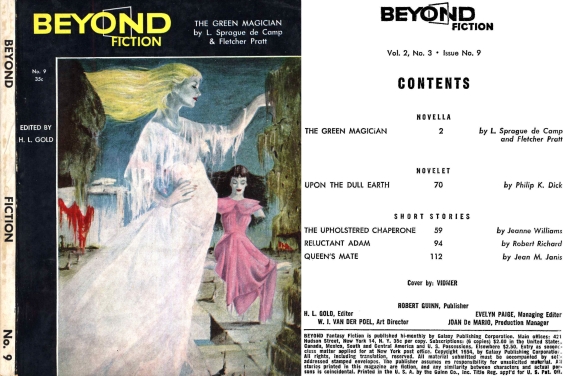
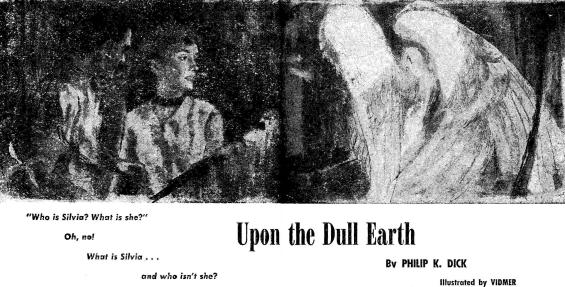
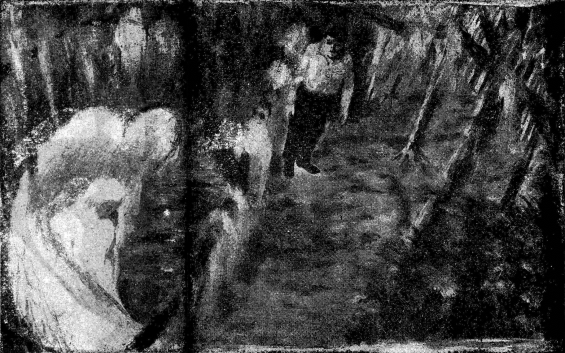
Upon The Dull Earth by Philip K. Dick - BEYOND FANTASY FICTION #9 (November 1954) illustrations by Rene Vidmer

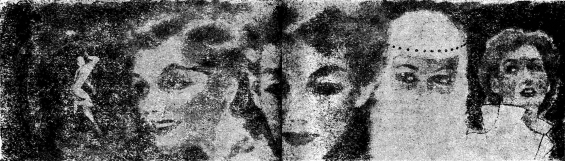
Upon The Dull Earth by Philip K. Dick - BEYOND FANTASY FICTION #9 (November 1954) illustrations by Rene Vidmer

Upon The Dull Earth by Philip K. Dick - BEYOND FANTASY FICTION #9 (November 1954) illustrations by Rene Vidmer

Upon The Dull Earth by Philip K. Dick - BEYOND FANTASY FICTION #9 (November 1954) illustrations by Rene Vidmer

Posted by Jesse Willis

Commentary: The Raven by Edgar Allan Poe

The Raven

The Raven by Edgar Allan Poe – |MP3| (read by Anne Cheng)

ONCE upon a midnight dreary, while I pondered, weak and weary,
Over many a quaint and curious volume of forgotten lore—
While I nodded, nearly napping, suddenly there came a tapping,
As of some one gently rapping, rapping at my chamber door.
“ ’Tis some visitor,” I muttered, “tapping at my chamber door—
Only this and nothing more.”

Ah, distinctly I remember it was in the bleak December,
And each separate dying ember wrought its ghost upon the floor.
Eagerly I wished the morrow;—vainly I had sought to borrow
From my books surcease of sorrow—sorrow for the lost Lenore—
For the rare and radiant maiden whom the angels name Lenore—
Nameless here for evermore.

And the silken sad uncertain rustling of each purple curtain
Thrilled me—filled me with fantastic terrors never felt before;
So that now, to still the beating of my heart, I stood repeating
“ ’Tis some visitor entreating entrance at my chamber door—
Some late visitor entreating entrance at my chamber door;
This it is and nothing more.”

Presently my soul grew stronger; hesitating then no longer,
“Sir,” said I, “or Madam, truly your forgiveness I implore;
But the fact is I was napping, and so gently you came rapping,
And so faintly you came tapping, tapping at my chamber door,
That I scarce was sure I heard you”—here I opened wide the door;—
Darkness there and nothing more.

Deep into that darkness peering, long I stood there wondering, fearing,
Doubting, dreaming dreams no mortals ever dared to dream before;
But the silence was unbroken, and the stillness gave no token,
And the only word there spoken was the whispered word, “Lenore!”
This I whispered, and an echo murmured back the word, “Lenore!”—
Merely this and nothing more.

Back into the chamber turning, all my soul within me burning,
Soon again I heard a tapping something louder than before.
“Surely,” said I, “surely that is something at my window lattice;
Let me see, then, what thereat is, and this mystery explore—
Let my heart be still a moment, and this mystery explore;—
’Tis the wind and nothing more.”

Open here I flung the shutter, when, with many a flirt and flutter,
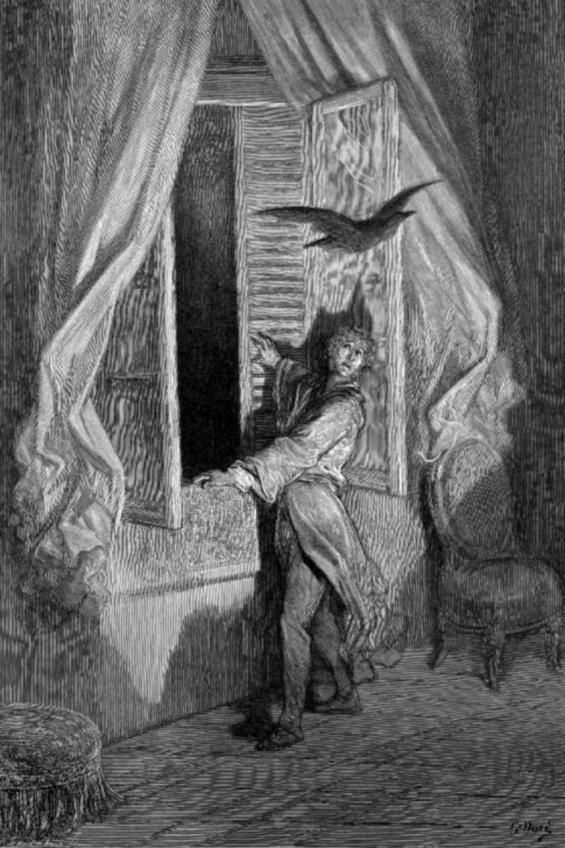
In there stepped a stately Raven of the saintly days of yore.
Not the least obeisance made he; not a minute stopped or stayed he,
But, with mien of lord or lady, perched above my chamber door—
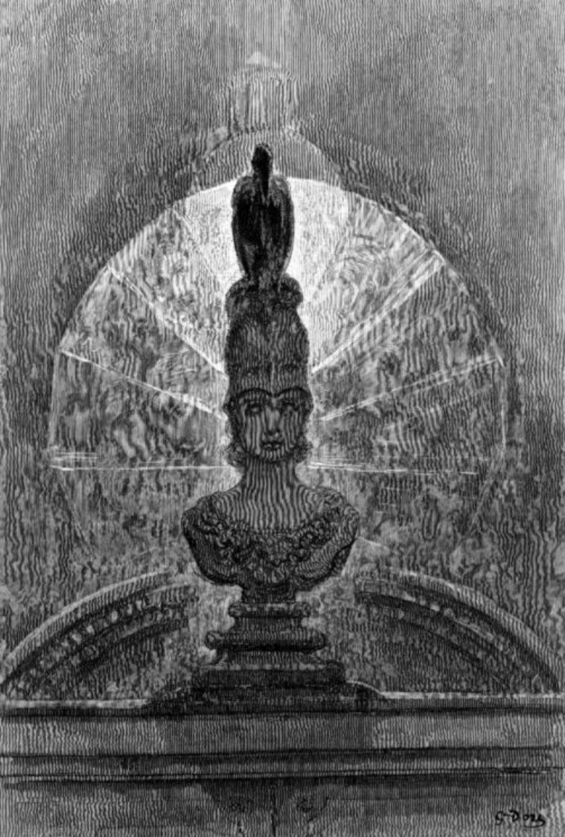
Perched upon a bust of Pallas just above my chamber door—
Perched, and sat, and nothing more.

Then this ebony bird beguiling my sad fancy into smiling,
By the grave and stern decorum of the countenance it wore,
“Though thy crest be shorn and shaven, thou,” I said, “art sure no craven,
Ghastly grim and ancient Raven wandering from the Nightly shore—
Tell me what thy lordly name is on the Night’s Plutonian shore!”
Quoth the Raven, “Nevermore.”

Much I marvelled this ungainly fowl to hear discourse so plainly,
Though its answer little meaning—little relevancy bore;
For we cannot help agreeing that no living human being
Ever yet was blessed with seeing bird above his chamber door—
Bird or beast upon the sculptured bust above his chamber door,
With such name as “Nevermore.”

But the Raven, sitting lonely on that placid bust, spoke only
That one word, as if his soul in that one word he did outpour.
Nothing further then he uttered; not a feather then he fluttered—
Till I scarcely more than muttered: “Other friends have flown before—
On the morrow he will leave me, as my Hopes have flown before.”
Then the bird said, “Nevermore.”

Startled at the stillness broken by reply so aptly spoken,
“Doubtless,” said I, “what it utters is its only stock and store,
Caught from some unhappy master whom unmerciful Disaster
Followed fast and followed faster till his songs one burden bore—
Till the dirges of his Hope that melancholy burden bore
Of ‘Never—nevermore.’ ”

But the Raven still beguiling all my sad soul into smiling,
Straight I wheeled a cushioned seat in front of bird and bust and door;
Then, upon the velvet sinking, I betook myself to linking
Fancy unto fancy, thinking what this ominous bird of yore—
What this grim, ungainly, ghastly, gaunt, and ominous bird of yore
Meant in croaking “Nevermore.”

This I sat engaged in guessing, but no syllable expressing
To the fowl whose fiery eyes now burned into my bosom’s core;
This and more I sat divining, with my head at ease reclining
On the cushion’s velvet lining that the lamp-light gloated o’er,
But whose velvet violet lining with the lamp-light gloating o’er
She shall press, ah, nevermore!

Then, methought, the air grew denser, perfumed from an unseen censer
Swung by Seraphim whose foot-falls tinkled on the tufted floor.
“Wretch,” I cried, “thy God hath lent thee—by these angels he hath sent thee
Respite—respite and nepenthe from thy memories of Lenore!
Quaff, oh quaff this kind nepenthe and forget this lost Lenore!”
Quoth the Raven, “Nevermore.”

“Prophet!” said I, “thing of evil!—prophet still, if bird or devil!—
Whether Tempter sent, or whether tempest tossed thee here ashore,
Desolate, yet all undaunted, on this desert land enchanted—
On this home by Horror haunted—tell me truly, I implore—
Is there—is there balm in Gilead?—tell me—tell me, I implore!”
Quoth the Raven, “Nevermore.”

“Prophet!” said I, “thing of evil!—prophet still, if bird or devil!
By that Heaven that bends above us—by that God we both adore—
Tell this soul with sorrow laden if, within the distant Aidenn,
It shall clasp a sainted maiden whom the angels name Lenore—
Clasp a rare and radiant maiden whom the angels name Lenore.”
Quoth the Raven, “Nevermore.”

“Be that word our sign of parting, bird or fiend!” I shrieked, upstarting—
“Get thee back into the tempest and the Night’s Plutonian shore!
Leave no black plume as a token of that lie thy soul hath spoken!
Leave my loneliness unbroken!—quit the bust above my door!
Take thy beak from out my heart, and take thy form from off my door!”
Quoth the Raven, “Nevermore.”

And the Raven, never flitting, still is sitting, still is sitting
On the pallid bust of Pallas just above my chamber door;
And his eyes have all the seeming of a demon’s that is dreaming,
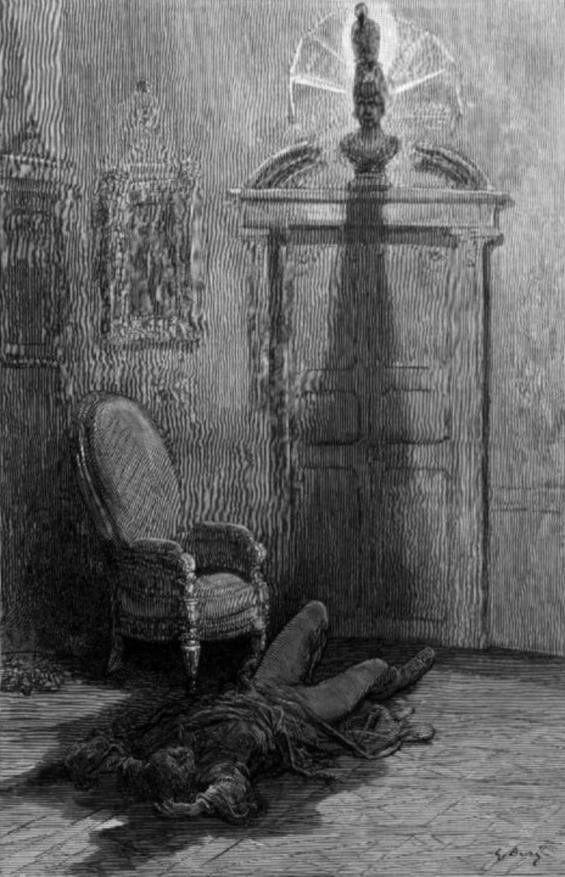
And the lamp-light o’er him streaming throws his shadow on the floor;
And my soul from out that shadow that lies floating on the floor
Shall be lifted—nevermore

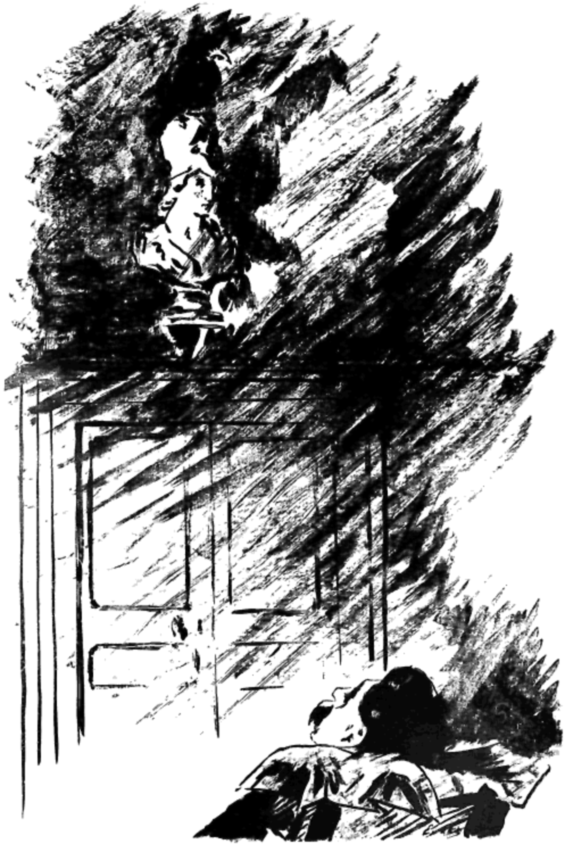
Upon The Bust Of Pallas - Edouard Manet

Edmund C. Steadman, in the introduction to Gustave Doré’s 1884 illustrated edition of The Raven, argues that while The Raven may not be Edgar Allan Poe’s best work that it is certainty “his representative poem” in part because it deals with his major theme: “the irretrievable loss of an idolized and beautiful woman.” And to my ears it certainly is a “treasure of mankind.” But, because of its length and accessibility, I think it is capable of being appreciated by even the roughest of barbarian hearts.

And why is that?

I’d suggest that the supernatural element, or the ambiguity of such, helps a lot. Ghosts, gods and demons are easy entry points.

Think of it as a more palatable forerunner to paranormal romance. Perhaps this kind of literature is best called “Dark Romanticism.”

From Wikipedia:

Dark Romanticism (often conflated with Gothicism or called American Romanticism) is a literary subgenre. It has been suggested that Dark Romantics present individuals as prone to sin and self-destruction, not as inherently possessing divinity and wisdom. G.R. Thompson describes this disagreement, stating “the Dark Romantics adapted images of anthropomorphized evil in the form of Satan, devils, ghosts, werewolves, vampires, and ghouls.” For these Dark Romantics, the natural world is dark, decaying, and mysterious; when it does reveal truth to man, its revelations are evil and hellish.

Now dark romanticism may just sound like a more literary description of paranormal romance, minus the mention of a myriad of tattoos, but its authors tackled tough subjects like the pointlessness of a loveless existence in a world without an afterlife. In a way that’s an inversion of paranormal romance.

So on that happy note, and bearing in mind the generally accepted saw that “Life is stranger than fiction”, my question for your barbarian heart is slightly different:

Is real life more horrific than fiction?

Poe’s answer in The Raven, I think, is that it is and by a wide margin.

I’m fairly confident that a wholly naturalistic interpretation of why The Raven quoth “nevermore” can be found in the lines (62-65):

“Doubtless,” said I, “what it utters is its only stock and store,
Caught from some unhappy master, whom unmerciful Disaster
Followed fast and followed faster till his songs one burden bore—
Till the dirges of his Hope the melancholy burden bore

And if it is true that the titular raven is not supernaturally prophetic, and its speech no more than mere mimicry, is the message it brings to the unnamed narrator at all lessened by a naturalistic interpretation?

I thought not.

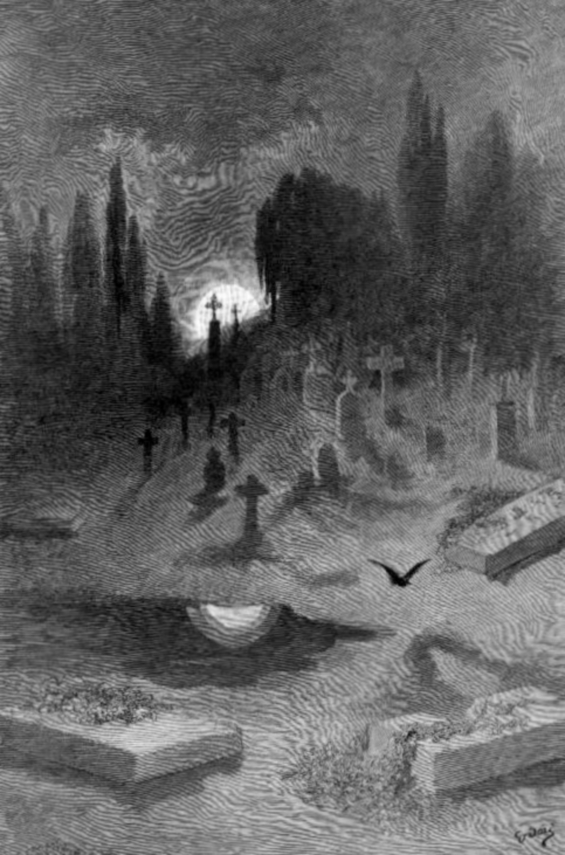
Plutonian Shore - GUSTAVE DORÉ

A Stately Raven Of The Saintly Days Of  Yore - GUSTAVE DORÉ

Upon The Bust Of Pallas  - GUSTAVE DORÉ

Shall Be Lifted Nevermore - GUSTAVE DORÉ

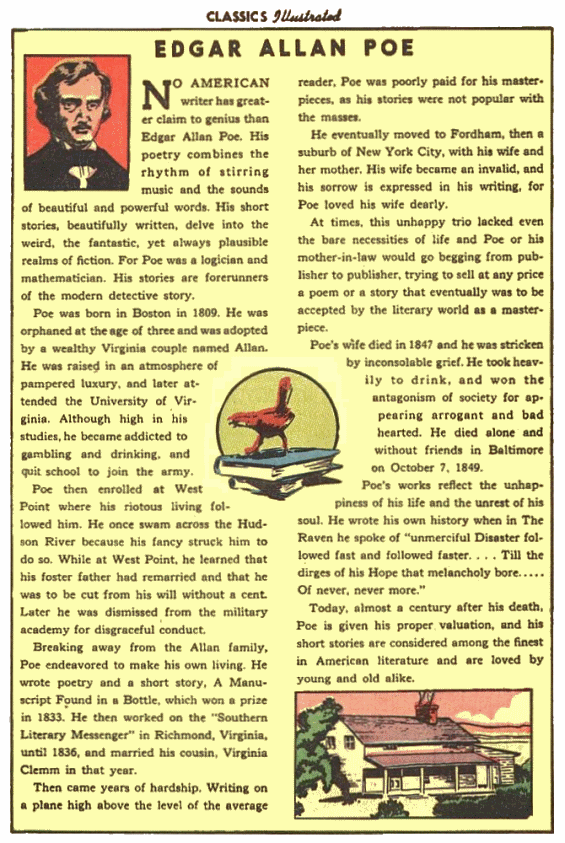
Classics Illustrated biography of Edgar Allan Poe

[via LibriVox and Gutenberg.org]

Posted by Jesse Willis

LibriVox: Phaedo by Plato

SFFaudio Online Audio

LibriVoxBob Neufeld’s reading of the Phaedo, Plato’s account of the final day of Socrates (in 399 BC), is of professional audiobook quality. There’s no way I could overstate how impressed I am with this audiobook. Neufeld’s pronunciation and character discrimination are spot-on and the sound quality of the recording is absolutely stellar. If you haven’t read any Plato I think you’ll be amazed at how clear and compelling the dialogue is. Its an accessible introduction to the thought of Socrates (and Plato) in that it discusses a very down to earth subject: death.
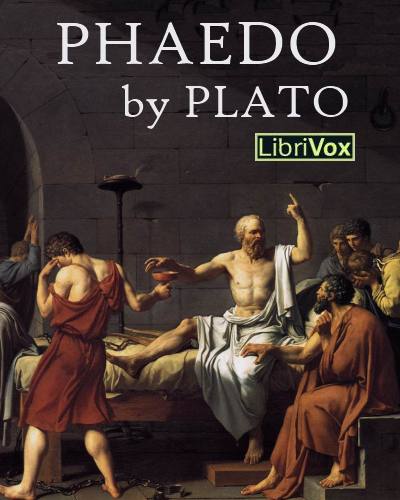
LIBRIVOX - Phaedo by PlatoPhaedo
By Plato; Translated by Benjamin Jowett; Read by Bob Neufeld
8 Zipped MP3 Files or Podcast – Approx. 3 Hours 4 Minutes [UNABRIDGED]
Publisher: LibriVox.org
Published: May 2, 2011
Socrates has been imprisoned and sentenced to death by an Athenian jury for not believing in the gods of the state and for corrupting the youth of the city. The dialogue is told from the perspective of one of Socrates’ students, Phaedo of Elis. Having been present at Socrates’ death bed, Phaedo relates the dialogue from that day to Echecrates, a fellow philosopher. By engaging in dialectic with a group of Socrates’ friends, including the Thebans Cebes and Simmias, Socrates explores various arguments for the soul’s immortality in order to show that there is an afterlife in which the soul will dwell following death. Phaedo tells the story that following the discussion, he and the others were there to witness the death of Socrates.

Podcast feed: http://librivox.org/rss/4421

iTunes 1-Click |SUBSCRIBE|

[Thanks also to Barry Eads]

Posted by Jesse Willis

Review of Dust by Joan Frances Turner

SFFaudio Review

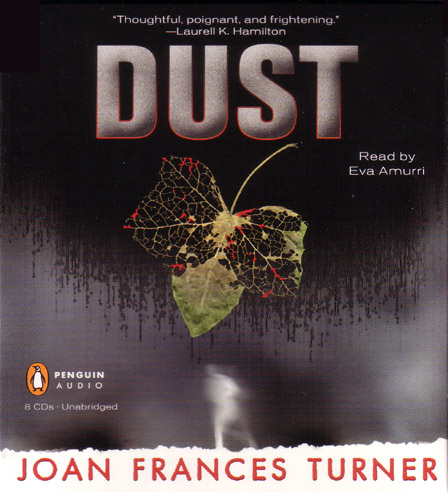
PENGUIN AUDIO - Dust by Joan Frances TurnerDust
By Joan Frances Turner; Read by Eva Amurri
8 CDs – Approx. 9 Hours 57 Minutes [UNABRIDGED]
Publisher: Penguin Audio
Published: September 02, 2010
ISBN: 9780142428535
Themes: / Horror / Fantasy / Zombies / Disease / Death / Resentment / Indiana /

Nine years ago, Jessie had a family. Now, she has a gang. Nine years ago, Jessie was a vegetarian. Now, she eats very fresh meat. Nine years ago, Jessie was in a car crash and died. Nine years ago, Jessie was human. Now, she’s not. After she was buried, Jessie awoke and tore through the earth to arise, reborn, as a zombie. Jessie’s gang is the Fly-by-Nights. She loves the ancient, skeletal Florian and his memories of time gone by. She’s in love with Joe, a maggot-infested corpse. They fight, hunt, dance together as one—something humans can never understand. There are dark places humans have learned to avoid, lest they run into the zombie gangs. But now, Jessie and the Fly-by-Nights have seen new creatures in the woods—things not human and not zombie. A strange new illness has flamed up out of nowhere, causing the undeads to become more alive and the living to exist on the brink of death. As bits and pieces of the truth fall around Jessie, like the flesh off her bones, she’ll have to choose between looking away or staring down the madness—and hanging onto everything she has come to know as life…

Here’s my take on Dust: Jessie is full of resentment, having died young in a car accident. Besides dying Jessie lost an arm and Jessie turned zombie. When Jessie was alive Jessie was a vegan – but now in Jessie’s undead form – Jessie works with a gang of bitter former humans (don’t call them zombies) that eat free range and organic animals like squirrels, possum and deer. Jessie and her associates communicate telepathically (because their mouths don’t make speech very well anymore). The undead very frequently address Jessie by her first name, which is Jessie. Jessie has many indignant conversations with her fellow embittered undead. They often punctuate their sentences with kicks, shoves and punches that break each other’s bones and dislodge sloughing off flesh. This is to be expected for Jessie. Despite these seemingly acrimonious interactions Jessie seems to love and respect her spiteful companions. They all share Jessie’s disdain for the un-undead (living people). Jessie and her surly companions have a hard life, having to deal with maggots, bloating and living out of doors all-year round. Then, after we understand Jessie well enough, Jessie’s living brother turns up, he’s interested in making peace with Jessie. But, Jessie isn’t having any of it. Jessie thinks he’s just a stupid “hoo” (that’s what Jessie and her friends call living humans). Jessie’s brother has a story to tell, but Jessie isn’t really willing to hear it. Next, a disease starts plaguing some of Jessie’s companions. Jessie thinks this is bad, but typical. Jessie also discovers something bad is happening to the stupid hoos. Jessie thinks that is what they get for being stupid hoos. But then the bad thing that hurts Jessie’s friends is something that turns the undead into less-rotty versions of themselves Jessie is angry. Jessie resents that her severed arm regrows. Jessie doesn’t want to look like a stupid hoo. The disease makes Jessie and everyone, even the stupid hoos, very hungry. That is bad, for Jessie, but deserving for the stupid hoos. The end (for Jesse).

You may be able to tell that I intensely disliked this novel. It was well written, with clear exposition, and it has clearly delineated story. Unfortunately Dust taught me nothing except that a clear exposition of the disagreeable does not improve it much. If you’re not teaching me anything, at least make the book fun. My dislike of Dust also stems from the fact that it posits multiple gimmes (a singular central conceit which may remain unexamined). Dust lets the reader assume nothing, the ground-rules aren’t fixed, and new rules are seemingly arbitrarily added on every tenth page. This means I, as a reader, cannot participate in the world of the book as much as sit back and observe what the author does with it. That is not fun. Based on the clarity of Dust I expect that Joan Frances Turner is capable of writing a fine novel, one that explores something more fruitful than resentment (which I will admit is a way to go with a zombie story told from the perspective of a zombie). But the zombie novel, as a phenomenon, may also be the problem. It may be time for people to stop writing stories from the perspective of a zombie. From my perspective Dust puts the final nail in the coffin of zombie stories told from the zombie’s perspective.

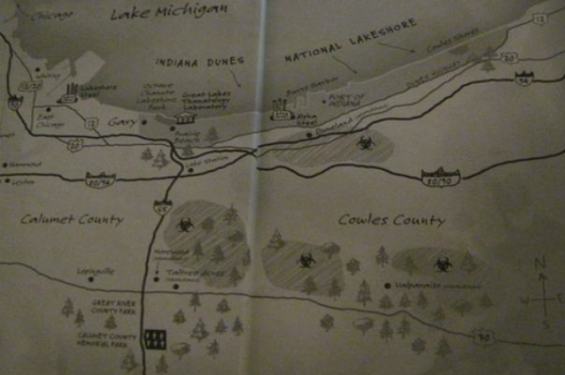
The audiobook of Dust does not contain the handy map that’s in the paperbook’s endpapers. Turner herself writes on her blog saying “the geography of the book is so vital to the story.” As to the narrator, typically when a narrator isn’t doing it for me I start looking for notable defects – asking myself “what is it that specifically bugs me about the narration?” Often this delivers some sort of gripe, like bad word pronunciation, an unconvincing accent or improper emphasis in important passages. I thought I spotted one badly pronounced word (“onerous”), but as it turns out, at least according to the Dictionary.com pronunciation guide, it is I who had been pronouncing “onerous” wrong! That said, Eva Amurri’s narration still doesn’t work for me. I’m not sure why. Other reviewers have praised her performance.

Here is the paperbook’s map (as illustrated by Claudia Carlson and designed by Tiffany Estreicher):

DUST by Joan Frances Turner MAP

Posted by Jesse Willis

Story Speiler: Accidental Death and All The World A Grave

SFFaudio Online Audio

Here are another two excellent unabridged audiobook short story offerings from Roy Turnbull…

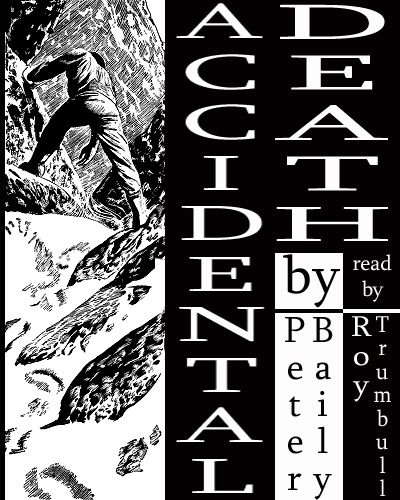
The first, Accidental Death by Peter Baily, is definitely Science Fiction. It’s about an ill-fated expedition to an alien planet with some friendly, though dangerous, tennis-playing aliens. It speculates on the nature of luck in a first person present tense narrative – which is fun.

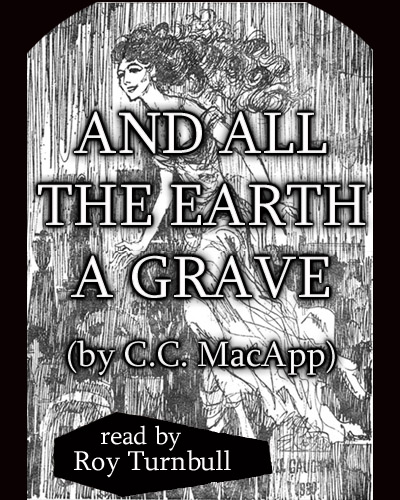
The second story, All The World A Grave by C.C. MacApp, is either Fantasy or Science Fiction, depending on your view of human nature. I take it as very apt satirical SF, in the same vein as The Space Merchants – as such, and despite its vintage, it has some very promising economic stimulus ideas for the new Barack Obama administration. Go economy, go!

Accidental Death by Peter BailyAccidental Death
By Peter Baily; Read by Roy Turnbull
1 |MP3| – Approx. 20 Minutes [UNABRIDGED]
Publisher: Story Spieler Podcast
Published: 2009?
Provider: Internet Archive
From Astounding Science Fiction February 1959. The most dangerous of weapons is the one you don’t know is loaded.

And All The Earth A Grave by C.C. MacAppAnd All The Earth A Grave
By C.C. MacApp; Read by Roy Turnbull
1 |MP3| – Approx. 16 Minutes [UNABRIDGED]
Publisher: Story Spieler Podcast
Published: 2009?
Provider: Internet Archive
From Galaxy Science Fiction, December 1963. There’s nothing wrong with dying—it just hasn’t ever had the proper sales pitch!

Posted by Jesse Willis

Review of The Halloween Tree by Ray Bradbury

SFFaudio Review

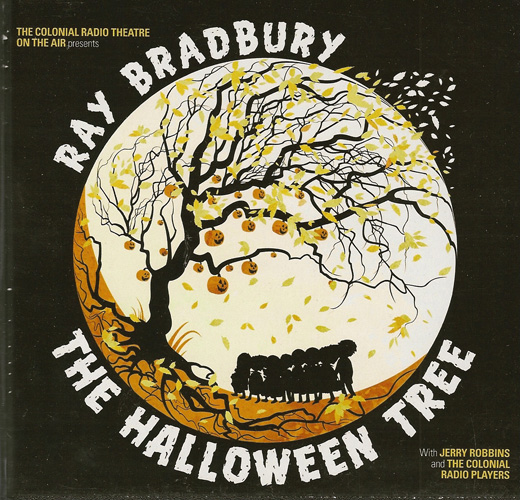
The Halloween Tree (audio drama) by Ray BradburyThe Halloween Tree
By Ray Bradbury; Performed by a full cast
2 CDs – 2 hours – [AUDIO DRAMA]
Publisher: Blackstone Audio
Published: 2008
ISBN: 9781433232145
Themes: / Fantasy / Halloween / Death / Religion / Time Travel / Witchcraft / Paganism /
What is Halloween? How did it start? Where, why, what for? Witches, cats, mummy dust, haunts… it’s all there in the country from which no one returns. Would you dive into the dark ocean, boys? Would you fly in the dark sky?

This review may be a little out of season, but it was with relatively recent memories of carving jack-o’lanterns and taking my costumed children out to trick-or-treat that I listened to The Colonial Radio Players dramatized adaptation of The Halloween Tree by Ray Bradbury. This neat little tale is ostensibly for children and young adults, but it contains an illuminating look into the origins of Halloween as well as an honest exploration of our own cultural view of death, that greatest of all mysteries.

The Halloween Tree opens with eight young boys gathered together on Halloween night to go trick-or-treating. A ninth boy, Pipkin, is notably absent from the group, and when he finally emerges from his house it’s apparent something is terribly wrong: He’s pale, moving gingerly, and clutching at a lancing pain his side. But the call of Halloween is too strong and he joins his friends. Later we learn that Pipkin is suffering from an acute bout of appendicitis.

The boys decide to go trick-or-treating at a haunted house, and there they encounter the ghostly, skeletal, white-haired Mr. Moundshroud. Moundshroud takes the boys to see The Halloween Tree. En route they have to cross a deep ravine, which proves to be a metaphor for the Valley of Death, and Pipkin fails to reach the other side. When the boys call to him, his pumpkin light goes out and he vanishes from sight.

Moundshroud offers to take the boys on a dreamlike trip back through time in order to save Pipkin. Along the way he reveals the origins of Halloween and its association with death. The boys travel back to ancient Egypt and view that culture’s reverence of the dead, including its great pyramid-tombs, mummies, and the worship of the sun god Osiris, murdered each night by his jealous brother only to rise again the next morning. They are whisked away to pre-Christian Europe and encounter the cowled, scythe-wielding Samhain, the druidic god of death from which Halloween derives its origins.

The boys witness the extinction of the druids and their religion at the hands of the murdering Romans, whose polytheistic approach to religion is itself eradicated by the coming of Christ. “Now the Christians come and cut the Romans down—new altars, boys, new incense, new names,” Moundshroud says. Here I’ll mention that The Halloween Tree includes a subversive view of Christianity, as the boys witness the persecution of innocent witches in the dark ages in the name of Christ.

The boys’ journey continues to 16th century Paris and Notre Dame Cathedral and finally to Mexico for the Day of the Dead celebration. Their strange, dreamlike trip not only reveals the origins of Halloween, but also illuminates our own view of death here in the United States—cemeteries are lonely, cold places, and when someone dies we turn our attention to moving on and forgetting, rather than remembering and honoring our deceased loved ones. When contrasted with Bradbury’s bright description of The Day of the Dead, our cultural reaction to death seems stunted and sad in comparison:

By every grave was a woman kneeling to place gardenias, or azaleas, or marigolds, in a frame upon the stone. By every grave knelt a daughter, who was lighting a new candle, or lighting a candle that had just blown out. By every grave was a quiet boy, with bright brown eyes, and in one hand a small papier-mâché funeral parade, glued to a shingle, and in the other hand a papier-mâché skeleton head, which rattled with rice or nuts inside.

Halloween, this odd, out-of-place holiday that has persisted through the ages, and remains with us now as a night to beg for candy in a costume, is revealed as an ancient ritual denoting the end of the harvest season and the onset of cold winter, of night, and of death. Its origins trace back thousands of years and span multiple cultures. “Four thousand years ago, one hundred years ago, this year, one place or time, but the celebration’s all the same—the Feast of Samhain, the Time of the Dead Ones, All Souls, All Saints, the Day of the Dead, El Dia de los Muertos, All Hallows, Halloween,” Bradbury writes.

In the end the boys are presented with a difficult choice to bring Pipkin back from the dead, one that involves a paganistic sacrifice to the dark gods. I won’t spoil the ending. But there’s a great line where one of the boys asks Moundshroud, “Will we ever stop being afraid of the night and death?” Moundshroud (who may be death himself, or the spirit of Halloween) replies reassuringly, “When you reach the stars, boy, yes, and live there forever, all the fears will go, and death himself will die.”

I had a few minor quibbles with the presentation of the story. The Colonial Radio Theatre presentation at times relies too heavily on unnecessary sound effects and crashing music that threatened to overwhelm the story, although the voice of Moundshroud, Jerry Robbins, was excellent, as were the production values. The tale also contained a bit more whimsy (a giant kite that whisks the boys back through time, etc.) than I typically like, but Bradbury is such a gifted, poetic writer that it mostly works.

Death may be our greatest mystery, but Bradbury is not afraid to look into its cold, impenetrable depths in search for meaning. The Halloween Tree illuminates the subject with a ghostly pumpkin candle whose light remained with me long after the tale was over, which is one sure mark of a good book.

Posted by Brian Murphy