CBC: Nightfall: Assassin Game by John G. Fisher

SFFaudio Online Audio

One of the very few legitimately Science Fiction stories in the CBC Nightfall series was this one, Assassin Game by John G. Fisher. It’s set in a then future in which all university students, in the top fifth percentile, are required to play an assassination game. Exceptional players are recruited by all the best transnational mega-corporations which offer free, but illegal, training in the summers. Chris Wiggins, a great voice actor best known perhaps for his role on Friday The 13th: The Series, plays the school’s president. And a very young sounding Saul Rubinek plays the protagonist, a student, and star player, who is unwilling to pick a sponsor. There’s a whole lot going on in this half hour show – with a big back-story, a vintage future sound design (Star Trek and Pac-Man), and a noirish plot.

Devoted readers may note some strong similarities to Robert Sheckley’s Seventh Victim and derivative tales.

CBC - NightfallNightfall #74 – Assassin Game
By John G. Fisher; Performed by a full cast
1 |MP3| – Approx. 28 Minutes [RADIO DRAMA]
Broadcaster: CBC
Broadcast: November 5, 1982
Source: Archive.org
In the future, your career will be determined by now many students you eliminate at university. Assassin was just a game at first, then it got real.

Cast:
Saul Rubinek … Joel Unson (a computer science student)
Nicky Guadagni … Wendy Hirsch?
David Ferry … Martin (a political science student)
Ralph McPherson … Alex (Joel’s AI)
Peter Jobin … the computer and the man
Chris Wiggins … university president
Barbara Kyle … Miss and the PA announcer

Posted by Jesse Willis

The SFFaudio Podcast #158 – READALONG: The Syndic by C.M. Kornbluth

Podcast

The SFFaudio PodcastThe SFFaudio Podcast #158 – Last week’s podcast was an unabridged reading of The Syndic by C.M. Kornbluth. This week Jesse discusses it with the narrator, Mark Douglas Nelson!

Talked about on today’s show:
SciPodBooks.com, the SciPodCast, The Syndic by C.M. Kornbluth, The City At World’s End by Edmond Hamilton, the virtues of democracy, Oath Of Fealty by Larry Niven and Jerry Pournelle, H. Beam Piper, Space Viking, a wealth of ideas, Frederik Pohl, the story as a straw man, Robert A. Heinlein, telepathy, witches, dystopia, utopia, polo played with jeeps (mounted with 50 caliber machine guns), the syndicate vs. the mob, Ireland, Iceland, libertarianism, the Prometheus Unbound review of The Syndic, polyandry, an economy run on alcohol, sex, and gambling, laissez faire capitalism, monopolies, robber barons, taxes vs. shakedowns, “a real mess of a book”, should a society compromise its ideals to save itself?, is the joke on us?, a velvet gloved invisible hand, The High Crusade by Poul Anderson, the children’s crusade, WWII, rule by mob vs. rule by mobsters, Ron Paul, the sustainability of a war based economy need not much concern the arms manufacturer, Isaac Asimov, The City At World’s End has a real plot, disaster stories, new ideas trump big flaws, “writing by the seat of your pants”, space opera, E.E. “Doc” Smith, respect for science and scientists, Farnham’s Freehold by Robert A. Heinlein, The Green Odyssey by Philip Jose Farmer, LibriVox.org, Riverworld series, rolling ships, Hyperion by Dan Simmons, the problem of endless series, StarShipSofa, The Truth Is A Cave In The Black Mountains by Neil Gaiman, A Princess Of Mars by Edgar Rice Burroughs, A Voyage To Arcturus by David Lindsay, “philosophy, philosophy, philosophy”, it starts with a séance, C.S. Lewis, Right Ho, Jeeves by P.G. Wodehouse, Jeeves And Wooster, Leave It To Jeeves, LibriVox’s new funding (from the Andrew W. Mellon Foundation), Orson Scott Card, Harlan Ellison, Airborn by Kenneth Oppel, Gregg Margarite, Lone Star Planet by H. Beam Piper, Kevin J. Anderson, Principles Of Economics, iambik audio, Wonder Audio, All Or Nothing by Preston L. Allen, The Tattoo Murder Case by Akimitsu Takagi, Toshiro Mifune, Akira Kurosawa, High And Low, Netflix, Sweet And Lowdown, One O’Clock Jump by Lise McClendon, A Is For Alibi by Sue Grafton, Talents Incorporated by Murray Leinster, goofy, the William Woodsworth Microphone Showdown, do expensive mics make great narrators?

Posted by Jesse Willis

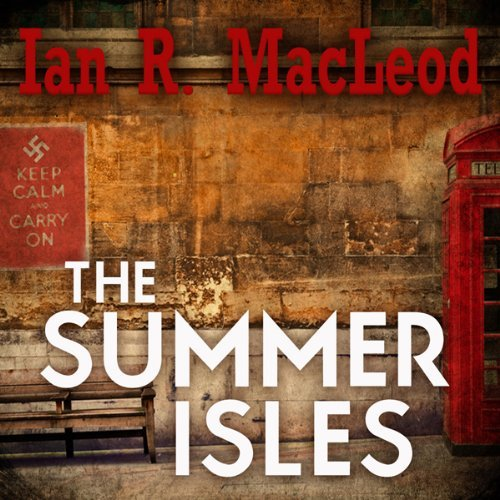
Review of The Summer Isles by Ian R. MacLeod

SFFaudio Review

AUDIBLE FRONTIERS - The Summer Isles by Ian R. MacLeodThe Summer Isles
By Ian R. MacLeod; Read by Steve Hodson
Audible Download – Approx. 13 Hours [UNABRIDGED]
Publisher: Audible Frontiers
Published: 2012
Themes: / Alternative History / Dystopia / History / Fascism / Homosexuality /

I have always been intrigued by alternative histories. Unfortunately my knowledge of history sometimes limits my enjoyment, being more of an overview of the subject. I often can’t tell if an event has been changed, and if so, whether it is significant or not. In some of the better alternate histories you can get away with not knowing too much about the period and still enjoy the story. Thankfully, in this case, I had recently been reading a history of Europe covering the same period from the early 1910’s to 1940.

MacLeod’s The Summer Isles is set primarily in a 1940 where Great Britain lost The Great War in 1918. America doesn’t enter the war and France makes an appeasement with Kaiser Wilhelm II’s Germany. The result is that Britain, not Germany, is left in a state of shock, feeling betrayed by their supposed allies. A young soldier, John Arthur, rises to power in the bleak years that follow, suggesting a parallel to Hitler, who gets only a single reference, never having the opportunities to gain power that losing the war afforded. The great Empire that was Britain is stripped away in the reparations following the war. That sense of betrayal is used to fuel Arthur’s rise to power as he brings in his political movement “Modernism”. John Arthur’s portrait hangs everywhere, even in the men’s public toilets.

Modernism is a very British take on fascism and drove several of the same horrors that Naziism did in our own history. Jews, homosexuals, intellectuals, the Irish and any and all other ‘deviants’ are persecuted and ultimately removed from the new Modernist society. The Jews in particular are sent to be “resettled” on the eponymous Summer Isles.

The story is told by Geoffrey Brook, a secretly homosexual Oxford history Don, who had some prestige for having been a favourite teacher of John Arthur as a child. Brook is in his 60’s in 1940 when he receives the news that he has at terminal lung cancer.

Brook, in trying to reconcile himself with his past, recounts in flashbacks the one true love of his life that he lost in the Great War. More flashbacks fill in the years before and after that war; several of the scenes flowing together with the present day as Brook’s mind drifts in and out of his reminiscences. Particularly when he visits some of the same locations.

MacLeod’s writing is excellent, at times didactic, as the historian narrator recounts past political and social events, yet by turns touching, confused, detailed and frightened as more personal or recent events are recounted. Slow at times, this fits will with the drifting recollections of the narrator as the hidden story is gradually revealed. The final act of the novel moves at a much faster pace, while still holding convincingly onto the character of the narrator. The Summer Isles was nominated for the John C Campbell Memorial Award, the Sidewise Award for Alternate History and the World Fantasy Award.

The audio narration by Steve Hodson fits the character perfectly. The weariness with life, the broken rapture at prized but lost moments of love and of lust are all perfectly portrayed. He even nails virtually all of the Scottish pronunciations; a pet peeve sf mind, being Scottish myself, with several other narrators.

Posted by Paul [W] Campbell

LibriVox: The Man In Asbestos: An Allegory Of The Future by Stephen Leacock

SFFaudio Online Audio

LibriVoxThere’s a new great narrator working over on LibriVox and his name is Phil Chenevert.
Now when I say new I mean new-to-me, Chenevert has, apparently, been active on LibriVox since 2010. Since then he’s recorded an impressive number of audiobooks. I only discovered that after hearing his newly released, pitch perfect, reading of The Man In Asbestos: An Allegory Of The Future by Stephen Leacock (which is just one section of THIS audiobook).

You can check out all of his narrations HERE – based on what he’s recorded so far Chenevert seems to have a fondness towards children’s literature with several whole single narration audiobooks of Lewis Carroll, L. Frank Baum, and the Br’er Rabbit stories (which are awesomely accented) as well as a schooling manual (Dr. Montessori’s Own Handbook by Dr. Maria Montessori). But there are a few SF titles in his catalogue too.

LIBRIVOX - The Man In Asbestos by Stephen LeacockThe Man In Asbestos: An Allegory Of The Future
By Stephen Leacock; Read by Phil Chenevert
1 |MP3| – Approx. 27 Minutes [UNABRIDGED]
Publisher: LibriVox.org
Published: April 16, 2012
A 20th century man travels to the distant future by typical means (eating donuts and reading comics) only to find himself in a museum of the 20th century. The museum’s curator isn’t exacty sure if it’s the year 3000 or not, but he is sure that life is better now that nobody dies, eats, or has a telephone. First published in 1911 as a part of Nonsense Novels.

[Thanks also to April Gonzales!]

Posted by Jesse Willis

The Status Civilization by Robert Sheckley on YouTube

SFFaudio News

One of the finest Science Fiction audiobooks on LibriVox, the novel that was the subject of SFFaudio Podcast #056, here it is …. The Status Civilization by Robert Sheckley on YouTube.

A man awakes with amnesia. He is aboard a spaceship. He is a prisoner. He is gnorant of his crime and his name. His destination is the planet Omega. It is a prison planet from which there is no escape.

If you give it a five minutes, it’ll take you into the full five hours and you’ll know the truth of The Status Civilization!

The regular audiobook is available HERE.

Posted by Jesse Willis

The Influence of RADIO DRAMA on comics and vice versa

SFFaudio News

EC ComicsThere’s a fascinating article by Kurt Kuersteiner HERE titled “OTR: The Evil Influence Behind EC.” In it Kuersteiner maps some of the many stories swiped from radio drama series and turned into EC Comics.

It came to me at the perfect time too. I’ve just been getting into EC comics over the last few months. Having grown up under the censorship of the Comics Code Authority I didn’t really know what I was missing. Now though, reading these pre-code comics, I can now see that my intellectual growth had been greatly stunted.

I’d have been a far smarter person if I’d been able to buy and read comics like these as a kid.

My favourite such tale so far was published in the July/August 1953 issue of Weird Fantasy (issue number 20). It’s called The Automaton. At first it seemed to me like a mashup of a Philip K. Dick’s The Electric Ant, Alfred Bester’s Fondly Fahrenheit and George Orwell’s 1984. But looking at the chronology that can’t be what it is. First off Philip K. Dick was just getting started around then. And while he was a comics reader The Electric Ant wasn’t published until 1969.

And while by 1953 Bester had already been working in comics – he hadn’t yet written Fondly Fahrenheit. So the story is definitely Orwellian and very cool, and certainly like a couple of Dick and Bester tales that were yet to be written. But then again, maybe it was inspired by a radio drama that I’ve not heard yet. Anybody know of one like this?

As it stands The Automaton is set in the futuristic dystopian world of Los Angeles in 2009. Our protagonist is XT-751, a man recounting his story of being sent to a northern labour camp after a suicide attempt. Suicide is illegal in this world because the state owns every person from the cradle to the grave.

I actually have been thinking about The Automaton for months now. And after reading Kuersteiner’s article it somehow gelled into a post. It’s just been something I could’t quite shake. The story is not only extremely thought provoking, and still timely, but also extremely frightening. And maybe a lot of the rest of it is that it is about as far away from superhero comics as you can possibly get. Best of all it’s told in just seven pages – that’s a highly distilled story.

The only credit for The Automaton is for the artist, Joe Orlando, but maybe he wrote it too?

From EC Comics - Weird Fantasy #020 - The Automaton Page 1

From EC Comics - Weird Fantasy #020 - The Automaton Page 2

From EC Comics - Weird Fantasy #020 - The Automaton Page 3

From EC Comics - Weird Fantasy #020 - The Automaton Page 4

From EC Comics - Weird Fantasy #020 - The Automaton Page 5

From EC Comics - Weird Fantasy #020 - The Automaton Page 6

From EC Comics - Weird Fantasy #020 - The Automaton Page 7

Posted by Jesse Willis