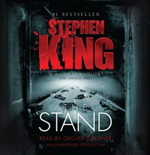
Review of The Stand by Stephen King

SFFaudio Review

The Stand by Stephen KingThe Stand
By Stephen King; Read by Grover Gardner
Publisher: Random House Audio
Publication Date: February 14, 2012
ISBN: 9780307987570
37 discs – 1 day 21 hours 36 minutes [UNABRIDGED]

Themes: / good versus evil / super-flu / post-apocalypse /

Publisher summary:

Stephen King’s apocalyptic vision of a world blasted by plague and tangled in an elemental struggle between good and evil remains as riveting and eerily plausible as when it was first published. A patient escapes from a biological testing facility, unknowingly carrying a deadly weapon: a mutated strain of -flu that will wipe out 99 percent of the world’s population within a few weeks. Those who remain are scared, bewildered, and in need of a leader. Two emerge—Mother Abagail, the benevolent 108-year-old woman who urges them to build a peaceful community in Boulder, Colorado; and Randall Flagg, the nefarious “Dark Man,” who delights in chaos and violence. As the dark man and the peaceful woman gather power, the survivors will have to choose between them—and ultimately decide the fate of all humanity.

I know, I just listened to Stephen King’s Carrie and now The Stand. I’ve found that reading one King book begets more just about every time. There’s something to these tragic characters that you need more and more of.

Now, I have to tell a quick story on this one and I promise this will (probably not) be the last time I tell it to intro a review for a Stephen King novel. This is THE novel I hated so I figure it has to be told here if anywhere.

A number of years ago, I was in Borders and that tells you it was a least a couple years ago. I hadn’t read Stephen King before this time, but you can’t help being an avid reader and reading King, it’s bound to happen at some point, he’s way too prolific. I was looking through his section and I decided I would either buy The Stand or The Talisman as I’d heard very good things about both. There happened to be a guy in the same section and I asked him to make the call. He enthusiastically pointed to The Stand and thus it was purchased. I was in the middle of a huge fantasy binge at the time, making up for lost time I guess since I was never a huge reader growing up. I had read The Lord of the Rings and Chronicles of Narnia and a number of other fantasy books, but it was always sporadic at best and this was a HUGE binge I’m telling you.

I had just finished The Riftwar Saga and loved it immensely. I had The First Law sitting on my shelf and waiting to be read, calling to me even. But I was determined to read this book everyone was talking about – The Stand by Stephen King. I started reading and it was compelling enough. The super-flu, or Captain Trips was interesting and it was obviously creating this world change, but the characters were almost too real. I didn’t really like any of them, maybe Nick Andros (and how do you not like him?) and it seemed to drone on and on without anything really happening. Yes, there were the coughs in the theater, the slow spread of the flu is documented ad nauseum, but at 300 pages in, I still felt like nothing was ever going to happen.

I figured, if I’m not enjoying myself at 300 pages, then when am I ever going to enjoy this book? So I stopped. This was no easy decision, let me tell you. After all the praise, I don’t even think I’ve ever heard one poor word said about this book, I had to keep pushing and 300 pages in is really a lot since I can drop a book now after 50 to 100 pages without any qualms whatsoever.

Somehow, a couple years later I was drawn into Stephen King’s world again. This time it was The Dark Tower series with the good folks at Goodreads. Everyone seemed to be reading this series a couple years back and so I jumped in. I didn’t love the first book, but it has some great moments. The second book made me rethink my whole opinion on King because it blew my mind in so many ways. The third and fourth are two of my top ten books I’ve ever read, so you know I got to thinking about my problems with The Stand and how this fantasy fan couldn’t get into it.

Thus, the reread or more like “retry.” This time, things were completely different. I loved it from just about the first page. The way the super-flu spreads is genius – one accident leads to the cough that’s heard around the world. Then we have the characters. The first time, I could hardly stand any of them. But this time, I absolutely loved them. It was simply genius to put them in situations that seemed monumental to them at the time and you just know it’s about to become the smallest thing in the world. The girl who has to tell her parents she’s pregnant, the guy who’s just had his first hit on the radio and blows all his money, the guy who works at a failing factory, the kid who just got beat up and robbed. Simply genius.

Then there’s the “bad guys” who aren’t even all that bad, who in fact have plenty of redeeming qualities, but who happen to be on the other side. Again, genius. I can’t stop using that word.

And for some reason none of this clicked the first time I attempted reading The Stand. I do have some theories, so indulge me if you would.

  1. I don’t think I was read for King and all his King-ness. You’d think after having read George R.R. Martin I could take brutal reality, but that was more an exception at the time from all my other non-realistic heroes and villains reading that I just wasn’t ready for this kind of reality.
  2. I didn’t really get the fantasy part of the book. I KNOW! The fantasy fan doesn’t get the fantasy! What is the world coming too? But I didn’t get it at all. We had this very realistic situation with very real people and then all of a sudden there’s this “walking dude” who embodies pure evil and even sparks some supernatural events. It just didn’t gel for me at the time and started to pull me out of the story. I knew this was considered a fantasy novel, but that wasn’t the kind of fantasy I was remotely comfortable with so it didn’t work for me at the time.
  3.  The characters. I don’t know if I’ve grown a lot as a person since then (I like to think I have), but the first time I thought Frannie was just being a brat and Larry was completely dumb. Now, I can’t even believe I thought those things of some of my favorite characters. Frannie’s giggling in awkward situations alone should have made me love her! But how else would you deal with such a situation? It was so great, I didn’t even realize it.

M-O-O-N. That spells didn’t even realize it.

Needless to say, I’m very happy I gave The Stand a second try. This is one amazing book that’s constantly compelling, especially witnessing the birth of a new civilization and the interactions of some of the greatest characters I’ve ever read. Really the only problem I had was that it felt a little too long and drawn out and that’s got to be the expanded version. For me, if there’s ever the choice between more editing and less, you should really go with less. I feel like a great book was made a little less great by adding back in what was cut in the first place. But then again … money!

I know that was the longest way in the history of anything to say, wow, what a good book. From the rise of the super-flu to the dawning of a new civilization and the ever-overshadowing and always looming confrontation, this was one epic read. Not for the faint of heart (or even close – The Kid, just think of The Kid!), but definitely an experience not to be rivaled.

Grover Gardner is just about the perfect narrator for this story. He has just the right amount of twang to his voice for the multiple southern accents and it’s gruff enough for the subject matter as well. There are plenty of characters in The Stand and he nailed every one of them.

4.5 out of 5 Stars (very highly recommended!)

Posted by Bryce L.
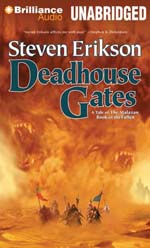
Review of Deadhouse Gates by Steven Erikson

SFFaudio Review

Deadhouse GatesDeadhouse Gates (Malazen Book of the Fallen #2)

By Steven Erikson; Performed by Ralph Lister
34 hours [UNABRIDGED]
Publisher: Brilliance Audio
Themes: / epic fantasy / magic / desert / empire /

Publisher summary:

In the vast dominion of Seven Cities, in the Holy Desert Raraku, the seer Sha’ik and her followers prepare for the long-prophesied uprising known as the Whirlwind. Unprecedented in size and savagery, this maelstrom of fanaticism and bloodlust will embroil the Malazan Empire in one of the bloodiest conflicts it has ever known, shaping destinies and giving birth to legends…. Set in a brilliantly realized world ravaged by dark, uncontrollable magic, this thrilling novel of war, intrigue, and betrayal confirms Steven Erikson as a storyteller of breathtaking skill, imagination, and originality — a new master of epic fantasy.

This book was pretty amazing.  I want to say that right off the bat.  This book is something special.  Steven Erikson has a wonderful way of writing about things that we know nothing about as readers but by the end of the book you look back and have a whole new appreciation for everything you read previously.  His foreshadowing is so subtle and wonderfully done that you don’t even realize that you realize that it’s coming, until in comes.

The characters are all very cool, including a few characters who return from Gardens of the Moon.  Kalam is a real favorite of mine; I really like his progression in this book as he is originally from Seven Cities and it affects him on an emotional level.  I also absolutely love Mappo and Icarium.  Those two were by far in my opinion the most interesting characters, and their relationship is memorable.

We get to see a whole new continent in this book in Seven Cities, with a middle eastern, desert feel.  The Whirlwind is an interesting concept; there is no doubt that this is another world that is extremely dangerous and volatile.  There is no safety anywhere and almost every decision made is one of life or death.

This book ends in a truly epic fashion and I think that anyone who enjoyed Gardens of the Moon will undoubtedly love Deadhouse Gates.  It has awesome magic, epic sword fights, political intrigue, and some truly horrifying monsters.  This book in my opinion surpasses Gardens of the Moon and sets the stage for a truly epic series that I can’t wait to finish.  This is only the second book of ten and I just can’t wait to see where this story is going to go.  I cannot recommend this book enough.

This book is read by Ralph Lister who really brings these characters to life in a way that is truly believable.  It’s as if there are a whole cast of people reading this book.  He does such a wonderful job.  I look forward to listening to Memories of Ice.

Posted by Scott Russell

Listen To Genius: Goblin Market by Christina Rossetti

SFFaudio Online Audio

I listened to a great episode of BBC Radio 4’s In Our Time about Christina Rossetti recently. I was fascinated by their brief discussion of her poem Goblin Market. Melvyn Bragg and guests described it as:

‘celebrated, fascinating, bizarre, extraordinary, powerful, strange, lascivious, and religious.’

I tracked down a reading, a very good one, and I think you’ll agree it is really amazing!

This poem is totally sexual, yet does not feature a word of sex. Full of lesbianism, incest, fruit and at least nine kinds of wow!

Listen To Genius!Goblin Market
By Christina Rossetti; Read by Kate Reading
1 |MP3| – Approx. 23 Minutes [POETRY]
Publisher: Redwood Audiobooks (Listen To Genius)
Published: 2008?
Source: Listen To Genius
Lizzie and Laura are two innocent sisters inhabiting a beautiful “per-raphaelite” fairy tale pastoral land. They hear the calls of the goblin men, sample the fruit once, buy’s a curl of her hair. First published in 1862.

Here’s a |PDF| featuring illustrations by Rossetti’s brother.

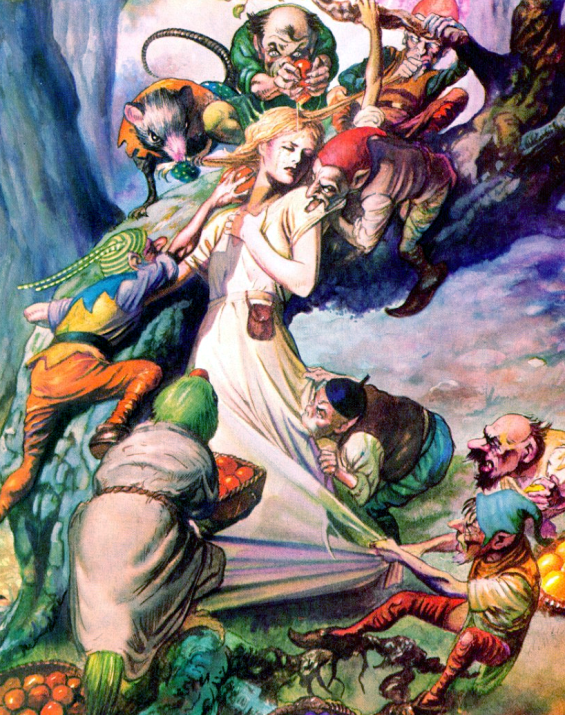
And behold a snippet from John Bolton‘s gorgeous 1983 comics adaptation of Goblin Market:

Goblin Market ilustration by John Bolton

Posted by Jesse Willis

BBC R4 + RA.cc: Markheim by Robert Louis Stevenson [RADIO DRAMA]

SFFaudio Online Audio

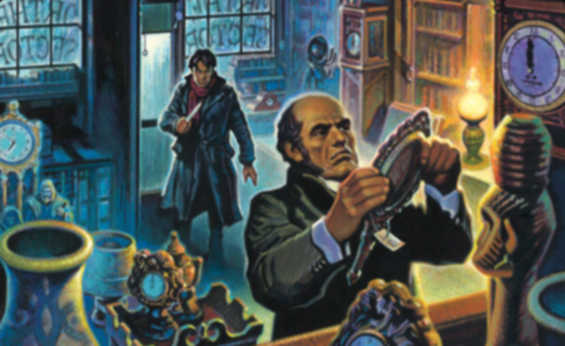
Gruselkabinett - Markheim by Robert Louis Stevenson

I’ve posted about Robert Louis Stevenson’s murderous classic, Markheim, before (the audiobook and another radio drama). But, I’ve just discovered a very good new adaptation (from 2006) available at RadioArchive.cc. The sound design is excellent, and its lengthy enough to bring out most of the nuance in the text.

BBC Radio 4RadioArchives.ccMarkheim
Adapted from the story by Robert Louis Stevenson; Adapted by John Taylor; Performed by a full cast
MP3 via TORRENT – Approx. 45 Minutes [RADIO DRAMA]
Broadcaster: BBC Radio 4
Broadcast: February 1, 2006
On Christmas Day 1886 with London shrouded in fog, a man shadows a girl across Blackfriars Bridge towards the back streets of Holborn. His name is Markheim and his intentions are unremittingly dark.

Directed by John Taylor

Cast:
Tommy – Mark Straker
Markheim – Jack Klaff
Girl – Abigail Hollick
Visitor – Anton Rodgers
Crispin – Anthony Jackson

And for German listeners there’s THIS sexy sounding version produced as a part of a cool series called Gruselkabinett (which translates to “Chamber of Horrors”).

As a bonus I offer this newly created |PDF| and a vintage anlaysisby C. Alphonso Smith from Short Stories Old And New (1916):

Setting:
There is no finer model for the study of setting than this story affords. It is three o’clock in the afternoon of a foggy Christmas Day in London. If Markheim’s manner and the dimly lighted interior of the antique shop suggest murder, the garrulous clocks, the nodding shadows, and the reflecting mirrors seem almost to compel confession and surrender. “And still as he continued to fill his pockets, his mind accused him, with a sickening iteration, of the thousand faults of his design. He should have chosen a more quiet hour.” So he should for the murder; but for the self-confession; which is Stevenson’s ultimate design, no time or place could have been better.

Plot:
There is little action in the plot. A man commits a dastardly murder and then, being alone and undetected, begins to think, think, think. It is the turning point in his life and he knows it. Instead of seizing the treasure and escaping, he submits his past career to a rigid scrutiny and review. This brooding over his past life and present outlook becomes so absorbing that what bade fair to be a soliloquy becomes a dialogue, a dialogue between the old self that committed the murder and the new self that begins to revolt at it. The old self bids him follow the line of least resistance and go on as he has begun; the newly awakened self bids him stop at once, check the momentum of other days, take this last chance, and be a man. His better nature wins. Markheim finds that though his deeds have been uniformly evil, he can still “conceive great deeds, renunciations, martyrdoms.” Though the active love of good seems too weak to be reckoned as an asset, he still has a “hatred of evil”; and on this twin foundation, ability to think great thoughts and to hate evil deeds, he builds at last his culminating resolve.

The story is powerfully and yet subtly told. It sweeps the whole gamut of the moral law. Many stories develop the same theme but none just like this. Stevenson himself is drawn again to the same problem a little later in “Dr. Jekyll and Mr. Hyde.” Hawthorne tried it in “Howe’s Masquerade,” in which the cloaked figure is the phantom or reduplication of Howe himself. In Poe’s “William Wilson,” to which Stevenson is plainly indebted, the evil nature triumphs over the good. But “Markheim,” by touching more chords and by sounding lower depths, makes the triumph at the end seem like a permanent victory for universal human nature.

Characters
If the story is the study of a given situation, Markheim, who is another type of the developing character, is the central factor in the situation. We see and interpret the situation only through the personality of Markheim himself. Another murderer might have acted differently, even with those clamorous clocks and accusing mirrors around him, but not this murderer. There is nothing abnormal about him, however, as a criminal. He is thirty-six years old and through sheer weakness has gone steadily downward, but he has never before done a deed approaching this in horror or in the power of sudden self revelation. He sees himself now as he never saw himself before and begins to take stock of his moral assets. They are pitifully meager, though his opportunities for character building have been good. He has even had emotional revivals, which did not, however, issue in good deeds. But with it all, Markheim illustrates the nobility of human nature rather than its essential depravity. I do not doubt his complete and permanent conversion. When the terrible last question is put to him – or when he puts it to himself – whether he is better now in anyone particular than he was, and when he is forced to say, “No, in none! I have gone down in all,” the moral resources of human nature itself seem to be exhausted. But they are not. “I see clearly what remains for me,” said Markheim, “by way of duty.” This word, not used before, sounds a new challenge and marks the crisis of the story. Duty can fight without calling in reserves from the past and without the vision of victory in the future. I don’t wonder that the features of the visitant “softened with a tender triumph.” The visitant was neither “the devil” as Markheim first thought him nor “the Saviour of men” as a recent editor pronounces him. He is only Markheim’s old self, the self that entered the antique shop, that with fear and trembling committed the deed, and that now, half-conscious all the time of inherent falseness, urges the old arguments and tries to energize the old purposes. It is this visitant that every man meets and overthrows when he comes to himself, when he breaks sharply with the old life and enters resolutely upon the new.

Posted by Jesse Willis

The SFFaudio Podcast #212 – READALONG: The Willows by Algernon Blackwood

Podcast

The SFFaudio PodcastThe SFFaudio Podcast #212 – Jesse, Mirko and Mr. Jim Moon discuss The Willows by Algernon Blackwood.

Talked about on today’s show:
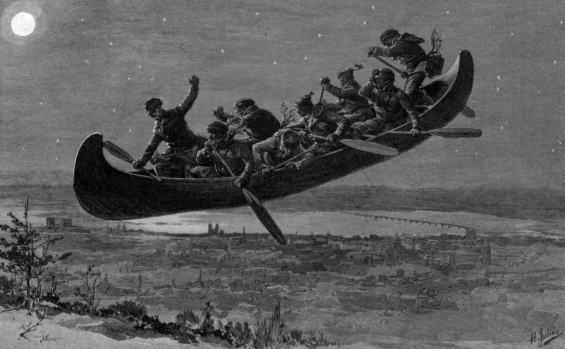
Algernon Blackwood’s television show, “the ghost man”, the expansion of consciousness, the extension of human personality, ghosts, Saturday Night Story, H.P. Lovecraft’s essay Supernatural Horror In Literature, almost nothing happens, “ghoulish work”, cosmic horror, Mr. Jim Moon outlines of the story, the nameless Swede, travelogue, the Danube, a lonesome expanse, an elemental presence, the rising spirits, the shunned place, the man’s body (or the black otter), “never human in the first place”, overlapping dimensions, The House On The Borderland by William Hope Hodgson, The Black Stone by Robert E. Howard, why is it set in Europe?, The Wendigo, Blackwood actually canoed on the Danube, Marcus Aurelius, the Black Forest, Blackwood attended school in the area, hard guys, Famous Fantastic Mysteries, “the soul chilling fury of Nature’s terrible dethroned gods”, the joke becomes unfunny, Romania, Transylvania, “looks fantastic but no-one lives there!”, evidence of human habitation, we have to keep going farther and farther to find the borderlands, their thoughts are manifested, telepathy, With Morning Comes Mistfall by George R.R. Martin, a review of Bright Messenger by Algernon Blackwood from Fantasy & science Fiction, the “Diva”, nature spirits, sprites, fairies, planetary entities, nature’s policemen, WWI, haunted tree?, occult and paranormal writing, occultist jargon, the chain of being, neo-Platonism, intermediary spirits, what did these two dudes do wrong?, sacred groves, druids, devilish places, The Children Of The Stones, the stolid Swede, red Indians, the noble savage, Guy de Maupassant’s The Horla, the drowned peasant, the conical holes, Chupacabra?, alien sampling?, footprints?, fingerprints?, Jaws, the hidden monster, “having rid himself of the morsel”, empty planet, “the sounds a planet must make driving along through space”, J.R.R. Tolkien, Old Man Willow, the Withywindle, the evil trees, Tolkien was familiar with Blackwood, Tom Bombadil is a nature spirit, Goldberry is a river spirit, “he’s got a bloody song for everything”, the Wikipedia entry for willow, the bronze skinned figures, fairy mischief, fairies fuck with you, what’s with the paddles?, a sacrifice, man where was your editor?, you didn’t really do anything wrong but show up, canoeing ghost stories, Voyageurs, a deal with the devil on Christmas Eve, La Chasse-Galerie (aka “The Bewitched Canoe” aka “The Flying Canoe“), Deliverance, leisure travel vs. work travel, the drones, the last gasp of the Grand Tour, Alien vs. Evil Dead, the punishment of the idle, reckless youth, Cabin In The Woods, The Complete Weird Fiction Of Algernon Blackwood, short stories are best enjoyed in short doses.

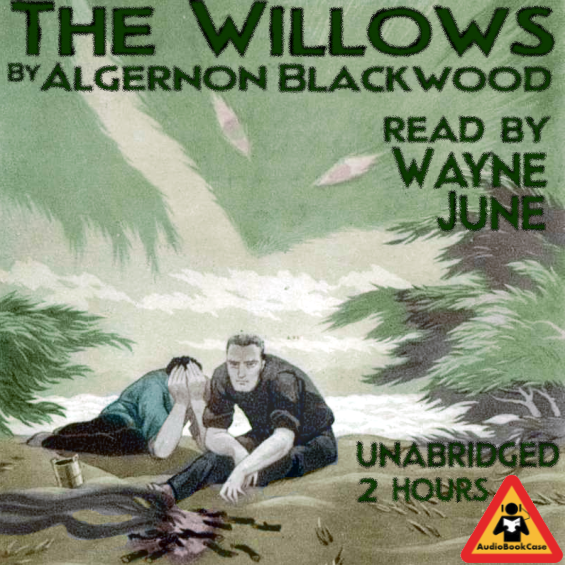
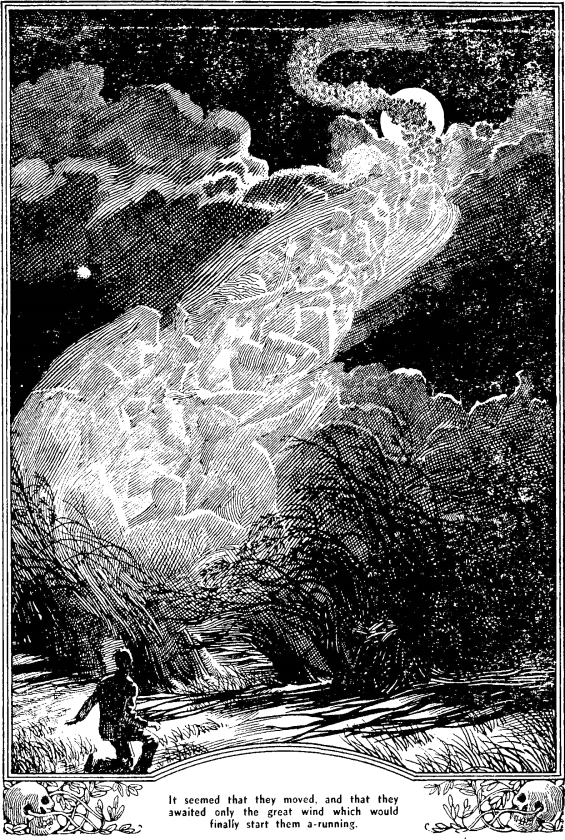
The Willows by Algernon Blackwood - read by Wayne June

The Willows by Algernon Blackwood

La Chasse-Galerie - illustrated by Henri Julien

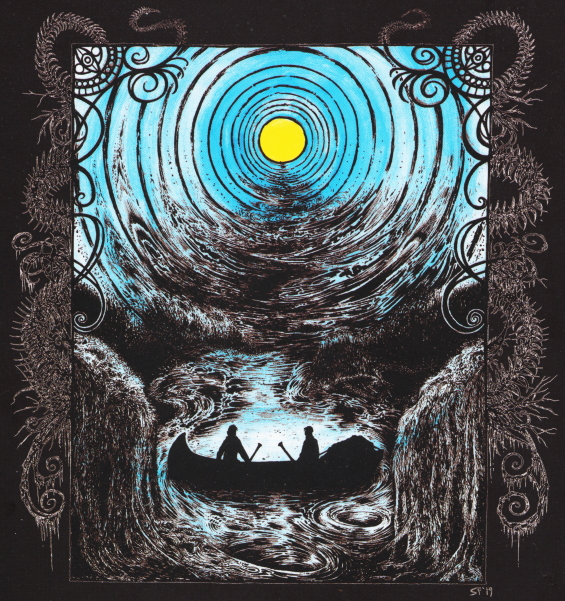
Algernon Blackwood's The Willows - illustration by Sam Ford

Posted by Jesse Willis