The SFFaudio Podcast #178 – AUDIOBOOK/READALONG: The Yellow Wallpaper by Charlotte Perkins Gilman

Podcast

The SFFaudio PodcastThe SFFaudio Podcast #178 – An unabridged reading of The Yellow Wallpaper by Charlotte Perkins Gilman (32 minutes, read for LibriVox by Michelle Sullivan) followed by a discussion of it. Participants in the discussion include Jesse, Tamahome, Jenny Colvin, and Julie Hoverson.

Talked about on today’s show:
Charlotte Perkins Gilman vs. Charlotte Perkins Stetson, wall-paper vs. wallpaper, a seminal work of feminist fiction, a ghost story, a psychological horror story, the Wikipedia entry for The Yellow Wallpaper, Alan Ryan, “quite apart from its origins [it] is one of the finest, and strongest, tales of horror ever written. It may be a ghost story. Worse yet, it may not.” postpartum depression, “the rest cure”, phosphates vs. phosphites, condescending husbands, infantilization of women, superstitions, is she dangerous?, is she only pretending to go insane or is she actually mad?, will reading The Yellow Wallpaper drive you to insanity?, an androcentric society, Titus Andronicus by William Shakespeare, Life by Emily Dickinson

MUCH madness is divinest sense
To a discerning eye;
Much sense the starkest madness.
’T is the majority
In this, as all, prevails.
Assent, and you are sane;
Demur,—you ’re straightway dangerous,
And handled with a chain.

Jenny is the husband’s sister (or mistress?), “gymnasium or prison, she doesn’t know she’s living in a short story”, does the family think she’s crazy a the story’s start?, biting the bed is a bit suspicious, barred windows, suicide, has she forgotten that she’s the wrecked the wallpaper to begin with, a haunted house vs. a haunted woman, is the supernatural only within minds?, Julie goes crazy without something to read, first time motherhood can be a struggle, duplicity, crazy people are known to make unreasonable requests, “why is the cork on the fork?”, Dirty Rotten Scoundrels, what’s the rope for?, “all persons need work”, counting the holes, are women moral by default?, Herland by Charlotte Perkins Gilman, utopia, “everything is both beautiful and practical”, the eighteenth amendment to the U.S. Constitution (prohibition), the husband faints (and so she wins?), creeping vs. crawling, the creepiest ending, smooch vs. smudge, neurasthenia, William James (brother of Henry James), “Americanitis”, the fashion of being sick, hypochondria as a fad, the “fresh air” movement, Kellogg’s cereal 9and other patented medicines), a yogurt colonic, mental illness is shameful in Asia, mental illness vs. oppression, an absolutely unreliable narrator, Stockholm syndrome style thinking, “You think you have mastered it, but just as you get well under way in following, it turns a back-somersault and there you are. It slaps you in the face, knocks you down, and tramples upon you.” worrying a tooth, tooth loss as an adult is horrific, as a kid it’s fun, why are we rewarded by the tooth-fairy?, is the tooth-fairy universal?, was chronic fatigue syndrome a fad?, fame is popular, Münchausen’s syndrome (the disease of faking a disease), take up a hobby!, distinguishing genuine from real, syndrome (symptoms that occur together) vs. disease (dis-ease), “which is worse…”, how to look at doctors, Tam’s doctor is nicer than House, M.D., witch doctors, non-invasive cures, gallium, Vitamin C, The Disappearing Spoon: And Other True Tales of Madness, Love, and the History of the World from the Periodic Table of the Elements by Sam Kean, Julie Hoverson’s reading of The Yellow Wallpaper, the unnamed narrator (let’s call her Julie), “what’s with the plantain leaf?”, a modern version of The Yellow Wallpaper would be set at fat camp (is that The Biggest Loser), starts off, Flowers In The Attic by V.C. Andrews, arsenic doughnuts (are not Münchausen syndrome by proxy), The Awakening by Kate Chopin, civilizing influence, bathing!, “men know what side their sex is buttered on”, In The Next Room (or The Vibrator Play) by Sarah Ruhl, Changeling (screenplay by J. Michael Straczynski), what is your Yellow Wallpaper?, fiction is Jesse’s wallpaper, ‘tv, videogames, comics … none of these make you crazy’, heroin chic, Julie has many yellow papers, Tam’s yellow wallpaper is the bookstore, Sebastian Junger vs. J.G. Ballard, 1920s, The Great Gatsby by F. Scott Fitzgerald, posing gowns, identical wigs, Jenny’s yellow wallpaper is dreams, The Evil Clergyman (aka The Wicked Clergyman) by H.P. Lovecraft, nice wallpaper, authorial self-interpretations, Eric S. Rabkin, re-reading as an adult something you read as a kid, The Prince Of Morning Bells by Nancy Kress, The Portrait Of A Lady by Henry James, The Lord Of The Rings by J.R.R. Tolkien, old time radio comedies, should you read fiction from the beginning? Start with Canterbury Tales by Geoffrey Chaucer?, Hyperion by Dan Simmons, Jonathan Swift, Peter F. Hamilton, E.E. ‘doc’ Smith, Mastermind Of Mars by Edgar Rice Burroughs.

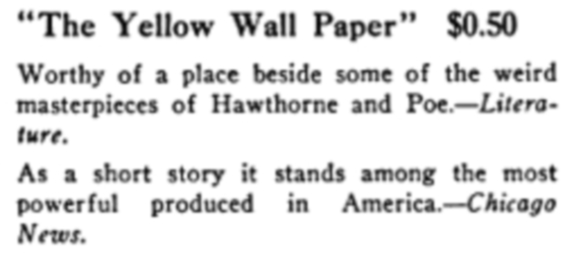
Ad for The Yellow Wall Paper from 1910

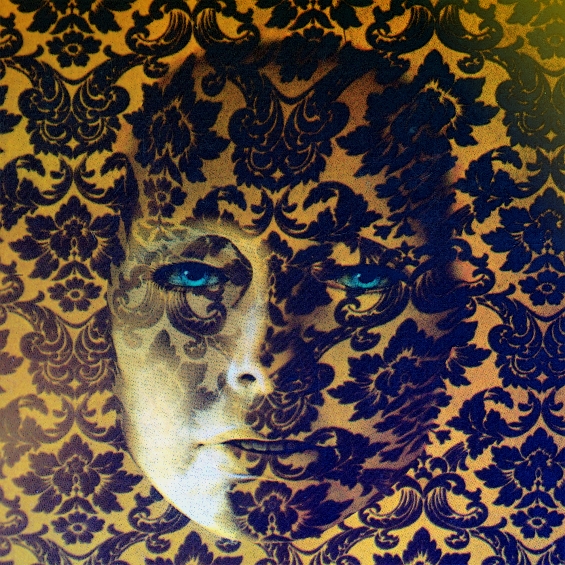
The Yellow Wallpaper by Charlotte Perkins Gilman - illustration by J.K. Potter

Sebastian Junger vs. J.G.  Ballard

Yellow Wallpaper

The Yellow Wallpaper - illustrated by Hyperphagia

Posted by Jesse Willis

Review of Last Call by Tim Powers

SFFaudio Review

Last Call by Tim PowersLast Call
By Tim Powers; Read by Bronson Pinchot
16 CDs – Approx. 19.1 Hours [UNABRIDGED]
Publisher: Blackstone Audio
Published: December 2010
ISBN: 9781441757364
Themes: / Fantasy / Gambling / Immortality / Las Vegas / Poetry / Arthurian Legend / Greek Mythology / Egyptian Mythology

Scott Crane abandoned his career as a professional poker player twenty years ago and hasn’t returned to Las Vegas, or held a hand of cards, in ten years. But troubling nightmares about a strange poker game he once attended on a houseboat on Lake Mead are drawing him back to the magical city. For the mythic game he believed he won did not end that night in 1969—and the price of his winnings was his soul. Now, a pot far more strange and perilous than he ever could imagine depends on the turning of a card. Enchantingly dark and compellingly real, this World Fantasy Award–winning novel is a masterpiece of magic realism set in the gritty, dazzling underworld known as Las Vegas.

Tim Powers’ Last Call (1992 William Morrow and Co.; 2010 Blackstone Audio, Inc.) is studded with references to old myths, snatches of T.S. Eliot’s “The Wasteland,” the art of poker playing, and the unique culture and atmosphere of old and new Las Vegas. It contains numerous major and minor characters, overarching themes and subplots, and digressions into probability theory. In other words, it demands close reading and attention to detail. Listening to it in half-hour chunks as I did while driving to work was probably not the best idea, and may have affected my review of the book, but what follows is an honest appraisal.

There’s a lot to like in Last Call, and I lot I liked. At its heart it’s really about the vast, mysterious forces driving the universe and the ways in which they manifest in our lives. Why does tragedy pass over a criminal and take a good person instead? Why does a disease like cancer randomly strike a family man with a wife and children to support? Although life appears chaotic and meaningless, perhaps there are active, purposeful forces of fate at work as well, old gods that exist outside our typical suburban lives but can be sought out and appealed to, and even manipulated. In Last Call Powers breathes new life into ancient myths like the Arthurian Fisher King, the Greek god Dionysus, and the Egyptian goddess Isis, incorporating themes of resurrection and physical health tied to spiritual health. These ancient demigods reappear in the forms of unlikely modern-day characters, including broken-down ex-gambler Scott Crane and his estranged foster-sister Diana. Last Call also includes a cast of memorable bad guys, including a bloated fat hit man Trumbull who is convinced that eternal life can be had through the consumption of raw flesh, and the chief baddie Georges Leon, a mystic who achieves immortality through stealing and possessing the bodies of the living. Crane is the central figure in the story, a man who in 1969 played a portentous game of Assumption with a powerful set of tarot cards. Twenty years later Crane returns for a second game against Leon with nothing less than his soul on the line.

Last Call is ultimately a hopeful book, as it implies that there may be a purpose to our lives and a way to control one’s destiny, if you can read the cards and master the archetypes of the Tarot. In Powers’ hands playing cards are a metaphor for the mysteries of life and the skill and luck required to navigate its uncertain waters.

Neil Gaiman’s American Gods employs a similar conceit of old gods reincarnated in the modern world but I must say I enjoyed Gaiman’s take better. Powers is a talented writer and I enjoyed his descriptions of the seedy soul of Las Vegas, as well as some memorable set-pieces he creates, including an encounter with the ghost of the infamous gangster Bugsy Siegel beneath the waters of Lake Mead. But the slow pace of the narrative, the meandering plotline, the too-numerous characters and plotlines that drop in and out of the story without sufficient explanation and resolution (Crane’s wife Susan, for example), and tedious descriptions of card game after card game make Last Call a difficult listen and at times an outright chore, despite the fine narration by Bronson Pinchot.

Perhaps my lukewarm reaction to Last Call has something to do with the fact that I I’m not a fan of card playing; Vegas is a cool place to visit and I’ve tried my hand at a few slot machines, but sitting down at a table in the company of hardcore gamblers has zero appeal for me. If you read Last Call watch closely for the signs, the subtle flush of cheek or restless eyes that the best card players know how to detect and interpret. As for casual readers: Beware.

Posted by Brian Murphy

Recent Arrivals: The Cold Beneath by Tonia Brown

SFFaudio Recent Arrivals

Written in the narrative form of DeMille’s A Strange Manuscript Found In A Copper Cylinder or Poe’s The Narrative of Arthur Gordon Pym Of Nantucket Tonia Brown’s The Cold Beneath is a new “steampunk horror” audiobook.

The Cold Beneath by Tonia Brown

The Cold Beneath
By Tonia Brown; Read by Chris Barnes
Download – Approx. 6 Hours 53 Minutes [UNABRIDGED]
Publisher: Dynamic Ram Audio Productions
Published: 2012
In the race to the North Pole, who will become the victor, and who will fall to the ravages of the Cold Beneath? Phillip Syntax is the world’s best biomechanic with a checkered past of betrayal and lost love. When given a chance at redemption by the celebrated soldier Gideon Lightbridge, how can he refuse? This ill-fated expedition turns from daring to disastrous when their airship, the Northern Fancy, crashes in the far and frozen north, leaving the crew stranded without hope. But that isn’t the worst of it. One by one the dead crew members arise from the cold ashes to seek the warmth of the living, and it becomes every man for himself in an effort not to join the ranks of the revenants.

Sample |MP3|

I’ve been listening to the novel, and find it to be punky, flowery and straightforward. The writing itself seems breezy, without pretense or subterfuge. The first few minutes of the audiobook introduces some very steampunkily named characters (“Mr. Syntax” and “Mr. Lightbridge”) – both voiced by the narrator Chris Barnes. Barnes seems to have a natural Scottish accent but as the characters are English and American he creditably voices them as such.

Writing this now, as I approach the first hour mark of the audiobook, I find The Cold Beneath to be a wholly improbable bit of fun, a brummagem amalgam of ahistorical realities, a sepia toned breccia of impossible ideas held in their interstices by a sticky cement of amiable frivolousness.

In other words, The Cold Beneath promises to be nothing more than a distracting steampuk adventure, set aboard an airship, with one of the characters sporting clockwork robotic legs, and, by looking at the cover, perhaps later, some scary frozen zombies.

If you liked the writing energy of Tee Morris’ Billibub Baddings And The Case Of The Singing Sword |READ OUR REVIEW| or the airship adventures of Jay Lake’s Mainspring |READ OUR REVIEW| then Tonia Brown’s The Cold Beneath might be your cup of brown joy.

Posted by Jesse Willis

New Releases: Eloquent Voice: A World Of Talent and Other Stories by Philip K. Dick

New Releases

Here’s William Coon’s fourth collection of Philip K. Dick short stories and novellas. It’s available via Amazon, Audible, Audiobooks Online, Barnes & Noble, Books-A-Million, BooksOnBoard, Read Without Paper, Waterstone’s.

These stories are Science Fiction, Fantasy and Horror.

And three of the five stories have never been audiobooked before!

“A novelist carries with him constantly what most women carry in large purses: much that is useless, a few absolutely essential items, and then, for good measure, a great number of things that fall in between. But the novelist does not transport them physically because his trove of possessions is mental. Now and then he adds a new and entirely useless idea; now and then he reluctantly cleans out the trash – the obviously worthless ideas – and with a few sentimental tears sheds them. Once in a great while, however, he happens by chance onto a thoroughly stunning idea new to him that he hopes will turn out to be new to everyone else. It is this final category that dignifies his existence. But such truly priceless ideas… perhaps during his entire lifetime he may, at best, acquire only a meager few. But that is enough; he has, through them, justified his existence to himself and to his God.”
– Philip K. Dick, 1977

ELOQUENT VOICE - A World Of Talent and Other Stories by Philip K. Dick

A World of Talent and Other Stories
By Philip K. Dick; Read by William Coon
Audible Download – Approx. 4 Hours 14 Minutes [UNABRIDGED]
Publisher: Eloquent Voice, LLC
Published: August 17, 2012
In this collection of five stories, all first published in the 1950s, Dick justified his existence by exploring a number of truly interesting ideas. In “Small Town” a man creates a perfect scale model of his own town, as a means of escaping his unbearable reality. In “Human Is” the wife of a scientist notices that her husband has returned from a scientific expedition a changed man, but she’s not complaining. In “Foster, You’re Dead” a father’s unwillingness to participate in his country’s preparations for a war that never happens, leads to unexpected consequences for his family. In “The Hanging Stranger” a man is unable to convince his fellow townspeople that something terribly wrong is happening to them all. Finally, in “A World of Talent“, society’s reactions against those who have unusual talents have pushed the situation to the brink of interplanetary war.

Sample |MP3|

Posted by Jesse Willis

George R.R. Martin on Fantasy (“Everything That Is Wrong With Commercial Fantasy In A Single Quote”)

SFFaudio News

Brian Murphy, of the Silver Key blog, has posted about something interesting he found on another blog (Everything Is Nice). It’s about this poetic description of Fantasy written and read by George R.R. Martin (that sums up “Everything That Is Wrong With Commercial Fantasy In A Single Quote”):

Myself, when I think of Fantasy I think of The Twilight Zone, of Philip K. Dick’s Beyond The Door, of James Powell’s A Dirge For Clowntown, of Homer’s The Iliad, of Jorge Luis Borges and his Garden Of Forking Paths.

To me fantasy is not an endless adventures in a magical medieval Europe, nor a tattooed vampire with a sword in one hand and a laser blaster in the other.

To me Fantasy is countless tiny worlds – many like our own – many radically different – some entirely impossible, but all of them firmly found within my world.

Fantasy, to me, exist within the books themselves, and in my memory of them, and in my consciousness when I think of them, all as a part of the larger world I live in.

Fantasy is not a place of escape, nor a world separate from mine in which I wish to live.

I don’t view Fantasy literature as a form of escapism.

To me Fantasy is something to enjoy, like a fine meal. Something to inspire an attitude, not a way to understand the world, nor as a consolation or a substitute for a harsh reality I’d rather not think about.

But commercial fantasy, the endless book series that take up larger and larger section of the bookstore shelves, is, to me, a very small and uninteresting part of Fantasy literature. It is the part that gets the most attention. But it shouldn’t.

Posted by Jesse Willis

LibriVox: The Watcher by R.H. Benson

SFFaudio Online Audio

E.F. Benson, A.C. Benson, and R.H. Benson were three brothers, all writers. They wrote weird fiction, Science Fiction and ghost stories.

R.H. Benson, the youngest of the three, started off as a clergyman in the Church of England, but later switched to the Roman Catholic Church and became an assistant to the Pope. An interesting choice since his biological father had been the Archbishop of Canterbury.

This short story of his, The Watcher, is somewhat difficult to classify. Reading it, it sounds like it could almost have been a true story – but it’s from a collection of fifteen stories depicting a fictional priest’s supernatural experiences.

I think it’s an allegory.

But the question is … an allegory for what?

Find out for yourself with Peter Yearsley’s fun reading of it…

LibriVoxThe Watcher
By R.H. Benson; Read by Peter Yearsley
1 |MP3| – Approx. 12 Minutes [UNABRIDGED]
Publisher: LibriVox.org
Published: January 7, 2007
A face in a bush takes delight in the death of a thrush. First published in 1903.

And here’s a |PDF|.

Posted by Jesse Willis